
Itinerary
United with France only since 1860, Nice has its own history and atmosphere, which dates back 230,000 years. It was on Colline du Château (now château-less) and at the Plage des Ponchettes, in front of the Old Town, that the Greeks established a market-port in 350 BC and named it Nikaia, which would become Marseilles’ chief coastal rival. The Romans established themselves a little later on the hills of Cimiez (Cemenelum), already previously occupied by Ligurians and Celts, and quickly overshadowed the waterfront port. After falling to the Saracen invasions, Nice regained power as an independent state, becoming an important port in the early Middle Ages.So cocksure did it become that in 1388, Nice, along with the hill towns behind, effectively seceded from the county of Provence, under Louis d’Anjou, and allied itself with Savoie. Thus began its liaison with the House of Savoy, and through it with Piedmont and Sardinia, it was the Comté de Nice (Nice County). This relationship lasted some 500 years, tinting the culture, architecture, and dialect in rich Italian hues.By the 19th century Nice was flourishing commercially, locked in rivalry with the neighboring shipping port of Genoa. Another source of income: the dawning of tourism, as first the English, then the Russian nobility, discovered its extraordinary climate and superb waterfront position. A parade of fine stone mansions and hotels closed into a nearly solid wall of masonry, separated from the smooth-round rocks of the beach by what was originally named Camin deis Anglés (the English Way), which of course is now the famous Promenade des Anglais. This magnificent crescent, which is seeking UNESCO recognition, is one of the noblest in France. Many of Nice’s most delightful attractions—the Cours Saleya market, the Old Town streets, the Hotel Negresco, and the Palais Masséna—are on or close to this 10-km (6-mile) waterfront, making it the first stop for most visitors, while the redevelopment of Nice’s port, around the other side of the Colline du Château, makes it easier for amblers who want to take in the Genoese architecture or peruse the antiques at the Puces de Nice, now part of the Promenade des 100 Antiquaires, along Quai Papacino. Nice also has the distinction of the “Family Plus” label, with free strollers, play areas, and restaurants with child-friendly activities.
At first glance, it really doesn’t look all that impressive. There’s a pretty port with cafés charging €5 for a coffee and a picturesque old town in sugared-almond hues, but there are many prettier in the hills nearby. There are sandy beaches, rare enough on the Riviera, and old-fashioned squares with plane trees and pétanque players, but these are a dime a dozen throughout Provence. So what made St-Tropez an internationally known locale? Two words: Brigitte Bardot. When this pulpeuse (voluptuous) teenager showed up in St-Tropez on the arm of Roger Vadim in 1956 to film And God Created Woman, the heads of the world snapped around. Neither the gentle descriptions of writer Guy de Maupassant (1850–93), nor the watercolor tones of Impressionist Paul Signac (1863–1935), nor the stream of painters who followed (including Matisse and Bonnard) could focus the world’s attention on this seaside hamlet as did this one sensual woman in a scarf, Ray-Bans, and capris. Vanity Fair ran a big article, “Saint Tropez Babylon,” detailing the over-the-top petrodollar parties, megayachts, and Beyoncé–d paparazzi. But don’t be turned off: the next year, Stewart, Tabori & Chang released an elegant coffee-table book, Houses of St-Tropez, packed with photos of supremely tasteful and pretty residences, many occupied by fashion designers, artists, and writers. Once a hangout for Colette, Anaïs Nin, and Françoise Sagan, the town still earns its old moniker, the “Montparnasse of the Mediterranean.” Yet you might be surprised to find that this byword for billionaires is so small and insulated. The lack of train service, casinos, and chain hotels keeps it that way. Yet fame, in a sense, came too fast for St-Trop. Unlike the chic resorts farther east, it didn’t have the decades-old reputation of the sort that would attract visitors all year around. For a good reason: its location on the south side of the gulf puts it at the mercy of the terrible mistral winter winds. So, in summer the crowds descend and the prices rise into the stratosphere. In July and August, you must be carefree about the sordid matter of cash. After all, at the most Dionysian nightclub in town, a glass of tap water goes for $37 and when the mojo really gets going, billionaires think nothing of “champagne-spraying” the partying crowds—think World Series celebrations but with $1,000 bottles of Roederer Cristal instead of Gatorade. Complaining about summer crowds, overpricing, and lack of customer service has become a tourist sport and yet this is what makes St-Tropez—described by the French daily newspaper Le Figaro as the place you can see “the greatest number of faces per square meter”—as intriguing as it is seductive.
Since being designated a European Capital of Culture for 2013, with an estimated €660 million of funding in the bargain, Marseille has been in the throes of an extraordinary transformation, with no fewer than five major new arts centers, a beautifully refurbished port, revitalized neighborhoods, and a slew of new shops and restaurants. Once the underdog, this time-burnished city is now welcoming an influx of weekend tourists who have colonized entire neighborhoods and transformed them into elegant pieds-à-terre (or should we say, mer). The second-largest city in France, Marseille is one of Europe’s most vibrant destinations. Feisty and fond of broad gestures, it is also as complicated and as cosmopolitan now as it was when a band of Phoenician Greeks first sailed into the harbor that is today’s Vieux Port in 600 BC. Legend has it that on that same day a local chieftain’s daughter, Gyptis, needed to choose a husband, and her wandering eyes settled on the Greeks’ handsome commander Protis. Her dowry brought land near the mouth of the Rhône, where the Greeks founded Massalia, the most important Continental shipping port in antiquity. The port flourished for some 500 years as a typical Greek city, enjoying the full flush of classical culture, its gods, its democratic political system, its sports and theater, and its naval prowess. Caesar changed all that, besieging the city in 49 BC and seizing most of its colonies. In 1214 Marseille was seized again, this time by Charles d’Anjou, and was later annexed to France by Henri IV in 1481, but it was not until Louis XIV took the throne that the biggest transformations of the port began; he pulled down the city walls in 1666 and expanded the port to the Rive Neuve (New Riverbank). The city was devastated by plague in 1720, losing more than half its population. By the time of the Revolution, Marseille was on the rebound once again, with industries of soap manufacturing and oil processing flourishing, encouraging a wave of immigration from Provence and Italy. With the opening of the Suez Canal in 1869, Marseille became the greatest boomtown in 19th-century Europe. With a large influx of immigrants from areas as exotic as Tangiers, the city quickly acquired the multicultural population it maintains to this day.
The capital of Menorca since 1721, Mahon has a impressive natural deep water harbour, which is one of the largest in the world. This, coupled with its strategic location, has made it a stronghold for many nations throughout history. Mahon has an abundance of historical buildings, the oldest being the Arch of Saint Roc which is all that remains of the wall that once encircled the whole town. The island was occupied by the British during the 18th century and Lord Nelson is thought to have stayed there. Indeed, San Antoni Mansion, located on the north side of the harbour, houses a collection of Nelson memorabilia. The legacy of colonial rule can be seen in the muted Georgian style of some of the buildings, but Mahon still boasts attractive examples of neo-Classical, Baroque and Romanesque architecture. With narrow streets to explore, pleasant shaded squares and welcoming pavement cafés, there is something for everyone to enjoy. Please be aware that most shops in town close for a siesta between 1330 and 1730.
If you look north of the cathedral (La Seu, or the seat of the bishopric, to Mallorcans) on a map of the city of Palma, you can see around the Plaça Santa Eulàlia a jumble of tiny streets that made up the earliest settlement. Farther out, a ring of wide boulevards traces the fortifications built by the Moors to defend the larger city that emerged by the 12th century. The zigzags mark the bastions that jutted out at regular intervals. By the end of the 19th century, most of the walls had been demolished; the only place where you can still see the massive defenses is at Ses Voltes, along the seafront west of the cathedral.A torrent (streambed) used to run through the middle of the old city, dry for most of the year but often a raging flood in the rainy season. In the 17th century it was diverted to the east, along the moat that ran outside the city walls. Two of Palma’s main arteries, La Rambla and the Passeig d’es Born, now follow the stream’s natural course. The traditional evening paseo (promenade) takes place on the Born.If you come to Palma by car, park in the garage beneath the Parc de la Mar (the ramp is just off the highway from the airport, as you reach the cathedral) and stroll along the park. Beside it run the huge bastions guarding the Almudaina Palace; the cathedral, golden and massive, rises beyond. Where you exit the garage, there’s a ceramic mural by the late Catalan artist and Mallorca resident Joan Miró, facing the cathedral across the pool that runs the length of the park.If you begin early enough, a walk along the ramparts at Ses Voltes from the mirador beside the cathedral is spectacular. The first rays of the sun turn the upper pinnacles of La Seu bright gold and then begin to work their way down the sandstone walls. From the Parc de la Mar, follow Avinguda Antoni Maura past the steps to the palace. Just below the Plaça de la Reina, where the Passeig d’es Born begins, turn left on Carrer de la Boteria into the Plaça de la Llotja (if the Llotja itself is open, don’t miss a chance to visit—it’s the Mediterranean’s finest Gothic-style civic building). From there stroll through the Plaça Drassana to the Museu d’Es Baluard, at the end of Carrer Sant Pere. Retrace your steps to Avinguda Antoni Maura. Walk up the Passeig d’es Born to Plaça Joan Carles I, then right on Avenida de La Unió.
Hedonistic and historic, Eivissa (Ibiza, in Castilian) is a city jam-packed with cafés, nightspots, and trendy shops; looming over it are the massive stone walls of Dalt Vila —the medieval city declared a UNESCO World Heritage site in 1999—and its Gothic cathedral. Squeezed between the north walls of the old city and the harbor is Sa Penya, a long labyrinth of stone-paved streets that offer some of the city’s best offbeat shopping, snacking, and exploring. The tourist information office on Vara de Rey has a useful map of walks through the old city.
A Mediterranean city and naval station located in the Region of Murcia, southeastern Spain, Cartagena’s sheltered bay has attracted sailors for centuries. The Carthaginians founded the city in 223BC and named it Cartago Nova; it later became a prosperous Roman colony, and a Byzantine trading centre. The city has been the main Spanish Mediterranean naval base since the reign of King Philip II, and is still surrounded by walls built during this period. Cartagena’s importance grew with the arrival of the Spanish Bourbons in the 18th century, when the Navidad Fortress was constructed to protect the harbour. In recent years, traces of the city’s fascinating past have been brought to light: a well-preserved Roman Theatre was discovered in 1988, and this has now been restored and opened to the public. During your free time, you may like to take a mini-cruise around Cartagena’s historic harbour: these operate several times a day, take approximately 40 minutes and do not need to be booked in advance. Full details will be available at the port.
As you sail into Malaga you will notice what an idyllic setting the city enjoys on the famous Costa del Sol. To the east of this provincial capital, the coast along the region of La Axarqua is scattered with villages, farmland and sleepy fishing hamlets – the epitome of traditional rural Spain. To the west stretches a continuous city where the razzmatazz and bustle creates a colourful contrast that is easily recognisable as the Costa del Sol. Surrounding the region, the Penibéetica Mountains provide an attractive backdrop overlooking the lower terraced slopes which yield olives and almonds. This spectacular mountain chain shelters the province from cold northerly winds, giving it a reputation as a therapeutic and exotic place in which to escape from cold northern climes. Malaga is also the gateway to many of Andalusia’s enchanting historic villages, towns and cities.
Ship features
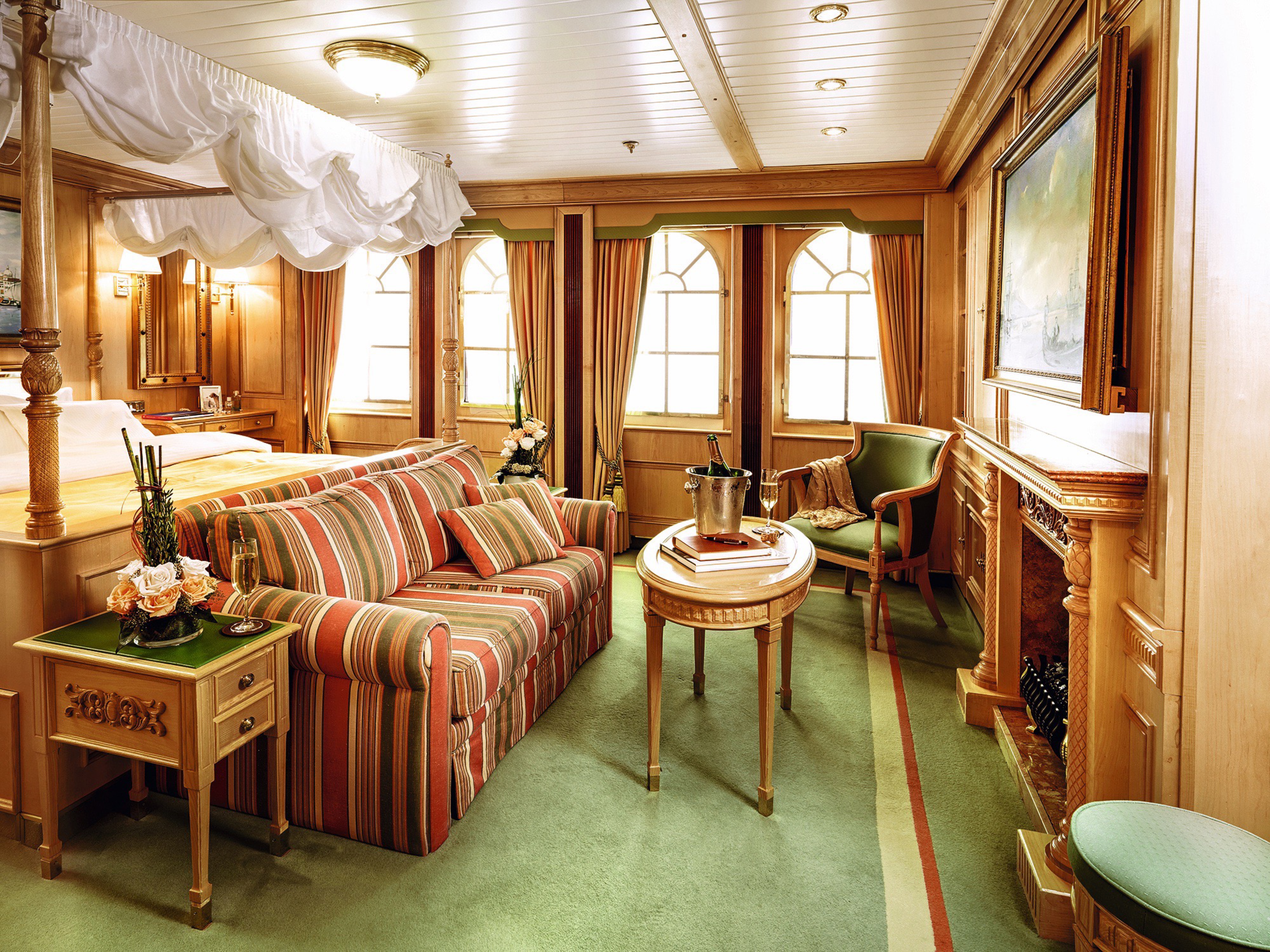
Luxury Owner Suites (Cat. A)
The two Owners’ Suites on SEA CLOUD II follow in the maritime spirit of always keeping exclusive quarters white-glove ready for the ship’s owners. Today, these luxury spaces are reserved for guests who appreciate the elevated side of sailing with the comforts of a private yacht. Both light-filled suites are located on the lido deck and feature panoramic windows for a unique view of the sea, even from the four-poster bed. The opulence includes a fireplace, elegant cabinetry, high-end furnishings, and a spacious marble bath outfitted in our legendary golden fixtures.
- approx. 290 sq. ft. / 27 m²
- marble bathroom approx. 45 sq. ft. / 4,2 m² with separate shower and bathtub
- canopy bed, 75 in. x 83 in. / 190 cm x 210 cm (2 mattresses)
- four closet spaces
- sofa with table
- fireplace (electric)
- minibar
- TV with DVD
- panoramic windows
- safe
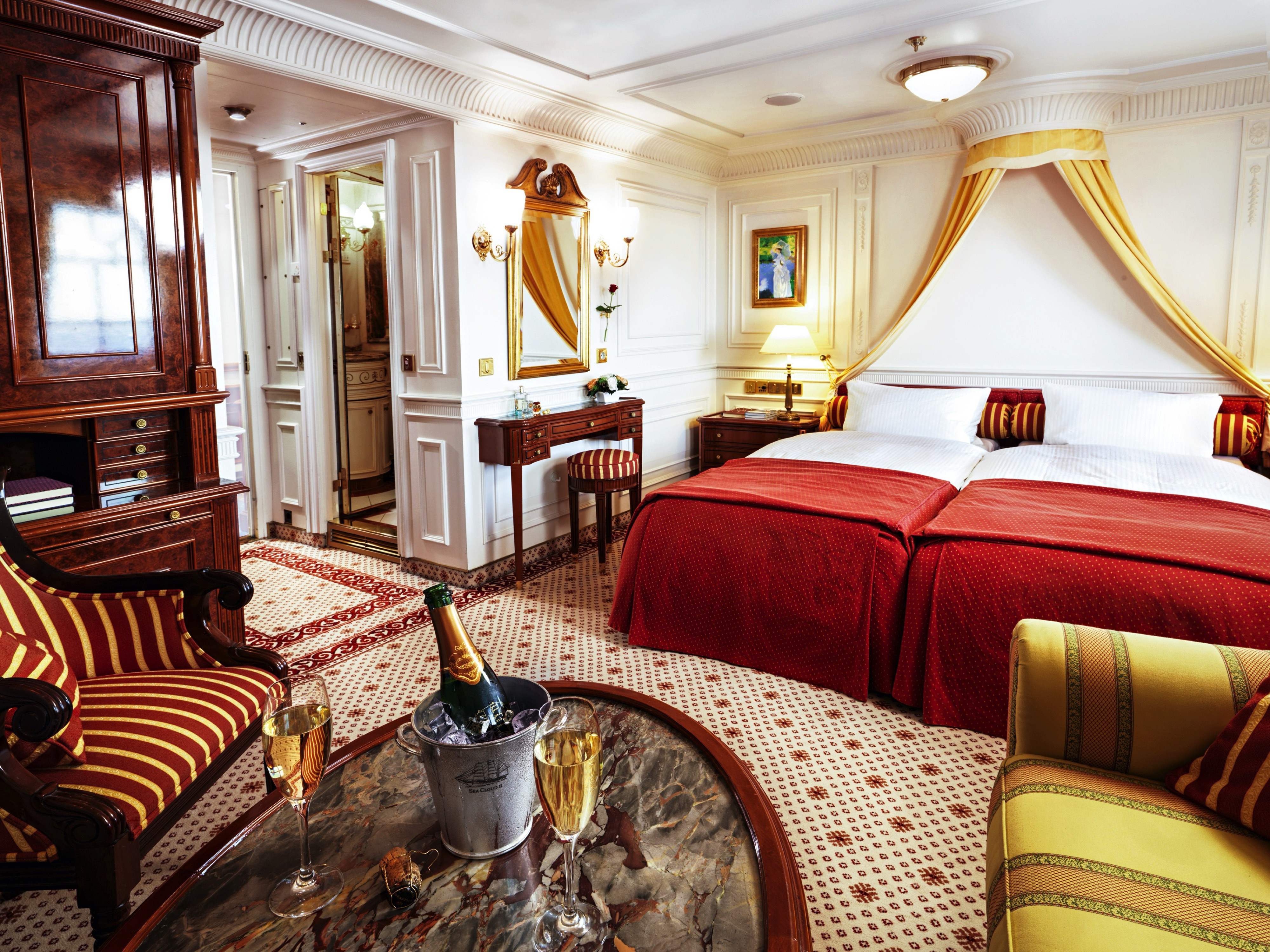
Junior Suites (Cat. B)
With rosewood furnishings, ornate wall finishings and a detailed marble fireplace, the junior suites are the epitome of luxury. Panoramic windows welcome in the sea, creating a bright, airy ambiance filled with casual elegance and upscale comfort. A separate sitting area makes the fireplace cosier. A majestic marble bath with golden fixtures is classic in this top tier. The Junior Suites are located on the promenade deck, with the restaurant, boutique, and reception close by.
- approx. 231 sq. ft. / 21,5 m²
- marble bathroom approx. 34 sq. ft. / 3,2 m² with shower and bathtub
- head-canopy bed, 71 in. x 79 in. / 180 cm x 200 cm (split king can be separated into 2 twins)
- walk-in closet
- sofa with table
- fireplace (electric)
- minibar
- TV with DVD
- panoramic windows
- safe
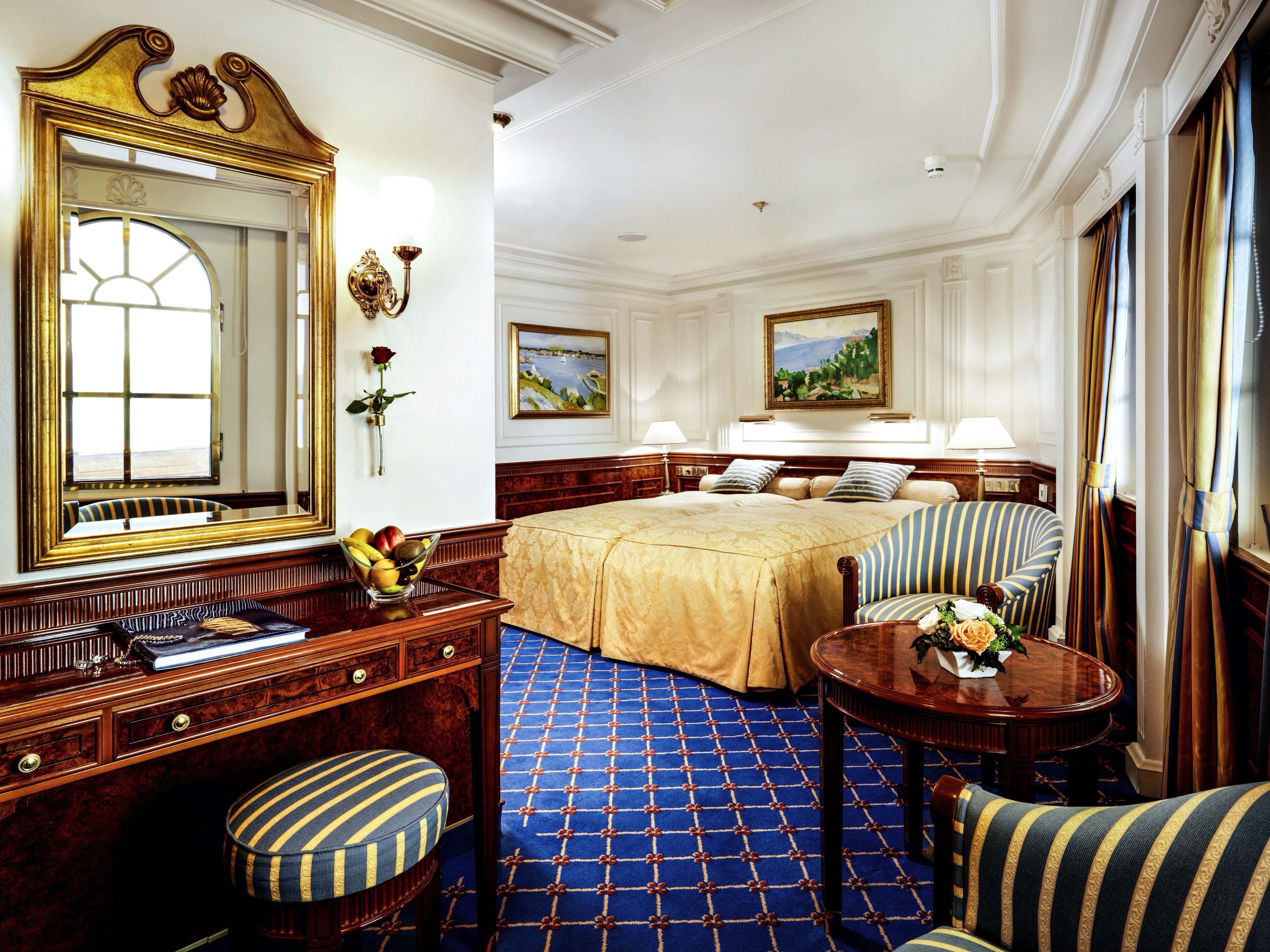
Grand Stateroom (Cat. C)
The two grand staterooms envelope guests in sophistication. While the design and decor are decidedly stately and classically maritime, they still offer ultimate comfort. Panoramic windows welcome expansive sea views. Their location in the front of the promenade deck follows the elegant line of the SEA CLOUD II, enhancing the exhilarating feeling of sailing on a private yacht.
- approx. 194 sq. ft. / 18 m²
- marble bathroom approx. 32 sq. ft. / 3 m² with shower, and golden fixtures
- double bed, 67 in. x 79 in. / 170 cm x 200 cm (2 mattresses)
- closet
- chair with table
- dressing table
- minibar
- TV with DVD
- panoramic windows
- safe

Deluxe Staterooms (Cat. D)
The three large porthole windows give these SEA CLOUD II deluxe staterooms a special maritime flair. With a luxurious yacht ambience, these upscale spaces magnify the feeling of being part of an extraordinary journey on an extraordinary ship. The spacious room exudes elevated coziness with sophisticated furnishing and finishings, a glamorous palette and a beautiful sitting area. The six deluxe staterooms are located mid-ship on the same deck as the massage and cosmetic treatments, fitness room, swim platform and hospital.
- approx. 226 sq. ft. / 21 m²
- marble bathroom approx. 32 sq. ft. / 3 m² with shower and golden fixtures
- double bed, 67 in. x 79 in. / 170 cm x 200 cm (2 mattresses)
- closet
- seating with table
- dressing table
- minibar
- •TV with DVD
- •three portholes
- •safe
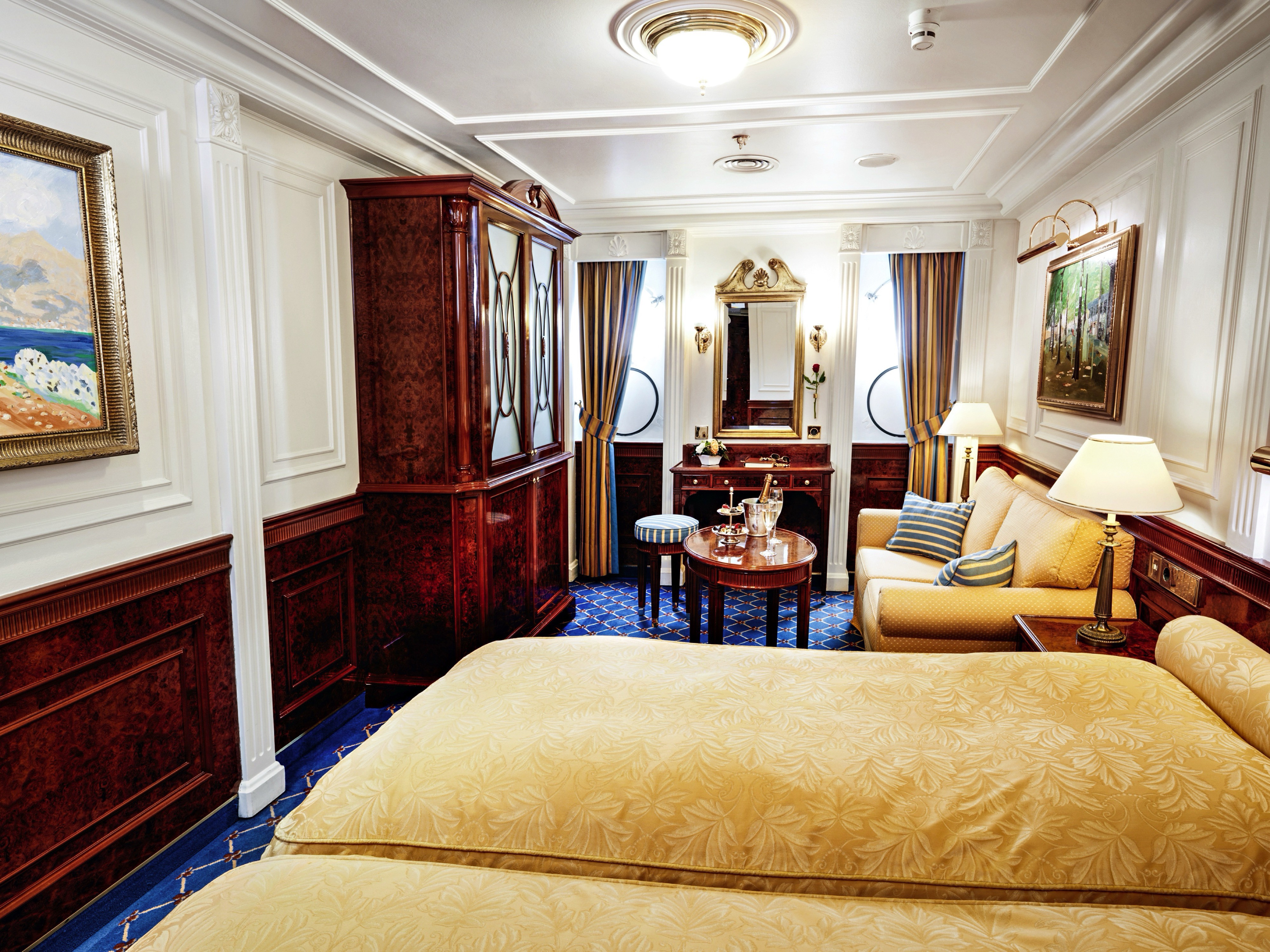
Deluxe Staterooms (Cat. E)
These outside deluxe staterooms with large porthole window are the epitome of nautical luxury on SEA CLOUD II. Located on both sides of the cabin deck, these are exclusive retreats of serenity that have made our sailing yachts famous. Sophisticated style comes in the form of rich wood finishings, Italian marble and golden fixtures.
- approx. 204 sq. ft. / 19 m²
- marble bathroom approx. 32 sq. ft. / 3 m² with shower and golden fixtures
- California king bed, 71 in. x 79 in. / 180 cm x 200 cm (split king can be separated into 2 twins)
- closet
- seating with table
- dressing table
- minibar
- TV with DVD
- two portholes
- safe
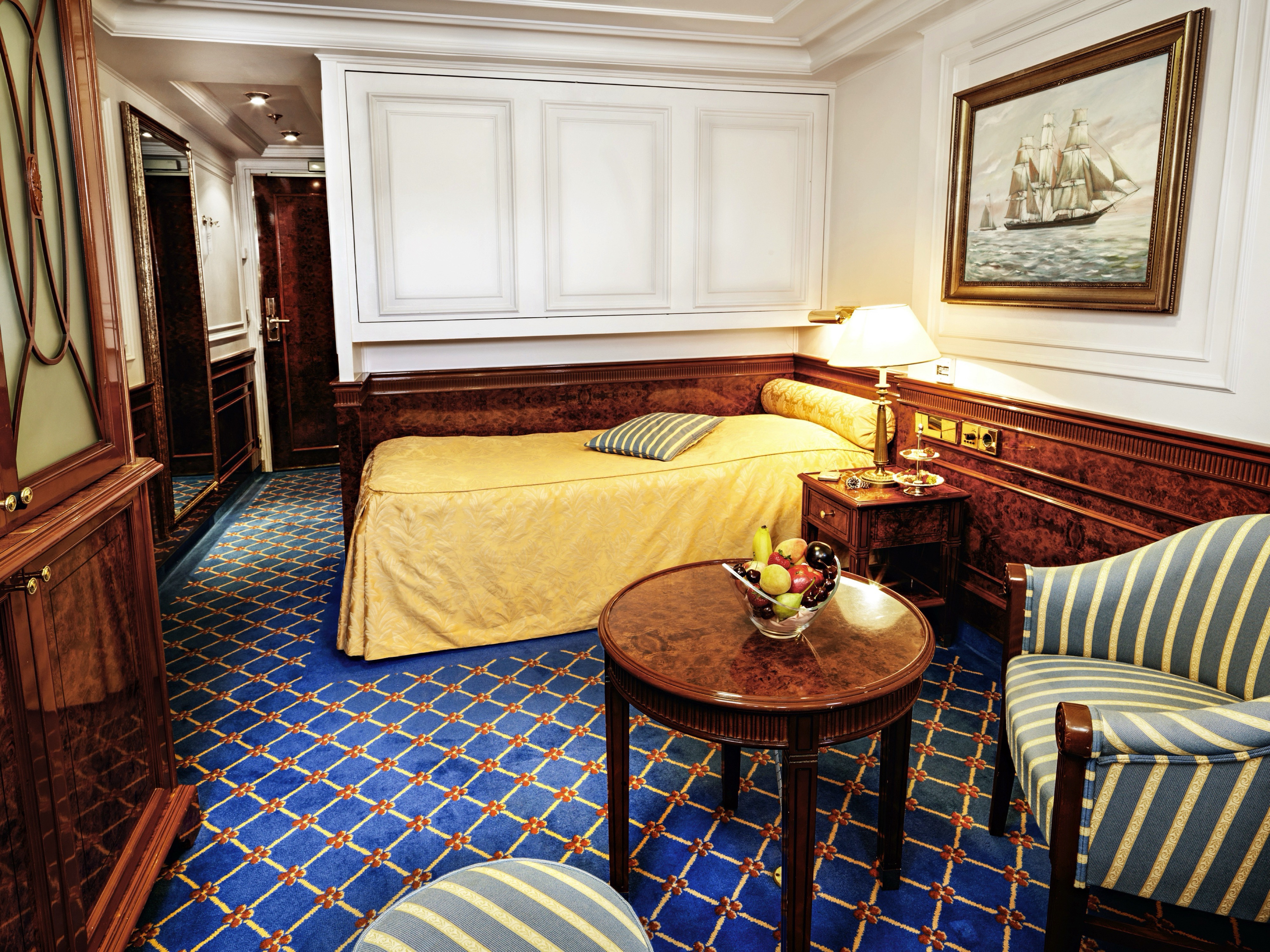
Cat. F Staterooms
These three outside staterooms with porthole windows spotlight a design inspired by officers’ cabins on traditional windjammers. Warm, lustrous woods and a comfortable sitting area exude a classically elegant maritime atmosphere and provide an elevated sanctuary at sea. They’re located on the same deck as massage and cosmetic treatments, the fitness room, swim platform and hospital.
- approx. 150 sq. ft. / 14 m²
- marble bathroom approx. 32 sq. ft. / 3 m² with shower and golden fixtures
- upper and lower beds, 32 in. x 75 in. / 80 cm x 190 cm
- closet
- chair with table
- dressing table
- minibar
- TV with DVD
- porthole
- safe
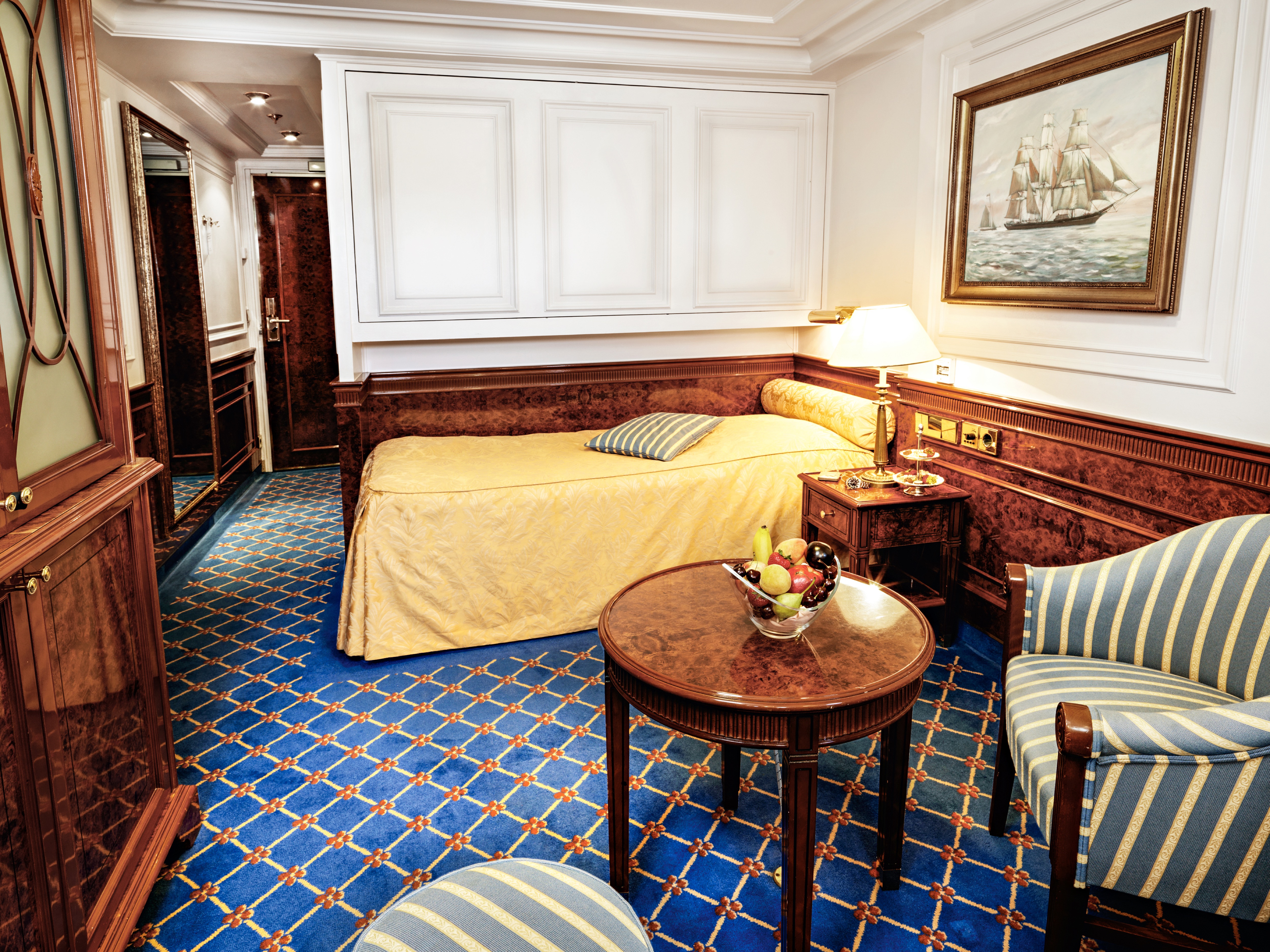
Guarantee Cabins
Guaranteed stateroom: Space is limited. Allocations are at SEA CLOUD CRUISES’ discretion starting in Category F. You will receive your exact stateroom number when arriving on board.
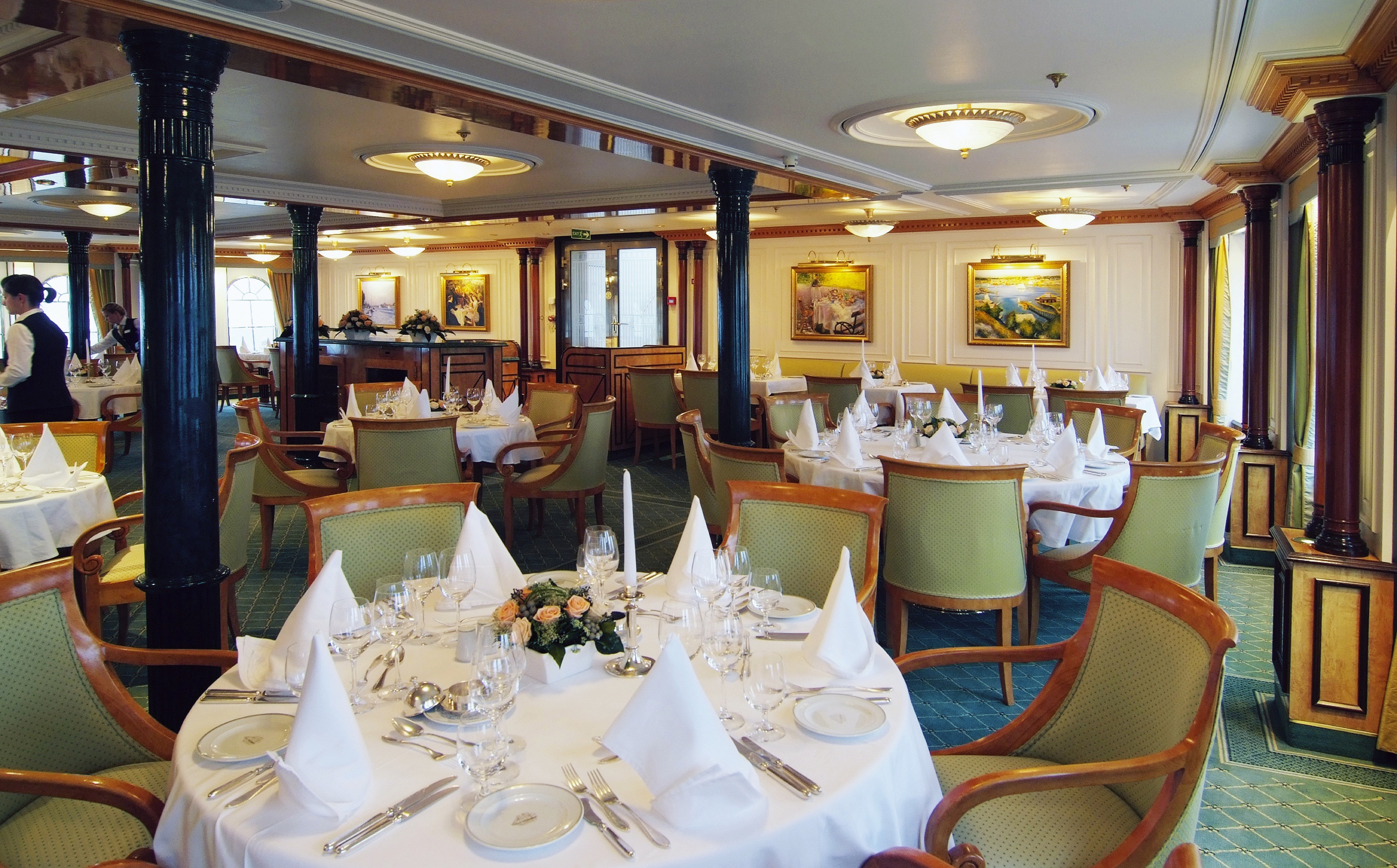
Restaurant
Meals are served on our ships in one seating. Service times can be found in the daily program on board. Please kindly note that reservations are not possible.
Our top-quality wines from well-known vineyards are often locally sourced. Our sommelier carefully selects each wine for every season and sailing destination. Wines are paired with lunch and dinner menus. In addition, you are always free to select your favourite wine from the menu.
A small breakfast with pastries and fruits is offered to early and late risers onboard the SEA CLOUDs. On board the SEA CLOUD II, a small breakfast is available at the Lido Bar. The main breakfast buffet is provided in the restaurant. Lunch is served as a buffet on the lido deck or in the restaurant. In the afternoon, coffee and tea are served, accompanied by some sweet treats and sandwiches. Dinner is a four-course menu with entrees to choose including a vegetarian option. Our executive chef will prepare an exclusive five-course meal for the gala dinner. A late-night snack nicely rounds up the evening’s culinary delights.

Lido Deck
You will find a dining area and Lido Bar on the Lido Deck.
Zodiacs
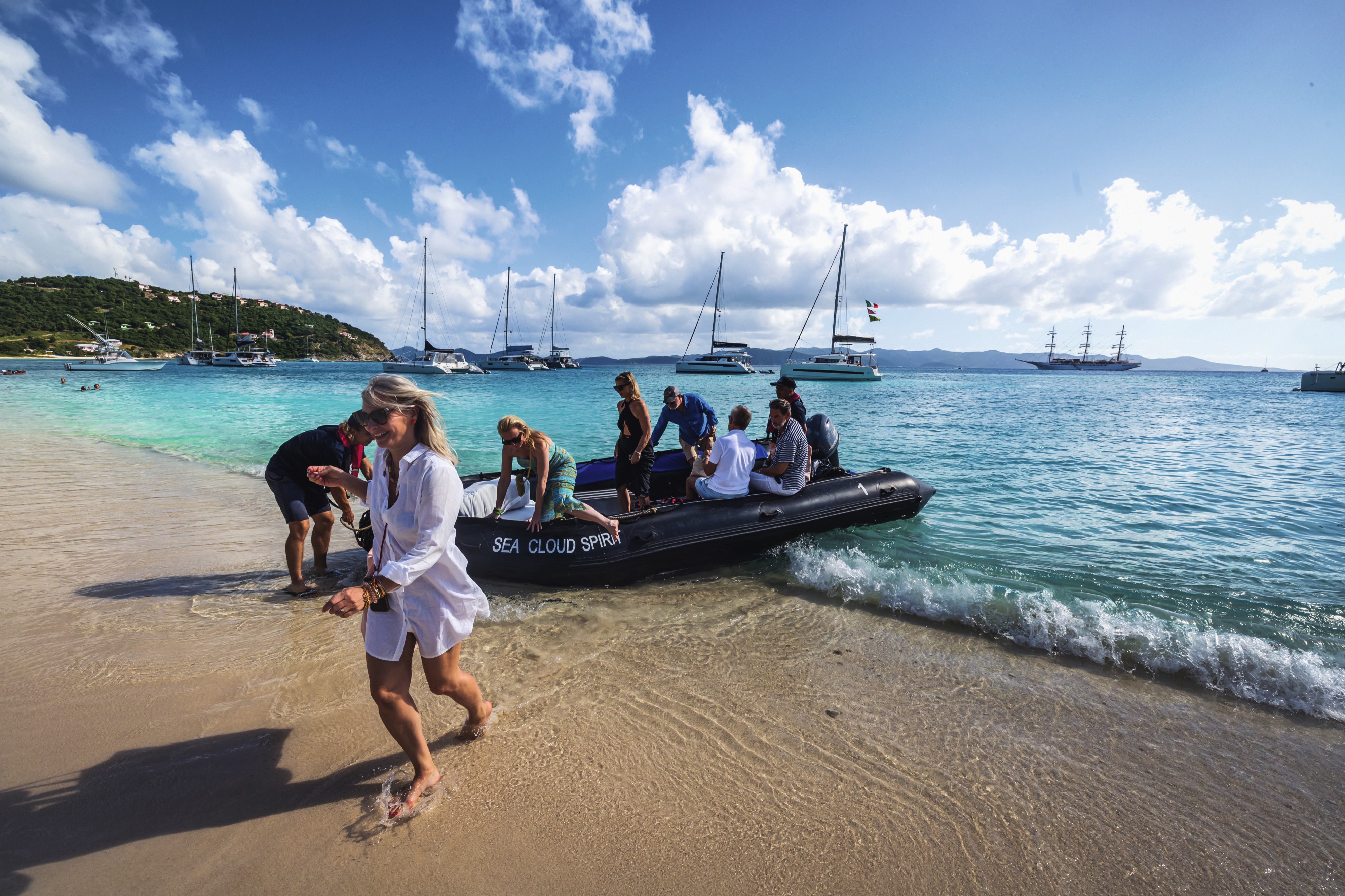
Zodiacs are small motor-driven rigid-hull inflatable boats with a capacity of approximately 8 to 10 guests, primarily used for beach landings on our cruises or our photo safaris.

Watersports
Water sport activities are offered from the gangway on the marina platform.
We do have snorkelling equipment in different sizes on board, stand-up paddle bards for beach landings and a towable tube from the gangway.
All water sport activities are included and subject to weather and Captains permission.
Excursions
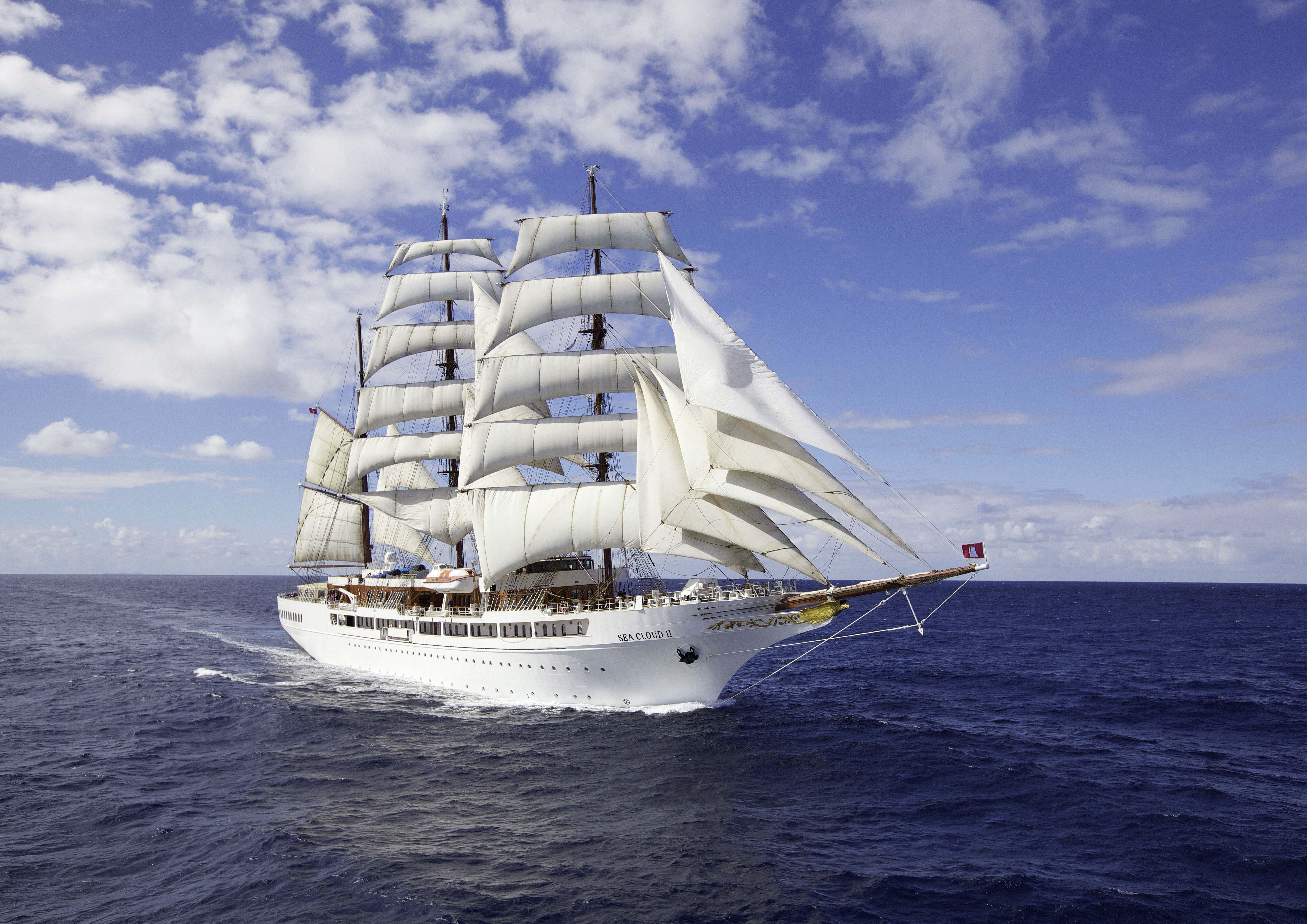
All our shore excursions are shown on the itinerary pages of our brochure. 4 weeks prior to departure you will receive detailed information on shore excursions with your travel documents. The shore excursion booklet also includes the order form to pre-book your excursions. On board the Cruise Director will be able to provide further details during a lecture. We do recommend pre-booking prior to embarkation to secure your spot. All excursions will be charged to your cabin account on board.
You are free to join an organised shore excursion, stay on board or make individual arrangements. You will find times for tender or to be back on board in your daily program and at the gangway.
Please remember to bring comfortable footwear, a light jacket/windbreaker, as well as sunscreen where appropriate.
Rigg Climbing
Join us for some rigg climbing
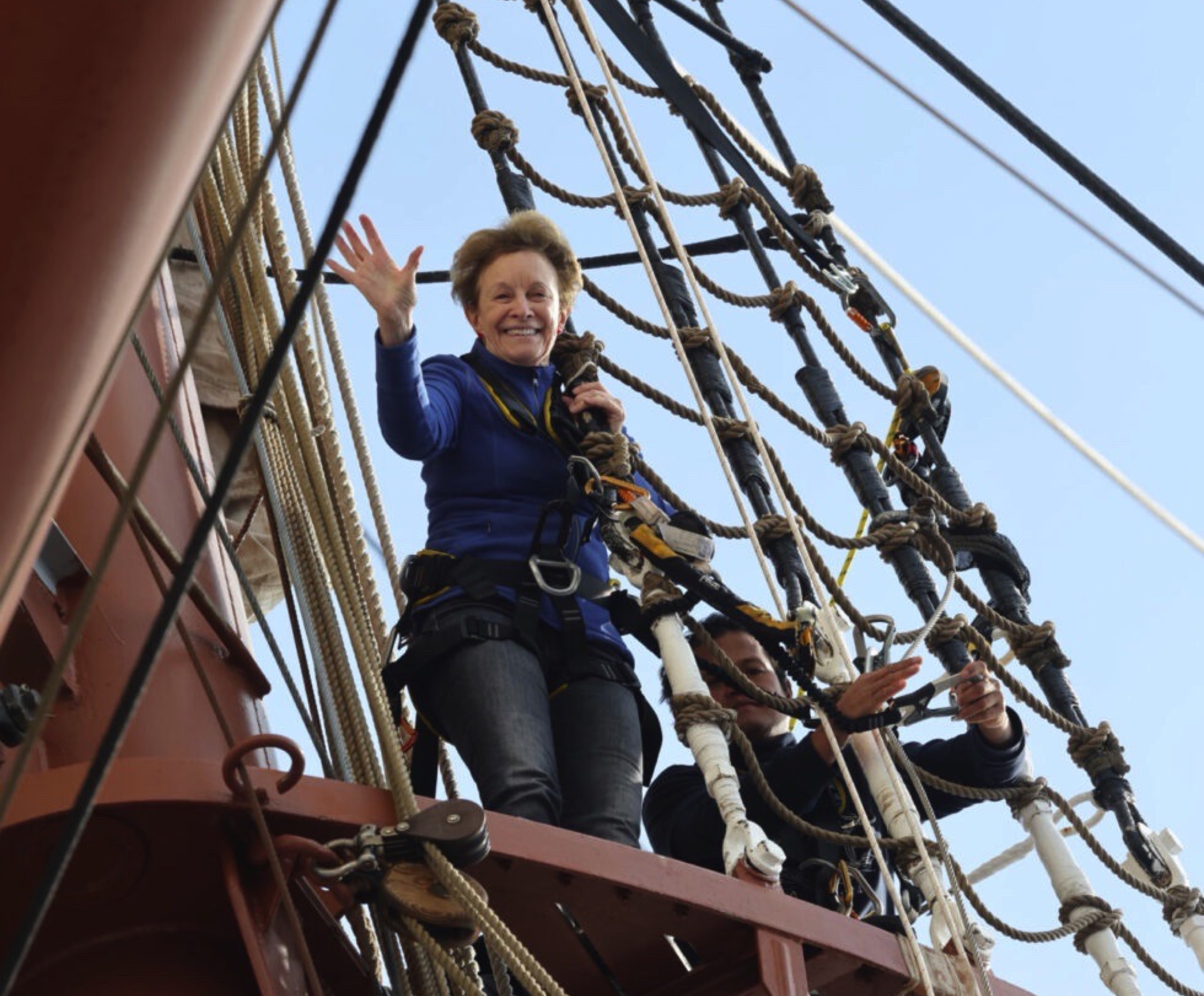
One of the most captivating experiences onboard the SEA CLOUD windjammer is watching the crew climb into the rigging to set the sails by hand. Now, you can share a piece of this adventure yourself and – if your fitness allows – climb up to the first platform!
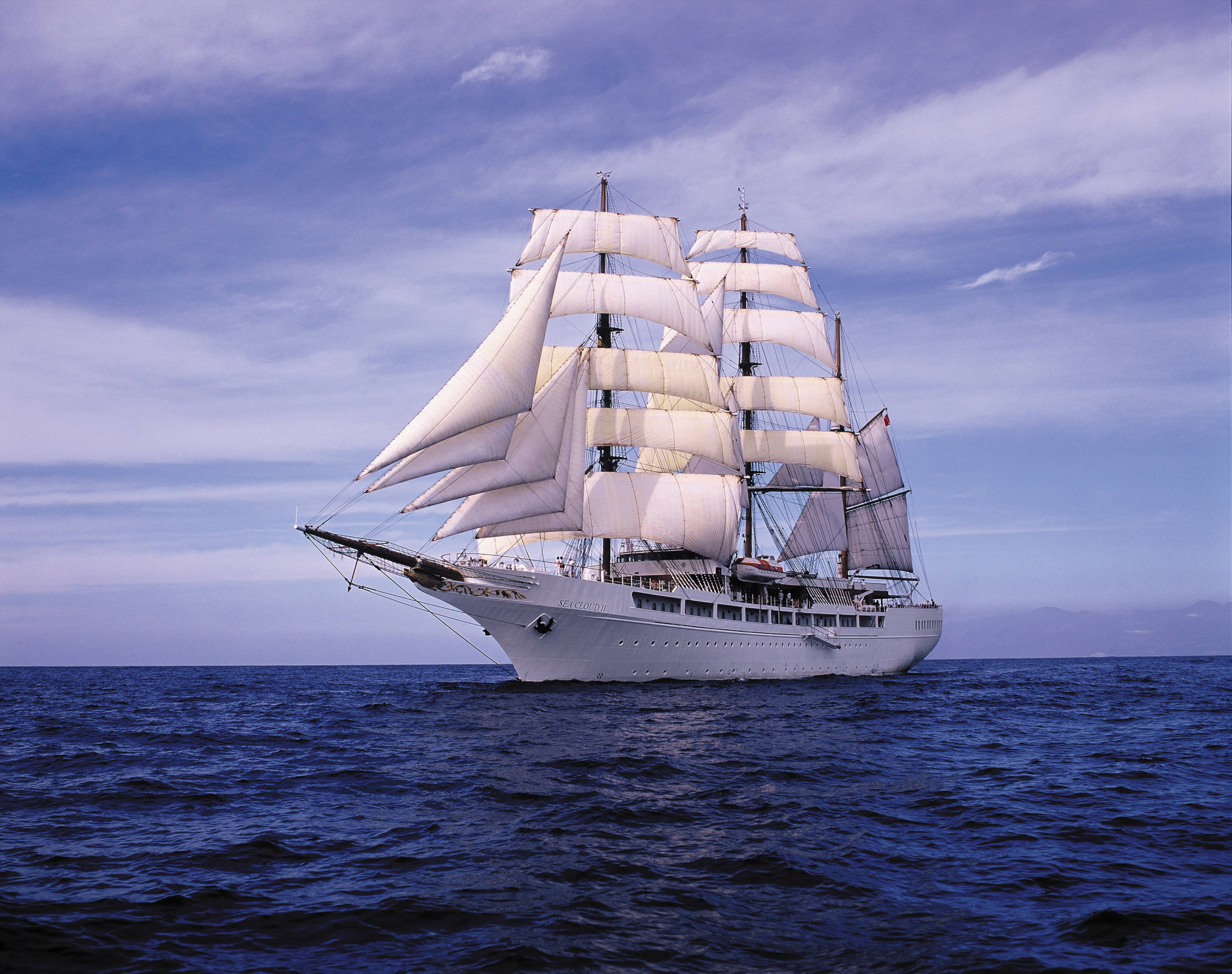
Our SEA CLOUDs are the only cruise ships in the world that are traditionally sailed by hand. Here, nothing happens at the push of a button: setting the sails follows centuries-old rituals, bringing the magic of sailing to life in a unique way. Now, you can experience this tradition up close! High up in the rigging, carried by the wind and with sweeping views over the sea, you’ll feel the majestic power of our tall ships even more intensely. Safely guided and equipped with state-of-the-art safety systems, you can climb up to the first platform, about 14 meters above the deck – an unforgettable moment for those seeking adventure!
A brief fitness check on board ensures that you feel completely comfortable and secure before you ascend. This includes: hanging from a bar for 10 seconds, balancing on one foot for 20 seconds and climbing stairs two at a time. Our experienced deckhands, specially trained for these activities, will guide you every step of the way so you always feel safe and well taken care of.
Embark on this unique adventure now – a once-in-a-lifetime moment that will leave you with a deep sense of joy and a touch of pride. Are you ready to experience the sea in all its splendour, high above the sails?
Lounge
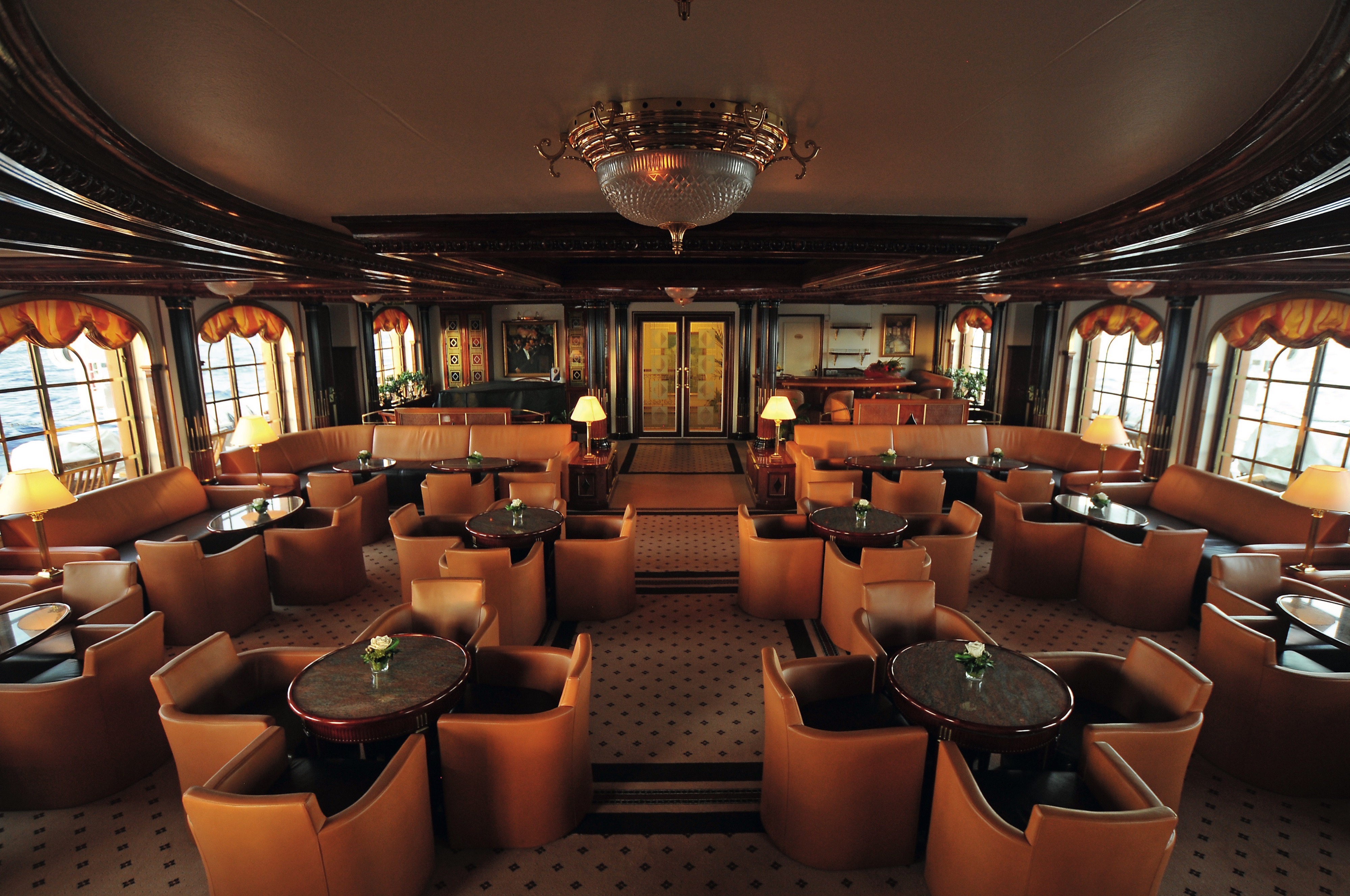
The lounge is located on the Lido Deck (SEA CLOUD II & SEA CLOUD SPIRIT) and is always open. This is where all lectures take place and on select sailings concerts on the Steinway grand piano (SEA CLOUD II and SEA CLOUD SPIRIT). Enjoy a selection of games or just an afternoon snack.
The Lounge Bar is open daily from 11:00 am. All drinks, alcoholic and non-alcoholic are included, premium drink are at an additional charge.
Library
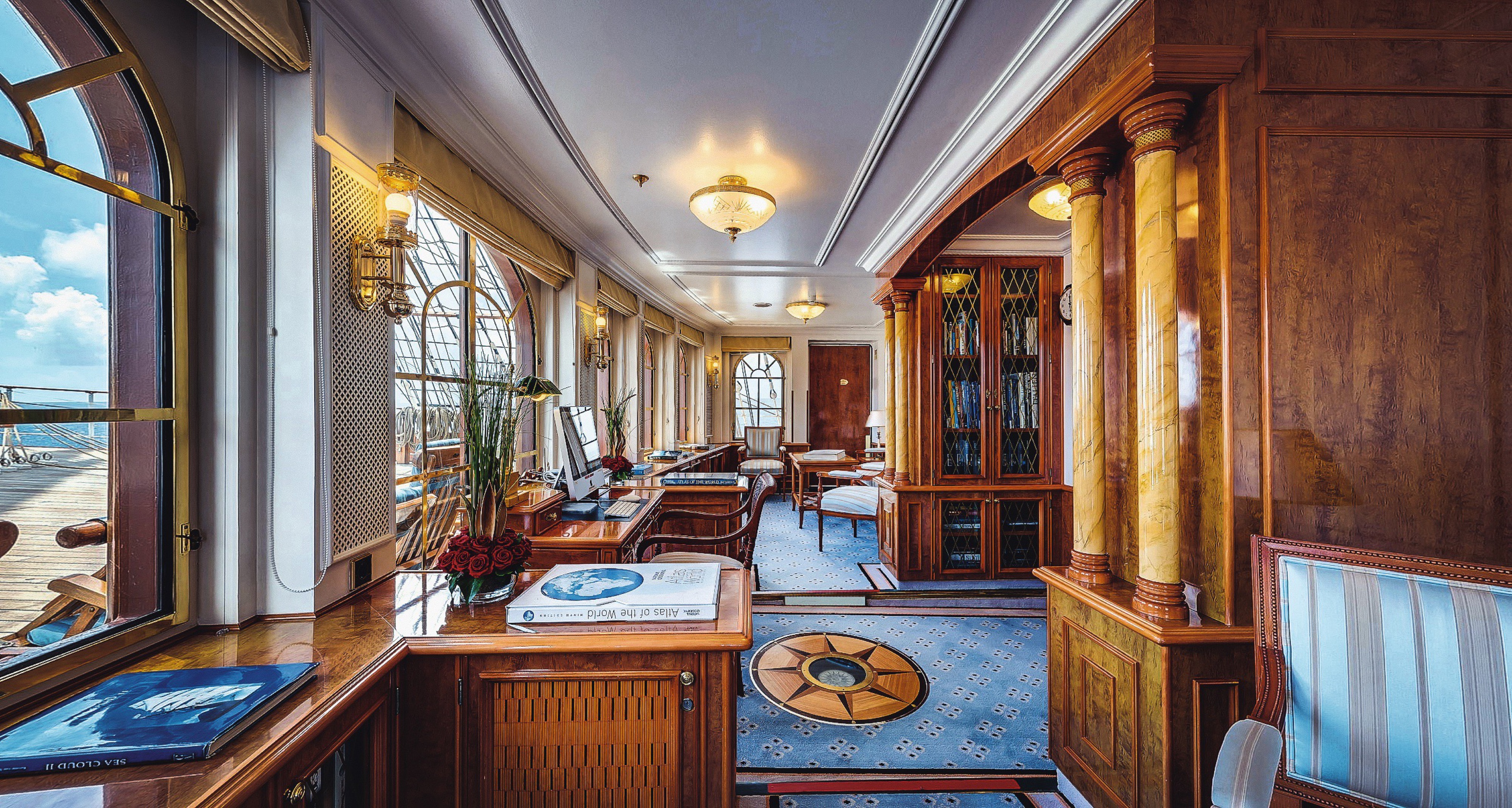
Our beautiful library offers a variety of English books, popular board games and DVDs (SEA CLOUD II only). You are welcome to take the books to your cabin during your sailing and return before the end of your cruise.

Lido Deck with Bar
The Lido is open daily from 11:00 am. All drinks, alcoholic and non-alcoholic are included, premium drink are at an additional charge.
Bridge
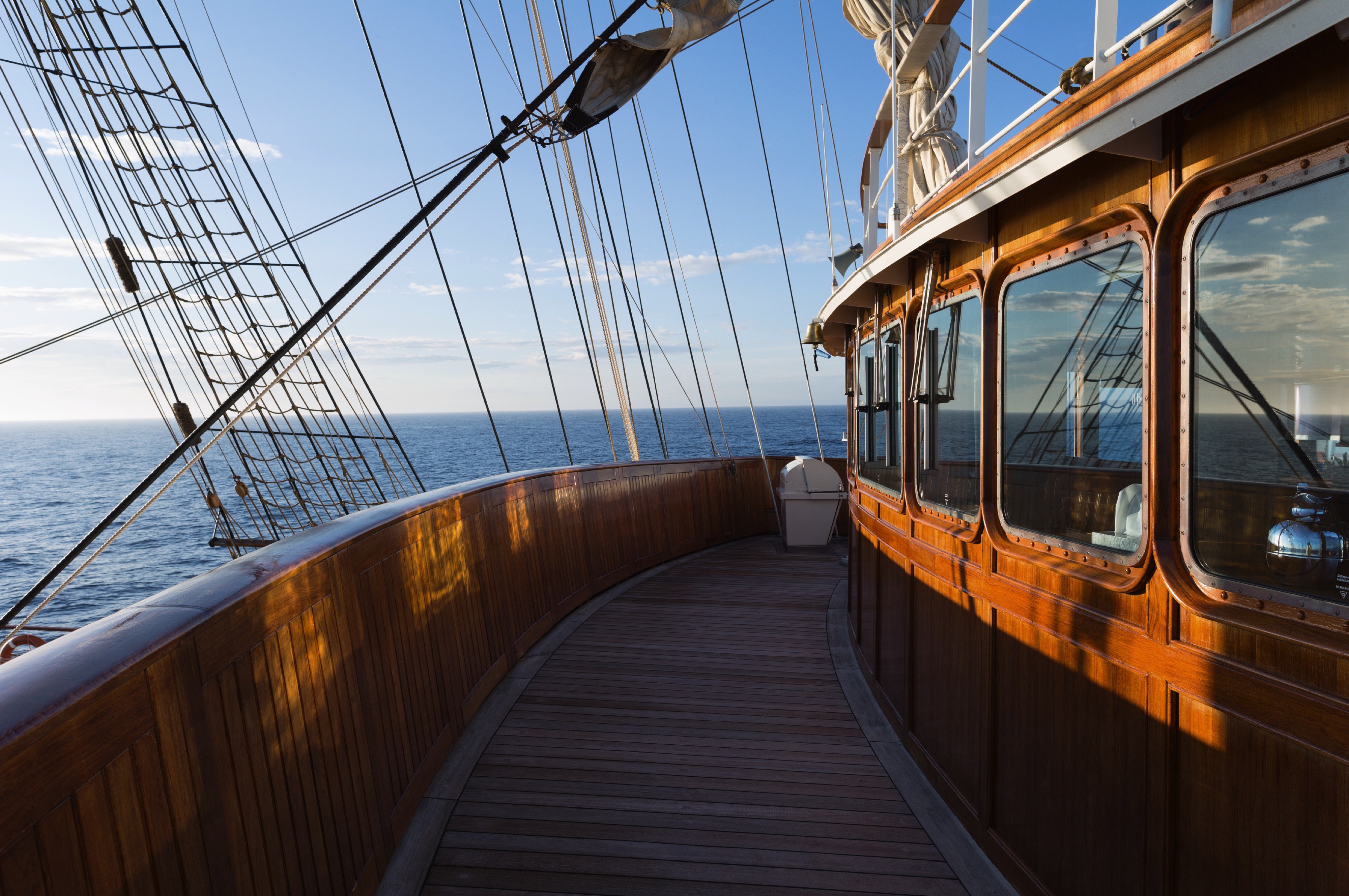
The bridge area can be visited during the day and/or at specified times, subject to captain’s approval. The bridge is closed during manoeuvring operations and night sailing.
Boutique
The boutique on our yachts offers accessories, clothes, and gifts. Opening hours vary. You will find the exact information in the daily program and on the public boards. Feel free to contact the reception with any questions or requests outside of opening hours.
Fitness and Sport
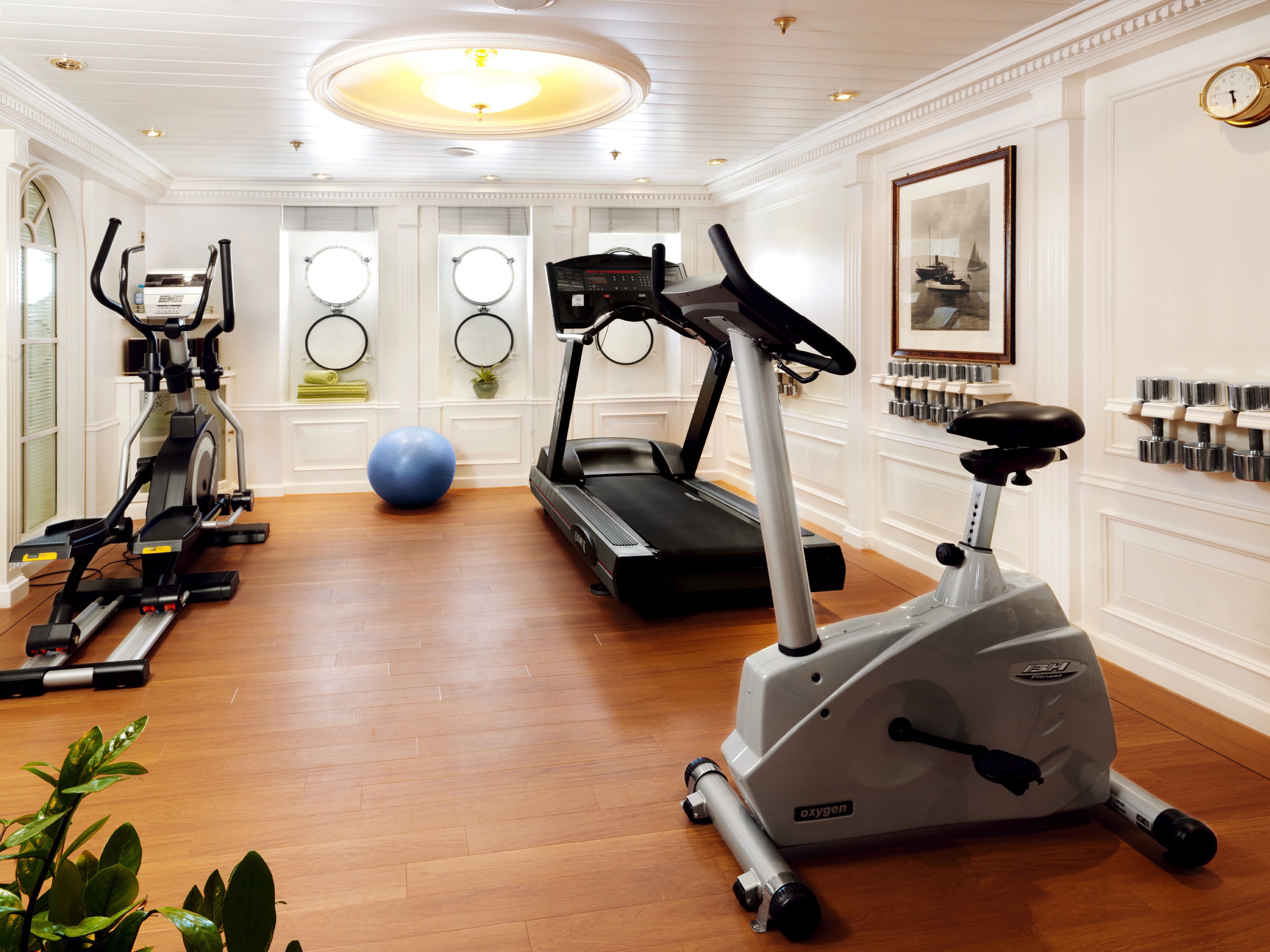
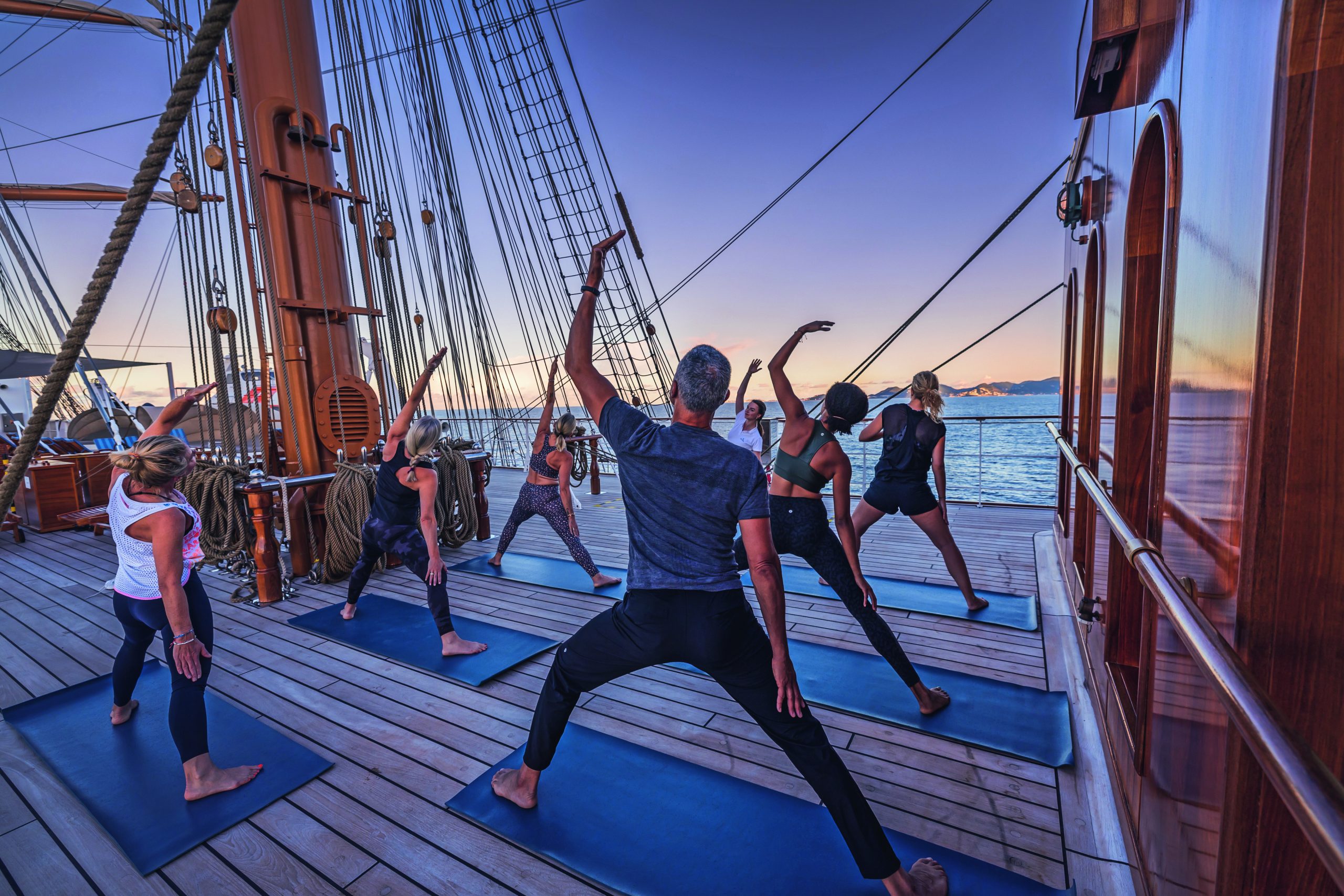
SEA CLOUD II has a fitness area on the cabin deck. The gym is open during the day and is equipped with a step machine, a bike, a treadmill, and a rowing machine.

Massage & Cosmetics
On SEA CLOUD II we offer massages and beauty treatments at an additional fee We do have a sauna on the cabin deck, which is heated upon request. Please contact the reception.
Special Dietary Requirements
Please inform us prior to your cruise if you have any allergies, intolerances, or other special dietary restrictions. We will try to accommodate your needs as far as possible.
Dress Code
During the day, we recommend casual chic, yachting clothes. The evenings are casual elegant. Please refrain from wearing swimwear during lunch and/or shorts at dinner. For the Captain’s Dinner (once or twice depending on lengths of the cruise), we recommend elegant cocktail attire, a suit or ensemble for the gentleman and matching dress for the lady. We additionally suggest bringing non-slippery boat shoes.
Disabled Access
Our windjammers, SEA CLOUD, SEA CLOUD II and SEA CLOUD SPIRIT, are not barrier-free and, therefore, unsuitable for wheelchair users. Please contact our reservations directly for details.
There are no elevators on the SEA CLOUD and SEA CLOUD II, only staircases. SEA CLOUD SPIRIT is equipped with an elevator. You will access and depart the ship via the onboard gangway, which is not always level. Depending on weather conditions, access might be steep. The tenders or zodiacs service is done via the gangway. Please contact us prior to cruise if you have any questions regarding accessibility. If you need specific medical arrangements, please contact us in advance.
Smoking Policy
Smoking is permitted only on the lido deck outside of mealtimes. We kindly request that smokers take the other passengers into consideration. Smoking is always prohibited in covered areas on the lido deck, of the spanker deck (SEA CLOUD), on the blue lagoon (SEA CLOUD II), on the sun deck and on the verandah (SEA CLOUD SPIRIT).
Internet Access
Each of our yachts is equipped with Starlink satellite internet. All three ships offer WI-FI access in the public areas and in the staterooms. You can use your own laptop to access the Internet with an access code (WI-FI). Data volume of 10 GB is free of charge; additional data volume can be obtained from the reception desk at a charge. Continuous reception cannot be guaranteed; in certain sailing areas or due to the set course, interruptions to network coverage might be experienced. The WI-FI connection on a ship is not comparable to the usual reception on land.
On board, a laptop that is located in the lounge (SEA CLOUD) or in the library (SEA CLOUD II & SEA CLOUD SPIRIT) can be used for e-mail use on board. The SEA CLOUDs have their own on-board email addresses as follows:
SEA CLOUD: seacloud@seacloud.com
SEA CLOUD II: seacloud2@seacloud.com
SEA CLOUD SPIRIT: passenger@scs.seacloud.com
Please advise anyone you give the above email address to not send messages with attachments. Please put your name and cabin number in the subject line to ensure that the reception can forward any correspondence to you. They will hand you a printout of the e-mail.
Incoming and outgoing e-mails up to 50 KB in size can be received or send free of charge. However, files larger than 50 KB per message are automatically rejected by the system.
Due to limited network availabilities at sea, cell phones use is limited. The SEA CLOUDs are equipped with Starlink that ensures WIFI connection. Phone numbers to reach the ship can be found in your travel documents and on board.
Laundry Services
Laundry services on board are limited to washing and ironing. There is no dry cleaning available. You will find a price list for the overnight laundry and ironing service in your closet. For guests who have booked a suite in category A-C (SEA CLOUD) or category A+B (SEA CLOUD II & SEA CLOUD SPIRIT) the laundry service complimentary. For safety reasons, passengers are not permitted to iron in their cabins.
Children on Board
Children are welcome on our ships, but please keep in mind there is no daycare or special entertainment for children on board our ships.
Sustainability & Low Impact Tourism
OUR CONTRIBUTION TO ECO-FRIENDLY TRAVEL
We approach the people and their cultures with respect in all the regions we visit, travelling mindfully through the local environment. By doing this, we can bring our guests closer – in the truest sense of the word – to these places, and what makes each one special.
THE WINDJAMMER EXPERIENCE
For you and us alike, the key attraction of our trips is the chance to sail on the open seas.
We therefore take every opportunity to set sail and be propelled by the sheer power of the wind. That is why the captain will sometimes change the route if the weather requires it. On board our SEA CLOUD tall ships, you’ll experience the elements, as many of the day-to-day activities take place outside.
HAVING AS LITTLE IMPACT AS POSSIBLE
When we do have to start the engines, we utilise low-sulphur marine diesel on all three of our windjammers.
For us, this is standard practice. Even the SEA CLOUD, our very first windjammer, was equipped with this technology right from the start. Our motto: to minimise our impact on the environment yet still make a profound and positive impression on those around us.
A SUSTAINABLE APPROACH TO LIFE ON-BOARD
Avoiding plastic, reducing water usage and protecting the environment.
These are the factors that guide us in the day to day operation of our ships and our ongoing development of eco-friendly alternatives. To cite just one example, our reusable drinks bottles are not only easy on the eye, but also easy on the environment.
QUALITY, NOT QUANTITY
Our ‘small but perfectly formed’ windjammers are able to visit smaller ports, away from the busy routes frequented by large cruise liners.
With a maximum of 64 to 136 passengers, we’re always welcomed in those locations thanks to our approach of visiting local communities rather than overwhelming them. Needless to say, our itineraries also include some classic destinations, though we usually visit these only when the mega-liners have moved on.
BOOSTING THE LOCAL ECONOMY
Procuring supplies locally, working with local, smaller-scale agencies and paying fair prices.
By taking this approach, we see ourselves as a partner for our local service providers, with whom we’ve built relationships based on trust over many years. After all, we want our voyages to benefit both our guests and the communities we visit around the world.
AUTHENTIC CUISINE
Our menus are always a true reflection of the regional cuisine.
This is because our chefs enjoy buying exotic spices, local specialities and freshly caught fish from local markets to bring you – even in a culinary sense – closer to the places we visit.
A MEMBER OF THE FUTOURIS NETWORK
Heading into the future with Futouris.
Preserving the natural and cultural heritage of our world and shaping the future of tourism in a sustainable way is what Futouris stands for. Members of the network are working globally to improve people’s living conditions, preserve biodiversity and protect the environment and climate.
Medical Facilities
All three ships have a clinic and a ship’s doctor. Medical consultation hours can be found in the daily program. In case of an emergency, the doctor can be reached at any time by calling 911.
What's Included
Complimentary with your sailing:
- Welcome champagne in suite/stateroom
- Daily fresh fruit basket in suite/stateroom
- All meals including nightly 4-course menu and a 5-course gala dinner
- Fine wines from renowned winemakers and beer for lunch and dinner
- All non-alcoholic coffee and tea specialties
- All soft drinks
- Welcome and farewell cocktail
- Bottled water on excursions
- Gratuities and port fees
- Curated moments
- Beach barbecues in select destinations
- Marina platform with use of water sports equipment such as snorkel gear, stand-up paddleboards, and towable tube (weather permitting)
- Laundry service in suites

Sun Deck
- Captain
- Bridge
Lido Deck
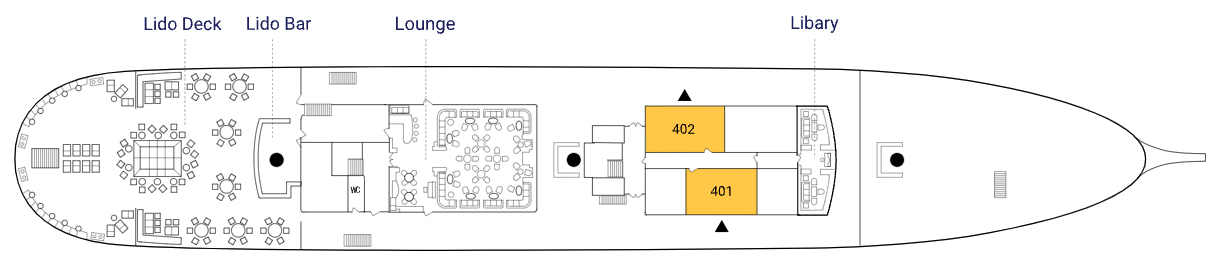
- Lounge
- Lido Bar
- Lido Deck
- Library
- Cat. A Owner’s Suites
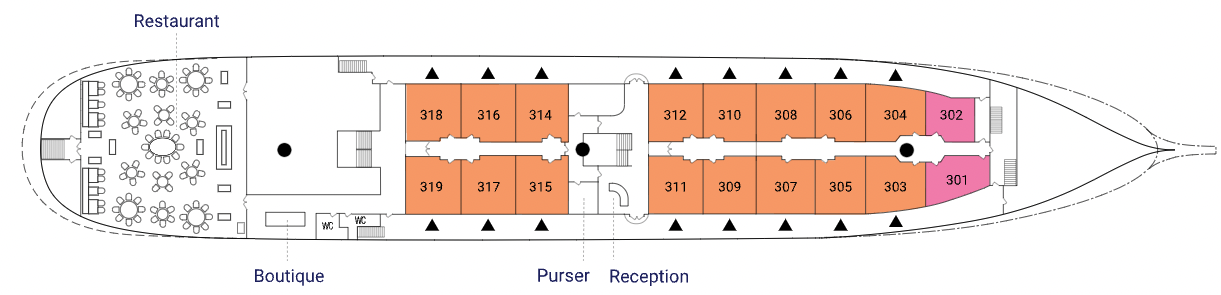
Promenade Deck
- Restaurant
- Boutique
- Purser
- Reception
- Junior Suites
- Grand Staterooms
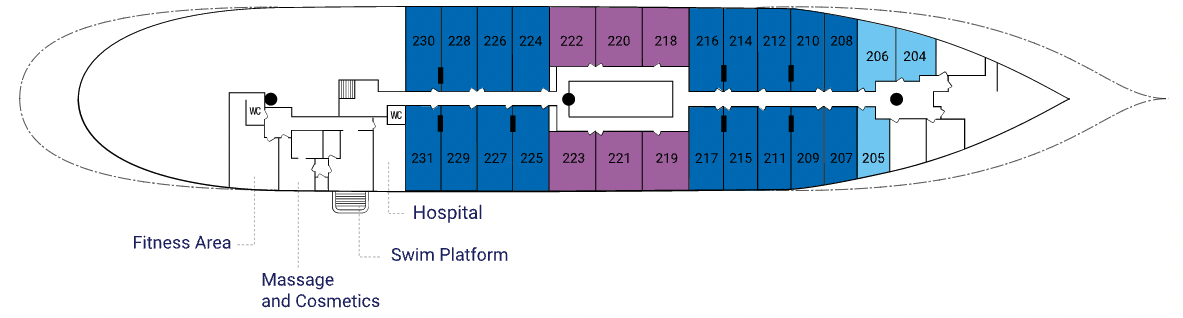
Cabin Deck
- Fitness Area
- Massage and Cosmetics
- Hospital
- Swim Platform
- Deluxe Stateroom
- Stateroom (Upper/Lower-bed Cabins)
Itinerary
United with France only since 1860, Nice has its own history and atmosphere, which dates back 230,000 years. It was on Colline du Château (now château-less) and at the Plage des Ponchettes, in front of the Old Town, that the Greeks established a market-port in 350 BC and named it Nikaia, which would become Marseilles’ chief coastal rival. The Romans established themselves a little later on the hills of Cimiez (Cemenelum), already previously occupied by Ligurians and Celts, and quickly overshadowed the waterfront port. After falling to the Saracen invasions, Nice regained power as an independent state, becoming an important port in the early Middle Ages.So cocksure did it become that in 1388, Nice, along with the hill towns behind, effectively seceded from the county of Provence, under Louis d’Anjou, and allied itself with Savoie. Thus began its liaison with the House of Savoy, and through it with Piedmont and Sardinia, it was the Comté de Nice (Nice County). This relationship lasted some 500 years, tinting the culture, architecture, and dialect in rich Italian hues.By the 19th century Nice was flourishing commercially, locked in rivalry with the neighboring shipping port of Genoa. Another source of income: the dawning of tourism, as first the English, then the Russian nobility, discovered its extraordinary climate and superb waterfront position. A parade of fine stone mansions and hotels closed into a nearly solid wall of masonry, separated from the smooth-round rocks of the beach by what was originally named Camin deis Anglés (the English Way), which of course is now the famous Promenade des Anglais. This magnificent crescent, which is seeking UNESCO recognition, is one of the noblest in France. Many of Nice’s most delightful attractions—the Cours Saleya market, the Old Town streets, the Hotel Negresco, and the Palais Masséna—are on or close to this 10-km (6-mile) waterfront, making it the first stop for most visitors, while the redevelopment of Nice’s port, around the other side of the Colline du Château, makes it easier for amblers who want to take in the Genoese architecture or peruse the antiques at the Puces de Nice, now part of the Promenade des 100 Antiquaires, along Quai Papacino. Nice also has the distinction of the “Family Plus” label, with free strollers, play areas, and restaurants with child-friendly activities.
At first glance, it really doesn’t look all that impressive. There’s a pretty port with cafés charging €5 for a coffee and a picturesque old town in sugared-almond hues, but there are many prettier in the hills nearby. There are sandy beaches, rare enough on the Riviera, and old-fashioned squares with plane trees and pétanque players, but these are a dime a dozen throughout Provence. So what made St-Tropez an internationally known locale? Two words: Brigitte Bardot. When this pulpeuse (voluptuous) teenager showed up in St-Tropez on the arm of Roger Vadim in 1956 to film And God Created Woman, the heads of the world snapped around. Neither the gentle descriptions of writer Guy de Maupassant (1850–93), nor the watercolor tones of Impressionist Paul Signac (1863–1935), nor the stream of painters who followed (including Matisse and Bonnard) could focus the world’s attention on this seaside hamlet as did this one sensual woman in a scarf, Ray-Bans, and capris. Vanity Fair ran a big article, “Saint Tropez Babylon,” detailing the over-the-top petrodollar parties, megayachts, and Beyoncé–d paparazzi. But don’t be turned off: the next year, Stewart, Tabori & Chang released an elegant coffee-table book, Houses of St-Tropez, packed with photos of supremely tasteful and pretty residences, many occupied by fashion designers, artists, and writers. Once a hangout for Colette, Anaïs Nin, and Françoise Sagan, the town still earns its old moniker, the “Montparnasse of the Mediterranean.” Yet you might be surprised to find that this byword for billionaires is so small and insulated. The lack of train service, casinos, and chain hotels keeps it that way. Yet fame, in a sense, came too fast for St-Trop. Unlike the chic resorts farther east, it didn’t have the decades-old reputation of the sort that would attract visitors all year around. For a good reason: its location on the south side of the gulf puts it at the mercy of the terrible mistral winter winds. So, in summer the crowds descend and the prices rise into the stratosphere. In July and August, you must be carefree about the sordid matter of cash. After all, at the most Dionysian nightclub in town, a glass of tap water goes for $37 and when the mojo really gets going, billionaires think nothing of “champagne-spraying” the partying crowds—think World Series celebrations but with $1,000 bottles of Roederer Cristal instead of Gatorade. Complaining about summer crowds, overpricing, and lack of customer service has become a tourist sport and yet this is what makes St-Tropez—described by the French daily newspaper Le Figaro as the place you can see “the greatest number of faces per square meter”—as intriguing as it is seductive.
Since being designated a European Capital of Culture for 2013, with an estimated €660 million of funding in the bargain, Marseille has been in the throes of an extraordinary transformation, with no fewer than five major new arts centers, a beautifully refurbished port, revitalized neighborhoods, and a slew of new shops and restaurants. Once the underdog, this time-burnished city is now welcoming an influx of weekend tourists who have colonized entire neighborhoods and transformed them into elegant pieds-à-terre (or should we say, mer). The second-largest city in France, Marseille is one of Europe’s most vibrant destinations. Feisty and fond of broad gestures, it is also as complicated and as cosmopolitan now as it was when a band of Phoenician Greeks first sailed into the harbor that is today’s Vieux Port in 600 BC. Legend has it that on that same day a local chieftain’s daughter, Gyptis, needed to choose a husband, and her wandering eyes settled on the Greeks’ handsome commander Protis. Her dowry brought land near the mouth of the Rhône, where the Greeks founded Massalia, the most important Continental shipping port in antiquity. The port flourished for some 500 years as a typical Greek city, enjoying the full flush of classical culture, its gods, its democratic political system, its sports and theater, and its naval prowess. Caesar changed all that, besieging the city in 49 BC and seizing most of its colonies. In 1214 Marseille was seized again, this time by Charles d’Anjou, and was later annexed to France by Henri IV in 1481, but it was not until Louis XIV took the throne that the biggest transformations of the port began; he pulled down the city walls in 1666 and expanded the port to the Rive Neuve (New Riverbank). The city was devastated by plague in 1720, losing more than half its population. By the time of the Revolution, Marseille was on the rebound once again, with industries of soap manufacturing and oil processing flourishing, encouraging a wave of immigration from Provence and Italy. With the opening of the Suez Canal in 1869, Marseille became the greatest boomtown in 19th-century Europe. With a large influx of immigrants from areas as exotic as Tangiers, the city quickly acquired the multicultural population it maintains to this day.
The capital of Menorca since 1721, Mahon has a impressive natural deep water harbour, which is one of the largest in the world. This, coupled with its strategic location, has made it a stronghold for many nations throughout history. Mahon has an abundance of historical buildings, the oldest being the Arch of Saint Roc which is all that remains of the wall that once encircled the whole town. The island was occupied by the British during the 18th century and Lord Nelson is thought to have stayed there. Indeed, San Antoni Mansion, located on the north side of the harbour, houses a collection of Nelson memorabilia. The legacy of colonial rule can be seen in the muted Georgian style of some of the buildings, but Mahon still boasts attractive examples of neo-Classical, Baroque and Romanesque architecture. With narrow streets to explore, pleasant shaded squares and welcoming pavement cafés, there is something for everyone to enjoy. Please be aware that most shops in town close for a siesta between 1330 and 1730.
If you look north of the cathedral (La Seu, or the seat of the bishopric, to Mallorcans) on a map of the city of Palma, you can see around the Plaça Santa Eulàlia a jumble of tiny streets that made up the earliest settlement. Farther out, a ring of wide boulevards traces the fortifications built by the Moors to defend the larger city that emerged by the 12th century. The zigzags mark the bastions that jutted out at regular intervals. By the end of the 19th century, most of the walls had been demolished; the only place where you can still see the massive defenses is at Ses Voltes, along the seafront west of the cathedral.A torrent (streambed) used to run through the middle of the old city, dry for most of the year but often a raging flood in the rainy season. In the 17th century it was diverted to the east, along the moat that ran outside the city walls. Two of Palma’s main arteries, La Rambla and the Passeig d’es Born, now follow the stream’s natural course. The traditional evening paseo (promenade) takes place on the Born.If you come to Palma by car, park in the garage beneath the Parc de la Mar (the ramp is just off the highway from the airport, as you reach the cathedral) and stroll along the park. Beside it run the huge bastions guarding the Almudaina Palace; the cathedral, golden and massive, rises beyond. Where you exit the garage, there’s a ceramic mural by the late Catalan artist and Mallorca resident Joan Miró, facing the cathedral across the pool that runs the length of the park.If you begin early enough, a walk along the ramparts at Ses Voltes from the mirador beside the cathedral is spectacular. The first rays of the sun turn the upper pinnacles of La Seu bright gold and then begin to work their way down the sandstone walls. From the Parc de la Mar, follow Avinguda Antoni Maura past the steps to the palace. Just below the Plaça de la Reina, where the Passeig d’es Born begins, turn left on Carrer de la Boteria into the Plaça de la Llotja (if the Llotja itself is open, don’t miss a chance to visit—it’s the Mediterranean’s finest Gothic-style civic building). From there stroll through the Plaça Drassana to the Museu d’Es Baluard, at the end of Carrer Sant Pere. Retrace your steps to Avinguda Antoni Maura. Walk up the Passeig d’es Born to Plaça Joan Carles I, then right on Avenida de La Unió.
Hedonistic and historic, Eivissa (Ibiza, in Castilian) is a city jam-packed with cafés, nightspots, and trendy shops; looming over it are the massive stone walls of Dalt Vila —the medieval city declared a UNESCO World Heritage site in 1999—and its Gothic cathedral. Squeezed between the north walls of the old city and the harbor is Sa Penya, a long labyrinth of stone-paved streets that offer some of the city’s best offbeat shopping, snacking, and exploring. The tourist information office on Vara de Rey has a useful map of walks through the old city.
A Mediterranean city and naval station located in the Region of Murcia, southeastern Spain, Cartagena’s sheltered bay has attracted sailors for centuries. The Carthaginians founded the city in 223BC and named it Cartago Nova; it later became a prosperous Roman colony, and a Byzantine trading centre. The city has been the main Spanish Mediterranean naval base since the reign of King Philip II, and is still surrounded by walls built during this period. Cartagena’s importance grew with the arrival of the Spanish Bourbons in the 18th century, when the Navidad Fortress was constructed to protect the harbour. In recent years, traces of the city’s fascinating past have been brought to light: a well-preserved Roman Theatre was discovered in 1988, and this has now been restored and opened to the public. During your free time, you may like to take a mini-cruise around Cartagena’s historic harbour: these operate several times a day, take approximately 40 minutes and do not need to be booked in advance. Full details will be available at the port.
As you sail into Malaga you will notice what an idyllic setting the city enjoys on the famous Costa del Sol. To the east of this provincial capital, the coast along the region of La Axarqua is scattered with villages, farmland and sleepy fishing hamlets – the epitome of traditional rural Spain. To the west stretches a continuous city where the razzmatazz and bustle creates a colourful contrast that is easily recognisable as the Costa del Sol. Surrounding the region, the Penibéetica Mountains provide an attractive backdrop overlooking the lower terraced slopes which yield olives and almonds. This spectacular mountain chain shelters the province from cold northerly winds, giving it a reputation as a therapeutic and exotic place in which to escape from cold northern climes. Malaga is also the gateway to many of Andalusia’s enchanting historic villages, towns and cities.
Ship features
Luxury Owner Suites (Cat. A)
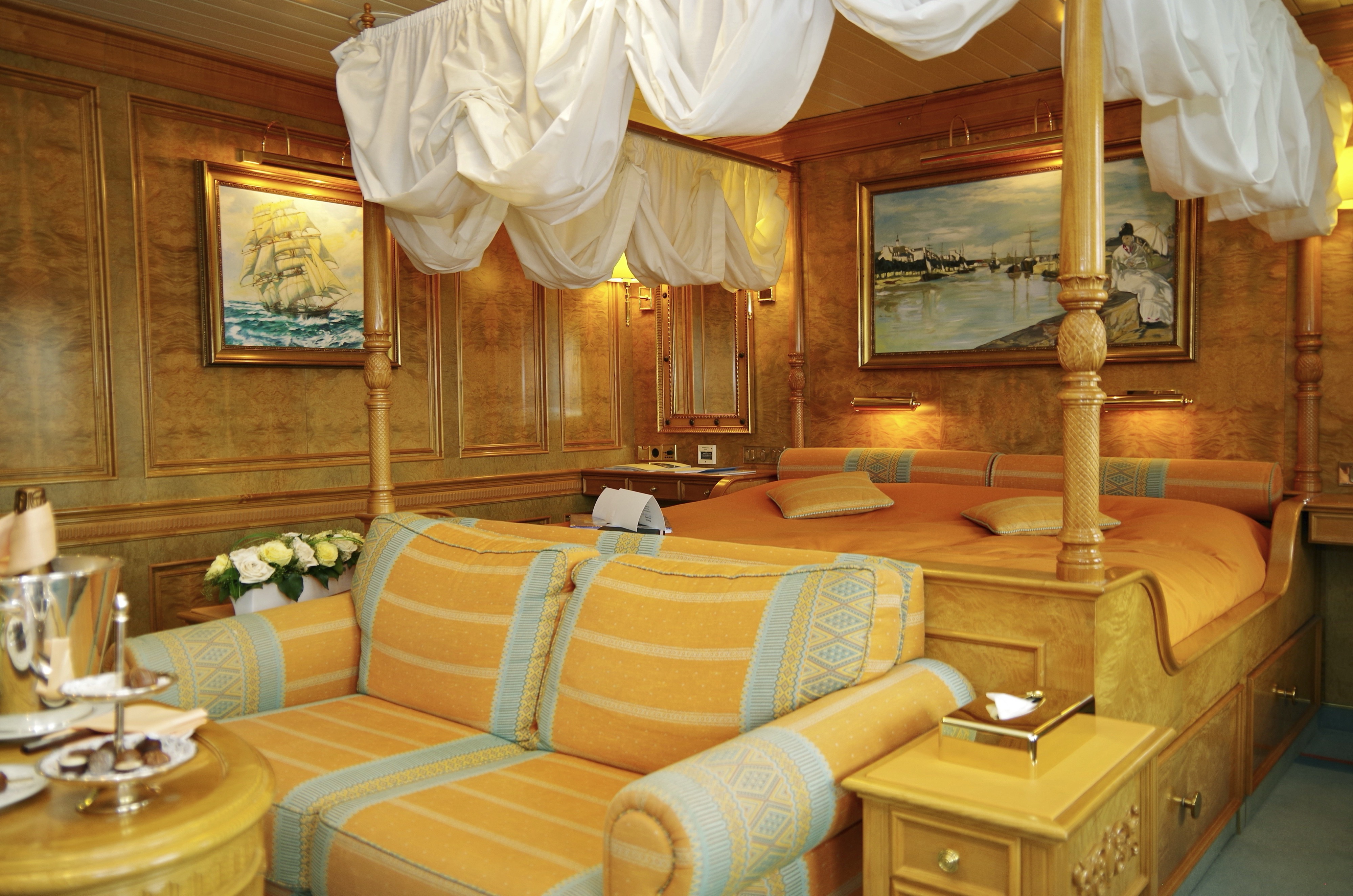
The two Owners’ Suites on SEA CLOUD II follow in the maritime spirit of always keeping exclusive quarters white-glove ready for the ship’s owners. Today, these luxury spaces are reserved for guests who appreciate the elevated side of sailing with the comforts of a private yacht. Both light-filled suites are located on the lido deck and feature panoramic windows for a unique view of the sea, even from the four-poster bed. The opulence includes a fireplace, elegant cabinetry, high-end furnishings, and a spacious marble bath outfitted in our legendary golden fixtures.
- approx. 290 sq. ft. / 27 m²
- marble bathroom approx. 45 sq. ft. / 4,2 m² with separate shower and bathtub
- canopy bed, 75 in. x 83 in. / 190 cm x 210 cm (2 mattresses)
- four closet spaces
- sofa with table
- fireplace (electric)
- minibar
- TV with DVD
- panoramic windows
- safe
Junior Suites (Cat. B)
With rosewood furnishings, ornate wall finishings and a detailed marble fireplace, the junior suites are the epitome of luxury. Panoramic windows welcome in the sea, creating a bright, airy ambiance filled with casual elegance and upscale comfort. A separate sitting area makes the fireplace cosier. A majestic marble bath with golden fixtures is classic in this top tier. The Junior Suites are located on the promenade deck, with the restaurant, boutique, and reception close by.
- approx. 231 sq. ft. / 21,5 m²
- marble bathroom approx. 34 sq. ft. / 3,2 m² with shower and bathtub
- head-canopy bed, 71 in. x 79 in. / 180 cm x 200 cm (split king can be separated into 2 twins)
- walk-in closet
- sofa with table
- fireplace (electric)
- minibar
- TV with DVD
- panoramic windows
- safe
Grand Stateroom (Cat. C)
The two grand staterooms envelope guests in sophistication. While the design and decor are decidedly stately and classically maritime, they still offer ultimate comfort. Panoramic windows welcome expansive sea views. Their location in the front of the promenade deck follows the elegant line of the SEA CLOUD II, enhancing the exhilarating feeling of sailing on a private yacht.
- approx. 194 sq. ft. / 18 m²
- marble bathroom approx. 32 sq. ft. / 3 m² with shower, and golden fixtures
- double bed, 67 in. x 79 in. / 170 cm x 200 cm (2 mattresses)
- closet
- chair with table
- dressing table
- minibar
- TV with DVD
- panoramic windows
- safe
Deluxe Staterooms (Cat. D)
The three large porthole windows give these SEA CLOUD II deluxe staterooms a special maritime flair. With a luxurious yacht ambience, these upscale spaces magnify the feeling of being part of an extraordinary journey on an extraordinary ship. The spacious room exudes elevated coziness with sophisticated furnishing and finishings, a glamorous palette and a beautiful sitting area. The six deluxe staterooms are located mid-ship on the same deck as the massage and cosmetic treatments, fitness room, swim platform and hospital.
- approx. 226 sq. ft. / 21 m²
- marble bathroom approx. 32 sq. ft. / 3 m² with shower and golden fixtures
- double bed, 67 in. x 79 in. / 170 cm x 200 cm (2 mattresses)
- closet
- seating with table
- dressing table
- minibar
- •TV with DVD
- •three portholes
- •safe
Deluxe Staterooms (Cat. E)
These outside deluxe staterooms with large porthole window are the epitome of nautical luxury on SEA CLOUD II. Located on both sides of the cabin deck, these are exclusive retreats of serenity that have made our sailing yachts famous. Sophisticated style comes in the form of rich wood finishings, Italian marble and golden fixtures.
- approx. 204 sq. ft. / 19 m²
- marble bathroom approx. 32 sq. ft. / 3 m² with shower and golden fixtures
- California king bed, 71 in. x 79 in. / 180 cm x 200 cm (split king can be separated into 2 twins)
- closet
- seating with table
- dressing table
- minibar
- TV with DVD
- two portholes
- safe
Staterooms (CAT. F)
These three outside staterooms with porthole windows spotlight a design inspired by officers’ cabins on traditional windjammers. Warm, lustrous woods and a comfortable sitting area exude a classically elegant maritime atmosphere and provide an elevated sanctuary at sea. They’re located on the same deck as massage and cosmetic treatments, the fitness room, swim platform and hospital.
- approx. 150 sq. ft. / 14 m²
- marble bathroom approx. 32 sq. ft. / 3 m² with shower and golden fixtures
- upper and lower beds, 32 in. x 75 in. / 80 cm x 190 cm
- closet
- chair with table
- dressing table
- minibar
- TV with DVD
- porthole
- safe
Guaranteed Double Cabins
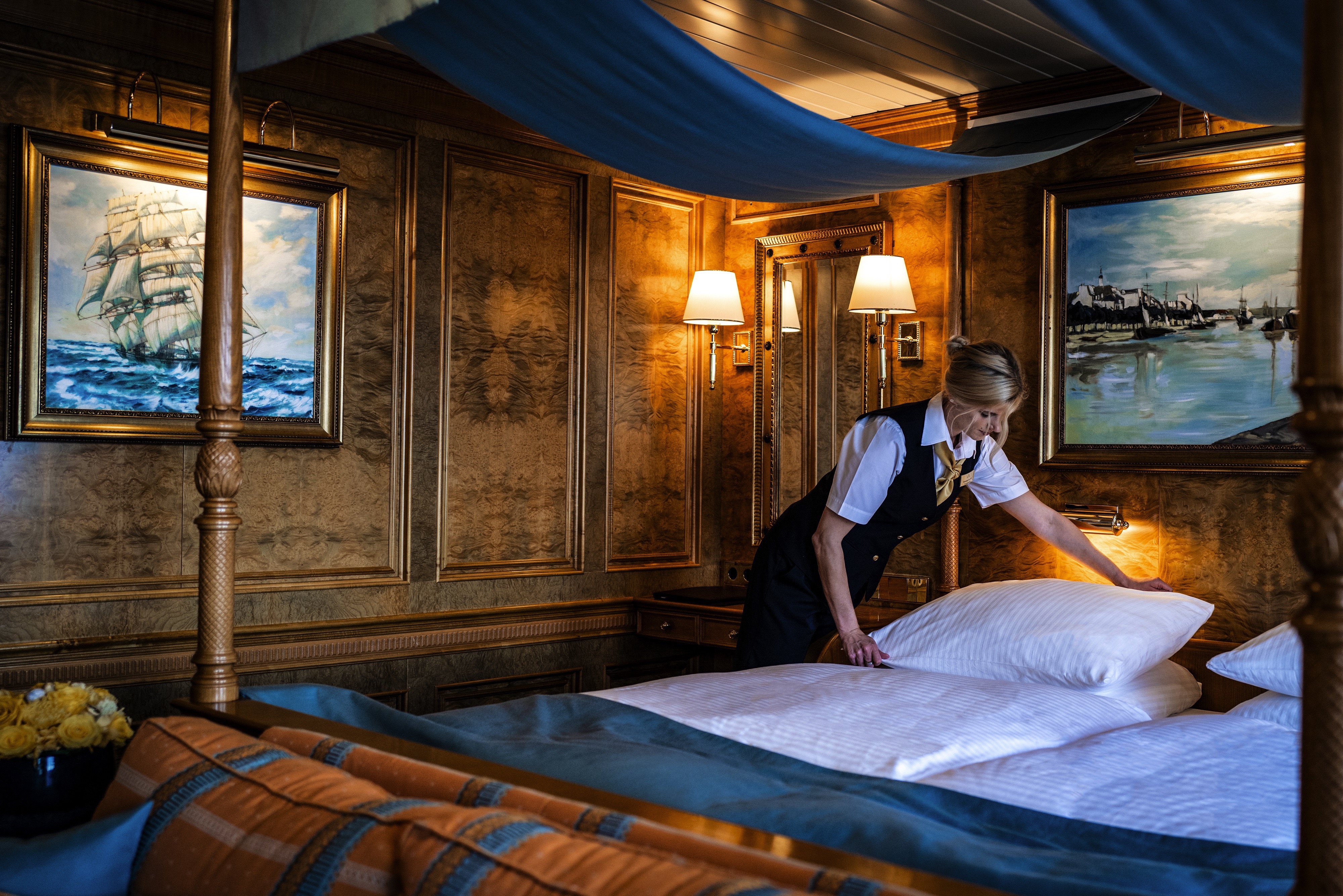
Guaranteed double cabins (on request only)
Our guaranteed cabins allow you to book our voyages at a lower rate. A specific cabin number or category cannot be selected. You will receive your exact cabin number when arriving on board. On the SEA CLOUD, the range of accommodation starts from Cat. F. The allotment for this category is very limited.
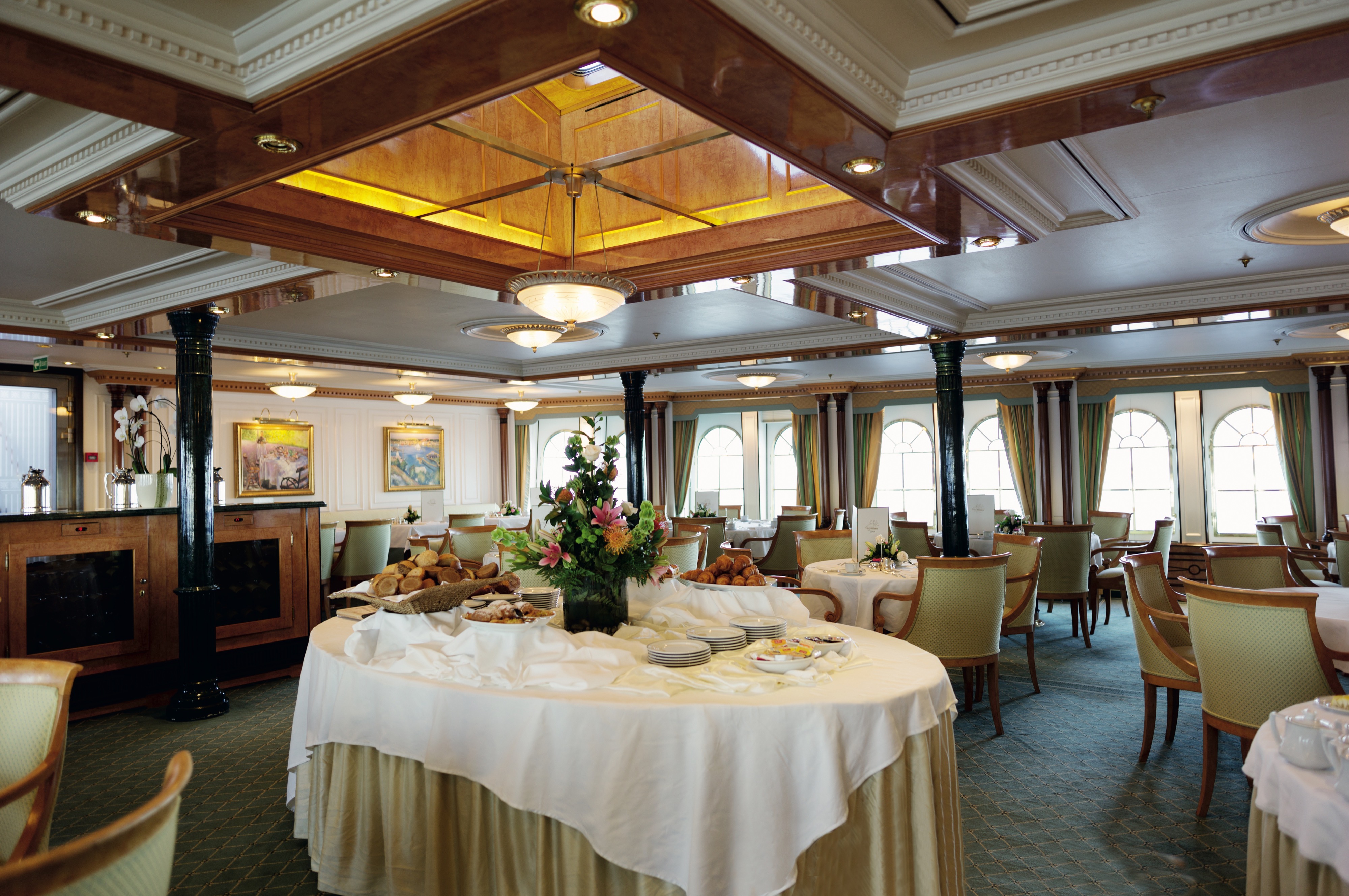
Restaurant
Meals are served on our ships in one seating. Service times can be found in the daily program on board. Please kindly note that reservations are not possible.
Our top-quality wines from well-known vineyards are often locally sourced. Our sommelier carefully selects each wine for every season and sailing destination. Wines are paired with lunch and dinner menus. In addition, you are always free to select your favourite wine from the menu.
A small breakfast with pastries and fruits is offered to early and late risers onboard the SEA CLOUDs. On board the SEA CLOUD II, a small breakfast is available at the Lido Bar. The main breakfast buffet is provided in the restaurant. Lunch is served as a buffet on the lido deck or in the restaurant. In the afternoon, coffee and tea are served, accompanied by some sweet treats and sandwiches. Dinner is a four-course menu with entrees to choose including a vegetarian option. Our executive chef will prepare an exclusive five-course meal for the gala dinner. A late-night snack nicely rounds up the evening’s culinary delights.
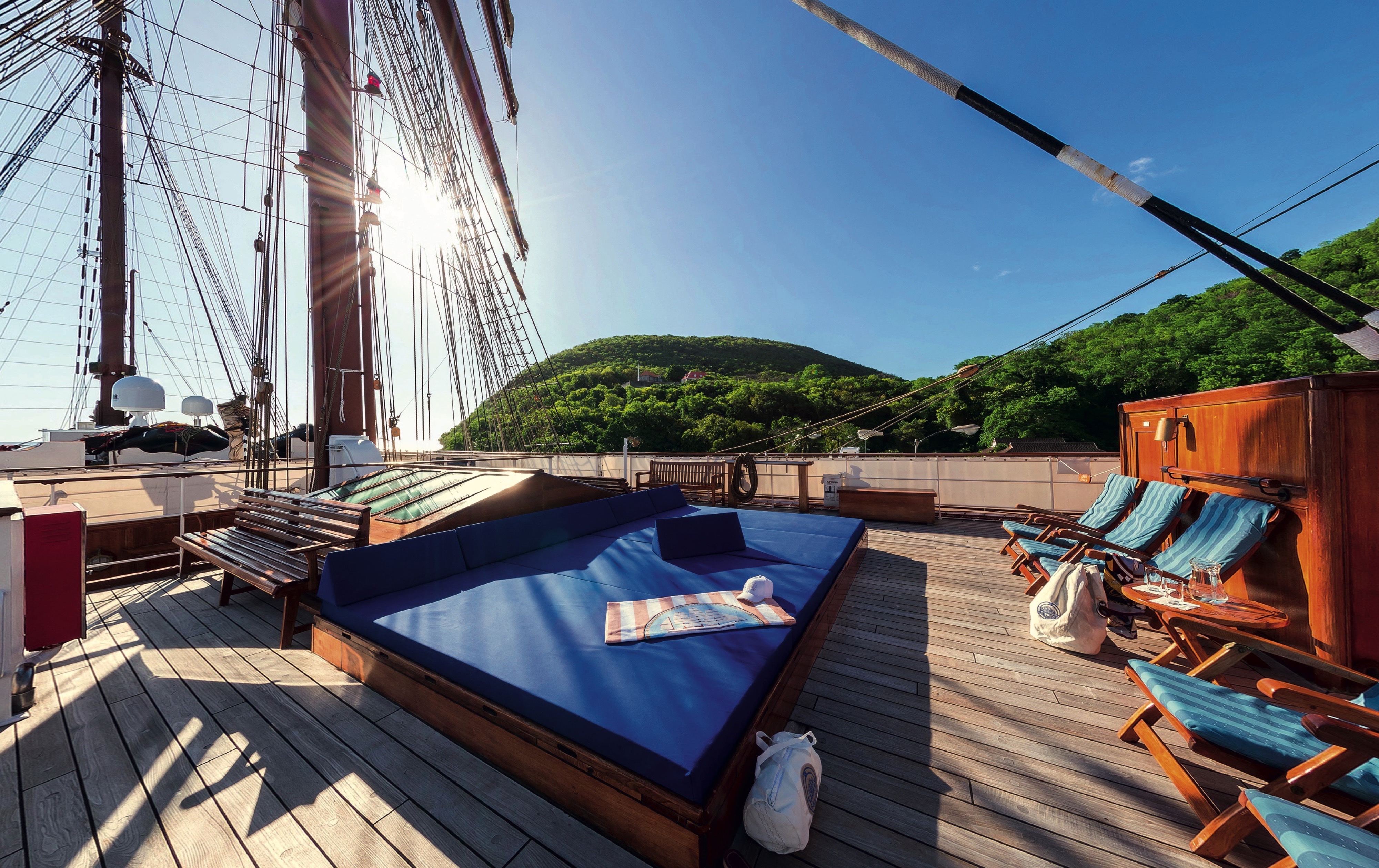
Lido Deck & Bar
You will find a dining area and Lido Bar on the Lido Deck. The Lido and Lounge Bar are open daily from 11:00 am. All drinks, alcoholic and non-alcoholic are included, premium drink are at an additional charge.
A small breakfast with pastries and fruits is offered to early and late risers onboard the SEA CLOUDs. On board the SEA CLOUD II, a small breakfast is available at the Lido Bar. Lunch is served as a buffet on the Lido Deck.
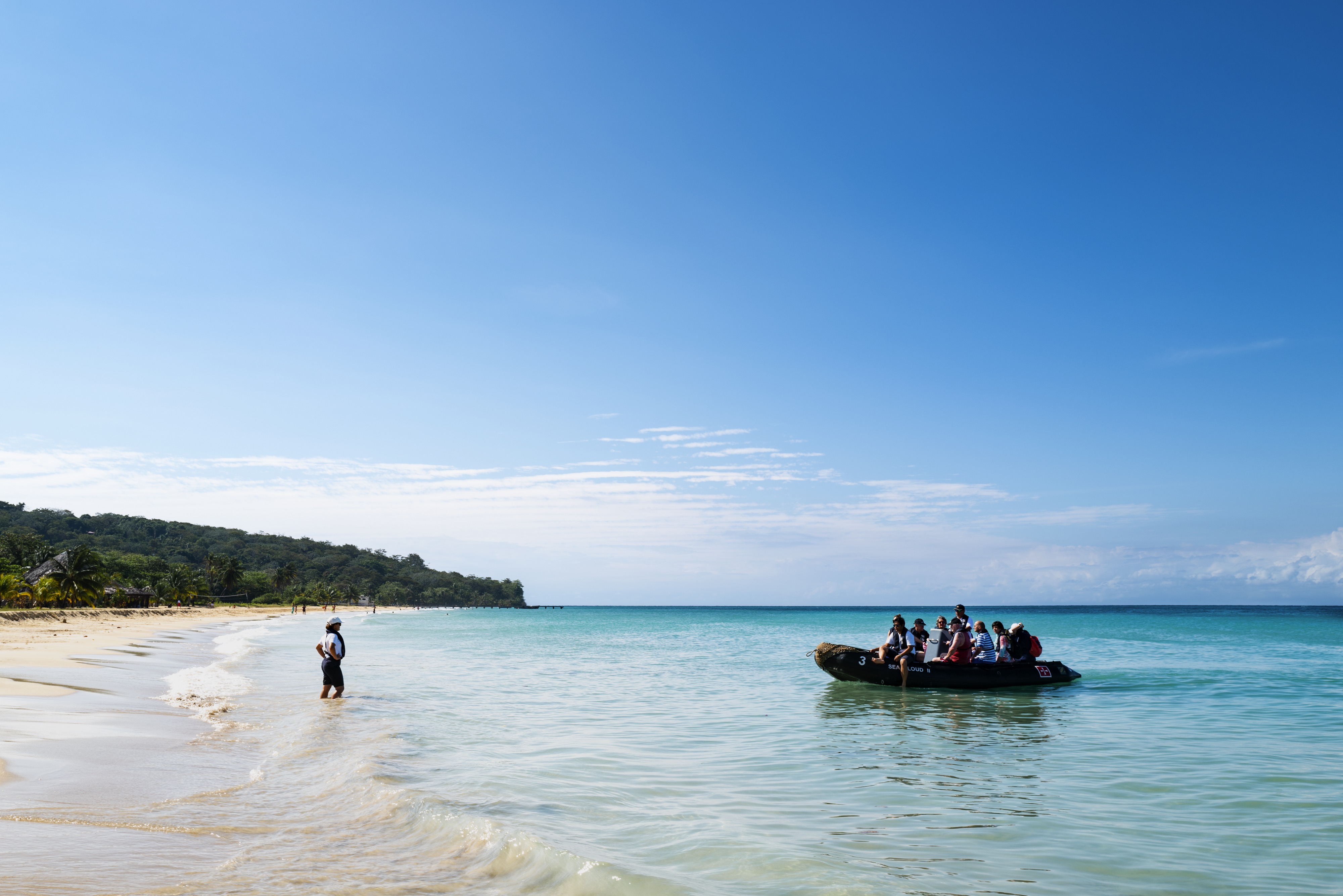
Zodiacs
Zodiacs are small motor-driven rigid-hull inflatable boats with a capacity of approximately 8 to 10 guests, primarily used for beach landings on our cruises or our photo safaris.
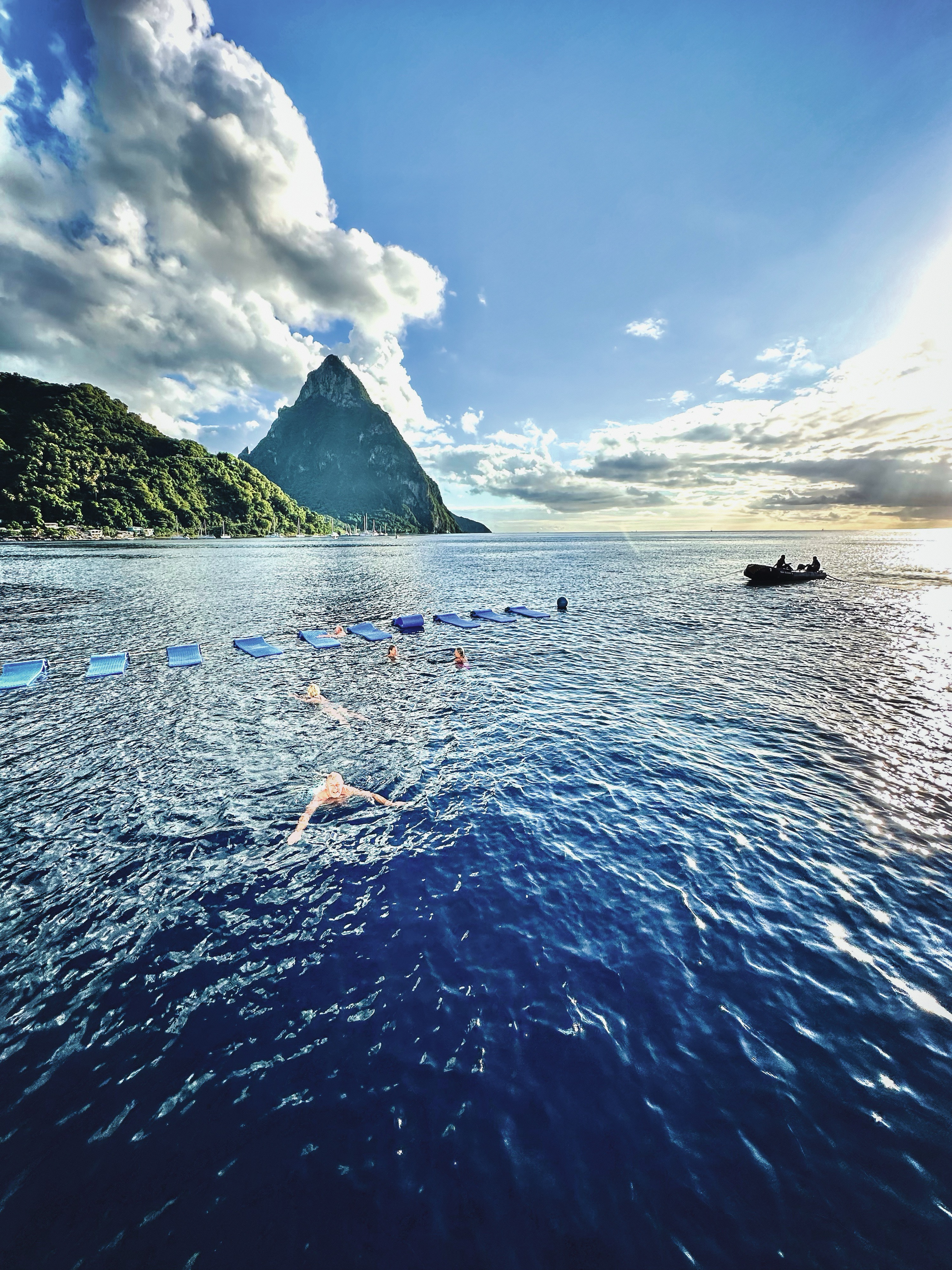
Watersports
Water sport activities are offered from the gangway on the marina platform.
We do have snorkelling equipment in different sizes on board, stand-up paddle bards for beach landings and a towable tube from the gangway.
All water sport activities are included and subject to weather and Captains permission.
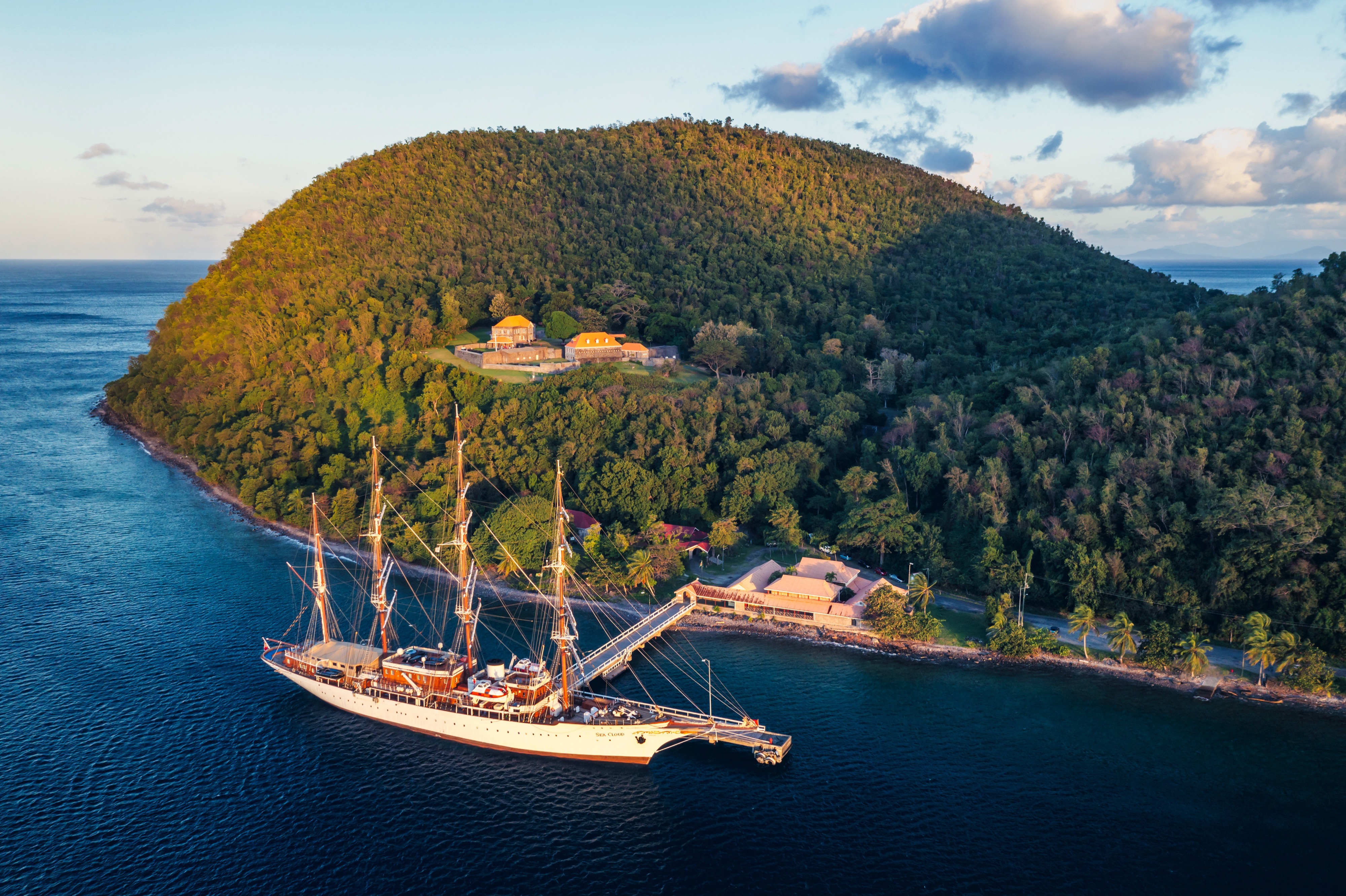
Excursions
All our shore excursions are shown on the itinerary pages of our brochure. 4 weeks prior to departure you will receive detailed information on shore excursions with your travel documents. The shore excursion booklet also includes the order form to pre-book your excursions. On board the Cruise Director will be able to provide further details during a lecture. We do recommend pre-booking prior to embarkation to secure your spot. All excursions will be charged to your cabin account on board.
You are free to join an organised shore excursion, stay on board or make individual arrangements. You will find times for tender or to be back on board in your daily program and at the gangway.
Please remember to bring comfortable footwear, a light jacket/windbreaker, as well as sunscreen where appropriate.
Rigg Climbing
Join us for some rigg climbing
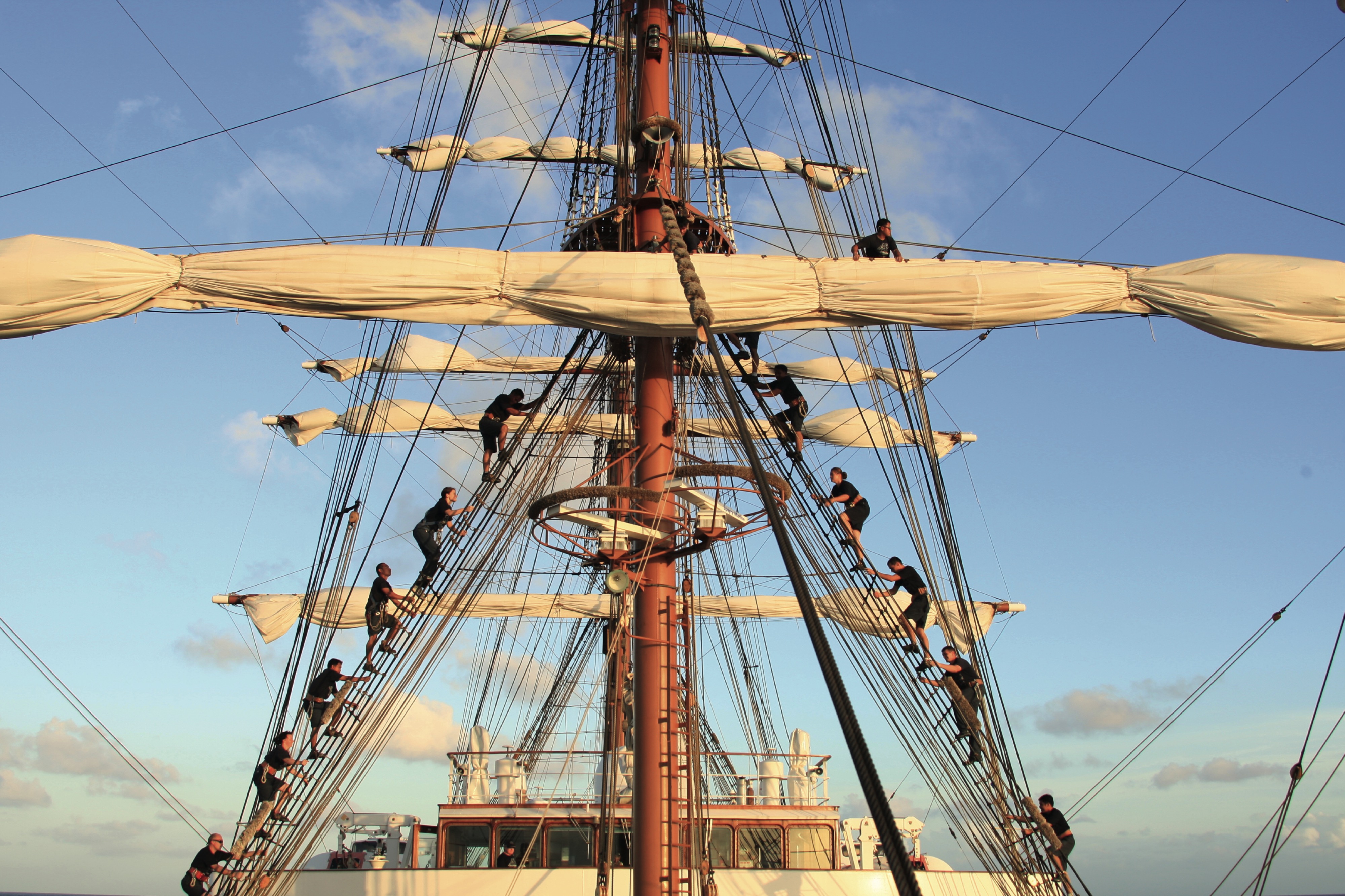
One of the most captivating experiences onboard the SEA CLOUD windjammer is watching the crew climb into the rigging to set the sails by hand. Now, you can share a piece of this adventure yourself and – if your fitness allows – climb up to the first platform!
Our SEA CLOUDs are the only cruise ships in the world that are traditionally sailed by hand. Here, nothing happens at the push of a button: setting the sails follows centuries-old rituals, bringing the magic of sailing to life in a unique way. Now, you can experience this tradition up close! High up in the rigging, carried by the wind and with sweeping views over the sea, you’ll feel the majestic power of our tall ships even more intensely. Safely guided and equipped with state-of-the-art safety systems, you can climb up to the first platform, about 14 meters above the deck – an unforgettable moment for those seeking adventure!
A brief fitness check on board ensures that you feel completely comfortable and secure before you ascend. This includes: hanging from a bar for 10 seconds, balancing on one foot for 20 seconds and climbing stairs two at a time. Our experienced deckhands, specially trained for these activities, will guide you every step of the way so you always feel safe and well taken care of.
Embark on this unique adventure now – a once-in-a-lifetime moment that will leave you with a deep sense of joy and a touch of pride. Are you ready to experience the sea in all its splendour, high above the sails?
Lounge
The lounge is located on the Lido Deck (SEA CLOUD II & SEA CLOUD SPIRIT) and is always open. This is where all lectures take place and on select sailings concerts on the Steinway grand piano (SEA CLOUD II and SEA CLOUD SPIRIT). Enjoy a selection of games or just an afternoon snack.
The Lounge Bar is open daily from 11:00 am. All drinks, alcoholic and non-alcoholic are included, premium drink are at an additional charge.
Library
Our beautiful library offers a variety of English books, popular board games and DVDs (SEA CLOUD II only). You are welcome to take the books to your cabin during your sailing and return before the end of your cruise.
Bridge
The bridge area can be visited during the day and/or at specified times, subject to captain’s approval. The bridge is closed during manoeuvring operations and night sailing.

Boutique
The boutique on our yachts offers accessories, clothes, and gifts. Opening hours vary. You will find the exact information in the daily program and on the public boards. Feel free to contact the reception with any questions or requests outside of opening hours.
Fitness and Sport
SEA CLOUD II has a fitness area on the cabin deck. The gym is open during the day and is equipped with a step machine, a bike, a treadmill, and a rowing machine.
Massage & Cosmetics
On SEA CLOUD II we offer massages and beauty treatments at an additional fee We do have a sauna on the cabin deck, which is heated upon request. Please contact the reception.
Special Dietary Requirements
Please inform us prior to your cruise if you have any allergies, intolerances, or other special dietary restrictions. We will try to accommodate your needs as far as possible.
Dress Code
During the day, we recommend casual chic, yachting clothes. The evenings are casual elegant. Please refrain from wearing swimwear during lunch and/or shorts at dinner. For the Captain’s Dinner (once or twice depending on lengths of the cruise), we recommend elegant cocktail attire, a suit or ensemble for the gentleman and matching dress for the lady. We additionally suggest bringing non-slippery boat shoes.
Disabled Access
Our windjammers, SEA CLOUD, SEA CLOUD II and SEA CLOUD SPIRIT, are not barrier-free and, therefore, unsuitable for wheelchair users. Please contact our reservations directly for details.
There are no elevators on the SEA CLOUD and SEA CLOUD II, only staircases. SEA CLOUD SPIRIT is equipped with an elevator. You will access and depart the ship via the onboard gangway, which is not always level. Depending on weather conditions, access might be steep. The tenders or zodiacs service is done via the gangway. Please contact us prior to cruise if you have any questions regarding accessibility. If you need specific medical arrangements, please contact us in advance.
Smoking Policy
Smoking is permitted only on the lido deck outside of mealtimes. We kindly request that smokers take the other passengers into consideration. Smoking is always prohibited in covered areas on the lido deck, of the spanker deck (SEA CLOUD), on the blue lagoon (SEA CLOUD II), on the sun deck and on the verandah (SEA CLOUD SPIRIT).
Internet Access
Each of our yachts is equipped with Starlink satellite internet. All three ships offer WI-FI access in the public areas and in the staterooms. You can use your own laptop to access the Internet with an access code (WI-FI). Data volume of 10 GB is free of charge; additional data volume can be obtained from the reception desk at a charge. Continuous reception cannot be guaranteed; in certain sailing areas or due to the set course, interruptions to network coverage might be experienced. The WI-FI connection on a ship is not comparable to the usual reception on land.
On board, a laptop that is located in the lounge (SEA CLOUD) or in the library (SEA CLOUD II & SEA CLOUD SPIRIT) can be used for e-mail use on board. The SEA CLOUDs have their own on-board email addresses as follows:
SEA CLOUD: seacloud@seacloud.com
SEA CLOUD II: seacloud2@seacloud.com
SEA CLOUD SPIRIT: passenger@scs.seacloud.com
Please advise anyone you give the above email address to not send messages with attachments. Please put your name and cabin number in the subject line to ensure that the reception can forward any correspondence to you. They will hand you a printout of the e-mail.
Incoming and outgoing e-mails up to 50 KB in size can be received or send free of charge. However, files larger than 50 KB per message are automatically rejected by the system.
Due to limited network availabilities at sea, cell phones use is limited. The SEA CLOUDs are equipped with Starlink that ensures WIFI connection. Phone numbers to reach the ship can be found in your travel documents and on board.
Laundry Services
Laundry services on board are limited to washing and ironing. There is no dry cleaning available. You will find a price list for the overnight laundry and ironing service in your closet. For guests who have booked a suite in category A-C (SEA CLOUD) or category A+B (SEA CLOUD II & SEA CLOUD SPIRIT) the laundry service complimentary. For safety reasons, passengers are not permitted to iron in their cabins.
Children on Board
Children are welcome on our ships, but please keep in mind there is no daycare or special entertainment for children on board our ships.
Medical Facilities
All three ships have a clinic and a ship’s doctor. Medical consultation hours can be found in the daily program. In case of an emergency, the doctor can be reached at any time by calling 911.
What's Included
Complimentary with your sailing:
- Welcome champagne in suite/stateroom
- Daily fresh fruit basket in suite/stateroom
- All meals including nightly 4-course menu and a 5-course gala dinner
- Fine wines from renowned winemakers and beer for lunch and dinner
- All non-alcoholic coffee and tea specialties
- All soft drinks
- Welcome and farewell cocktail
- Bottled water on excursions
- Gratuities and port fees
- Curated moments
- Beach barbecues in select destinations
- Marina platform with use of water sports equipment such as snorkel gear, stand-up paddleboards, and towable tube (weather permitting)
- Laundry service in suites
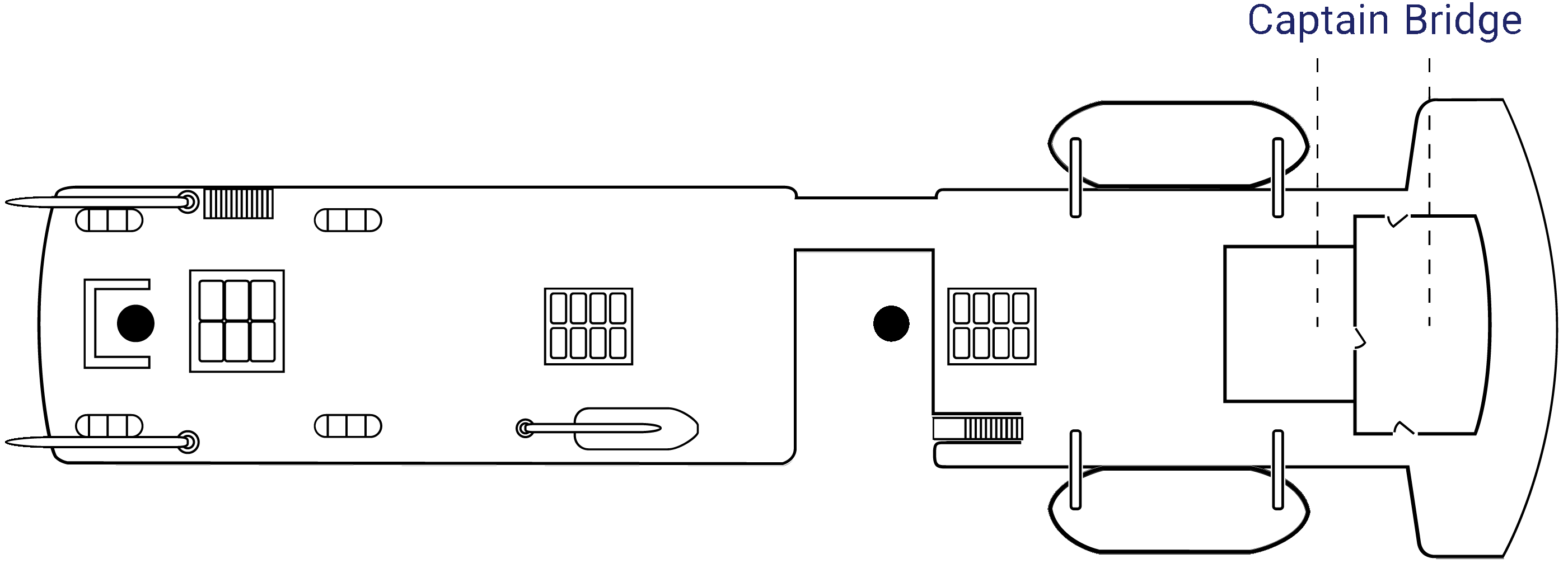
Sun Deck
- Captain
- Bridge
Lido Deck
- Lounge
- Lido Bar
- Lido Deck
- Library
- Cat. A Owner’s Suites
Promenade Deck
- Restaurant
- Boutique
- Purser
- Reception
- Junior Suites
- Grand Staterooms
Cabin Deck
- Fitness Area
- Massage and Cosmetics
- Hospital
- Swim Platform
- Deluxe Stateroom
- Stateroom (Upper/Lower-bed Cabins)