
Itinerary
Glamorous and gritty, Buenos Aires is two cities in one. What makes Argentina’s capital so fascinating is its dual heritage—part European, part Latin American. Plaza de Mayo resembles a grand square in Madrid, and the ornate Teatro Colón would not be out of place in Vienna. But you’ll know you’re in South America by the leather shoes for sale on cobbled streets and impromptu parades of triumphant soccer fans. Limited-production wines, juicy steaks, and ice cream in countless flavors are among the old-world imports the city has perfected.
Day programme:
Upon arriving in this cosmopolitan city, known for its architecture and rich European heritage, you will independently transfer to your group hotel, which is in your Charter Flight and Hotel Package.
Approaching from Ruta 3, it’s hard to believe that the horizon line of buildings perched just beyond the windswept dunes and badlands is the most successful of all coastal Patagonia settlements. But once you get past the outskirts of town and onto the wide coastal road known as the Rambla, the picture begins to change. Ranged along the clear and tranquil Golfo Nuevo are restaurants, cafés, dive shops, and hotels, all busy—but not yet overcrowded—with tourists from around the world.Puerto Madryn is more a base for visiting nearby wildlife-watching sites like Península Valdés and Punta Tombo than a destination in its own right. The town’s architecture is unremarkable, and beyond a walk along the coast there isn’t much to do. Indeed, even the few museums serve mainly to introduce you to the fauna you’ll see elsewhere. The exception is the beginning of whale season (May through July), when the huge animals cavort right in the bay before heading north—you can even walk out alongside them on the pier. During these months it’s worth the extra expense for a room with a sea view.The many tour agencies and rental-car companies here make excursion planning easy. Aim to spend most of your time here on one- or two-day trips exploring the surroundings. Note that competition is fierce between tourism operators in destinations such as Puerto Madryn and Puerto Pirámides on Península Valdés. Take information that tour operators and even the tourism office give you about these with a grain of salt: they often exaggerate Madryn’s virtues and other areas’ flaws.
Day programme:
Following breakfast at our hotel, we will transfer to the airport for our charter flight to Puerto Madryn, in the Patagonian province of Chubut on Argentina’s stunning Atlantic coast. Upon arrival in Puerto Madryn, your checked bags will be transferred directly to your cabin on Ultramarine, leaving you free to explore this lively Patagonian port town. As you stroll the shoreline, you may spot sea lions basking on the beach or catch sight of southern right whales offshore. Visit the local cafés and artisan markets for a taste of the region’s Welsh-Argentine heritage. In the afternoon, we’ll gather for the group transfer to the port to board Ultramarine. After check-in, you’ll be shown to your comfortable cabin— your home for the next 18 nights. Once you’ve settled in, your warm and friendly Expedition Team will introduce themselves and the ship, sharing important details about the voyage ahead. Expect an air of excitement as we set off toward the wildlife-rich subAntarctic islands of the Falkland Islands and South Georgia.
Day programme:
With extended time in the Falklands, we’ll seek opportunities to visit seldom explored sites renowned for birdlife and beauty. Our destinations will depend entirely on weather and marine forecasts, as the outer Falklands are exposed to oceanic swells. We’ll choose locations that offer the best—and safest—conditions for exploration. One such site is the small, slender Steeple Jason, one of the most northwesterly islands in the Falklands. Difficult to access, it has been featured in numerous wildlife documentaries for its prolific black-browed albatross colony—the largest in the world, with an estimated 100,000 to 180,000 breeding pairs. It’s truly a sight to behold. Their closely packed nests stretch for hundreds of meters along the shoreline, just beyond dense tussock grasses. Looking west to sea, you’ll likely see albatross riding the wind. The walk to the colony crosses uneven terrain and impressive tussock grass, which provides critical habitat for many other bird species. These vivid green grasses, rooted in rocky soil, create a striking contrast with the sharp ridgeline in the background. Largely untouched by humans, Steeple Jason is home to a small shepherd’s outpost and a research field station— overshadowed by vast wilderness. Steeple Jason offers a rare chance to feel truly remote amid a vast ecosystem alive with countless animals. Our explorations may also take us to New Island, just over thirty nautical miles south of Steeple Jason. A paradise for birders, this small island boasts coves with white sandy beaches sheltered from the open ocean, and is considered one of the most beautiful in the Falklands. Around 25,000 to 30,000 black-browed albatross nest here, joined by Magellanic, gentoo, and southern rockhopper penguins—each with its own distinct nesting style. Other common sightings include songbirds and the formidable striated caracara. Dolphins, including those in shallow waters, are frequently seen in the area, adding to the island’s remarkable wildlife encounters. Other wilderness destinations may include bird-rich West Point and Saunders Islands in the western Falklands. Saunders Island will amaze you with its long white-sand beaches, the northern shore stretching for kilometers and facing the open sea. It’s almost surreal—particularly if you’ve encountered penguins in ice-and snowladen Antarctica on previous voyages— to watch gentoo, Magellanic, and southern rockhopper penguins making their way to the water along sandy stretches. There’s also a smaller colony of black-browed albatross nests on a nearby cliff, sharing the gently sloped, grassy island with grazing sheep tended by the warm-hearted Saunders family. Look for Commerson’s dolphins, often spotted in the shallow waters near Saunders’ sandy beaches. West Point Island is another Falkland gem, with vibrant green vegetation and blooming spring flowers. From the rocky beach, a gentle walk (with slight elevation) leads through a picturesque meadow to a cliff where black-browed albatross nest. West Point Island is home to 2,000 breeding pairs. We’ll visit a small section of the colony for intimate views of albatross in their nests and soaring above the waters. The walk passes through grassy fields dotted with wildflowers, blending the domestic with the wild. Energetic hikers may tackle Mt. Ararat for sweeping views, while others can travel by 4X4 to the colony and overlooks. Peale’s dolphins, Falkland steamer ducks, and striated caracara are often seen here. Carcass is another excellent destination. Like Saunders and New islands, Carcass boasts stunning white-sand beaches meeting the cold, blue waters of the South Atlantic. Magellanic and gentoo penguins nest here, and the tussock grasses are especially impressive. Look overhead for peregrine falcons soaring high above. No visit to the Falklands is complete without a stop in its largest community— Stanley. Highlights include the museum (admission covered) and the striking arch monument built from the jaws of blue whales. Pop into a local restaurant or traditional British pub for Falkland f ish and chips, or a pint while chatting with locals about life on this windswept sub-Antarctic island. Stanley has a distinct boundary—where residential streets end and open wilderness and sheep meadows begin to stretch into the horizon. We’ll set sail in early afternoon, allowing plenty of time to cover the 700+ nautical miles to our next destination: South Georgia.
Day programme:
With extended time in the Falklands, we’ll seek opportunities to visit seldom explored sites renowned for birdlife and beauty. Our destinations will depend entirely on weather and marine forecasts, as the outer Falklands are exposed to oceanic swells. We’ll choose locations that offer the best—and safest—conditions for exploration. One such site is the small, slender Steeple Jason, one of the most northwesterly islands in the Falklands. Difficult to access, it has been featured in numerous wildlife documentaries for its prolific black-browed albatross colony—the largest in the world, with an estimated 100,000 to 180,000 breeding pairs. It’s truly a sight to behold. Their closely packed nests stretch for hundreds of meters along the shoreline, just beyond dense tussock grasses. Looking west to sea, you’ll likely see albatross riding the wind. The walk to the colony crosses uneven terrain and impressive tussock grass, which provides critical habitat for many other bird species. These vivid green grasses, rooted in rocky soil, create a striking contrast with the sharp ridgeline in the background. Largely untouched by humans, Steeple Jason is home to a small shepherd’s outpost and a research field station— overshadowed by vast wilderness. Steeple Jason offers a rare chance to feel truly remote amid a vast ecosystem alive with countless animals. Our explorations may also take us to New Island, just over thirty nautical miles south of Steeple Jason. A paradise for birders, this small island boasts coves with white sandy beaches sheltered from the open ocean, and is considered one of the most beautiful in the Falklands. Around 25,000 to 30,000 black-browed albatross nest here, joined by Magellanic, gentoo, and southern rockhopper penguins—each with its own distinct nesting style. Other common sightings include songbirds and the formidable striated caracara. Dolphins, including those in shallow waters, are frequently seen in the area, adding to the island’s remarkable wildlife encounters. Other wilderness destinations may include bird-rich West Point and Saunders Islands in the western Falklands. Saunders Island will amaze you with its long white-sand beaches, the northern shore stretching for kilometers and facing the open sea. It’s almost surreal—particularly if you’ve encountered penguins in ice-and snowladen Antarctica on previous voyages— to watch gentoo, Magellanic, and southern rockhopper penguins making their way to the water along sandy stretches. There’s also a smaller colony of black-browed albatross nests on a nearby cliff, sharing the gently sloped, grassy island with grazing sheep tended by the warm-hearted Saunders family. Look for Commerson’s dolphins, often spotted in the shallow waters near Saunders’ sandy beaches. West Point Island is another Falkland gem, with vibrant green vegetation and blooming spring flowers. From the rocky beach, a gentle walk (with slight elevation) leads through a picturesque meadow to a cliff where black-browed albatross nest. West Point Island is home to 2,000 breeding pairs. We’ll visit a small section of the colony for intimate views of albatross in their nests and soaring above the waters. The walk passes through grassy fields dotted with wildflowers, blending the domestic with the wild. Energetic hikers may tackle Mt. Ararat for sweeping views, while others can travel by 4X4 to the colony and overlooks. Peale’s dolphins, Falkland steamer ducks, and striated caracara are often seen here. Carcass is another excellent destination. Like Saunders and New islands, Carcass boasts stunning white-sand beaches meeting the cold, blue waters of the South Atlantic. Magellanic and gentoo penguins nest here, and the tussock grasses are especially impressive. Look overhead for peregrine falcons soaring high above. No visit to the Falklands is complete without a stop in its largest community— Stanley. Highlights include the museum (admission covered) and the striking arch monument built from the jaws of blue whales. Pop into a local restaurant or traditional British pub for Falkland f ish and chips, or a pint while chatting with locals about life on this windswept sub-Antarctic island. Stanley has a distinct boundary—where residential streets end and open wilderness and sheep meadows begin to stretch into the horizon. We’ll set sail in early afternoon, allowing plenty of time to cover the 700+ nautical miles to our next destination: South Georgia.
Day programme:
With extended time in the Falklands, we’ll seek opportunities to visit seldom explored sites renowned for birdlife and beauty. Our destinations will depend entirely on weather and marine forecasts, as the outer Falklands are exposed to oceanic swells. We’ll choose locations that offer the best—and safest—conditions for exploration. One such site is the small, slender Steeple Jason, one of the most northwesterly islands in the Falklands. Difficult to access, it has been featured in numerous wildlife documentaries for its prolific black-browed albatross colony—the largest in the world, with an estimated 100,000 to 180,000 breeding pairs. It’s truly a sight to behold. Their closely packed nests stretch for hundreds of meters along the shoreline, just beyond dense tussock grasses. Looking west to sea, you’ll likely see albatross riding the wind. The walk to the colony crosses uneven terrain and impressive tussock grass, which provides critical habitat for many other bird species. These vivid green grasses, rooted in rocky soil, create a striking contrast with the sharp ridgeline in the background. Largely untouched by humans, Steeple Jason is home to a small shepherd’s outpost and a research field station— overshadowed by vast wilderness. Steeple Jason offers a rare chance to feel truly remote amid a vast ecosystem alive with countless animals. Our explorations may also take us to New Island, just over thirty nautical miles south of Steeple Jason. A paradise for birders, this small island boasts coves with white sandy beaches sheltered from the open ocean, and is considered one of the most beautiful in the Falklands. Around 25,000 to 30,000 black-browed albatross nest here, joined by Magellanic, gentoo, and southern rockhopper penguins—each with its own distinct nesting style. Other common sightings include songbirds and the formidable striated caracara. Dolphins, including those in shallow waters, are frequently seen in the area, adding to the island’s remarkable wildlife encounters. Other wilderness destinations may include bird-rich West Point and Saunders Islands in the western Falklands. Saunders Island will amaze you with its long white-sand beaches, the northern shore stretching for kilometers and facing the open sea. It’s almost surreal—particularly if you’ve encountered penguins in ice-and snowladen Antarctica on previous voyages— to watch gentoo, Magellanic, and southern rockhopper penguins making their way to the water along sandy stretches. There’s also a smaller colony of black-browed albatross nests on a nearby cliff, sharing the gently sloped, grassy island with grazing sheep tended by the warm-hearted Saunders family. Look for Commerson’s dolphins, often spotted in the shallow waters near Saunders’ sandy beaches. West Point Island is another Falkland gem, with vibrant green vegetation and blooming spring flowers. From the rocky beach, a gentle walk (with slight elevation) leads through a picturesque meadow to a cliff where black-browed albatross nest. West Point Island is home to 2,000 breeding pairs. We’ll visit a small section of the colony for intimate views of albatross in their nests and soaring above the waters. The walk passes through grassy fields dotted with wildflowers, blending the domestic with the wild. Energetic hikers may tackle Mt. Ararat for sweeping views, while others can travel by 4X4 to the colony and overlooks. Peale’s dolphins, Falkland steamer ducks, and striated caracara are often seen here. Carcass is another excellent destination. Like Saunders and New islands, Carcass boasts stunning white-sand beaches meeting the cold, blue waters of the South Atlantic. Magellanic and gentoo penguins nest here, and the tussock grasses are especially impressive. Look overhead for peregrine falcons soaring high above. No visit to the Falklands is complete without a stop in its largest community— Stanley. Highlights include the museum (admission covered) and the striking arch monument built from the jaws of blue whales. Pop into a local restaurant or traditional British pub for Falkland f ish and chips, or a pint while chatting with locals about life on this windswept sub-Antarctic island. Stanley has a distinct boundary—where residential streets end and open wilderness and sheep meadows begin to stretch into the horizon. We’ll set sail in early afternoon, allowing plenty of time to cover the 700+ nautical miles to our next destination: South Georgia.
Day programme:
After enjoying South Georgia from a distance, we’ll head toward its numerous beaches to find a bay for your first excursion. Landing sites are varied, largely determined by the weather conditions. The sites you visit will deliver wildlife encounters unrivaled anywhere else on Earth. Biodiverse South Georgia—often described as the Galapagos of the south seas—is one of the most fertile breeding grounds in the world for sub-Antarctic wildlife, with beaches blanketed with penguins and seals. It won’t take you long to realize that you are in a birder’s paradise, as burrowing seabirds, albatrosses, and petrels can be seen in abundance. You’ll find that South Georgia, once a popular base for whalers and sealers, is also scattered with abandoned relics and evidence of human activity from centuries gone by. Your Expedition Team will help bring those days to life when you visit old whaling stations and enjoy presentations on the South Georgia then and now. One of the most significant sites you will visit on South Georgia is Grytviken. This settlement is one of the first whaling stations established in sub-Antarctic waters. Grytviken has a special appeal largely because it’s the site of the grave of Sir Ernest Shackleton, one of the most famous Antarctic explorers. Guests and expedition team members uphold a cherished tradition at the Grytviken cemetery, raising a toast to one of the greatest polar heroes. Mid-October and early November are exceptional times to visit South Georgia, especially for wildlife enthusiasts. At this time of year, male elephant seals battle for control of beach sections, securing breeding rights for females entering their territories. These bouts are fought in bursts, with rest periods between clashes. As the largest pinniped species on the planet, watching these giants spar is a true spectacle. Mid-October and early November are exceptional times to visit South Georgia, especially for wildlife enthusiasts. At this time of year, male elephant seals battle for control of beach sections, securing breeding rights for females entering their territories. These bouts are fought in bursts, with rest periods between clashes. As the largest pinniped species on the planet, watching these giants spar is a true spectacle. With extra time in South Georgia, we’ll have greater flexibility to explore more sites. If conditions allow, we may visit King Haakon Bay and the very beach where Ernest Shackleton and his party aboard the James Caird landed after their perilous journey from Elephant Island. If not, we’ll spend more time along the island’s leeward coast, aiming to visit its massive king penguin coloniesThe largest of these colonies. St. Andrew’s, which—by conservative estimates—is home to more than 150,000 breeding pairs. We’ll also seek out macaroni penguin colonies—conditions permitting—as these birds favor rugged, exposed coastlines. Possible sites include Hercules Bay, Royal Bay, and Cooper Bay. Expect to encounter some of the island’s millions of petrels and prions. For those craving some active off-ship adventure, we plan to offer (weatherpermitting) an extended hike along the f inal stretch of the route taken by Ernest Shackleton, Frank Worsley, and Tom Crean to the Stromness whaling station in May 1916.
Day programme:
After enjoying South Georgia from a distance, we’ll head toward its numerous beaches to find a bay for your first excursion. Landing sites are varied, largely determined by the weather conditions. The sites you visit will deliver wildlife encounters unrivaled anywhere else on Earth. Biodiverse South Georgia—often described as the Galapagos of the south seas—is one of the most fertile breeding grounds in the world for sub-Antarctic wildlife, with beaches blanketed with penguins and seals. It won’t take you long to realize that you are in a birder’s paradise, as burrowing seabirds, albatrosses, and petrels can be seen in abundance. You’ll find that South Georgia, once a popular base for whalers and sealers, is also scattered with abandoned relics and evidence of human activity from centuries gone by. Your Expedition Team will help bring those days to life when you visit old whaling stations and enjoy presentations on the South Georgia then and now. One of the most significant sites you will visit on South Georgia is Grytviken. This settlement is one of the first whaling stations established in sub-Antarctic waters. Grytviken has a special appeal largely because it’s the site of the grave of Sir Ernest Shackleton, one of the most famous Antarctic explorers. Guests and expedition team members uphold a cherished tradition at the Grytviken cemetery, raising a toast to one of the greatest polar heroes. Mid-October and early November are exceptional times to visit South Georgia, especially for wildlife enthusiasts. At this time of year, male elephant seals battle for control of beach sections, securing breeding rights for females entering their territories. These bouts are fought in bursts, with rest periods between clashes. As the largest pinniped species on the planet, watching these giants spar is a true spectacle. Mid-October and early November are exceptional times to visit South Georgia, especially for wildlife enthusiasts. At this time of year, male elephant seals battle for control of beach sections, securing breeding rights for females entering their territories. These bouts are fought in bursts, with rest periods between clashes. As the largest pinniped species on the planet, watching these giants spar is a true spectacle. With extra time in South Georgia, we’ll have greater flexibility to explore more sites. If conditions allow, we may visit King Haakon Bay and the very beach where Ernest Shackleton and his party aboard the James Caird landed after their perilous journey from Elephant Island. If not, we’ll spend more time along the island’s leeward coast, aiming to visit its massive king penguin coloniesThe largest of these colonies. St. Andrew’s, which—by conservative estimates—is home to more than 150,000 breeding pairs. We’ll also seek out macaroni penguin colonies—conditions permitting—as these birds favor rugged, exposed coastlines. Possible sites include Hercules Bay, Royal Bay, and Cooper Bay. Expect to encounter some of the island’s millions of petrels and prions. For those craving some active off-ship adventure, we plan to offer (weatherpermitting) an extended hike along the f inal stretch of the route taken by Ernest Shackleton, Frank Worsley, and Tom Crean to the Stromness whaling station in May 1916.
Day programme:
After enjoying South Georgia from a distance, we’ll head toward its numerous beaches to find a bay for your first excursion. Landing sites are varied, largely determined by the weather conditions. The sites you visit will deliver wildlife encounters unrivaled anywhere else on Earth. Biodiverse South Georgia—often described as the Galapagos of the south seas—is one of the most fertile breeding grounds in the world for sub-Antarctic wildlife, with beaches blanketed with penguins and seals. It won’t take you long to realize that you are in a birder’s paradise, as burrowing seabirds, albatrosses, and petrels can be seen in abundance. You’ll find that South Georgia, once a popular base for whalers and sealers, is also scattered with abandoned relics and evidence of human activity from centuries gone by. Your Expedition Team will help bring those days to life when you visit old whaling stations and enjoy presentations on the South Georgia then and now. One of the most significant sites you will visit on South Georgia is Grytviken. This settlement is one of the first whaling stations established in sub-Antarctic waters. Grytviken has a special appeal largely because it’s the site of the grave of Sir Ernest Shackleton, one of the most famous Antarctic explorers. Guests and expedition team members uphold a cherished tradition at the Grytviken cemetery, raising a toast to one of the greatest polar heroes. Mid-October and early November are exceptional times to visit South Georgia, especially for wildlife enthusiasts. At this time of year, male elephant seals battle for control of beach sections, securing breeding rights for females entering their territories. These bouts are fought in bursts, with rest periods between clashes. As the largest pinniped species on the planet, watching these giants spar is a true spectacle. Mid-October and early November are exceptional times to visit South Georgia, especially for wildlife enthusiasts. At this time of year, male elephant seals battle for control of beach sections, securing breeding rights for females entering their territories. These bouts are fought in bursts, with rest periods between clashes. As the largest pinniped species on the planet, watching these giants spar is a true spectacle. With extra time in South Georgia, we’ll have greater flexibility to explore more sites. If conditions allow, we may visit King Haakon Bay and the very beach where Ernest Shackleton and his party aboard the James Caird landed after their perilous journey from Elephant Island. If not, we’ll spend more time along the island’s leeward coast, aiming to visit its massive king penguin coloniesThe largest of these colonies. St. Andrew’s, which—by conservative estimates—is home to more than 150,000 breeding pairs. We’ll also seek out macaroni penguin colonies—conditions permitting—as these birds favor rugged, exposed coastlines. Possible sites include Hercules Bay, Royal Bay, and Cooper Bay. Expect to encounter some of the island’s millions of petrels and prions. For those craving some active off-ship adventure, we plan to offer (weatherpermitting) an extended hike along the f inal stretch of the route taken by Ernest Shackleton, Frank Worsley, and Tom Crean to the Stromness whaling station in May 1916.
Day programme:
After enjoying South Georgia from a distance, we’ll head toward its numerous beaches to find a bay for your first excursion. Landing sites are varied, largely determined by the weather conditions. The sites you visit will deliver wildlife encounters unrivaled anywhere else on Earth. Biodiverse South Georgia—often described as the Galapagos of the south seas—is one of the most fertile breeding grounds in the world for sub-Antarctic wildlife, with beaches blanketed with penguins and seals. It won’t take you long to realize that you are in a birder’s paradise, as burrowing seabirds, albatrosses, and petrels can be seen in abundance. You’ll find that South Georgia, once a popular base for whalers and sealers, is also scattered with abandoned relics and evidence of human activity from centuries gone by. Your Expedition Team will help bring those days to life when you visit old whaling stations and enjoy presentations on the South Georgia then and now. One of the most significant sites you will visit on South Georgia is Grytviken. This settlement is one of the first whaling stations established in sub-Antarctic waters. Grytviken has a special appeal largely because it’s the site of the grave of Sir Ernest Shackleton, one of the most famous Antarctic explorers. Guests and expedition team members uphold a cherished tradition at the Grytviken cemetery, raising a toast to one of the greatest polar heroes. Mid-October and early November are exceptional times to visit South Georgia, especially for wildlife enthusiasts. At this time of year, male elephant seals battle for control of beach sections, securing breeding rights for females entering their territories. These bouts are fought in bursts, with rest periods between clashes. As the largest pinniped species on the planet, watching these giants spar is a true spectacle. Mid-October and early November are exceptional times to visit South Georgia, especially for wildlife enthusiasts. At this time of year, male elephant seals battle for control of beach sections, securing breeding rights for females entering their territories. These bouts are fought in bursts, with rest periods between clashes. As the largest pinniped species on the planet, watching these giants spar is a true spectacle. With extra time in South Georgia, we’ll have greater flexibility to explore more sites. If conditions allow, we may visit King Haakon Bay and the very beach where Ernest Shackleton and his party aboard the James Caird landed after their perilous journey from Elephant Island. If not, we’ll spend more time along the island’s leeward coast, aiming to visit its massive king penguin coloniesThe largest of these colonies. St. Andrew’s, which—by conservative estimates—is home to more than 150,000 breeding pairs. We’ll also seek out macaroni penguin colonies—conditions permitting—as these birds favor rugged, exposed coastlines. Possible sites include Hercules Bay, Royal Bay, and Cooper Bay. Expect to encounter some of the island’s millions of petrels and prions. For those craving some active off-ship adventure, we plan to offer (weatherpermitting) an extended hike along the f inal stretch of the route taken by Ernest Shackleton, Frank Worsley, and Tom Crean to the Stromness whaling station in May 1916.
Day programme:
After enjoying South Georgia from a distance, we’ll head toward its numerous beaches to find a bay for your first excursion. Landing sites are varied, largely determined by the weather conditions. The sites you visit will deliver wildlife encounters unrivaled anywhere else on Earth. Biodiverse South Georgia—often described as the Galapagos of the south seas—is one of the most fertile breeding grounds in the world for sub-Antarctic wildlife, with beaches blanketed with penguins and seals. It won’t take you long to realize that you are in a birder’s paradise, as burrowing seabirds, albatrosses, and petrels can be seen in abundance. You’ll find that South Georgia, once a popular base for whalers and sealers, is also scattered with abandoned relics and evidence of human activity from centuries gone by. Your Expedition Team will help bring those days to life when you visit old whaling stations and enjoy presentations on the South Georgia then and now. One of the most significant sites you will visit on South Georgia is Grytviken. This settlement is one of the first whaling stations established in sub-Antarctic waters. Grytviken has a special appeal largely because it’s the site of the grave of Sir Ernest Shackleton, one of the most famous Antarctic explorers. Guests and expedition team members uphold a cherished tradition at the Grytviken cemetery, raising a toast to one of the greatest polar heroes. Mid-October and early November are exceptional times to visit South Georgia, especially for wildlife enthusiasts. At this time of year, male elephant seals battle for control of beach sections, securing breeding rights for females entering their territories. These bouts are fought in bursts, with rest periods between clashes. As the largest pinniped species on the planet, watching these giants spar is a true spectacle. Mid-October and early November are exceptional times to visit South Georgia, especially for wildlife enthusiasts. At this time of year, male elephant seals battle for control of beach sections, securing breeding rights for females entering their territories. These bouts are fought in bursts, with rest periods between clashes. As the largest pinniped species on the planet, watching these giants spar is a true spectacle. With extra time in South Georgia, we’ll have greater flexibility to explore more sites. If conditions allow, we may visit King Haakon Bay and the very beach where Ernest Shackleton and his party aboard the James Caird landed after their perilous journey from Elephant Island. If not, we’ll spend more time along the island’s leeward coast, aiming to visit its massive king penguin coloniesThe largest of these colonies. St. Andrew’s, which—by conservative estimates—is home to more than 150,000 breeding pairs. We’ll also seek out macaroni penguin colonies—conditions permitting—as these birds favor rugged, exposed coastlines. Possible sites include Hercules Bay, Royal Bay, and Cooper Bay. Expect to encounter some of the island’s millions of petrels and prions. For those craving some active off-ship adventure, we plan to offer (weatherpermitting) an extended hike along the f inal stretch of the route taken by Ernest Shackleton, Frank Worsley, and Tom Crean to the Stromness whaling station in May 1916.
Day programme:
After enjoying South Georgia from a distance, we’ll head toward its numerous beaches to find a bay for your first excursion. Landing sites are varied, largely determined by the weather conditions. The sites you visit will deliver wildlife encounters unrivaled anywhere else on Earth. Biodiverse South Georgia—often described as the Galapagos of the south seas—is one of the most fertile breeding grounds in the world for sub-Antarctic wildlife, with beaches blanketed with penguins and seals. It won’t take you long to realize that you are in a birder’s paradise, as burrowing seabirds, albatrosses, and petrels can be seen in abundance. You’ll find that South Georgia, once a popular base for whalers and sealers, is also scattered with abandoned relics and evidence of human activity from centuries gone by. Your Expedition Team will help bring those days to life when you visit old whaling stations and enjoy presentations on the South Georgia then and now. One of the most significant sites you will visit on South Georgia is Grytviken. This settlement is one of the first whaling stations established in sub-Antarctic waters. Grytviken has a special appeal largely because it’s the site of the grave of Sir Ernest Shackleton, one of the most famous Antarctic explorers. Guests and expedition team members uphold a cherished tradition at the Grytviken cemetery, raising a toast to one of the greatest polar heroes. Mid-October and early November are exceptional times to visit South Georgia, especially for wildlife enthusiasts. At this time of year, male elephant seals battle for control of beach sections, securing breeding rights for females entering their territories. These bouts are fought in bursts, with rest periods between clashes. As the largest pinniped species on the planet, watching these giants spar is a true spectacle. Mid-October and early November are exceptional times to visit South Georgia, especially for wildlife enthusiasts. At this time of year, male elephant seals battle for control of beach sections, securing breeding rights for females entering their territories. These bouts are fought in bursts, with rest periods between clashes. As the largest pinniped species on the planet, watching these giants spar is a true spectacle. With extra time in South Georgia, we’ll have greater flexibility to explore more sites. If conditions allow, we may visit King Haakon Bay and the very beach where Ernest Shackleton and his party aboard the James Caird landed after their perilous journey from Elephant Island. If not, we’ll spend more time along the island’s leeward coast, aiming to visit its massive king penguin coloniesThe largest of these colonies. St. Andrew’s, which—by conservative estimates—is home to more than 150,000 breeding pairs. We’ll also seek out macaroni penguin colonies—conditions permitting—as these birds favor rugged, exposed coastlines. Possible sites include Hercules Bay, Royal Bay, and Cooper Bay. Expect to encounter some of the island’s millions of petrels and prions. For those craving some active off-ship adventure, we plan to offer (weatherpermitting) an extended hike along the f inal stretch of the route taken by Ernest Shackleton, Frank Worsley, and Tom Crean to the Stromness whaling station in May 1916.
At 55 degrees latitude south, Ushuaia (pronounced oo-swy-ah) is closer to the South Pole than to Argentina’s northern border with Bolivia. It is the capital and tourism base for Tierra del Fuego, the island at the southernmost tip of Argentina.Although its stark physical beauty is striking, Tierra del Fuego’s historical allure is based more on its mythical past than on rugged reality. The island was inhabited for 6,000 years by Yámana, Haush, Selk’nam, and Alakaluf Indians. But in 1902 Argentina, eager to populate Patagonia to bolster its territorial claims, moved to initiate an Ushuaian penal colony, establishing the permanent settlement of its most southern territories and, by implication, everything in between.When the prison closed in 1947, Ushuaia had a population of about 3,000, made up mainly of former inmates and prison staff. Today the Indians of Darwin’s “missing link” theory are long gone—wiped out by diseases brought by settlers and by indifference to their plight—and the 60,000 residents of Ushuaia are hitching their star to tourism.The city rightly (if perhaps too loudly) promotes itself as the southernmost city in the world (Puerto Williams, a few miles south on the Chilean side of the Beagle Channel, is a small town). You can make your way to the tourism office to get your clichéd, but oh-so-necessary, “Southernmost City in the World” passport stamp. Ushuaia feels like a frontier boomtown, at heart still a rugged, weather-beaten fishing village, but exhibiting the frayed edges of a city that quadrupled in size in the ’70s and ’80s and just keeps growing. Unpaved portions of Ruta 3, the last stretch of the Pan-American Highway, which connects Alaska to Tierra del Fuego, are finally being paved. The summer months (December through March) draw more than 120,000 visitors, and dozens of cruise ships. The city is trying to extend those visits with events like March’s Marathon at the End of the World and by increasing the gamut of winter activities buoyed by the excellent snow conditions.A terrific trail winds through the town up to the Martial Glacier, where a ski lift can help cut down a steep kilometer of your journey. The chaotic and contradictory urban landscape includes a handful of luxury hotels amid the concrete of public housing projects. Scores of “sled houses” (wooden shacks) sit precariously on upright piers, ready for speedy displacement to a different site. But there are also many small, picturesque homes with tiny, carefully tended gardens. Many of the newer homes are built in a Swiss-chalet style, reinforcing the idea that this is a town into which tourism has breathed new life. At the same time, the weather-worn pastel colors that dominate the town’s landscape remind you that Ushuaia was once just a tiny fishing village, snuggled at the end of the Earth.As you stand on the banks of the Canal Beagle (Beagle Channel) near Ushuaia, the spirit of the farthest corner of the world takes hold. What stands out is the light: at sundown the landscape is cast in a subdued, sensual tone; everything feels closer, softer, and more human in dimension despite the vastness of the setting. The snowcapped mountains reflect the setting sun back onto a stream rolling into the channel, as nearby peaks echo their image—on a windless day—in the still waters.Above the city rise the last mountains of the Andean Cordillera, and just south and west of Ushuaia they finally vanish into the often-stormy sea. Snow whitens the peaks well into summer. Nature is the principal attraction here, with trekking, fishing, horseback riding, wildlife spotting, and sailing among the most rewarding activities, especially in the Parque Nacional Tierra del Fuego (Tierra del Fuego National Park).
Day programme:
We will arrive in Ushuaia in the morning and disembark after breakfast. You will be transferred to the airport for the return group charter flight to Buenos Aires, which is part of your Charter Flight and Hotel Package.
Ship features

Ultra Suite
Located on Deck 6, with approximately 563 sq. ft. (52.3m2) of interior living space, and a 46 sq. ft. (4.3 m2) balcony. This suite is perfect for guests who want to travel without compromise. Our largest and most luxurious suite features the most sleeping, entertainment and storage space onboard the ship. It is perfect for families or travelers who want all the comforts of home onboard the ship.
Features: one double or two single beds in a private bedroom with walk-in closet, sitting area with sofa bed and additional walk-in hallway closet, private balcony, desk, refrigerator, TV, private bathroom with shower, bathtub and heated floors and separate powder room.
Standard Amenities: hair dryer, bathrobe, slippers, shampoo, conditioner, shower gel, complimentary water bottle.
Premium Amenities: upgraded bedding, in suite coffee, binoculars on loan.
Services: onboard WiFi credit*, included laundry**, in suite dining during scheduled meals, included spa package, upgraded hotel accommodation pre-/post-expedition where applicable, included arrival transfers where applicable.
Bed Config.
- 1 double or 2 single beds
*terms & conditions apply, WiFi may be limited in duration or data
**terms & conditions apply, limited number of laundry loads per voyage

Owner's Suite
Located on Deck 6, with approximately 446 sq. ft. (41.4 m2) of indoor living space and a 46.3 sq. ft. (4.3 m2) balcony. This suite is perfect for guests who want it all. A large, luxurious suite featuring a private bedroom, full bathroom, powder room, and two separate living spaces. This suite is perfect for families or couples who want all the comforts of home onboard the ship.
Features: one double or two single beds in a private bedroom with walk-in closet, sitting area with sofa bed and additional closet, private balcony, desk, refrigerator, TV, private bathroom with shower, bathtub and heated floors and separate powder room.
Standard Amenities: hair dryer, bathrobe, slippers, shampoo, conditioner, shower gel, complimentary water bottle.
Premium Amenities: upgraded bedding, in suite coffee, binoculars on loan.
Services: onboard WiFi credit*, included laundry**, in suite dining during scheduled meals, included spa package, upgraded hotel accommodation pre-/post-expedition where applicable, included arrival transfers where applicable.
Bed Config.
- 1 double or 2 single beds
*terms & conditions apply, WiFi may be limited in duration or data
**terms & conditions apply, limited number of laundry loads per voyage

Penthouse Suite
The only suite category to be located on Deck 7, with approximately 369 sq. ft. (34.3 m2) of indoor living space, and a 67 sq. ft. (6.2 m2) balcony. This suite is perfect for guests wanting to wake up to unobstructed polar views from the warmth and comfort of their bed onboard the ship. These suites offer the best of everything—views, spacious interiors, full bathrooms and generous balcony sizes—as well as easy access to the wellness centre.
Features: one double or two single beds, sitting area with sofa bed, private balcony, desk, refrigerator, TV, private bathroom with shower, bathtub and heated floors.
Standard Amenities: hair dryer, bathrobe, slippers, shampoo, conditioner, shower gel, complimentary water bottle.
Premium Amenities: upgraded bedding, in suite coffee.
Services: onboard WiFi credit*, included laundry**, in suite dining during scheduled meals.
Bed Config.
- 1 double or 2 single beds
*terms & conditions apply, WiFi may be limited in duration or data
**terms & conditions apply, limited number of laundry loads per voyage

Terrace Suite
Located on Deck 6, with approximately 350 sq. ft. (32.5 m2) of indoor living space, and a 100 sq. ft. (9.3 m2) balcony. This suite is perfect for guests wanting generous interiors with a wide layout and the largest balconies on the ship. Centrally located on Deck 6, guests will enjoy minimal movement and motion from the comfort of these suites.
Features: one double or two single beds, sitting area with sofa bed, private extra-wide balcony, desk, refrigerator, TV, private bathroom with shower, bathtub and heated floors.
Standard Amenities: hair dryer, bathrobe, slippers, shampoo, conditioner, shower gel, complimentary water bottle.
Premium Amenities: upgraded bedding, in suite coffee.
Services: onboard WiFi credit*, included laundry**, in suite dining during scheduled meals.
Bed Config.
- 1 double or 2 single beds
*terms & conditions apply, WiFi may be limited in duration or data
**terms & conditions apply, limited number of laundry loads per voyage

Deluxe Balcony Suite
Located on Decks 4 and 6, with approximately 299 sq. ft. (27.8 m2) of indoor living space, and a 70 sq. ft. (6.5 m2) balcony. This suite is perfect for guests wanting a larger living space, full bathroom, and a substantial balcony. Deluxe Balcony Suites are the first suite type to offer additional privacy in the bathroom with an enclosed toilet, a full bath and shower to make it easier for guests to get ready together in the morning.
Features: one double or two single beds, sitting area with sofa bed, private balcony, desk, refrigerator, TV, private bathroom with shower, bathtub and heated floors.
Standard Amenities: hair dryer, bathrobe, slippers, shampoo, conditioner, shower gel, complimentary water bottle.
Bed Config.
- 1 double or 2 single beds

Balcony Suite
Located on Decks 4 and 6, with approximately 226 sq. ft. (21 m2) of indoor living space, and a 52 sq. ft. (4.8 m2) balcony, this entry-level balcony suite is one of the largest available on a ship of this class. This suite is perfect for guests who are looking for both indoor and outdoor living spaces. There are four connecting suites in this category, making this an excellent option for families or groups wanting to stay connected to each other during their expedition.
Features: one double or two single beds, sitting area with sofa bed, private balcony, desk, refrigerator, TV, private bathroom with shower and heated floors.
Standard Amenities: hair dryer, bathrobe, slippers, shampoo, conditioner, shower gel, complimentary water bottle.
Bed Config.
- 1 double or 2 single beds

Explorer Suite
Located on Deck 3, and approximately 285 sq. ft. (26.5 m2). These suites are perfect for people traveling together or solo guests looking to share with like-minded individuals. This suite maximizes interior living space while still offering guests the opportunity to stay connected to the outdoors. Our entry-level twin suites are the largest available on a ship of this class.
Features: one double or two single beds, sitting area with sofa bed, picture window, desk, refrigerator, TV, private bathroom with shower and heated floors.
Standard Amenities: hair dryer, bathrobe, slippers, shampoo, conditioner, shower gel, complimentary water bottle.
Bed Config.
- 1 double or 2 single beds

Explorer Triple
Located on Deck 3, and approximately 285 sq. ft. (26.5 m2). This suite is perfect for guests traveling solo who want to share their experience with other like-minded travelers of the same gender, or for groups of three traveling together. Featuring three separate single beds, and amenities for each of the three guests.
Features: three single beds (two of which can be combined into a double bed), sitting area, picture window, desk, refrigerator, TV, private bathroom with shower and heated floors.
Standard Amenities: hair dryer, bathrobe, slippers, shampoo, conditioner, shower gel, complimentary water bottle.
Bed Config.
- 3 single beds, two of which can be converted to a double bed

Solo Panorama
Located on Deck 6, and approximately 132 sq. ft. (12.3 m2). This suite is perfect for solo guests who appreciate privacy and want to wake up to sweeping views from the comfort of their bed. These are the only solo suites with floor-to-ceiling windows available onboard any ship in its class.
Features: single bed, floor-to-ceiling window, desk, refrigerator, TV, private bathroom with shower and heated floors.
Standard Amenities: hair dryer, bathrobe, slippers, shampoo, conditioner, shower gel, complimentary water bottle.
Bed Config.
- 1 twin

Balena
Featuring table tops that accommodate 2 to 10, guests can enjoy a quiet dinner with a loved one or join a larger table of new friends. Guests will also enjoy views from every seat in addition to direct access to the wraparound deck.

Bistro 487
Guests can enjoy a meal in the Bistro which offers an indoor/outdoor dining experience. Perfect for enjoying the polar landscapes.

Ambassador Theater
A state-of-the-art, high-resolution LED screen wall in the main theater ensures high-definition viewing of presentations from your Expedition Team from any angle.

Ready Room
Designed for efficiency—with wider hallways, plenty of seating, and conveniently located bathrooms—our two ready rooms allow guests to quickly change in and out of their expedition gear.

Zodiac Cruising
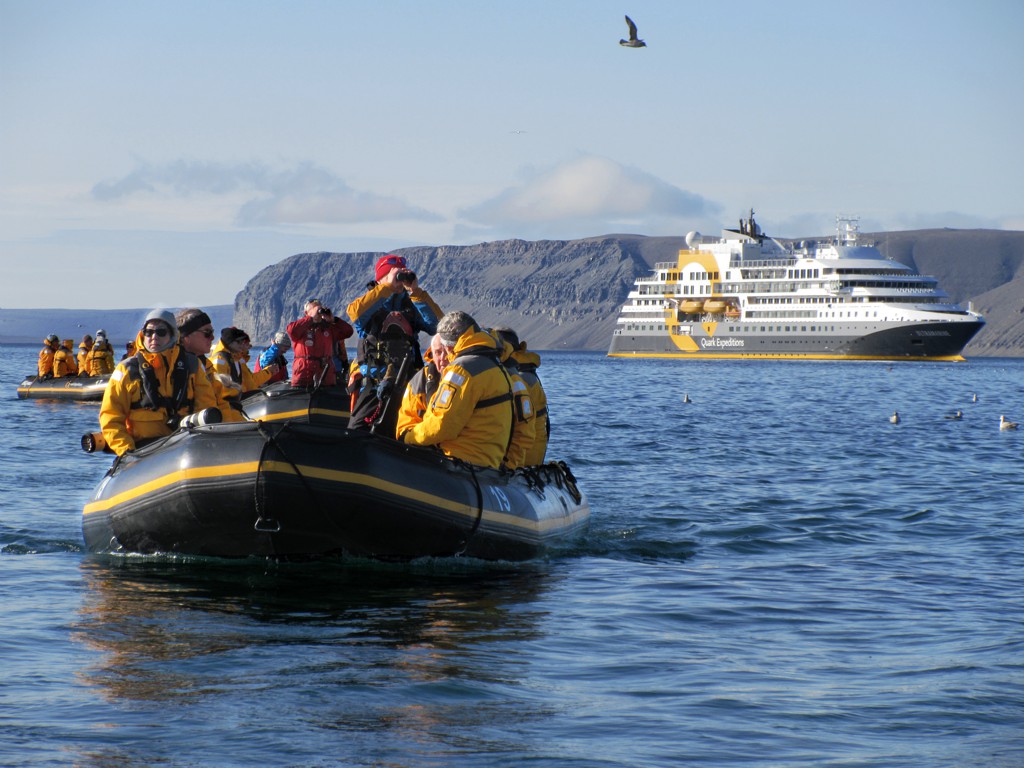
Zodiacs are used for transferring you ashore, transporting your luggage when necessary and for taking you ocean-level cruising among icebergs, whales and seabirds. During the expedition, you will visit remote and isolated sites that are accessible only by Zodiac.
These large, heavy-duty inflatable vessels are extremely safe and were specially designed for expedition work. Zodiacs are the workhorses of Polar expeditions. Separate air compartments retain a large reserve of buoyancy even if these sturdy boats are damaged. Their flat bottom design permits the craft to land directly onto the cobble and ice-strewn beaches that you will encounter on your Polar expedition.

Expedition Team
The perfect polar expedition doesn’t just happen. It takes a team of talented, knowledgeable and experienced professionals to bring it all together. Our Expedition Team is comprised of seasoned veterans with rich backgrounds in marine biology, history, glaciology, geology and more. With the highest staff-to-guest ratio in the industry, our Expedition Teams safely deliver your trip-of-a-lifetime to maximize your polar adventure every step of the way.

Twin Engine Helicopters
Two twin-engine helicopters operated from two helidecks allow more passengers to simultaneously experience new destinations accessible only by air, and to enjoy more unique aerial perspectives of the polar regions than on any other ship.

Flightseeing aboard Ultramarine
While polar landscapes are spectacular from the sea, they’re even more stunning from the air, a view you can enjoy while seated in one of the two twin-engine helicopters stationed on Ultramarine. Typically in groups of 7 to 9, you will experience an unforgettable aerial∘ tour of the Arctic during a 10- to 15-minute flightseeing excursion∘ that’s included in the cost of the voyage. Additional helicopter activities may also be available for purchase onboard. Please note: all helicopter operations are weather- and logistics-dependent.

Sea Kayaking
Sea kayaking is offered on all of our departures and you require no previous experience to enjoy this activity. Our sea kayaks are the ideal means by which to get some good exercise and explore the cliffs and shores of the various visitor sites around the archipelago. A typical cruise week offers great opportunities to go kayaking around secluded coves, shores, mangrove estuaries and beautiful beaches. Galapagos penguins, flightless cormorants, sea lions and many other animals can be seen up close on a kayak and even as they swim.
Polar Plunge
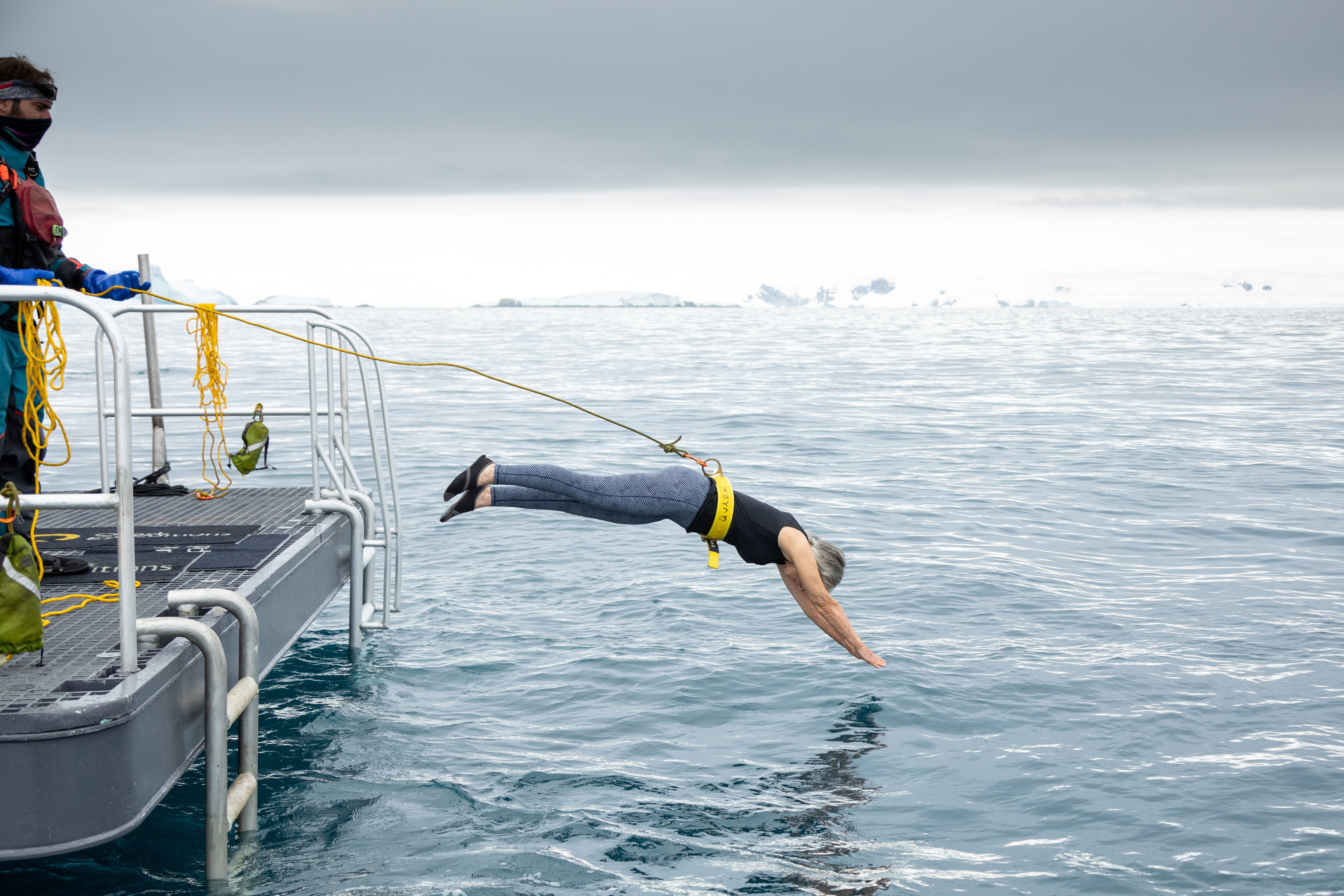
The Polar Plunge is scheduled once during each voyage. Throughout the journey, the Expedition Leader and Captain constantly monitor conditions in order to choose the optimal time and location. The Polar Plunge sometimes takes place onshore or, in many cases, from the gangway or Zodiac. All participants wear a tethered harness and plunge into the polar waters from the side of Zodiac or safety of the gangplank cheered on, of course, by fellow passengers and Expedition Team.
Safety is paramount—the onboard physician always attends the Polar Plunge. Guides in survival gear circle the area in Zodiacs as guests take their turn jumping or cannon-balling into the polar waters.
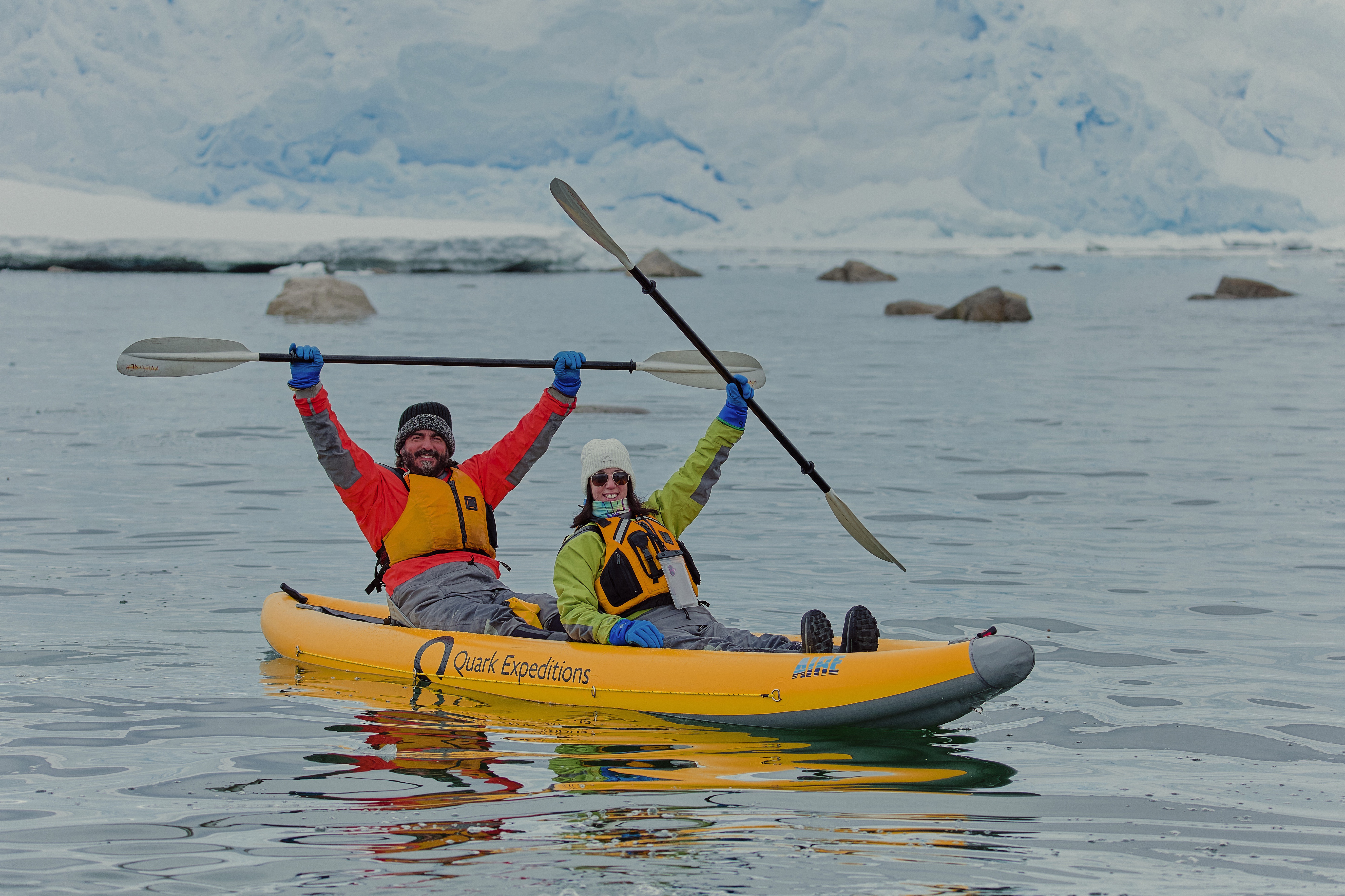
Paddling Excursion
Explore the ocean from a more intimate vantage point on a sit-on-top kayak. No experience is required to manoeuvre these very stable kayaks, allowing you to enjoy an unforgettable experience on the water, taking in breathtaking landscapes and wildlife. Whether it’s your first time in a kayak or you want greater flexibility to try other Adventure options, this shorter excursion is for you.
Paddling in the Polar Regions is highly weather-dependent and a one-time experience. Your kayak guides will attempt to take you out on the water for 1-1.5 hours of paddling. Offered on most voyages, spaces are limited. All equipment, guides and instructions are provided by Quark.
Pricing subject to change based on season. Please proceed to checkout or contact a Polar Travel Adviser for more details.

Camping
Imagine for a moment, staring at the stars in the indigo glow of an Antarctic night as you bed down for the night outside in the elements. The buzz of your daily life becomes a distant memory as you listen to the bray of penguin, the ethereal calls of the Weddell sea – even the exhalation of a humpback whale. And then you fall asleep.
Antarctic Camping with Quark Expeditions is an unforgettable experience. After dinner onboard, you’ll be escorted ashore by Zodiac to camp out on the snow for the night in your ready-to-roll bivy sack (tents can be used upon request). Once you decide on your spot, you set up camp and enjoy the peace as the Antarctic night unfolds.
Camping in Antarctica is limited to 50 participants, all of whom will be briefed beforehand on the principals of basic camping. Prior to you settling down for the night, Quark Expeditions staff will prepare the site, including setting up a perimeter in safe, flat to gently-sloping and beautiful site. You’re free to choose where (within the perimeters) you want to settle down for the night.

Hiking
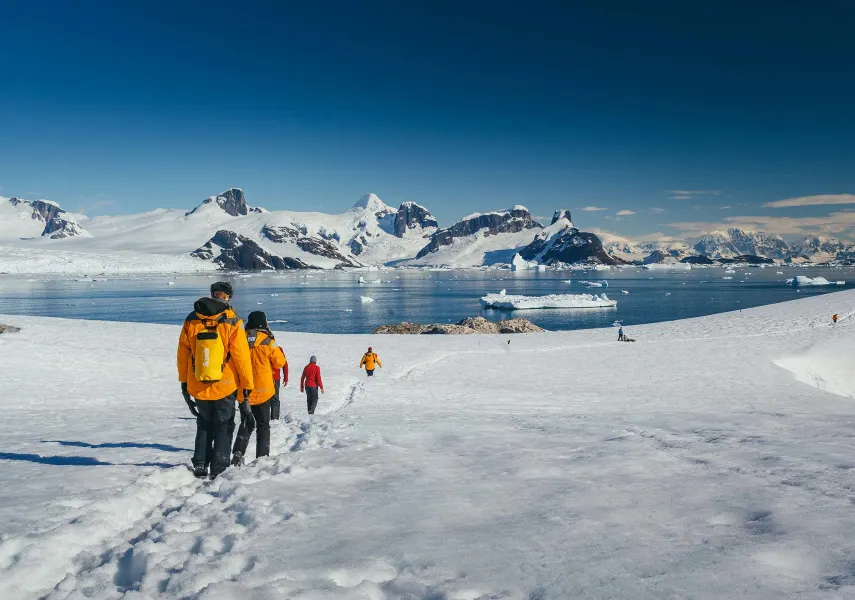
Hiking in the polar regions differs from your typical trail experience. Here, in a tree-less terrain, you are the tallest figure on the landscape as you walk over spongy tundra, crusty snow or sandy beaches in remotes parts of the Arctic and Antarctica. Stepping ashore anywhere in the polar regions means you’re not a distant observer.
Our organized hikes range from short jaunts to the top of lookouts or visits to see wildlife or longer walks of several kilometers over ice and rock and snow. Hiking excursions may last from two to three hours with plenty of time for photographs of wildlife, learning moments from your experienced guides, or just time to stand back and admire the incredible polar surroundings.
No experience is necessary but participants should be able to get in and out of a Zodiac and walk on uneven terrain. Hiking options are tailored to all interests and abilities, from those who want to contemplate the landscape in silence to photographers who want that perfect image to energetic travelers who want to summit a peak in the hopes of seeing wildlife in their natural habitat.

Exclusive Heli-Landing
Imagine setting foot in an area of the Antarctic that can only be safely accessed by helicopter. With a small group of fellow passengers and expert guides, you’ll board one of Ultramarine’s two twin-engine helicopters to soar off to an exclusive polar site where no ships can navigate. Expect stunning bird’s-eye views during your flight, and then, upon arrival, simply sit back, relax and take in the splendor of the Antarctic from “the best seat in the house”: glacial amphitheaters, breath-taking summits, and more. Traveling in groups of 12 with no more than 4 groups (48 guests) at a time on each landing, you’ll have time to relax and quietly reflect on the beauty of your polar surroundings, after which you’ll be picked up by the helicopters in the same location and returned to Ultramarine.
Each heli-landing experience is uniquely curated by our expedition team, taking conditions and location capacity into consideration.

Alpine Heli-Trekking
Let us take you on an active adventure high up in the Antarctic Peninsula. You’ll be part of an intimate group of adventurers to board one of Ultramarine’s two twin-engine helicopters for a trekking excursion in an area only safely accessed by air. The helicopter flight alone rewards guests with unforgettable views of the expansive polar landscape down below. On land, during an invigorating walk, hike or snowshoe trek (depending on conditions), you’ll be rewarded with equally stunning views of remote ridgelines, glaciated terrain, and snow-topped peaks. This once-in-a-lifetime heli-adventure will leave you marveling at the overwhelming beauty of the Antarctic.

Panorama Lounge and Bar
Enclosed in glass and featuring unobstructed views, the Panorama Lounge and Bar allows guests to relax indoors while staying connected to the awe-inspiring landscapes drifting by. It serves as a cozy gathering point where guests can sip a glass of wine, engage in great conversation, indulge in a board game, or socialize at the bar—and, later in the evening, bust a move on the dance floor.

Bridge
During your voyage you may be given access to the Bridge, where you can observe how the Captain and officers sail and navigate the ship.

Reception
A crew member is available at reception to assist you or answer any questions during posted hours. You can purchase internet or email access cards and phone cards here, arrange for a wake-up call or settle your accounts at the end of the voyage.

Polar Boutique
If you forgot any essentials or need a little souvenir from your voyage, the Polar Boutique on Deck 3 is our onboard gift shop. Opening hours will vary based on the daily expedition activities.
Gifts and souvenirs are great to bring home as mementos of your polar expedition. In addition to small souvenirs, our Polar Boutique offers a selection of expedition gear, including base layer clothing, waterproof pants, gloves and more.

Library
Located on Deck 7, the library offers a large collection of field guides, picture books and reference books, and also includes a selection of games for your entertainment. The Ultramarine collection includes books in multiple languages covering subjects like wildlife, history, marine biology, ecology and geology.

Tundra Spa
Offering a variety of treatments exclusively crafted for our guests, the spa and adjacent steam room allow passengers; to fully relax and unwind before their next off-ship adventure.

Tundra Sauna
Perfectly juxtaposed luxury: guests can rest and relax in the comfort and warmth of the sauna while enjoying the spectacular views outside.

Fitness Center
In the fully-equipped fitness center, featuring a separate yoga space with views to the outside.
Medical Facilities
Quark Expeditions provides an English-speaking doctor on board who manages a medical clinic stocked with a supply of common prescription medicines and basic first aid equipment.
If you are under regular treatment for any ailment, you must bring a sufficient supply of medicine. We recommend that you pack an extra two weeks’ supply of medication in case of emergency. We cannot accept responsibility for not having a specific brand or type of drug on board. Should you fall ill, the doctor will refer to the medical forms that you completed and returned to us; therefore it is vital that the information you provide is complete and accurate
Dress Code
To Wear on Board
- Comfortable casual clothing like lighter shirts, pants or jeans, etc. (in case the ship gets warm)
- Comfortable non-slip closed-toed, heelless shoes (flip flops, sandals or slip-on shoes should not be worn on board due to safety concerns)
- Workout attire (for the fitness center and other indoor activities)
- Swimsuit (for the Polar Plunge! Some vessels may also have a pool, hot tub, sauna and/or steam room. See your ship book for details.)
Just a reminder: no formal evening wear required on our voyages! (but if you want to you can bring a little something more dressy for the Captain’s Welcome and Farewell cocktail parties)
Additional Items
- Passport, visas, immunization records, travel documents, etc. as required
- Camera gear complete with charger, storage medium, transport & cleaning kit (lens cloth etc.) and extra batteries
- Waterproof cell phone case or rain sleeve for camera
- Earplugs and eye masks for sleeping
- Voltage converters and plug adapters (see ship book for details)
- Moisturizer for face and hands (skin dryness due to wind and temperature changes)
- Seasickness, indigestion, headache, or other medications
- Small amount of local currency (see pre-departure book for more details)
- Insect repellant
- Mosquito netting
For Shore Excursions & Hiking
In addition to the mandatory gear requirements (as above) for the transit from ship to shore, it is recommended to bring:
- Worn-in Hiking footwear: While Muck-boots are provided and encouraged for most shore excursions, additional hiking footwear (Goretex-lined boots or similar water-proof hiking boots) can add to your hiking comfort, especially if you are a keen hiker
- (Smart) Wool or synthetic hiking socks for above footwear (bring an extra pair)
- Lightweight and quick-dry, trekking pants that may or may not convert to zip-off shorts* (*depending on your thermo-regulation)
- Breathable waterproof pants* and rain jacket** for outdoor activities in inclement weather (*can be the same pair you use for Zodiac operations / ** can be outer shell of complimentary Quark 3in1 Parka)
- Comfortable long or short-sleeve shirt for hiking either synthetic/quick-dry or merino (smart) wool
- (Hiking) gloves (medium thickness, waterproof preferred)
- Hat, buff or scarf (for wind and weather protection)
- UV protection (hat, polarized sun glasses, sun block, lip balm)
- Collapsible Walking stick for hikes (if required). Quantities are available on every vessel to borrow.
- Additional reusable thermos or water bottle (in addition to the reusable collapsible water bottle provided)
By Sea & Air
All transfers ship to shore, helicopter flights & Zodiac/ship cruising
- Waterproof Pants (Mandatory for every Zodiac and helicopter ride. For Ultramarine guests who are participating in Helicopter flights, we recommend packing loose fitting rain pant style waterproof pants, rather than fitted ski pants. You will also be required to wear a drysuit, which our team will help you prepare for on the ship.)
- Base-layer wool or synthetic top*
- Base-layer wool or synthetic bottom*
- Mid-layer warm or fleece top*
- Mid-layer warm or fleece bottom*
- Warm hat that covers ears (bring an extra)
- Scarf, buff, or other face protection
- Warm wool or synthetic socks (keep a dry pair in your bag, and bring extras for layering)
- Waterproof gloves or mitts (bring an extra, lighter pair for hiking)
- Glove liners*
- Hand and feet warmers*
- Binoculars
- Polarized sunglasses with UV protection (bring an extra pair)
- Sunscreen
- Ski goggles (for Zodiac cruising on snowy or windy days)
- Waterproof, lightweight backpack or dry sack &/or rain sleeve for camera or a waterproof phone case (to keep camera & gear dry)
Smoking Policy
To protect the health and safety of its guests, Quark Expeditions® maintains a no smoking policy in the interior of the ship including cabins, near Zodiacs and on landings. Smoking on the ship is permitted in the designated smoking area only, which your Expedition∘ Team members will be happy to point out for you. Always make sure to extinguish cigarettes properly and dispose of them in the proper receptacle. Please, never throw cigarettes overboard.
Dietary Requirements & Allergies
If you do not eat meat there is a wide selection of vegetables, pasta, grains and fruit available. Quark Expeditions® is able to cater to most special dietary requests, as long as you clearly indicated your needs on the required expedition forms when you booked your voyage. Menus will be clearly labeled for vegetarian and gluten free options, but please do notify your server of the dietary restrictions you indicated on your form. We regret that kosher food cannot be prepared.
Wi-Fi & Communications
When you are not busy exploring the natural beauty of the Polar Regions, you may wish to connect with family and friends back home to share some of your voyage highlights. Guests on Quark Expeditions can now enjoy free Wi-Fi as part of our “Raise a Glass and Stay Connected Free” program. This complementary Wi-Fi service permits basic Internet browsing and voice applications.
Please note that we travel to some of the most remote parts of the world. As we utilize satellite equipment for our connection, Wi-Fi signal may be intermittent.
To access email or internet on your personal computer, tablet or smart phone, connect to the network on your device, where you can access our complimentary plan, or purchase Priority Wi-Fi.
Complimentary Wi-Fi
- Lower speeds
- Suitable for basic internet browsing, texting and voice calling using text and voice apps
- Some site filtering
- No charge
- One device logged in at a time
Priority Wi-Fi
- Higher speeds
- Suitable for larger data volume apps, video calling, video streaming (in lower resolutions) etc.
- See rates by logging in
- One device logged in at a time
Life at Sea
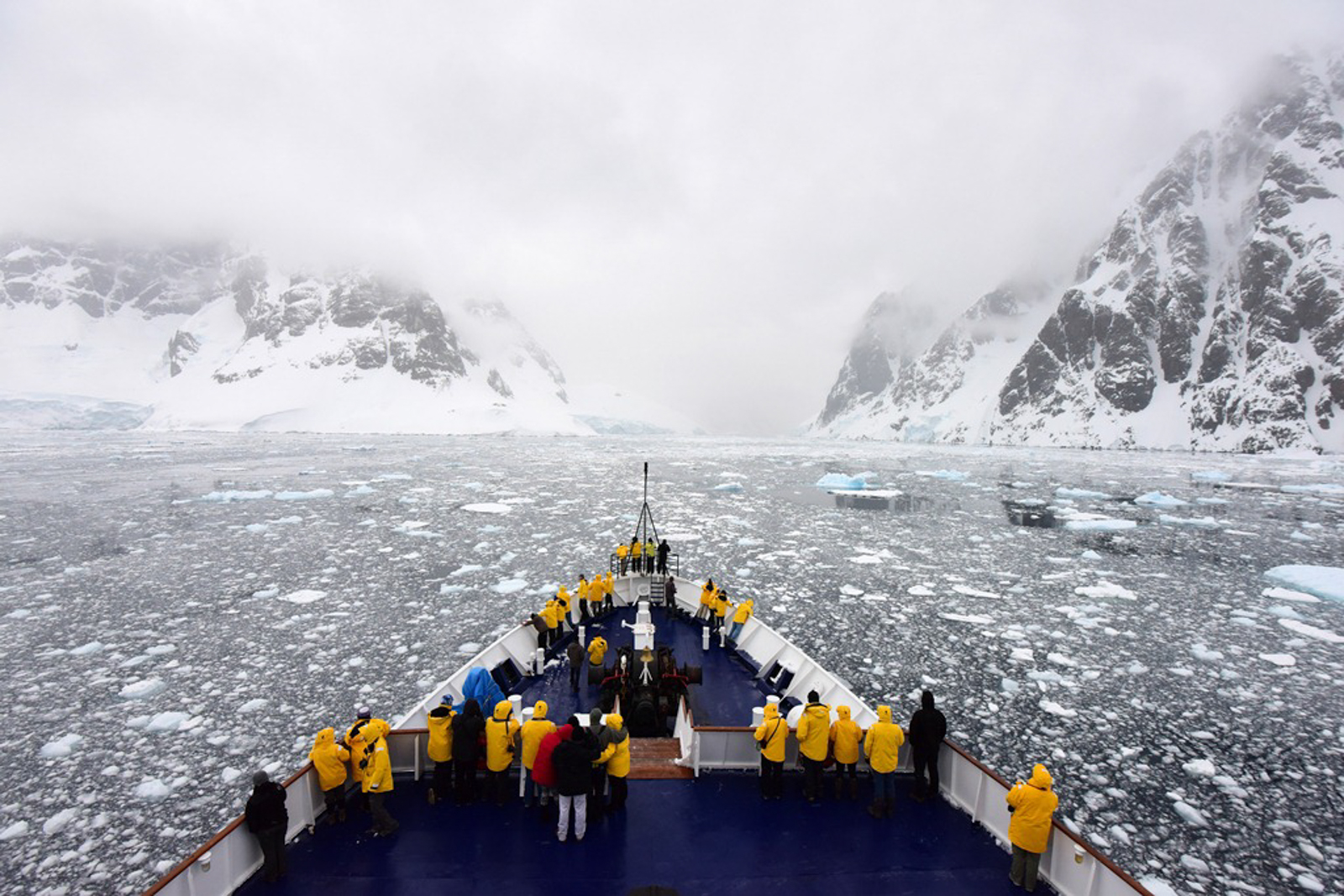
During days at sea, you’ll enjoy lectures and workshops presented by our Expedition Team and spend time on deck looking for seabirds and cetaceans. Other days are packed full with multiple landings, Zodiac cruises and activities. Exhausting or relaxing, smiles abound as do great meals from your onboard chefs!
We have a number of policies and procedures that help make sure things run smoothly on the Ultramarine, so take a look below to help get the most out of your time aboard.
SCHEDULE CHANGES
While a daily program will be posted, sometimes new opportunities present themselves on short notice – so expect the unexpected and enjoy knowing that staff members are always here to make sure your expedition is as memorable and enjoyable as possible!
SAFETY ON BOARD AND ASHORE
Your safety and security are a top priority for our Expedition Team and crew members. Knowing how to safely move about your ship, act ashore and handle both wet and dry landings will help ensure you have a hassle-free expedition. Please take time to read the instructions in this important safety section.
SAFETY WHILE ON DECK
Be careful while walking around the outer decks, as footing can be slippery. Always use the handrails and wear proper closed-toe, nonslip footwear. Slip-on sandals, slippers or flip flops are neither safe nor suitable for wearing on board.
STAIRS & DOORS
There are high steps in many doorways that lead to the outer decks, please watch your step and proceed with caution. When passing through doorways or walking in your room, do not place your hands around the edges of doors. Be aware that if doors are not closed or latched open properly, they present a danger and can open or close violently and unexpectedly as the ship moves across the sea.
SAFETY BRIEFING & LIFEBOAT DRILL
By international maritime law, you must participate in an emergency drill within 24 hours of sailing. Upon embarkation, you will have a safety briefing to outline appropriate behavior on board, and emergency procedures. Afterward, a drill will be conducted to familiarize you with your lifeboat, life vest and emergency evacuation route. This mandatory drill will be scheduled as soon as possible by the Expedition Leader. You will be provided with full details after you embark.
CONDUCT ASHORE
- For safety reasons, never walk alone while ashore. Always travel with someone else, or as part of a group.
- If weather conditions deteriorate the Captain will sound the return to ship signal (continuous short blasts). If you hear this, immediately return to the landing area or follow instructions from staff members.
- Do not litter. Take only photos and leave only footprints.
- Be punctual, as on time boarding and efficient landings mean we’ll have more time to explore at future landings.
HELICOPTER SAFETY
The Ultramarine provides an expedition adventure above that of many other ships – by taking you on helicopter excursions. Helicopters allow us to take you on aerial sightseeing adventures, to bays that are inaccessible to shore landings, as well as glaciers high atop mountains!
Please see your expedition brochure for details on whether helicopter activities are offered on your itinerary, as helicopter operations are not permitted in certain regions (for example, Svalbard and South Georgia). Weather conditions permitting, you will find that we make good use of the helicopter operations. As your safety is our first concern, a mandatory briefing will be held before the first helicopter excursion. You will be required to sign the Helicopter Waiver form before your first flight. Please note that the decision to fly is ultimately up to the Pilot in Command who will be working closely with the Captain and Expedition Leader.
You will be assigned to a small group for your flightseeing excursion. Please note that as weather factors and time constraints can shorten the time available for helicopter flights on any given day, no particular day or time can be guaranteed for flightseeing, and all helicopter operations are weather- and logistics-dependent.
DRESS APPROPRIATELY FOR SAFETY
There is some possibility that you could be stranded ashore or on the ice for a period of hours until conditions improve for your helicopter to return. In the unlikely event that you are grounded for a long duration, the Expedition Team will prepare a base camp with a large tent for shelter and emergency supplies. Be sure to always dress warmly in layers, including your Quark Expeditions® parka as your outer layer which is weatherproof in case this eventuality occurs. Bring along extra clothes and water in a small waterproof backpack on each of your helicopter rides.
ADVENTURE TAKES TIME
Be aware that even in the best conditions, it may take six hours for 100 people to make a 20-minute helicopter flight inland. For efficient operations, weather, or refueling and maintenance, the helicopter may not be available for you to return immediately.
PROCEDURES FOR BOARDING A HELICOPTER:
- Dress warmly for all excursions.
- Follow instructions from the Helicopter Team on life jacket procedures during helicopter excursions.
- Watch your footing on deck, walk slowly and deliberately.
- Stay clear of the helicopter deck.
- Remain at the muster area well away from the helicopter deck until instructed by the Helicopter Team.
- When in a hurry, slow down – the noise of the helicopter can be unsettling.
- An Helicopter Team member will always direct you to the helicopter doors.
- Always approach and leave the helicopter from the front.
- Never approach and leave the helicopter unsupervised.
- Beware of the down-draft.
- Ensure that your belongings are properly secured.
- Carry long items, such as tripods or walking sticks, below your waistline.
Cabin Information
SHOWERS AND TOILETS
Each cabin has a private bathroom with shower and heated floors, toilet and wash basin. Shampoo, conditioner and shower gel are provided for your use.
ELECTRIC CURRENT
The electrical supply on board is 220 volts, 50 Hz. Passengers coming from the USA and Canada may need to bring a small 220v/110v converter. Before you buy a converter, check your electronics, as most modern cameras, computers and devices are already compatible to use 220/110 volts.
The electrical outlets found in your cabin and around the ship accept standard European two round pin plugs, so you may need to bring a travel adapter. You’ll also find a USB outlet at each bedside, and some in the public presentation spaces.
Please be aware that the electricity supply may not be sufficient to power your electronic devices at all times. It is recommended that you check the voltage of your device before plugging it in, as the device may be damaged if the incoming voltage is higher than that for which it is manufactured. Please see www.quarkexpeditions.com/en/terms-and-conditions for more information.
HAIRDRYERS
There is a hair dryer included in each cabin.
BATHROBES
The bathrobes in your cabins are on loan for you to enjoy for the duration of your expedition.
VALUABLES
Please store your valuables in the safe in your cabin. We recommend you travel with as few valuables as possible.
LAUNDRY
A complete list of laundry fees will be provided on board. Laundry is collected each morning; please allow 48 hours for your laundry to be returned. Ironing services are also available at a minimal charge. We encourage you to take advantage of the laundry services, as it will mean you can pack fewer articles of clothing. If you prefer to hand wash small items in your cabin, please remember to bring environmentally friendly detergent.
Onboard Procedures
WATER
All passengers receive an eco-friendly, reusable water bottle in their cabin upon arrival. There are water filling stations throughout the ship.
ONBOARD ACCOUNTS
To make things as stress-free as possible, items you purchase from the Polar Boutique, lounge or bar (including drinks) are charged to your ship account. Cabin charges can also include laundry, postage, communication charges and adventure options booked on board (space permitting). Payments of shipboard accounts are made towards the end of the expedition, at the reception area. The US dollar is the standard currency on board. You can use cash, Visa, MasterCard or American Express credit cards to pay your shipboard account. Personal checks are not accepted.
Note: If you are sharing a cabin and would like separate accounts, you must advise reception.
BRIDGE VISITS
During your voyage you may be given access to the Bridge, where you can observe how the Captain and officers sail and navigate the ship. However, the Captain and Bridge officers do restrict access during arrivals and departures from port and during times of complicated navigation. As the Bridge is an important working area on the ship, we ask that you keep noise to a minimum to avoid distracting the officers from conducting their jobs efficiently. Understandably, Bridge etiquette includes a ‘no eating, drinking or smoking’ policy.
ELEVATOR
The onboard elevator system is available for travel between decks. However, for your safety this elevator will be shut down during any periods of inclement weather.
Expedition Brochures
Find Ultramarines itineraries here.

Deck 8
- Helipad

Deck 7
- Panorama Bar & Lounge
- Library
- Sauna
- Tundra Spa
- Fitness Centre
- Bistro 487
- Studio
- Penthouse Suite

Deck 6
- Bridge
- Deluxe Balcony Suite
- Balcony Suite
- Terrace Suite
- Owner’s Suite
- Ultra Suite
- Solo Panorama

Deck 5
- Balena Restaurant
- Ambassadors Theatre

Deck 4
- Balcony Suite
- Deluxe Balcony Suite

Deck 3
- Explorer Suite
- Explorer Triple
- Reception
- Polar Boutique
- Expedition Desk
- Clinic

Deck 2
- Ready Room
- Zodiacs
- Zodiacs Embarkation