
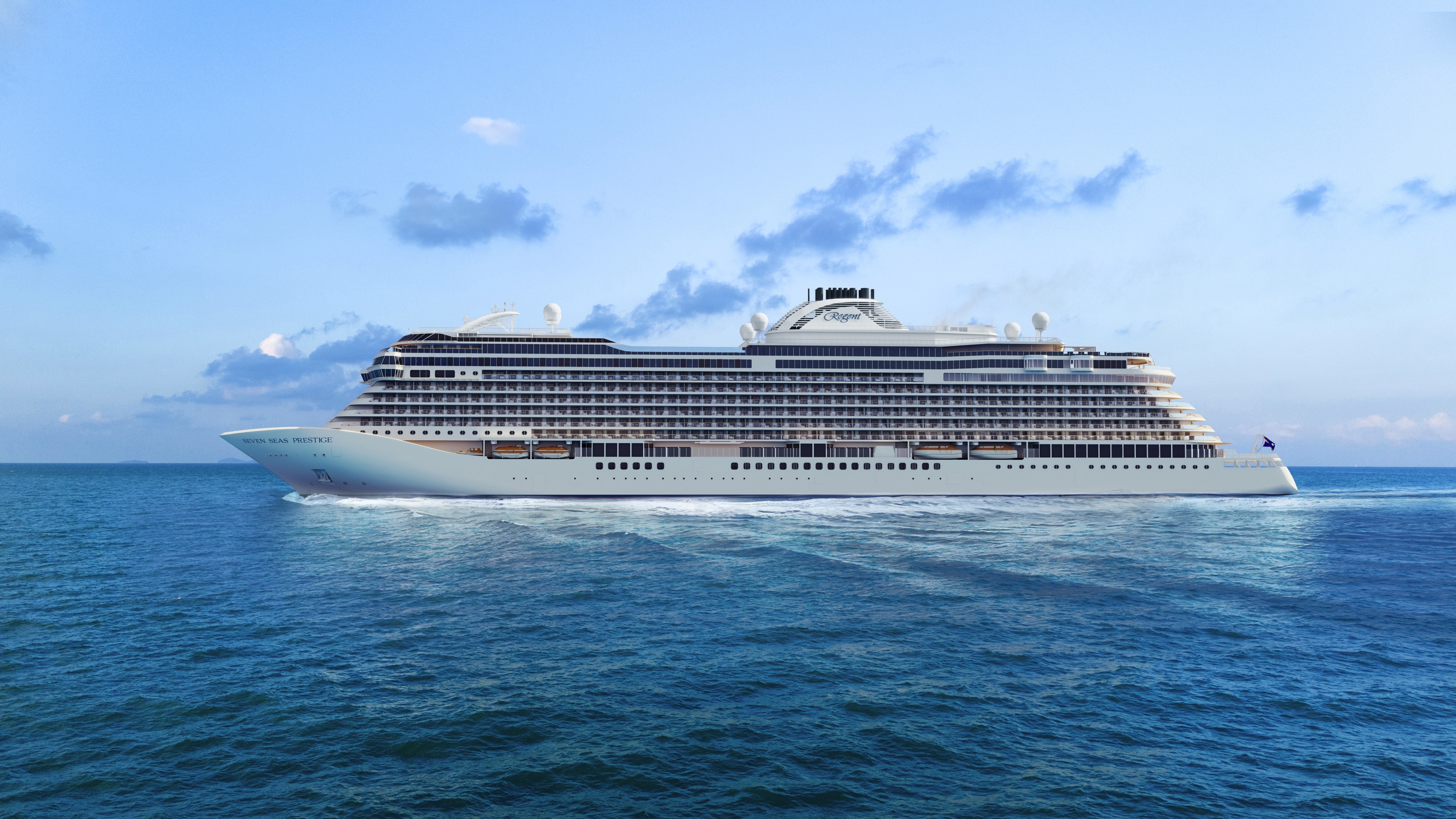
Itinerary
Italy’s vibrant capital lives in the present, but no other city on earth evokes its past so powerfully. For over 2,500 years, emperors, popes, artists, and common citizens have left their mark here. Archaeological remains from ancient Rome, art-stuffed churches, and the treasures of Vatican City vie for your attention, but Rome is also a wonderful place to practice the Italian-perfected il dolce far niente, the sweet art of idleness. Your most memorable experiences may include sitting at a caffè in the Campo de’ Fiori or strolling in a beguiling piazza.
Salerno is an Italian city located on the Gulf of Salerno. Famous for being home to the first medical university, Salerno is a great destination for anyone looking for gorgeous sea views filled with sunshine and Italian food.
Home to the Museo Regionale of Messina, known for featuring two of Caravaggio’s paintings, the city is also famous for having been the capital of the ancient kingdom of Sicily.
Backed by imposing mountains, tiny Kotor lies hidden from the open sea, tucked into the deepest channel of the Bokor Kotorska (Kotor Bay), which is Europe’s most southerly fjord. To many, this town is more charming than its sister UNESCO World Heritage Site, Dubrovnik, retaining more authenticity, but with fewer tourists and spared the war damage and subsequent rebuilding which has given Dubrovnik something of a Disney feel.Kotor’s medieval Stari Grad (Old Town) is enclosed within well-preserved defensive walls built between the 9th and 18th centuries and is presided over by a proud hilltop fortress. Within the walls, a labyrinth of winding cobbled streets leads through a series of splendid paved piazzas, rimmed by centuries-old stone buildings. The squares are now haunted by strains from buskers but although many now house trendy cafés and chic boutiques, directions are still given medieval-style by reference to the town’s landmark churches.In the Middle Ages, as Serbia’s chief port, Kotor was an important economic and cultural center with its own highly regarded schools of stonemasonry and iconography. From 1391 to 1420 it was an independent city-republic and later, it spent periods under Venetian, Austrian, and French rule, though it was undoubtedly the Venetians who left the strongest impression on the city’s architecture. Since the breakup of Yugoslavia, some 70% of the stone buildings in the romantic Old Town have been snapped up by foreigners, mostly Brits and Russians. Porto Montenegro, a new marina designed to accommodate some of the world’s largest super yachts, opened in nearby Tivat in 2011, and along the bay are other charming seaside villages, all with better views of the bay than the vista from Kotor itself where the waterside is congested with cruise ships and yachts. Try sleepy Muo or the settlement of Prčanj in one direction around the bay, or Perast and the Roman mosaics of Risan in the other direction.
Nothing can prepare you for your first sight of Dubrovnik. Lying 216 km (135 miles) southeast of Split and commanding a jaw-dropping coastal location, it is one of the world’s most beautiful fortified cities. Its massive stone ramparts and fortress towers curve around a tiny harbor, enclosing graduated ridges of sun-bleached orange-tiled roofs, copper domes, and elegant bell towers. Your imagination will run wild picturing what it looked like seven centuries ago when the walls were built, without any suburbs or highways around it, just this magnificent stone city rising out of the sea.In the 7th century AD, residents of the Roman city Epidaurum (now Cavtat) fled the Avars and Slavs of the north and founded a new settlement on a small rocky island, which they named Laus, and later Ragusa. On the mainland hillside opposite the island, the Slav settlement called Dubrovnik grew up. In the 12th century the narrow channel separating the two settlements was filled in (now the main street through the Old Town, called Stradun), and Ragusa and Dubrovnik became one. The city was surrounded by defensive walls during the 13th century, and these were reinforced with towers and bastions in the late 15th century.From 1358 to 1808 the city thrived as a powerful and remarkably sophisticated independent republic, reaching its golden age during the 16th century. In 1667 many of its splendid Gothic and Renaissance buildings were destroyed by an earthquake. The defensive walls survived the disaster, and the city was rebuilt in baroque style.Dubrovnik lost its independence to Napoléon in 1808, and in 1815 passed to Austria-Hungary. During the 20th century, as part of Yugoslavia, the city became a popular tourist destination, and in 1979 it was listed as a UNESCO World Heritage Site. During the war for independence, it came under heavy siege. Thanks to careful restoration, few traces of damage remain; however, there are maps inside the Pile and Ploče Gates illustrating the points around the city where damage was done. It’s only when you experience Dubrovnik yourself that you can understand what a treasure the world nearly lost
Water is the essence of Kvarner, and the region’s largest city expresses this simply. Whether in Croatian or Italian (Fiume) the translation of the name to English is the same: river. Although the history of Croatia’s third city goes back to the days of Imperial Rome, modern Rijeka evolved under the rule of Austria-Hungary. The historic core retains vestiges of the old Habsburg monarchy from the time when Rijeka served as the empire’s outlet to the Adriatic. During the 1960s, under Yugoslavia, the suburbs expanded rapidly. Rijeka is the country’s largest port, with a huge shipyard, massive dry-dock facilities, refineries, and other heavy industries offering large-scale employment. Since the breakup of Yugoslavia, however, Rijeka’s role as a shipping town has declined significantly. Much business shifted north to the smaller Slovene ports during the crippling wars of the 1990s, and although some has returned, the volume remains less than half that seen in 1980.
Dalmatia’s capital for more than 1,000 years, Zadar is all too often passed over by travelers on their way to Split or Dubrovnik. What they miss out on is a city of more than 73,000 that is remarkably lovely and lively despite—and, in some measure, because of—its tumultuous history. The Old Town, separated from the rest of the city on a peninsula some 4 km (2½ miles) long and just 1,640 feet wide, is bustling and beautiful: the marble pedestrian streets are replete with Roman ruins, medieval churches, palaces, museums, archives, and libraries. Parts of the new town are comparatively dreary, a testament to what a world war followed by decades of communism, not to mention a civil war, can do to the architecture of a city that is 3,000 years old. A settlement had already existed on the site of the present-day city for some 2,000 years when Rome finally conquered Zadar in the 1st century BC; the foundations of the forum can be seen today. Before the Romans came the Liburnians had made it a key center for trade with the Greeks and Romans for 800 years. In the 3rd century BC the Romans began to seriously pester the Liburnians, but required two centuries to bring the area under their control. During the Byzantine era, Zadar became the capital of Dalmatia, and this period saw the construction of its most famous church, the 9th-century St. Donat’s Basilica. It remained the region’s foremost city through the ensuing centuries. The city then experienced successive onslaughts and occupations—both long and short—by the Osogoths, the Croatian-Hungarian kings, the Venetians, the Turks, the Habsburgs, the French, the Habsburgs again, and finally the Italians before becoming part of Yugoslavia and, in 1991, the independent republic of Croatia. Zadar was for centuries an Italian-speaking city, and Italian is still spoken widely, especially by older people. Indeed, it was ceded to Italy in 1921 under the Treaty of Rapallo (and reverted to its Italian name of Zara). Its occupation by the Germans from 1943 led to intense bombing by the Allies during World War II, which left most of the city in ruins. Zadar became part of Tito’s Yugoslavia in 1947, prompting many Italian residents to leave. Zadar’s most recent ravages occurred during a three-month siege by Serb forces and months more of bombardment during the Croatian-Serbian war between 1991 and 1995. But you’d be hard-pressed to find outward signs of this today in what is a city to behold. There are helpful interpretive signs in English all around the Old Town, so you certainly won’t feel lost when trying to make sense of the wide variety of architectural sites you might otherwise pass by with only a cursory look.
Bari, capital of the province of Apulia, lies on southern Italy’s Adriatic coast. Its busy port is a leading commercial and industrial centre as well as a transit point for travellers catching ferries across the Adriatic to Greece. Bari comprises a new and an old town. To the north, on a promontory between the old and new harbours, lies the picturesque old town, or Citta Vecchia, with a maze of narrow, crooked streets. To the south is the spacious and regularly planned new town, which has developed considerably since 1930, when the Levant Fair was first held here. The heart of the modern town is Piazza della Liberta. The busy thoroughfare, Corso Vittorio Emanuele II, separates the new town from the old. At the eastern end of the Corso begins the Lungomare Nazario Sauro, a magnificent seafront promenade that runs along the old harbour. Bari and the Apulian region were long recognized for their strategic location, attracting a succession of colonizers such as the Normans, Moors and Spaniards, each leaving their mark.
Ground literally to ashes in World War II and wracked by a massive earthquake a decade later, the capital of Kefalonia once more shows pride in its native spirit and natural beauty. The vast harbor on Argostoli’s east side makes an especially attractive port for cruise ships full of visitors who never seem to tire of strolling the cobbled seaside promenade, sipping ouzos in cafés, and stocking up on the succulent Mediterranean fruits in the outdoor markets.
Milos or Melos is a volcanic Greek island in the Aegean Sea, just north of the Sea of Crete. Milos is the southwesternmost island in the Cyclades group. The Venus de Milo and the Asclepius of Milos were both found on the island, as were a Poseidon and an archaic Apollo now in Athens.
Although the fishing boats still go out in good weather, Mykonos largely makes its living from tourism these days. The summer crowds have turned one of the poorest islands in Greece into one of the richest. Old Mykonians complain that their young, who have inherited stores where their grandfathers once sold eggs or wine, get so much rent that they have lost ambition, and in summer sit around pool bars at night with their friends, and hang out in Athens in winter when island life is less scintillating. Put firmly on the map by Jackie O in the 1960s, Mykonos town—called Hora by the locals—remains the Saint-Tropez of the Greek islands. The scenery is memorable, with its whitewashed streets, Little Venice, the Kato Myli ridge of windmills, and Kastro, the town’s medieval quarter. Its cubical two- or three-story houses and churches, with their red or blue doors and domes and wooden balconies, have been long celebrated as some of the best examples of classic Cycladic architecture. Luckily, the Greek Archaeological Service decided to preserve the town, even when the Mykonians would have preferred to rebuild, and so the Old Town has been impressively preserved. Pink oleander, scarlet hibiscus, and trailing green pepper trees form a contrast amid the dazzling whiteness, whose frequent renewal with whitewash is required by law. Any visitor who has the pleasure of getting lost in its narrow streets (made all the narrower by the many outdoor stone staircases, which maximize housing space in the crowded village) will appreciate how its confusing layout was designed to foil pirates—if it was designed at all. After Mykonos fell under Turkish rule in 1537, the Ottomans allowed the islanders to arm their vessels against pirates, which had a contradictory effect: many of them found that raiding other islands was more profitable than tilling arid land. At the height of Aegean piracy, Mykonos was the principal headquarters of the corsair fleets—the place where pirates met their fellows, found willing women, and filled out their crews. Eventually the illicit activity evolved into a legitimate and thriving trade network. Morning on Mykonos town’s main quay is busy with deliveries, visitors for the Delos boats, lazy breakfasters, and street cleaners dealing with the previous night’s mess. In late morning the cruise-boat people arrive, and the shops are all open. In early afternoon, shaded outdoor tavernas are full of diners eating salads (Mykonos’s produce is mostly imported); music is absent or kept low. In mid- and late afternoon, the town feels sleepy, since so many people are at the beach, on excursions, or sleeping in their air-conditioned rooms; even some tourist shops close for siesta. By sunset, people have come back from the beach, having taken their showers and rested. At night, the atmosphere in Mykonos ramps up. The cruise-boat people are mostly gone, coughing three-wheelers make no deliveries in the narrow streets, and everyone is dressed sexy for summer and starting to shimmy with the scene. Many shops stay open past midnight, the restaurants fill up, and the bars and discos make ice cubes as fast as they can. Ready to dive in? Begin your tour of Mykonos town (Hora) by starting out at its heart: Mando Mavrogenous Square.
It’s no wonder that all roads lead to the fascinating and maddening metropolis of Athens. Lift your eyes 200 feet above the city to the Parthenon, its honey-color marble columns rising from a massive limestone base, and you behold architectural perfection that has not been surpassed in 2,500 years. But, today, this shrine of classical form dominates a 21st-century boomtown. To experience Athens—Athína in Greek—fully is to understand the essence of Greece: ancient monuments surviving in a sea of cement, startling beauty amid the squalor, tradition juxtaposed with modernity. Locals depend on humor and flexibility to deal with the chaos; you should do the same. The rewards are immense. Although Athens covers a huge area, the major landmarks of the ancient Greek, Roman, and Byzantine periods are close to the modern city center. You can easily walk from the Acropolis to many other key sites, taking time to browse in shops and relax in cafés and tavernas along the way. From many quarters of the city you can glimpse “the glory that was Greece” in the form of the Acropolis looming above the horizon, but only by actually climbing that rocky precipice can you feel the impact of the ancient settlement. The Acropolis and Filopappou, two craggy hills sitting side by side; the ancient Agora (marketplace); and Kerameikos, the first cemetery, form the core of ancient and Roman Athens. Along the Unification of Archaeological Sites promenade, you can follow stone-paved, tree-lined walkways from site to site, undisturbed by traffic. Cars have also been banned or reduced in other streets in the historical center. In the National Archaeological Museum, vast numbers of artifacts illustrate the many millennia of Greek civilization; smaller museums such as the Goulandris Museum of Cycladic Art Museum and the Byzantine and Christian Museum illuminate the history of particular regions or periods. Athens may seem like one huge city, but it is really a conglomeration of neighborhoods with distinctive characters. The Eastern influences that prevailed during the 400-year rule of the Ottoman Empire are still evident in Monastiraki, the bazaar area near the foot of the Acropolis. On the northern slope of the Acropolis, stroll through Plaka (if possible by moonlight), an area of tranquil streets lined with renovated mansions, to get the flavor of the 19th-century’s gracious lifestyle. The narrow lanes of Anafiotika, a section of Plaka, thread past tiny churches and small, color-washed houses with wooden upper stories, recalling a Cycladic island village. In this maze of winding streets, vestiges of the older city are everywhere: crumbling stairways lined with festive tavernas; dank cellars filled with wine vats; occasionally a court or diminutive garden, enclosed within high walls and filled with magnolia trees and the flaming trumpet-shaped flowers of hibiscus bushes. Formerly run-down old quarters, such as Thission, Gazi and Psirri, popular nightlife areas filled with bars and mezedopoleia (similar to tapas bars), are now in the process of gentrification, although they still retain much of their original charm, as does the colorful produce and meat market on Athinas. The area around Syntagma Square, the tourist hub, and Omonia Square, the commercial heart of the city about 1 km (½ mi) northwest, is distinctly European, having been designed by the court architects of King Otho, a Bavarian, in the 19th century. The chic shops and bistros of ritzy Kolonaki nestle at the foot of Mt. Lycabettus, Athens’s highest hill (909 feet). Each of Athens’s outlying suburbs has a distinctive character: in the north is wealthy, tree-lined Kifissia, once a summer resort for aristocratic Athenians, and in the south and southeast lie Glyfada, Voula, and Vouliagmeni, with their sandy beaches, seaside bars, and lively summer nightlife. Just beyond the city’s southern fringes is Piraeus, a bustling port city of waterside fish tavernas and Saronic Gulf views.
Ship features
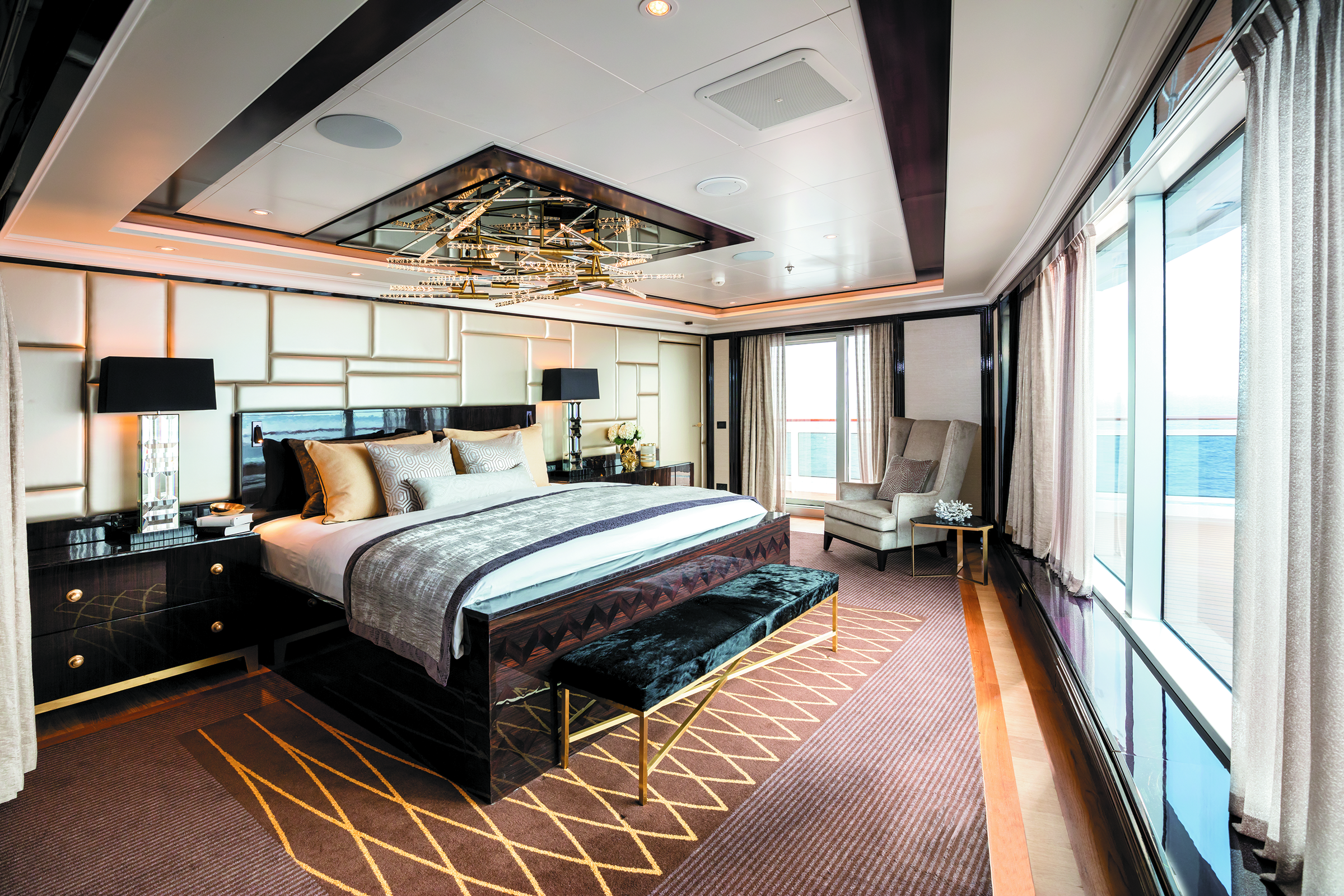
Skyview Regent Suite
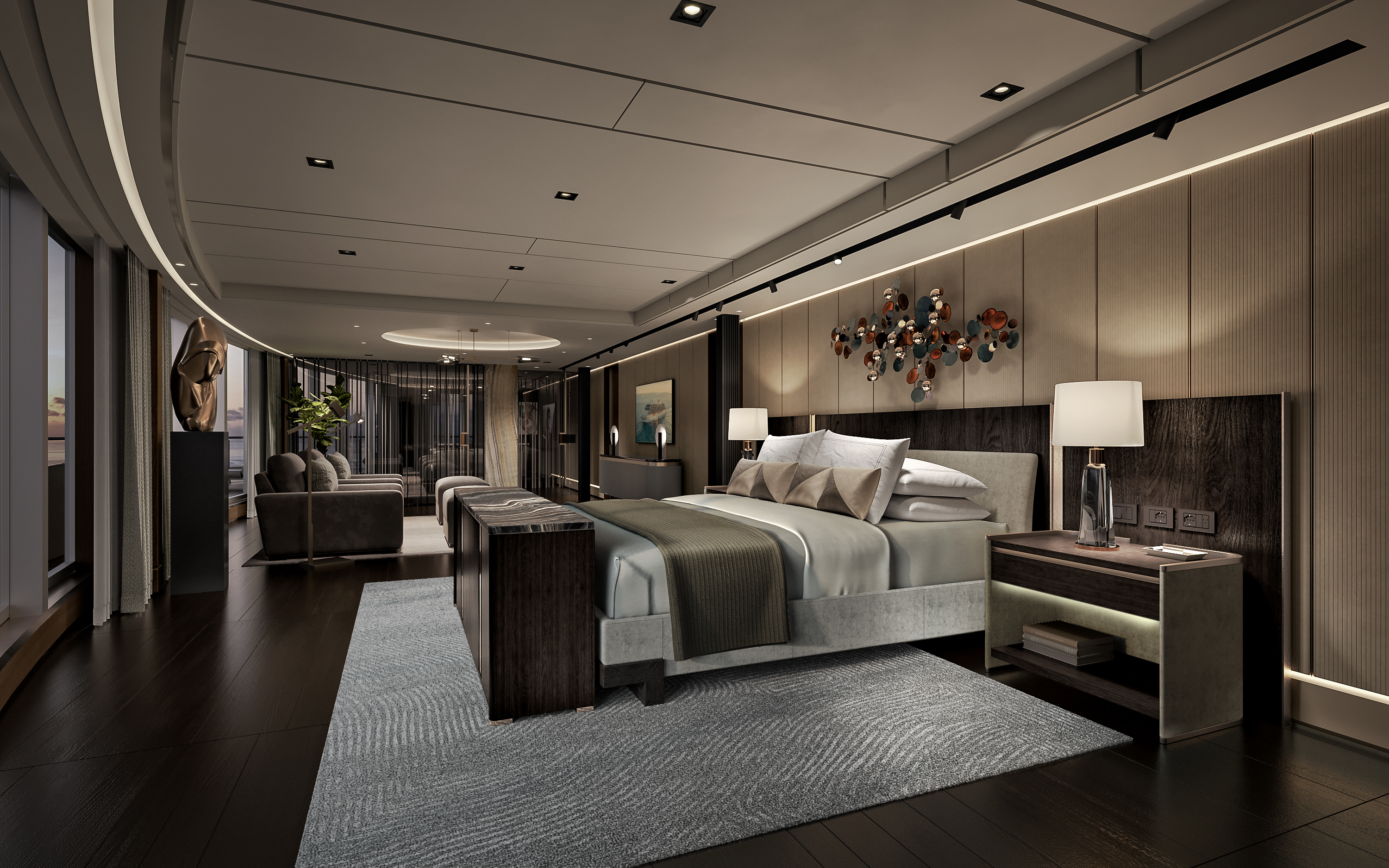
Nearly 9,000 square feet of ultra-luxury at sea, the Skyview Regent Suite offers unparalleled ocean views, a spa bath, private gym, an in-suite elevator, and so much more.
Ship renderings are artistic representations intended to provide a vision of the ship experience. Actual layouts, furnishings, and design elements may vary by deck, and specific location.
Skyview Suites
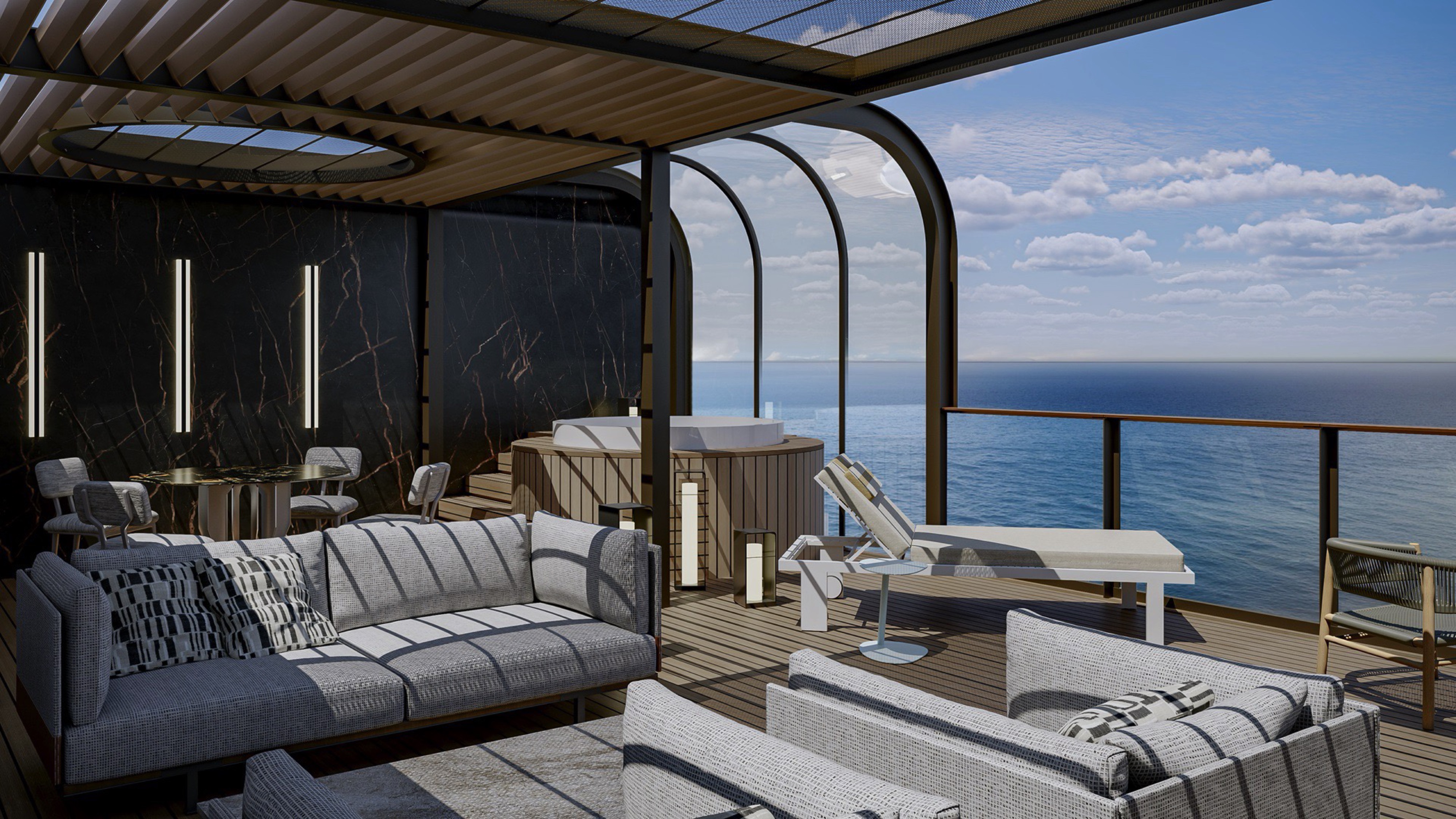
Introducing the Skyview Suites, one of twelve accommodation categories and available in three distinct layouts: Aura, Luna and Sola. These bespoke suites feature private in-suite elevators, second floor private terraces, the bespoke service of a personal butler, and so much more. Which will you choose?
Comprising 6 suites in total, the Skyview Aura Suite (2,024 sq. ft.), Skyview Luna Suite (1,728 sq. ft.), and Skyview Sola Suite (1,325 sq. ft.) will be situated on Decks 14 and 15 and offer a sophisticated, high-end residential feel. An in-suite elevator transports guests to a peaceful terrace deck with shaded areas and jetted tubs that provides stunning views and opportunities for al fresco dining. Creating a luxurious and timeless experience, each Skyview Suite has its own unique layout and character, with design elements that combine classical detailing, a color palette of cool greys with black accents and pops of ruby red, clean lines, plus luxurious materials. The living areas are styled with a refined tone-on-tone décor with jewel-hued accents, while the dining spaces feature custom millwork and sculptural furniture.
Ship renderings are artistic representations intended to provide a vision of the ship experience. Actual layouts, furnishings, and design elements may vary by deck, and specific location.
Grand Loft Suites
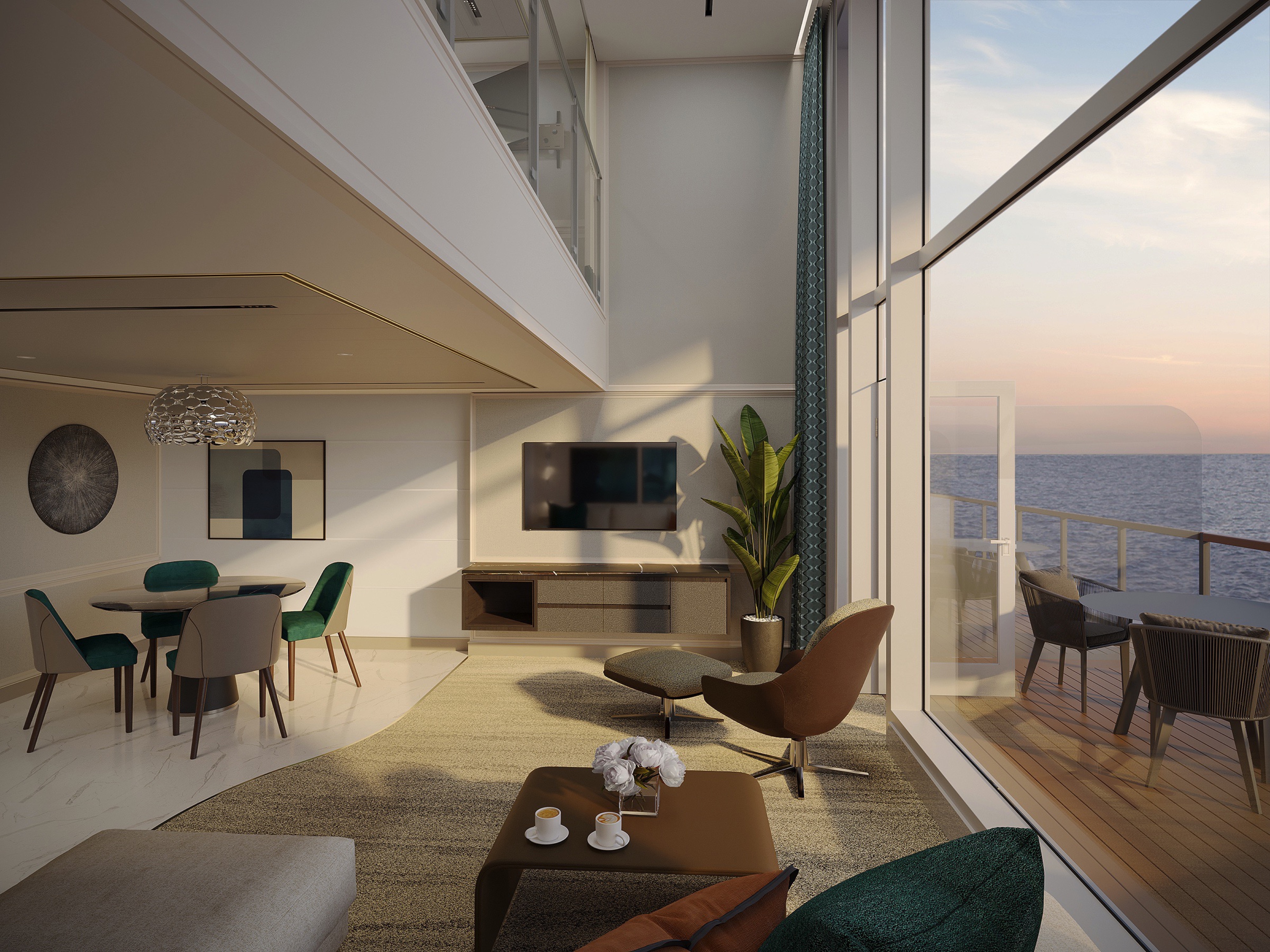
With its contemporary design, this double-story, 856-square-foot suite evokes the feel of a refined Lower Manhattan residence. A soaring double-height space and extraordinary window wall create jaw-dropping views from the upstairs bed, which faces directly toward the horizon.
Ship renderings are artistic representations intended to provide a vision of the ship experience. Actual layouts, furnishings, and design elements may vary by deck, and specific location.
Horizon Penthouse Suites
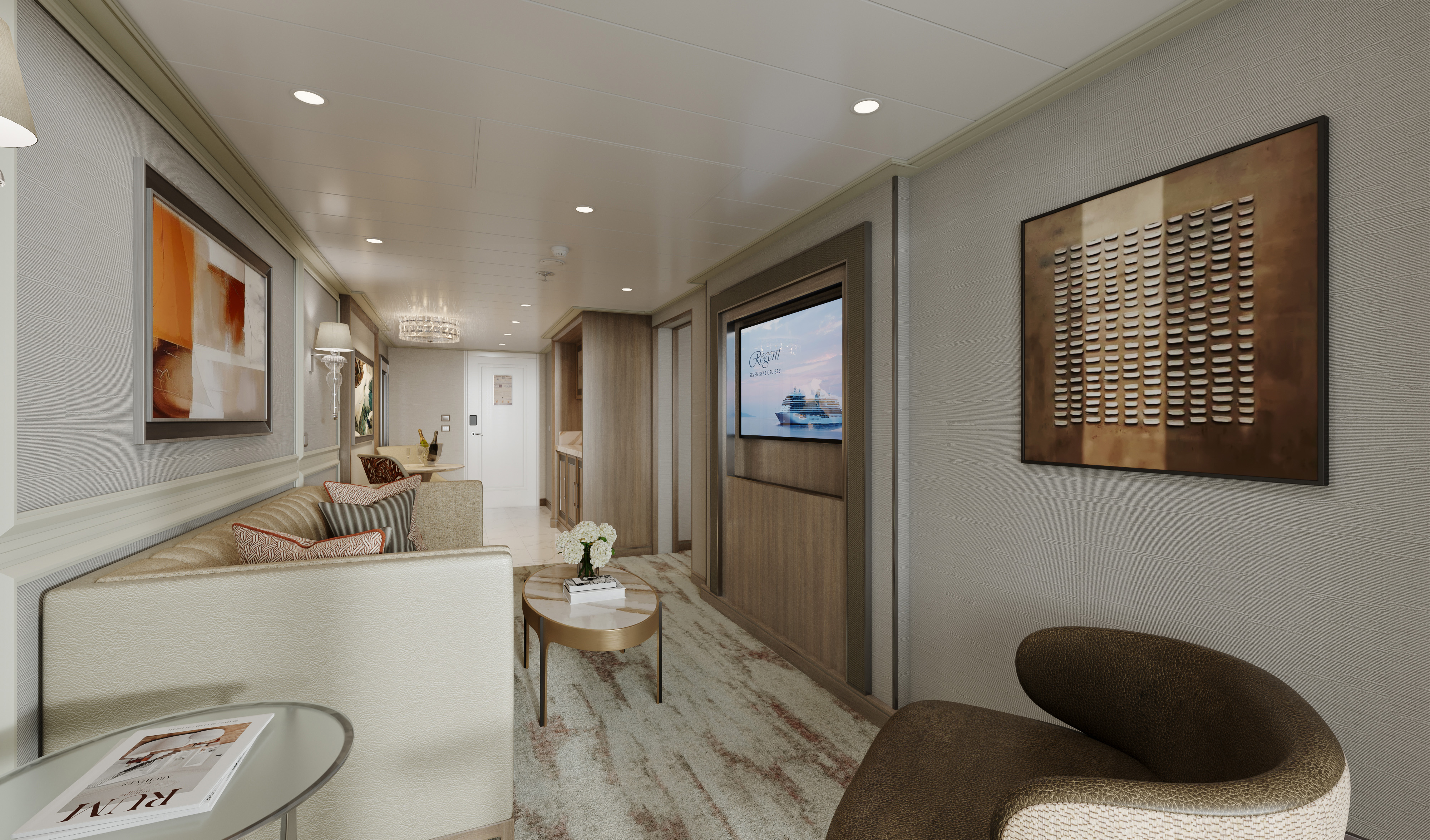
Featuring a beautifully appointed bedroom, full bath suite, and spacious living area — plus an oversized 182-263-square-foot balcony with outdoor dining, a plush sofa and sun loungers. These limited 15 suites allow the opportunity to enjoy a seamless blend of indoor elegance and open-air relaxation.
Ship renderings are artistic representations intended to provide a vision of the ship experience. Actual layouts, furnishings, and design elements may vary by deck, and specific location.
Signature Suites
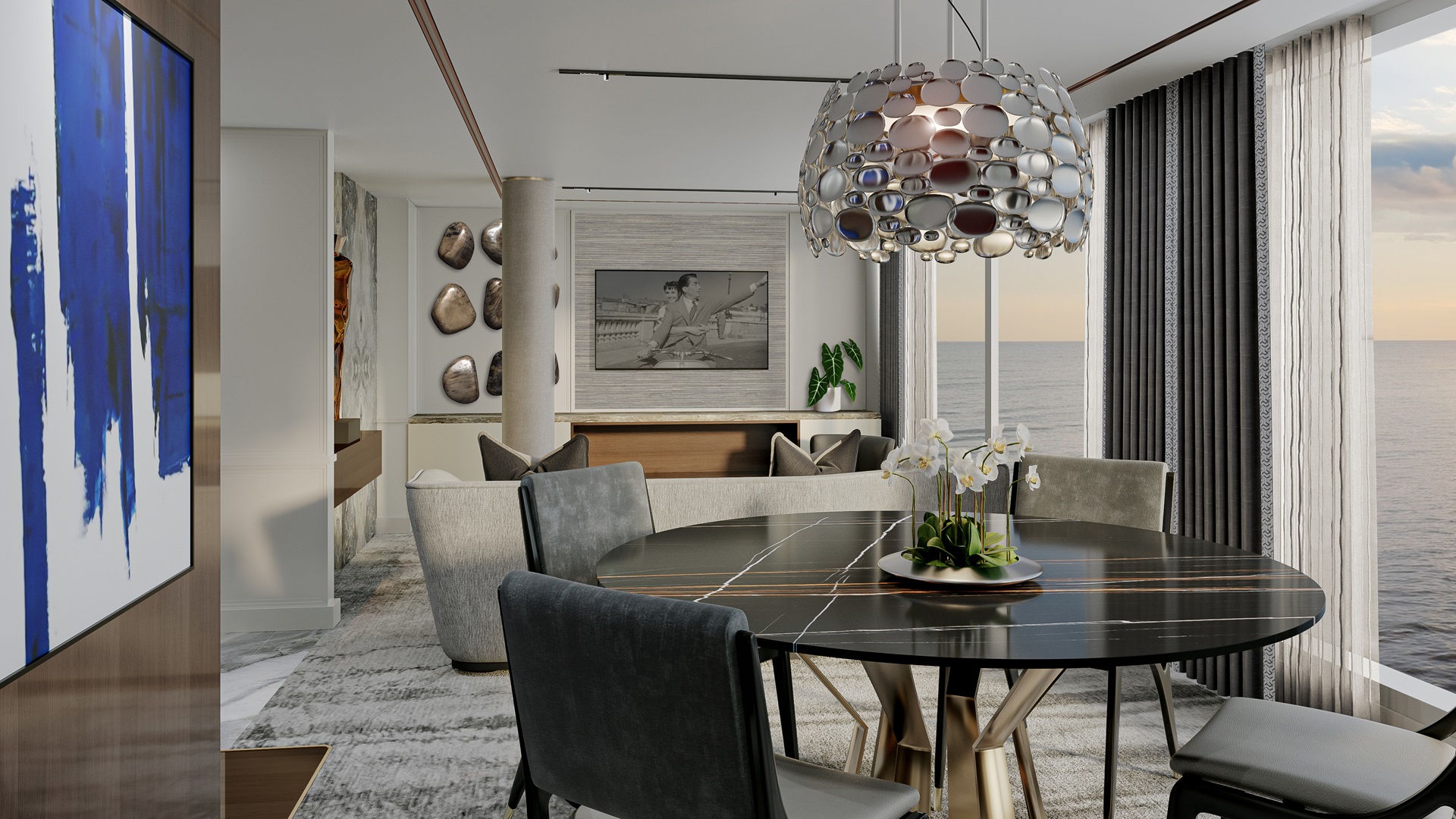
Offering a total of 2,037 sq. ft. the Signature Suites are outfitted with a rich color palette and the finest fabrics across two spacious bedrooms and two bathrooms, along with a generous living room. A private wraparound balcony — one of the largest at sea at 1,023 sq. ft. — extends the living space outdoors, making it ideal for entertaining or simply soaking in the view.
Ship renderings are artistic representations intended to provide a vision of the ship experience. Actual layouts, furnishings, and design elements may vary by deck, and specific location.
Grand Suites
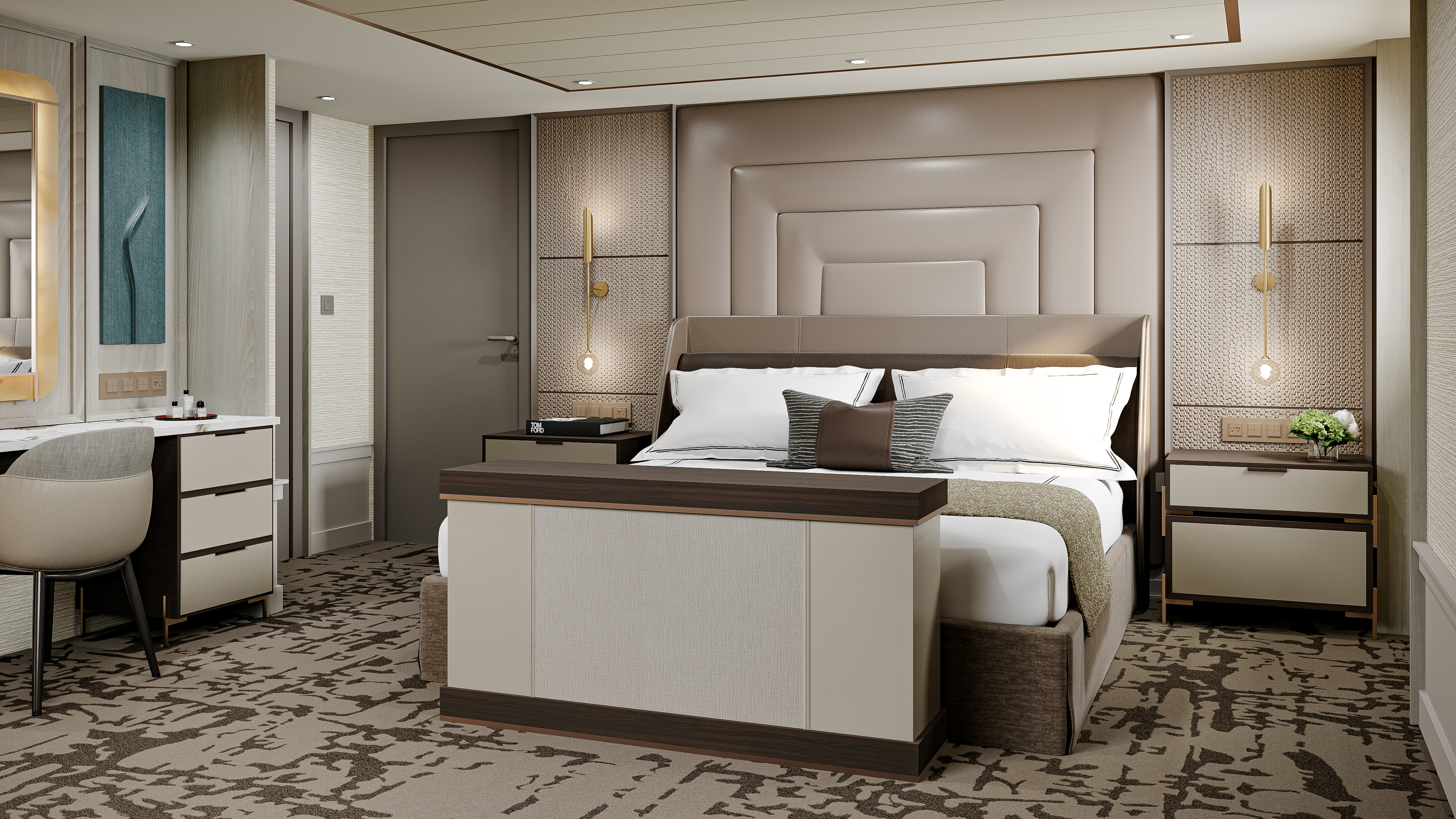
The Grand Suites feature clean lines, mid-century inspired furniture and a color palette that features neutrals with shades of green. The design highlights Italian artistry with textured fabrics and woven leather accents, creating a sophisticated and luxurious ambiance. At 1,214-1,417 sq. ft., the suite houses a private terrace as well as a dining room for in-suite meals.
Ship renderings are artistic representations intended to provide a vision of the ship experience. Actual layouts, furnishings, and design elements may vary by deck, and specific location.
Prestige Suites
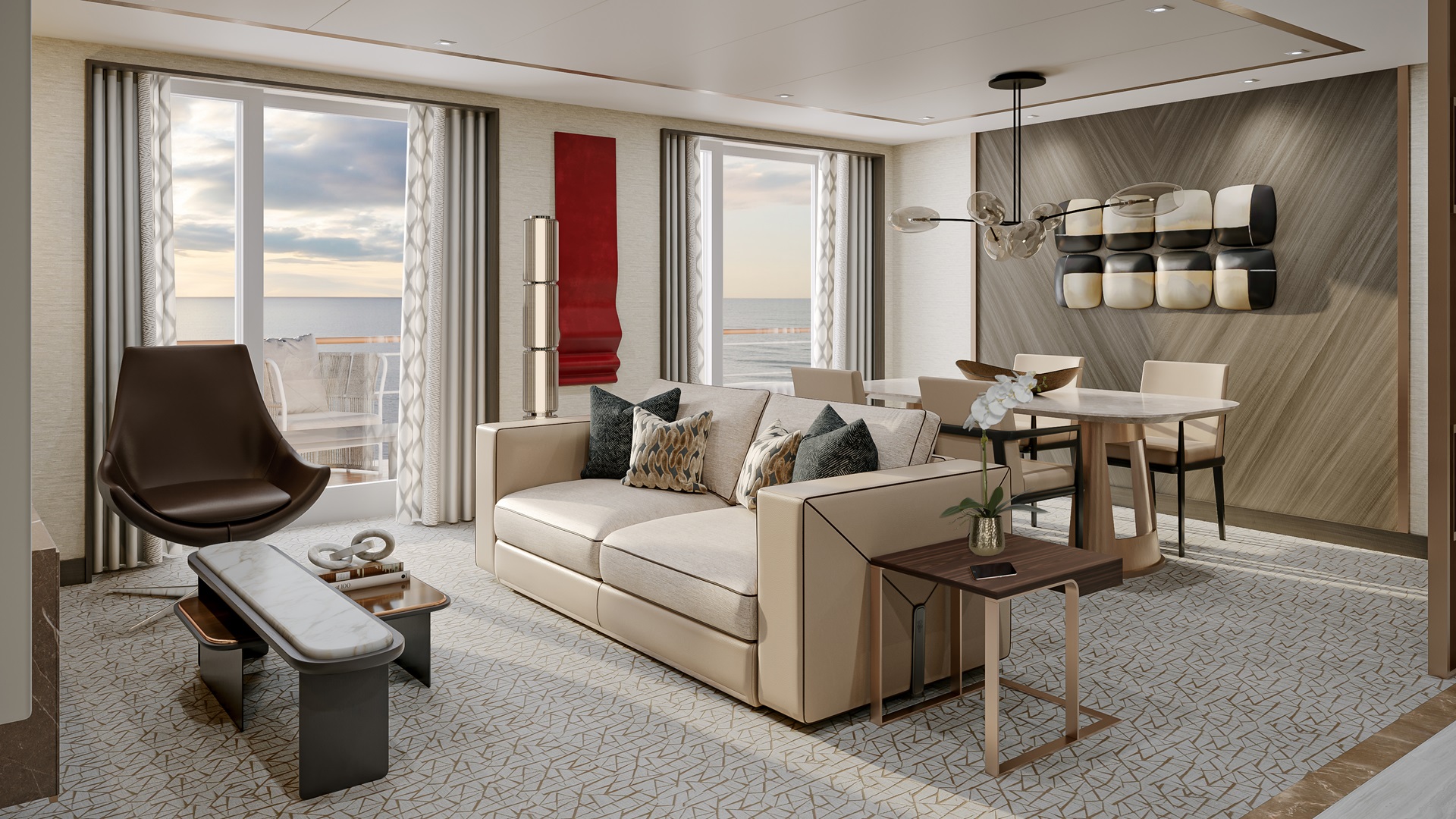
At 813-1,354 sq. ft., the thoughtfully designed Prestige Suites are the embodiment of refined living at sea. The one-bedroom, one-and-a-half bathroom suites are designed with calming hues of cream, gray and brown. They feature a dining table for in-suite service, a spacious closet and an elegant bath.
Ship renderings are artistic representations intended to provide a vision of the ship experience. Actual layouts, furnishings, and design elements may vary by deck, and specific location.
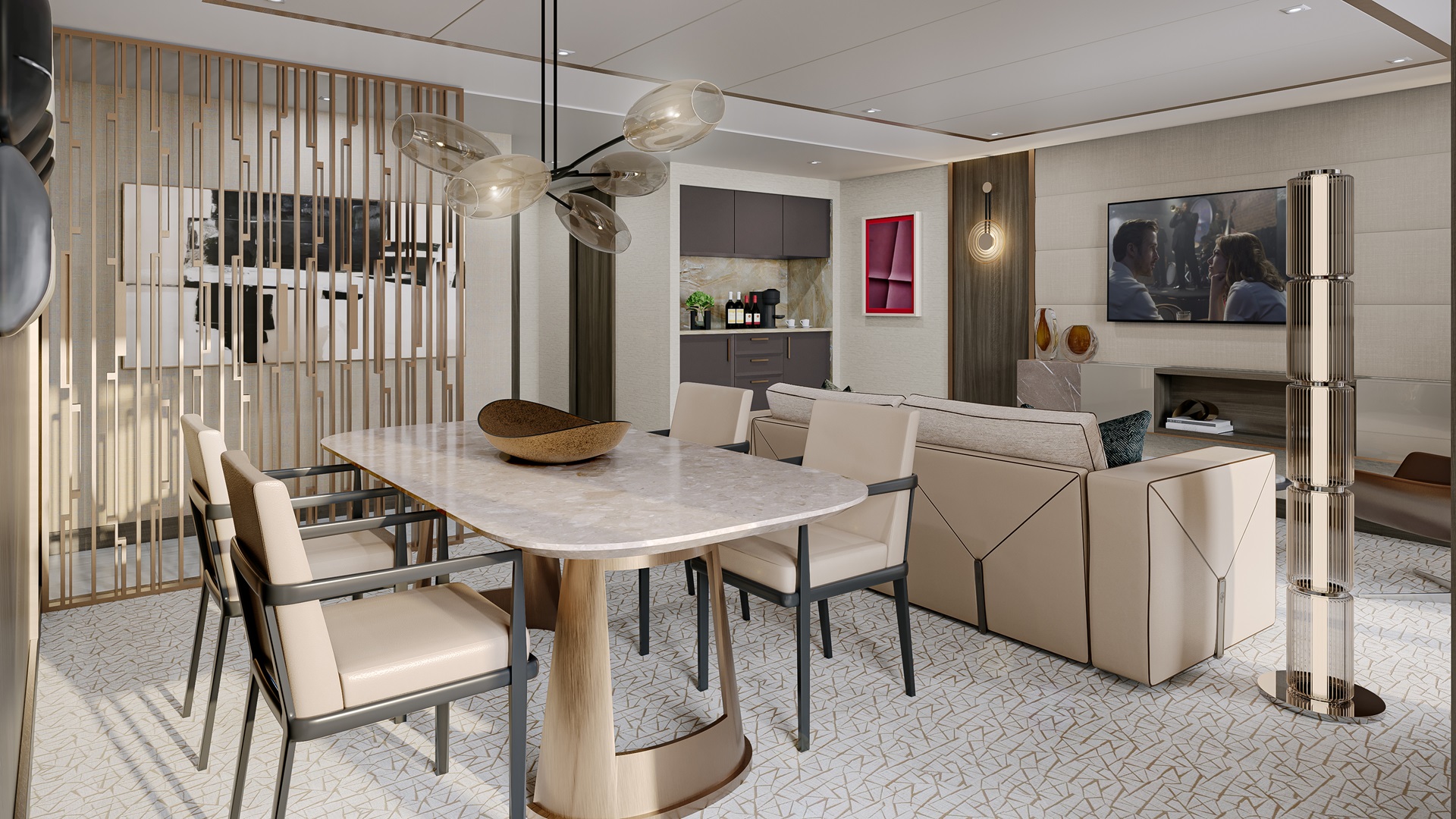
Seven Seas Suites
Providing 721 sq. ft. of luxury, the Seven Seas Suites have been designed with a soothing color palette complemented by plush furnishings. The suite flows effortlessly from the living room to the dining area to the bedroom, with sliding glass doorways leading to a spacious private balcony. A magnificent bathroom sits adjacent to the oversized bedroom and large walk-in closet.
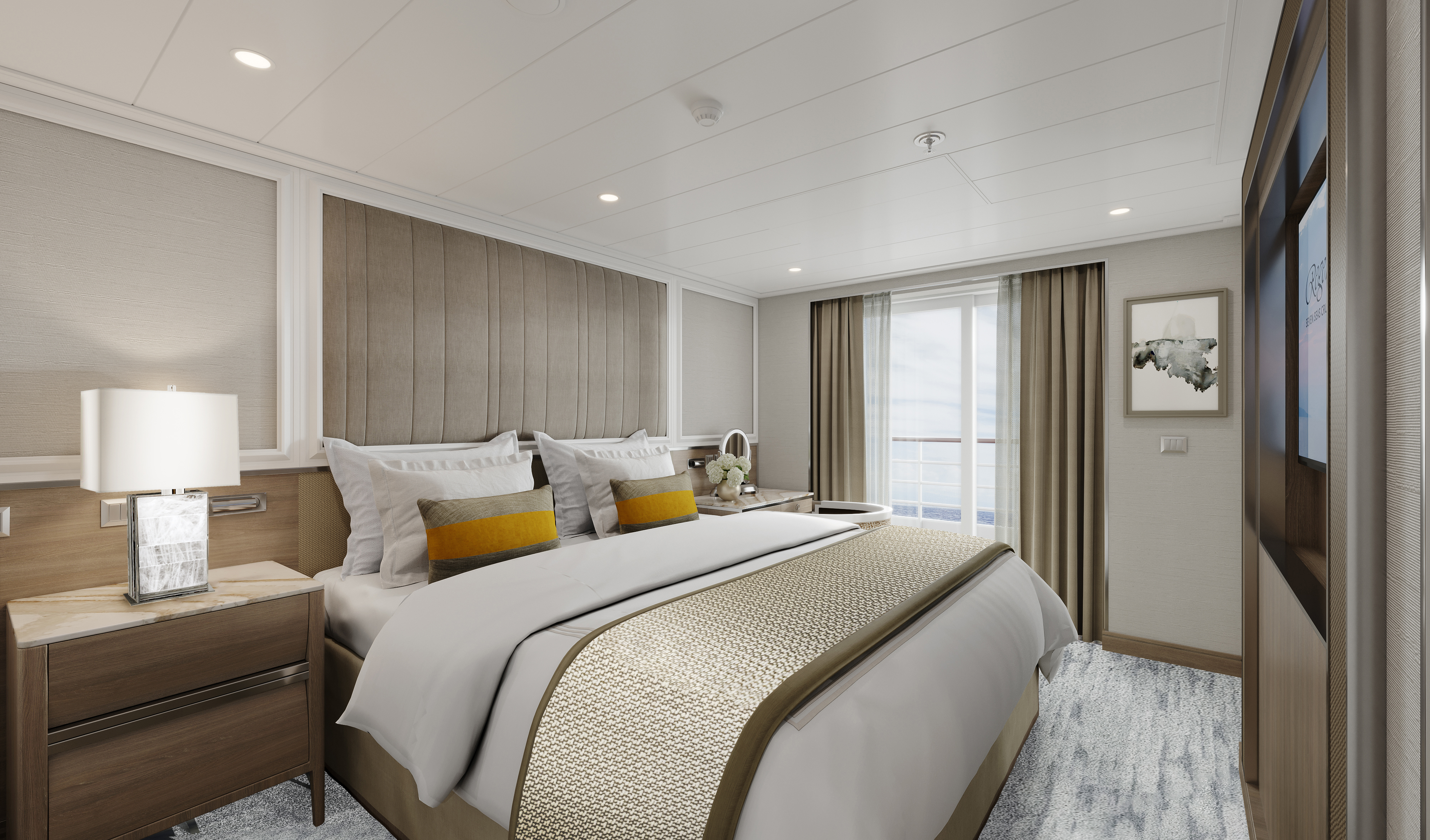
Penthouse Suites
This luxurious suite has been carefully designed to maximize space and comfort, with more than 600 square feet from door to balcony deck. As you make your way through the separated living and bedroom, you have the choice to section off the area with a pocket door for added privacy. Your Penthouse also features a spacious walk-through closet that offers ample storage.
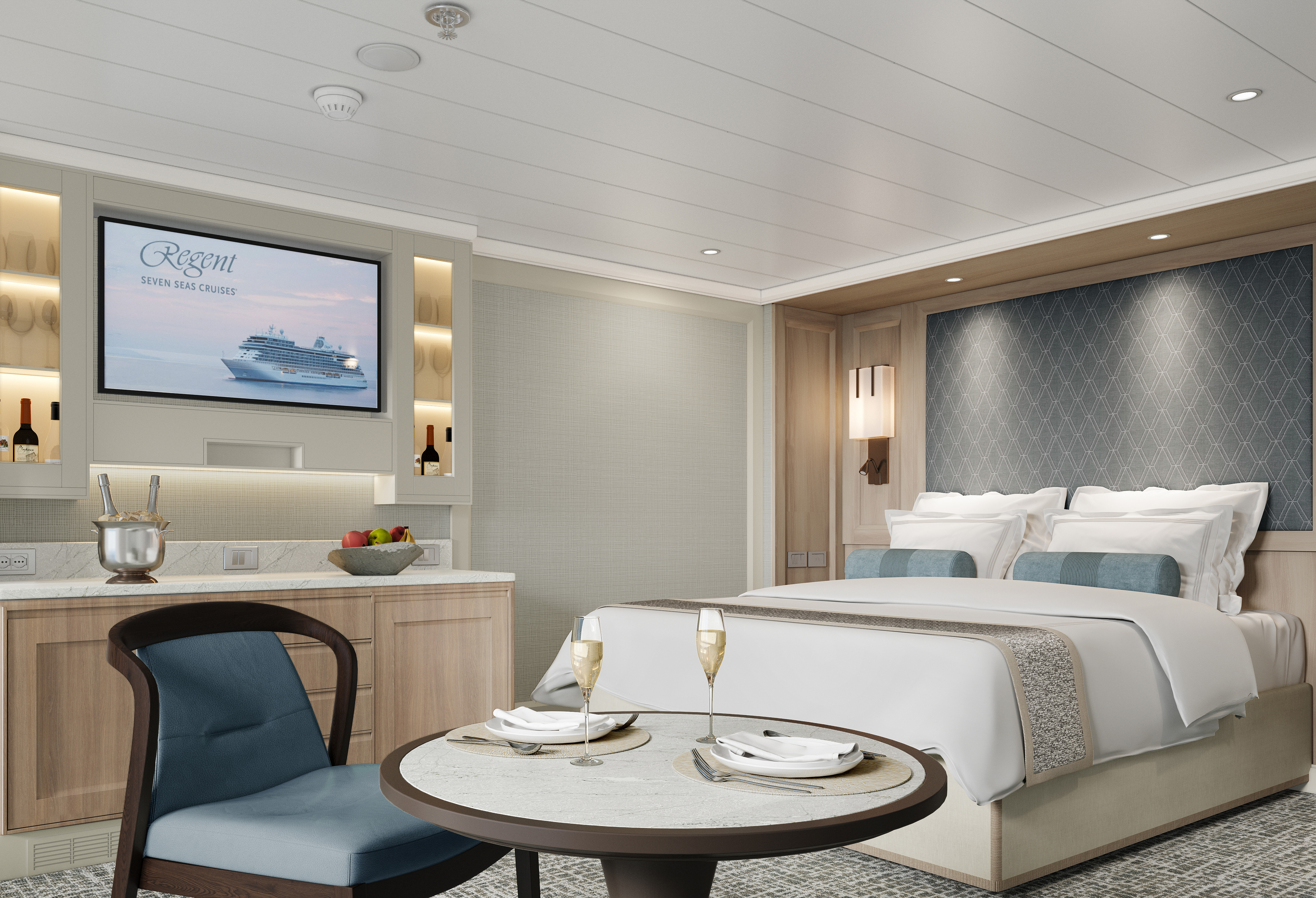
Concierge Suites
Ranging from 440 to 485 sq. ft. the Concierge Suites aboard Seven Seas Prestige offer a sophisticated retreat complete with a bathroom and a spacious, furnished veranda. Guests also enjoy the added benefits of priority online dining and shore excursion reservations, plus a one-night pre-cruise hotel package.
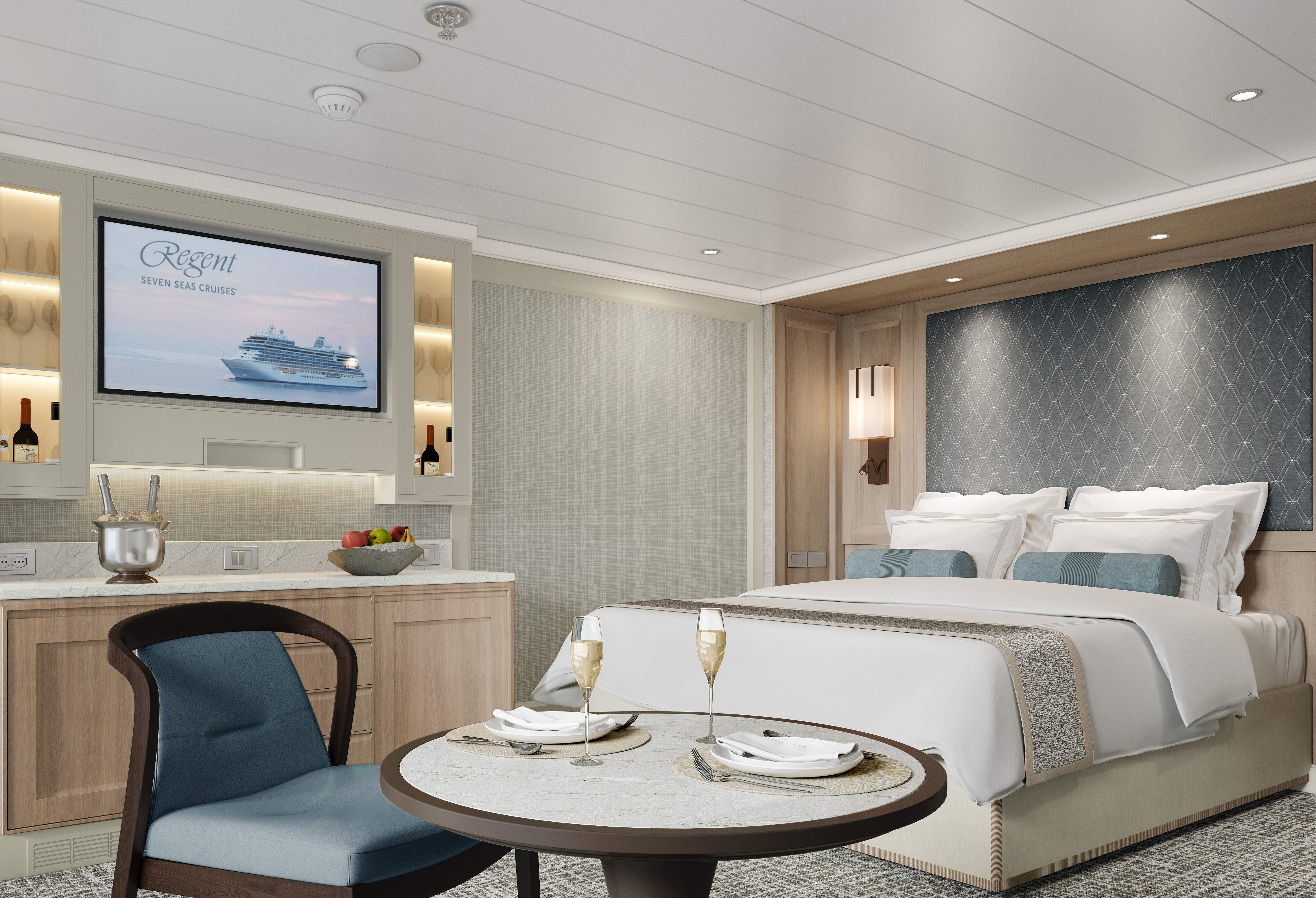
Serenity Suites
At 440 sq. ft., the Serenity Suites feature bluish teal accents, built-in minibars and screening elements that separate the bedroom and bathroom. Clean lines and contemporary detailing create a relaxing and inviting atmosphere.
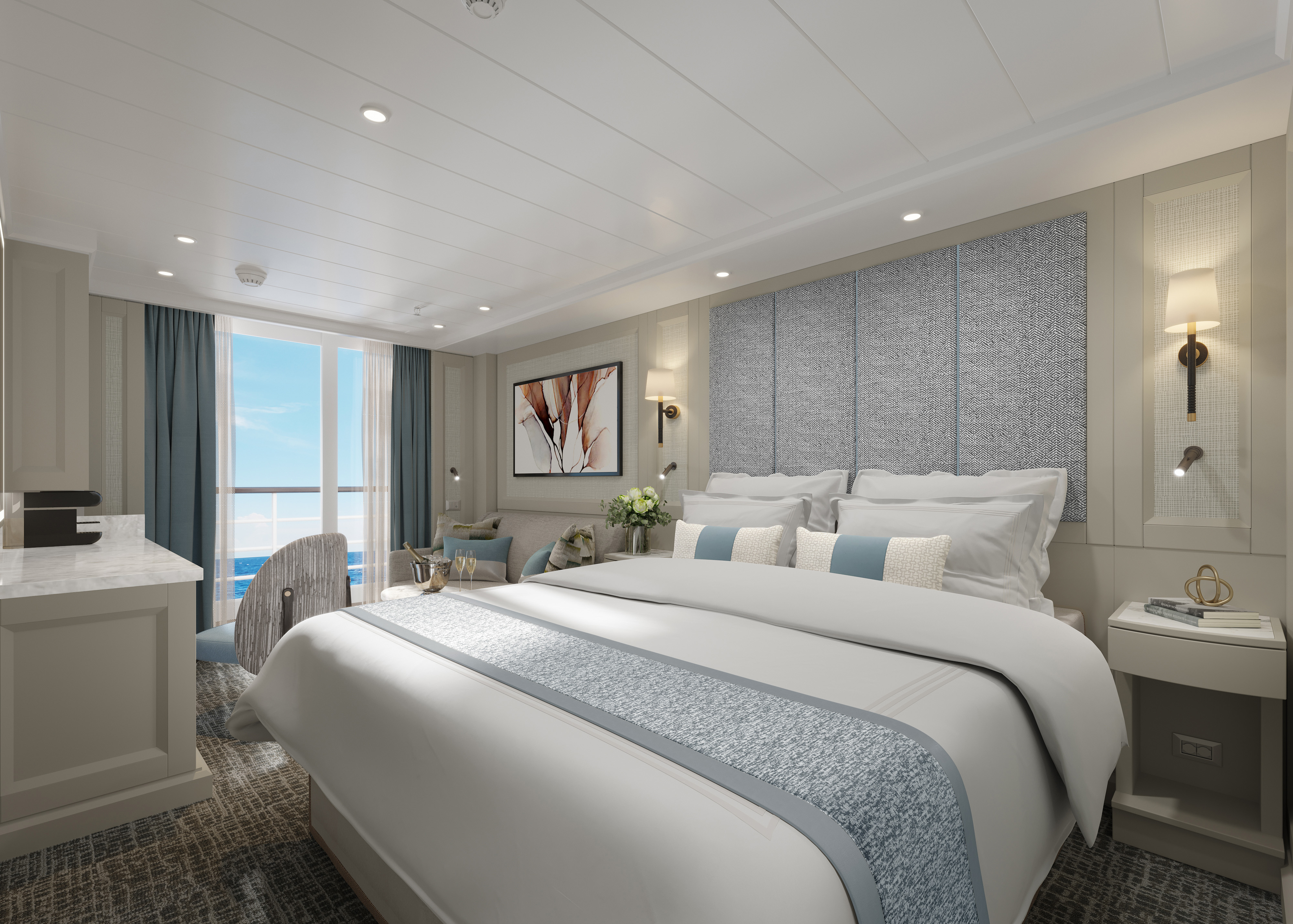
Deluxe Veranda Suites
The Deluxe Veranda Suites aboard Seven Seas Prestige offer 285-440 sq. ft. of refined comfort. Each features a private balcony and a European King-Sized Elite Slumber® Bed.
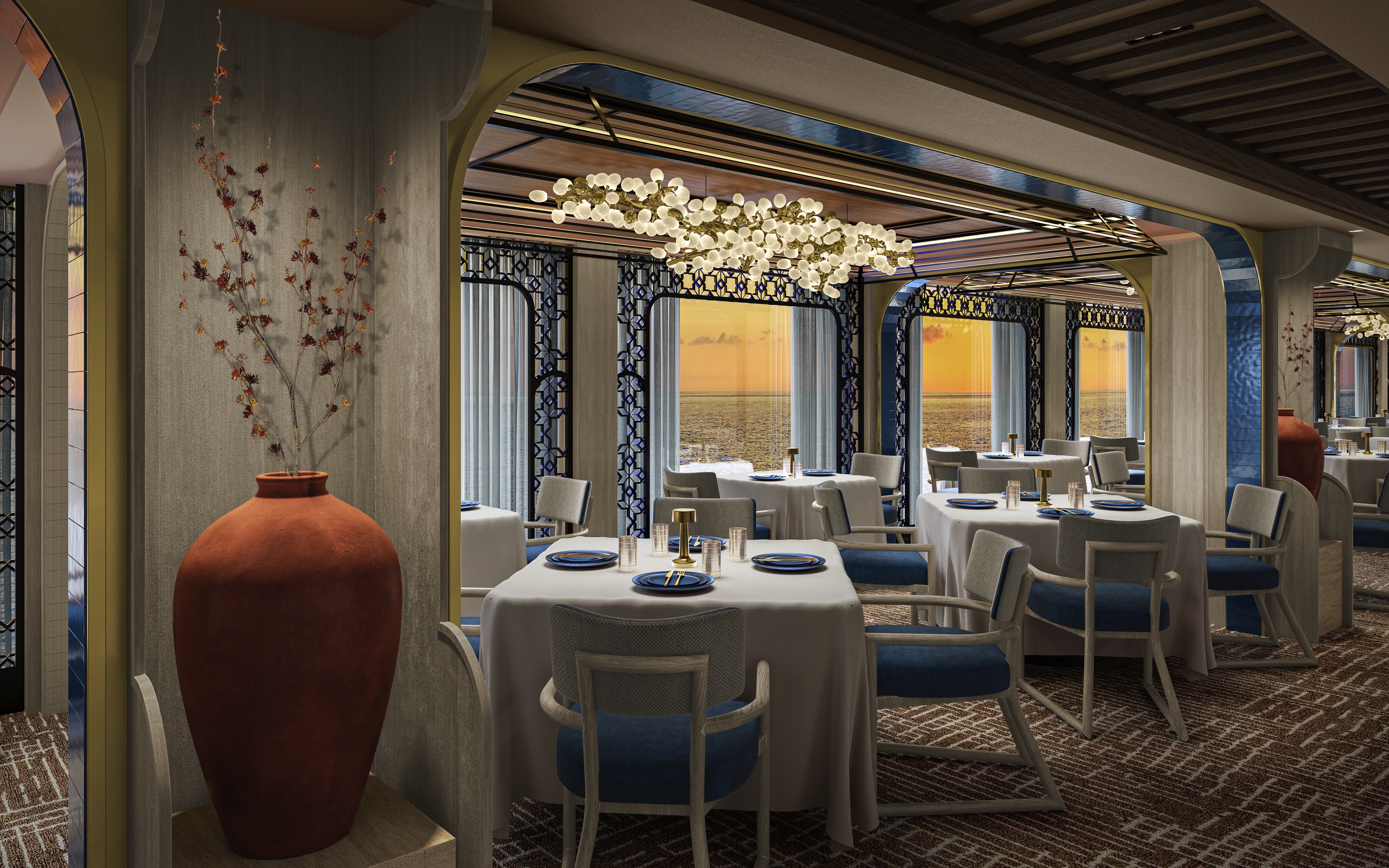
Azure
Unique mezze-style dining concept inspired by the Mediterranean’s varied cultural tapestry.
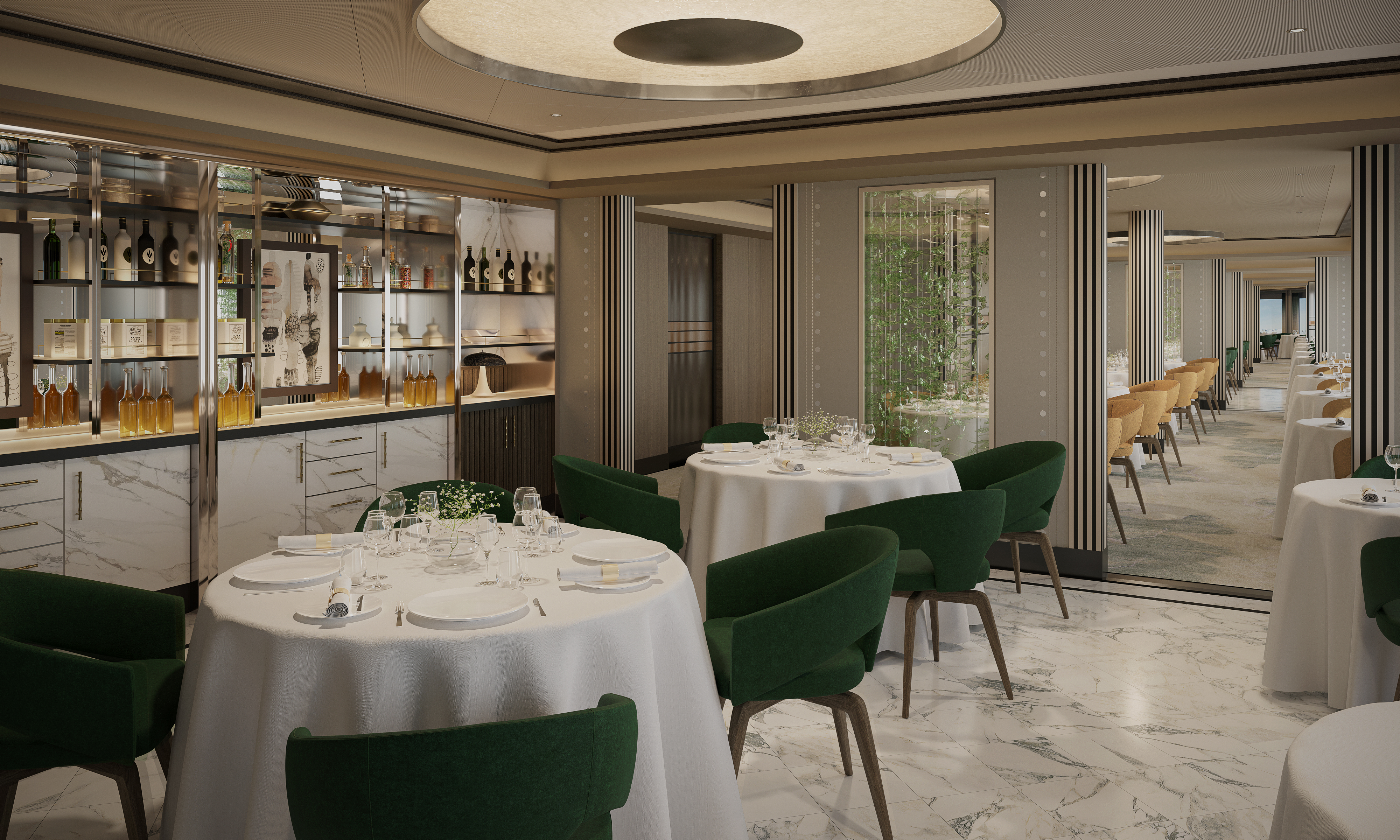
Chartreuse
Offering classic French fare with a modern twist.
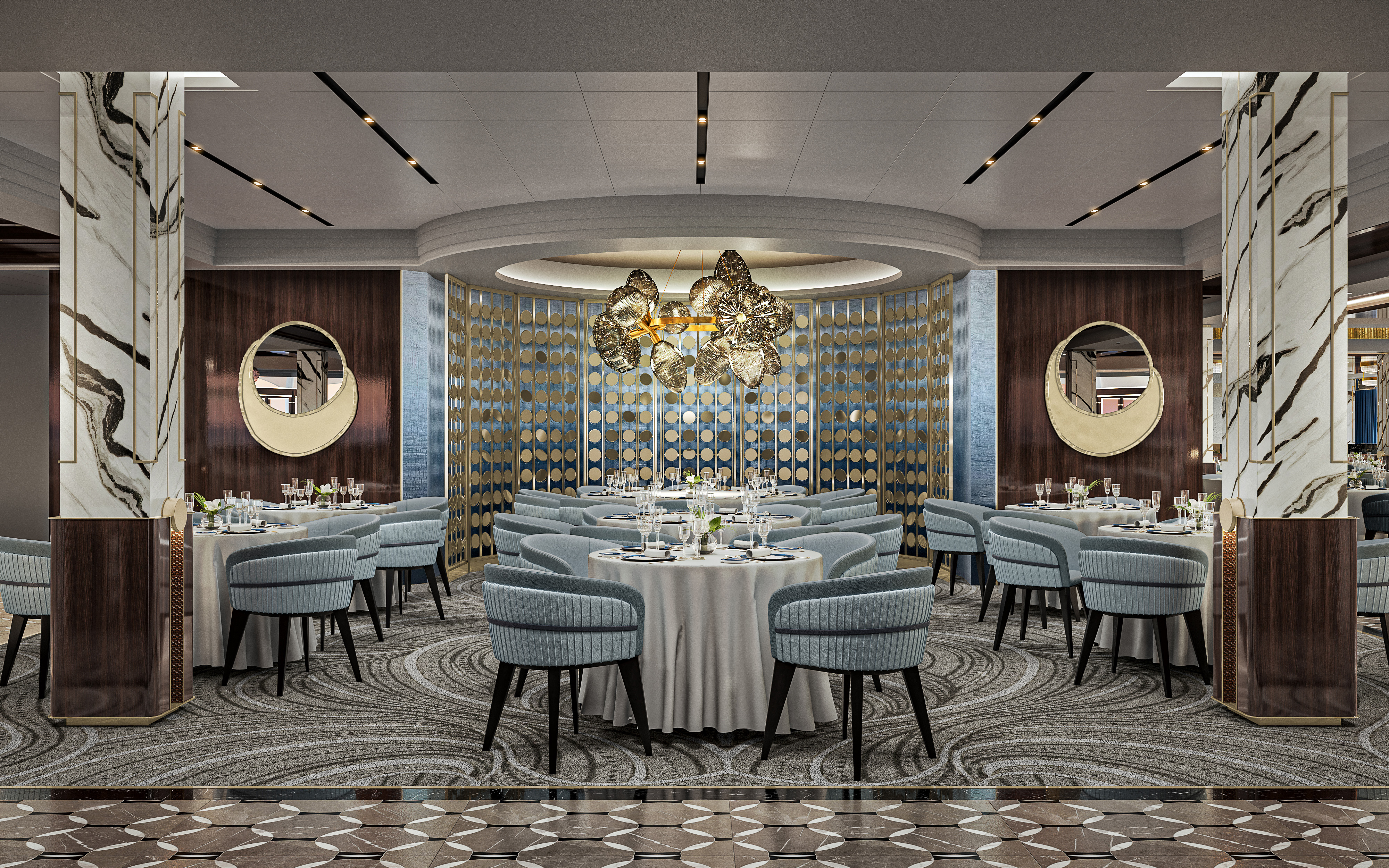
Compass Rose
The largest specialty restaurant at sea, where you can customize your meal every night.
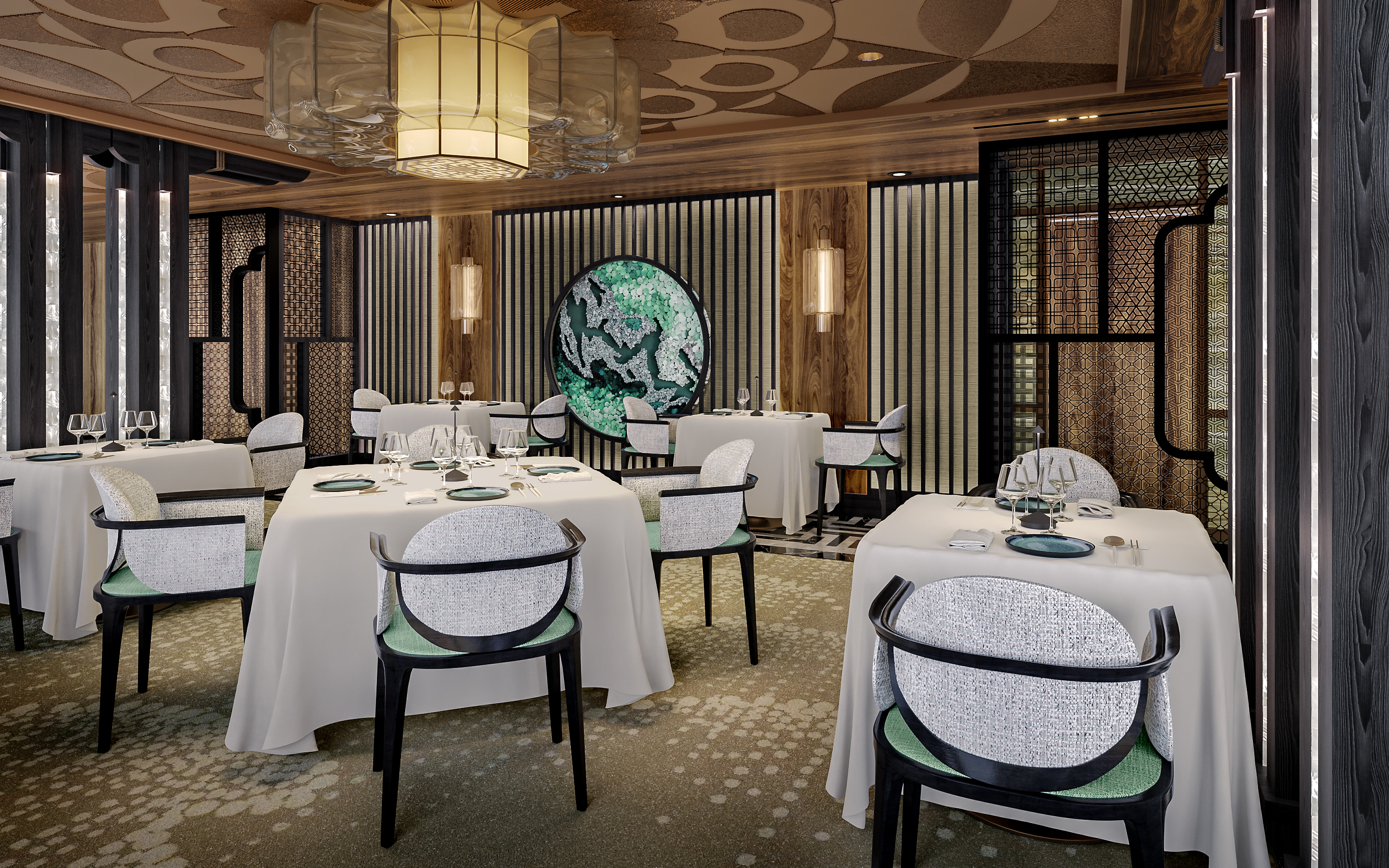
Pacific Rim
A dramatic Pan-Asian dining experience.
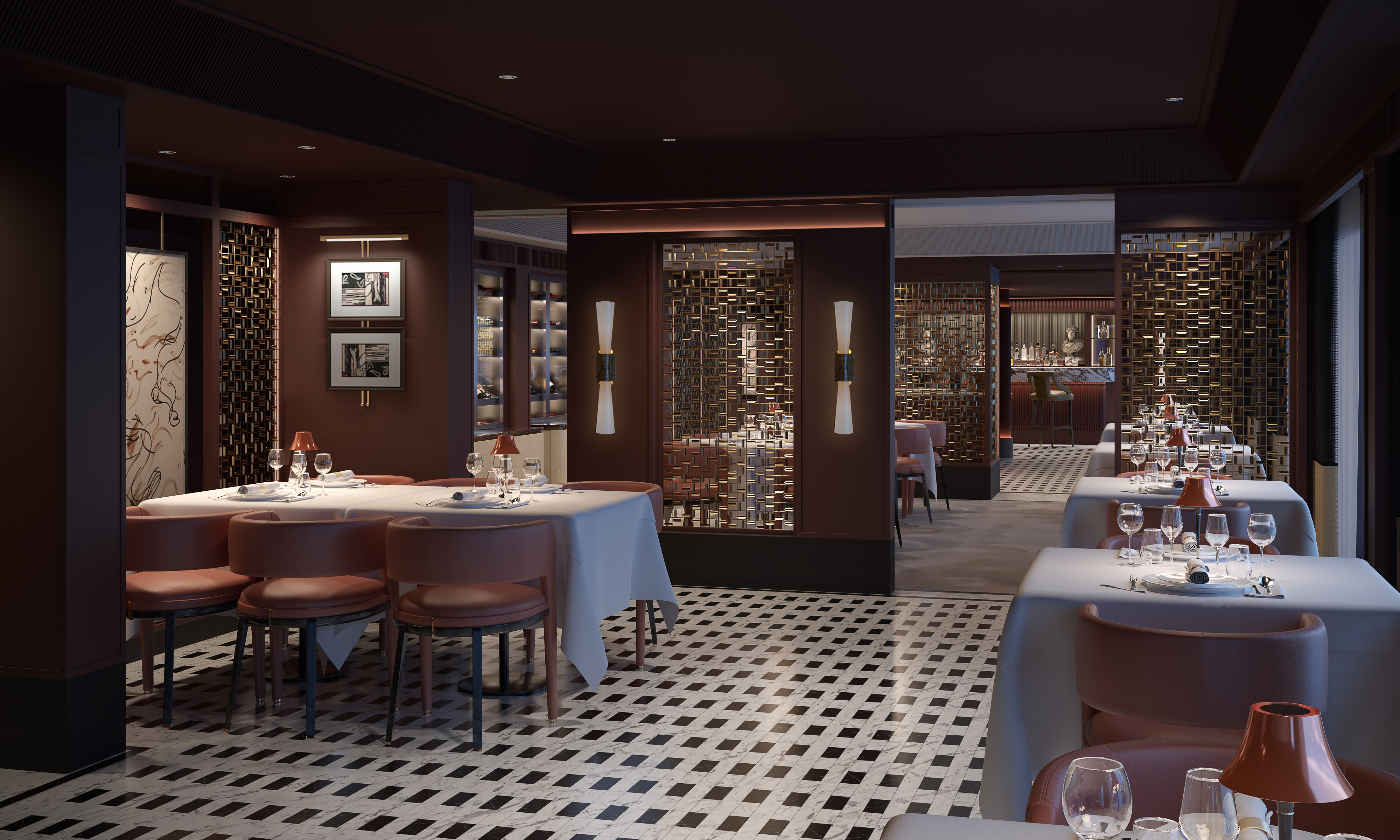
Prime 7
An intimate and elegant steakhouse.
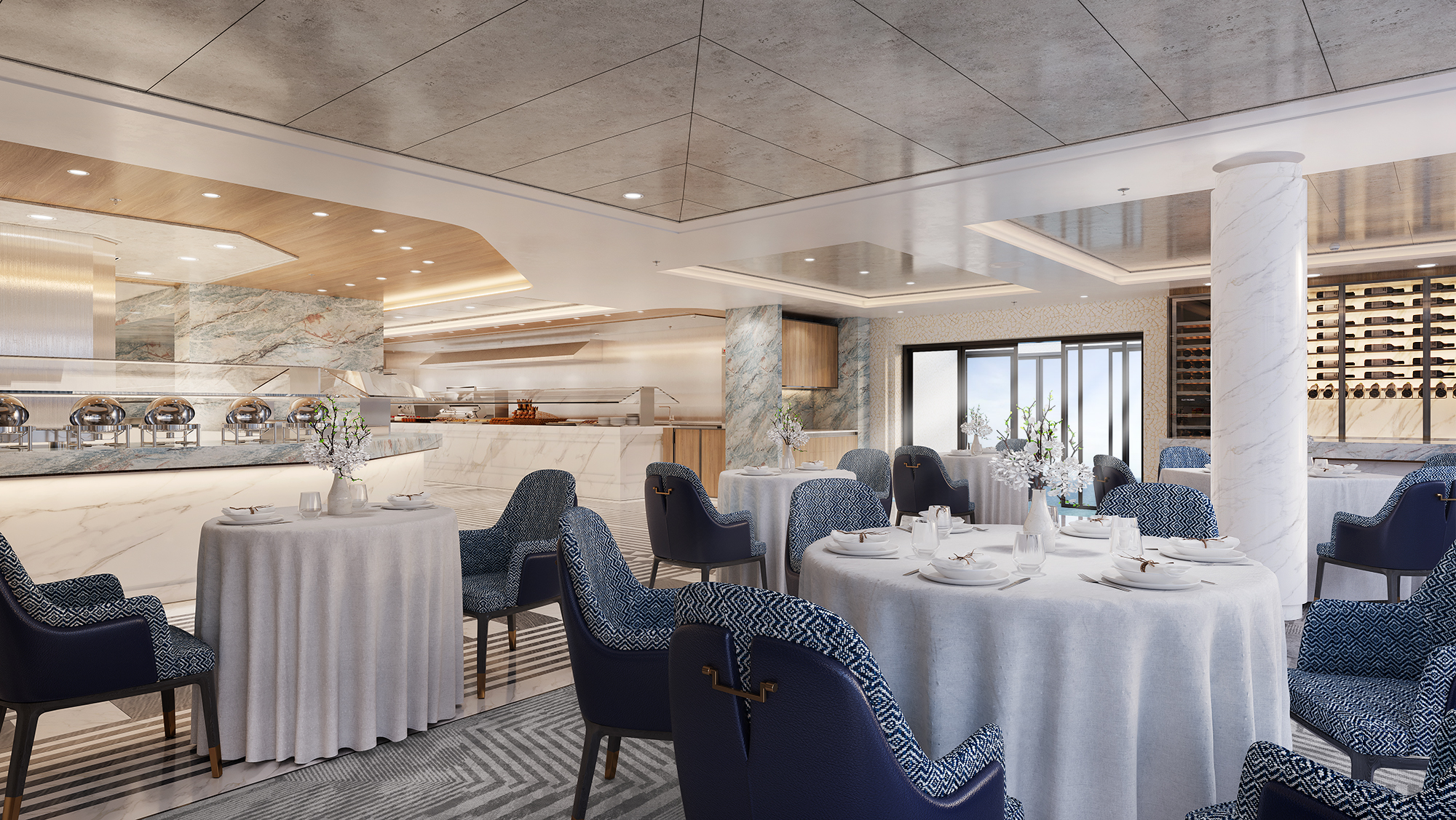
La Veranda
Where guests to enjoy sumptuous breakfasts and lunch buffets.
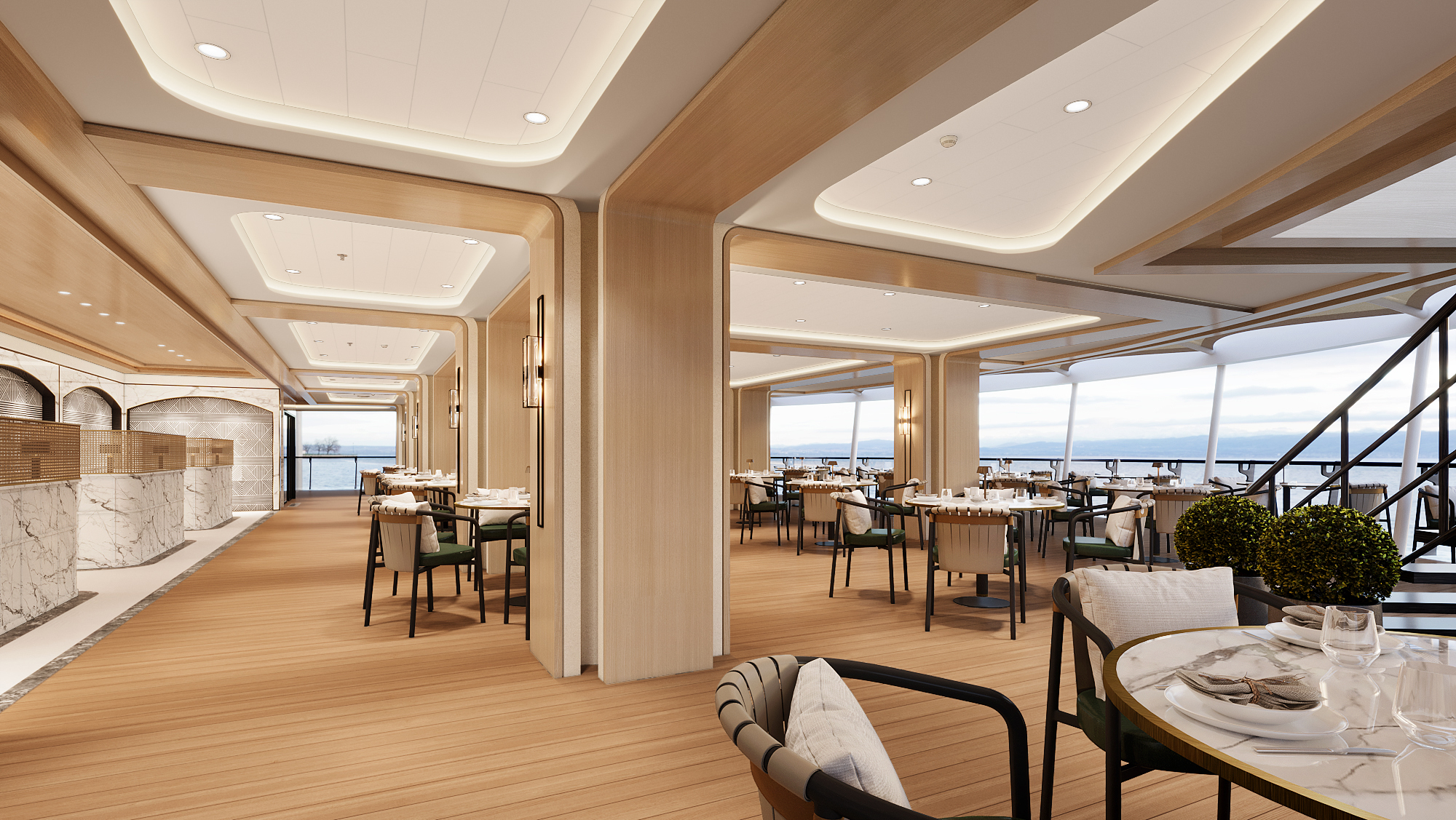
Sette Mari at Le Veranda
Serving authentic Italian specialties and boasting the most expansive al fresco dining area ever seen aboard Regent.
Gourmet Explorer Tours
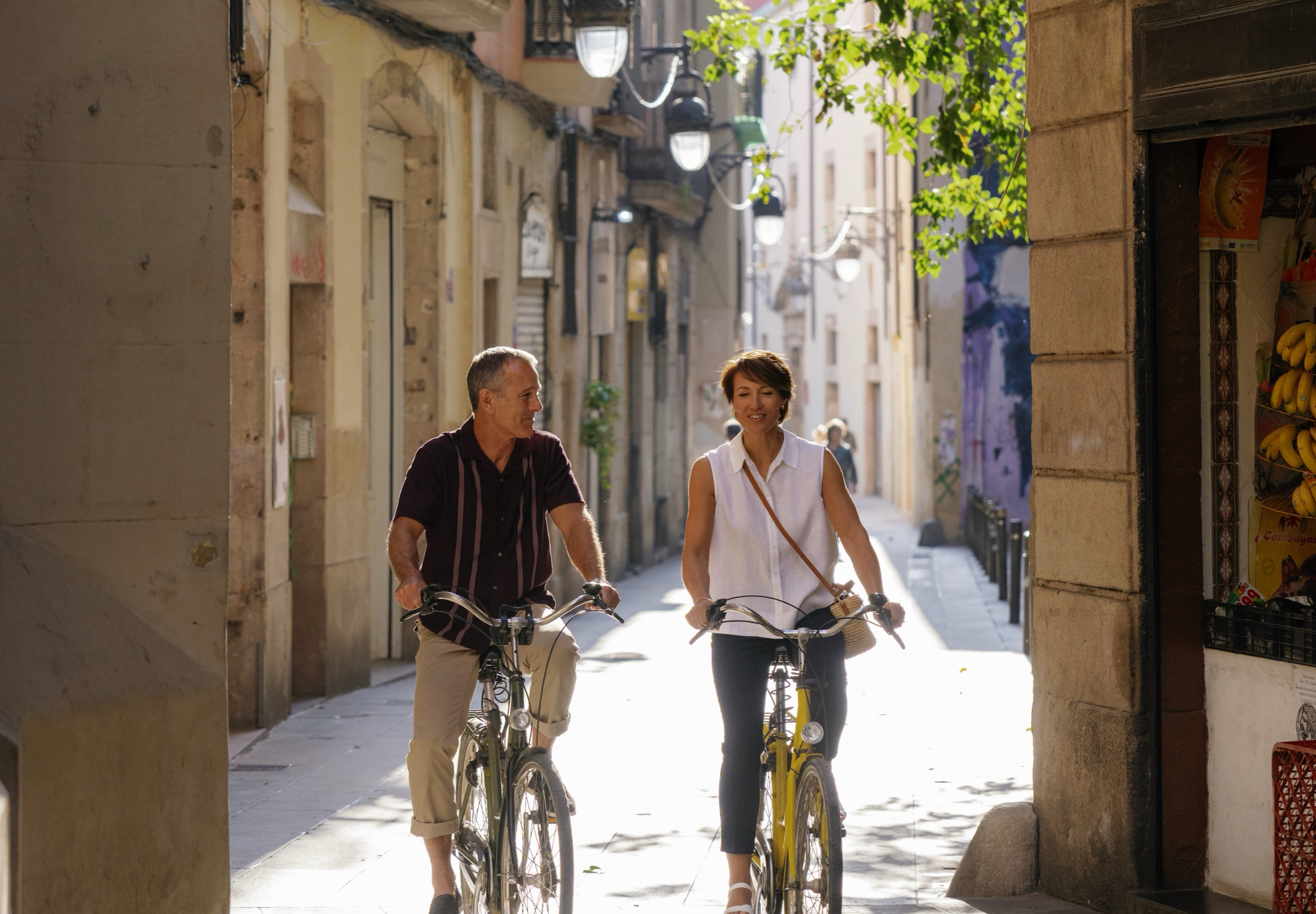
Our distinctive Gourmet Explorer Tours, offered exclusively aboard Seven Seas Explorer, allows guests the unique opportunity to experience the culinary culture of the world’s most delicious destinations. From savouring the authentic flavours of a region to learning new techniques in local cooking classes, guests can choose from a variety of optional tours that take them to local markets to find exotic spices, sample delicious wines at breathtaking estates and savour gourmet meals expertly prepared by renowned chefs. Due to their unique itineraries, Gourmet Explorer tours require a discounted, supplementary charge.
Regent Choice Shore Excursions
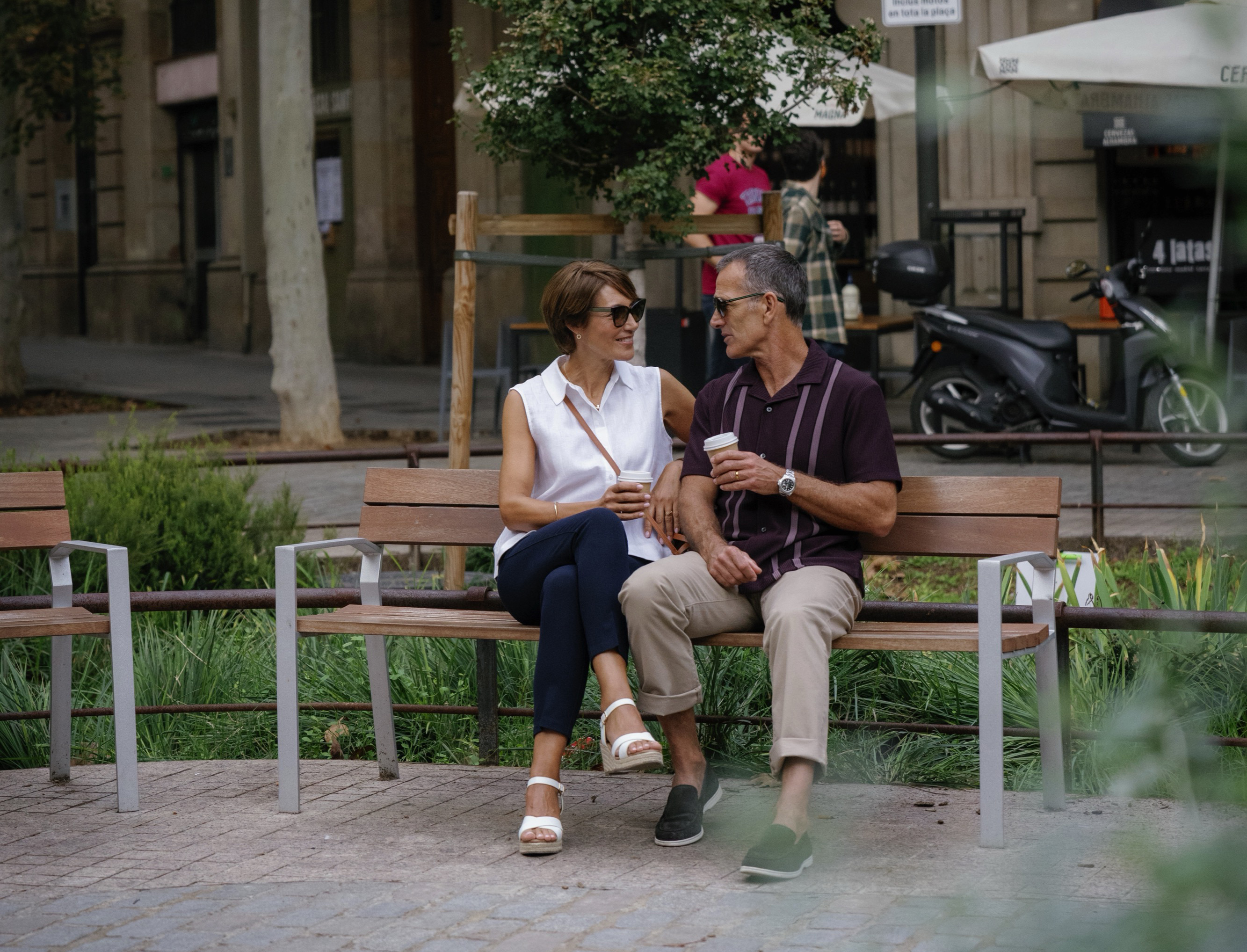
Take your experience to another level with the select itineraries and smaller group tours offered by our Regent Choice Shore Excursions. These unique opportunities require a discounted, supplementary charge and invite you to discover the heights of travel, from our Gourmet Explorer Tours to special experiences that take you off the beaten path.
As the name suggests, these excursions work a little harder to engage your explorer spirit. Unique itineraries and smaller groups create more personal experiences… and memories of a lifetime.
UNIQUE, UNPARALLELED EXPERIENCES
Soaring over Alaskan forests and mountains via helicopter en route to feeling the majesty of Mendenhall Glacier beneath your feet. Discover the best our world has to offer through the unparalleled experiences you’ll enjoy with Regent Choice Shore Excursions.
Enhance your shoreside experience with a Regent Choice Small Group tour. Hosting up to 16 guests, these tours provide a more intimate experience and allow for more personal engagement with your knowledgeable guide.
Starlight Atrium
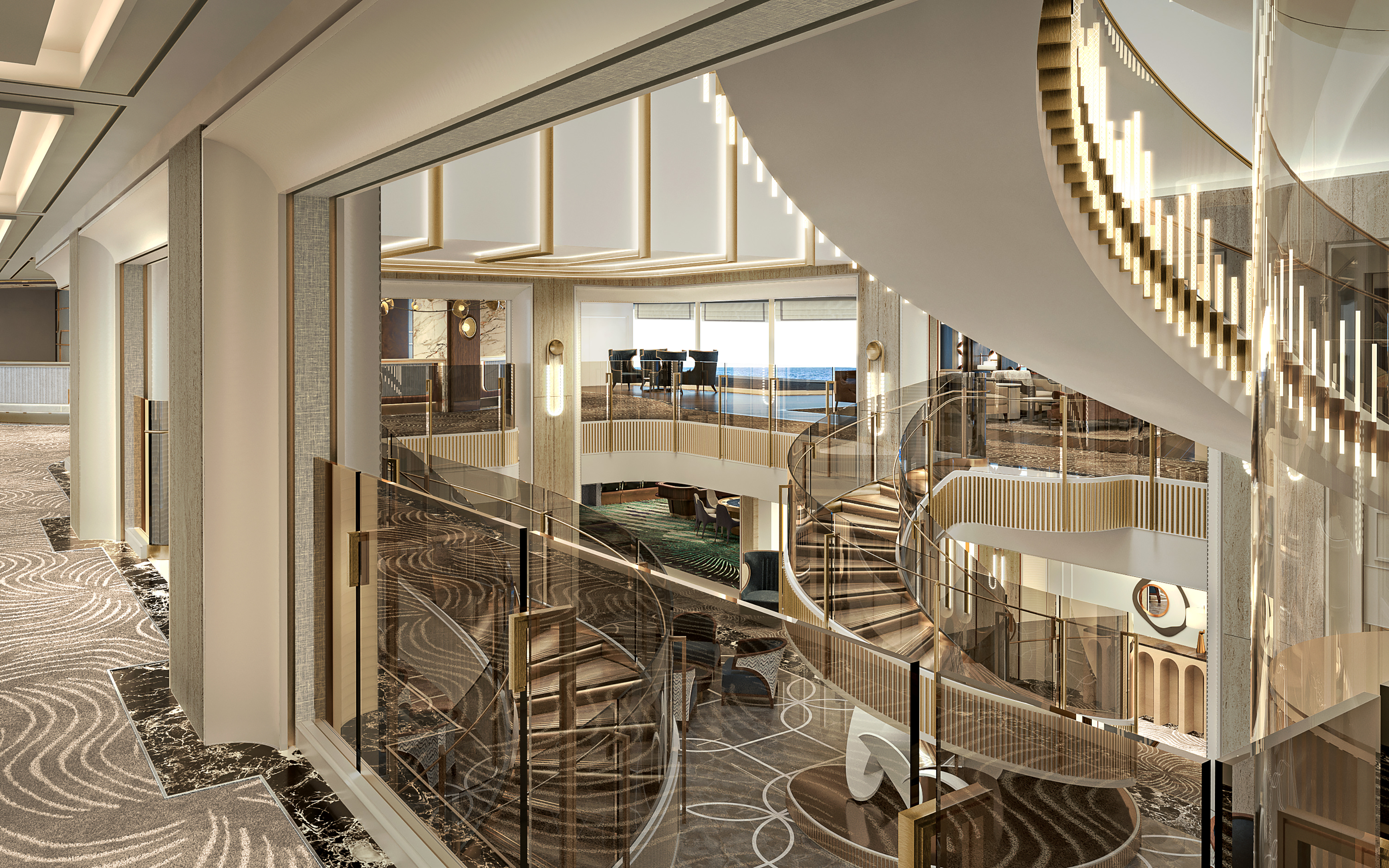
Embodying a blend of old-world elegance and modern sophistication, the Starlight Atrium recalls an era of quality craftmanship and style, illuminated by a glass-enclosed ceiling that allows sunlight and starlight to grace the space.
Not only a place for quiet contemplation while enjoying a glass of Champagne, or practical matters with essential guest services, the Starlight Atrium’s generous space connects multiple guest amenities across decks 4 & 5, such as Galileo’s Bar, the Casino, Prestige Lounge, Meridian Lounge, Coffee Connection, concierge desk and reception.
On deck 5, alcoves with sculptural furniture and curated art offer breathtaking ocean views—the perfect place to watch the sun rise or slip beyond the horizon at the end of a perfect day. Designed with a neutral palette of dusty rose, taupe, and cream, combined with embellished trims and fringed pillows, the alcoves harken back to old-world detailing.
Galileo's Bar
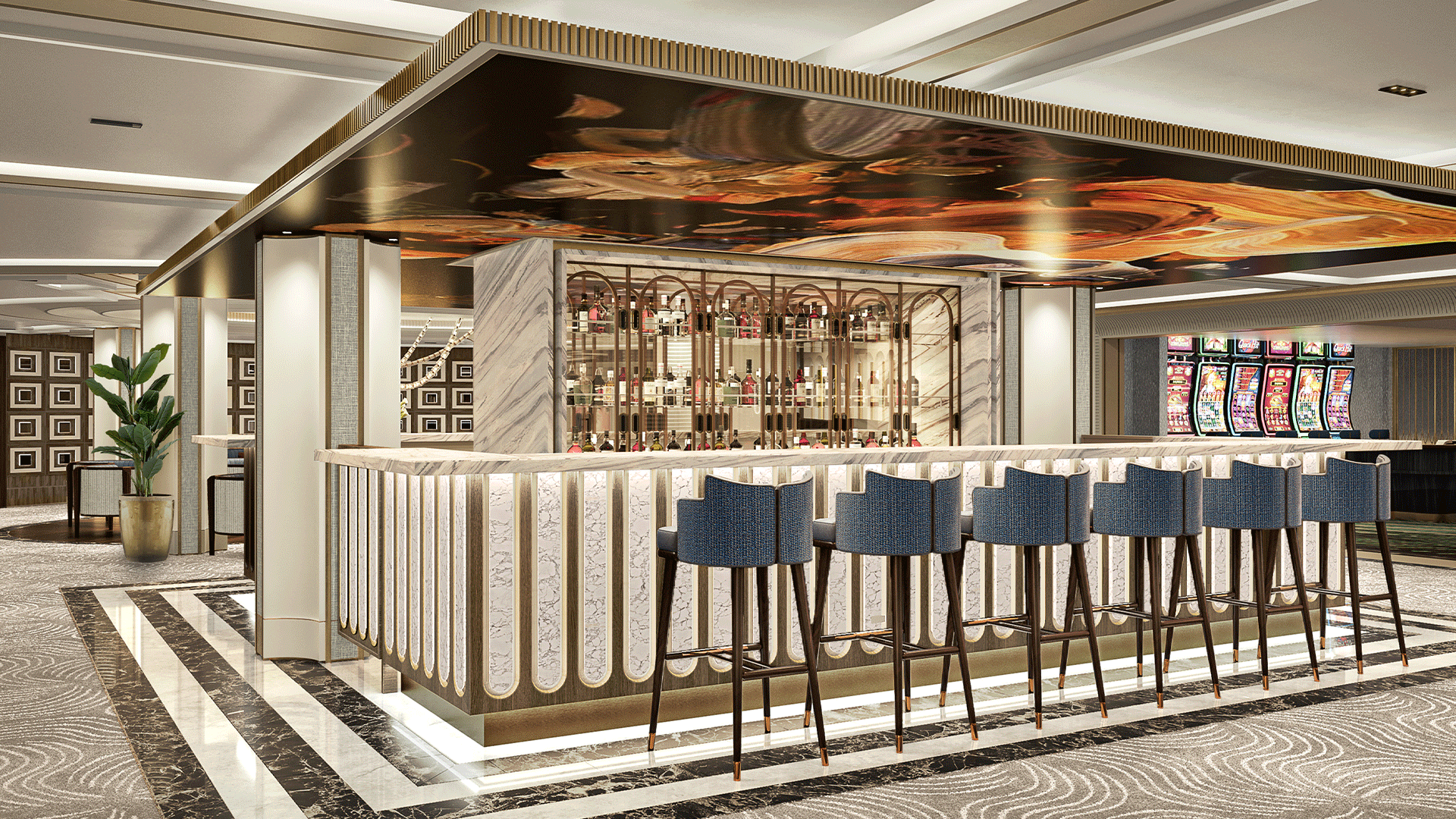
Galileo’s Bar is strategically placed to serve both the Prestige Lounge and adjacent casino. The bar’s ceiling is a canvas displaying a contemporary masterpiece styled like an oil painting, framed by fretted metal detailing.
The base of the bar features fluted elements, and the bold, striped floor highlights the bar’s footprint, creating a focal point for the Starlight Atrium; it is the place for guests to indulge in complimentary premium beverages that come as standard with a Regent sailing.
From the bar, views of the spiral staircases extend back into the Starlight Atrium on both port and starboard sides. The walls, clad in a limestone texture, are adorned with sconces designed to resemble jewellery, adding a touch of glamour.
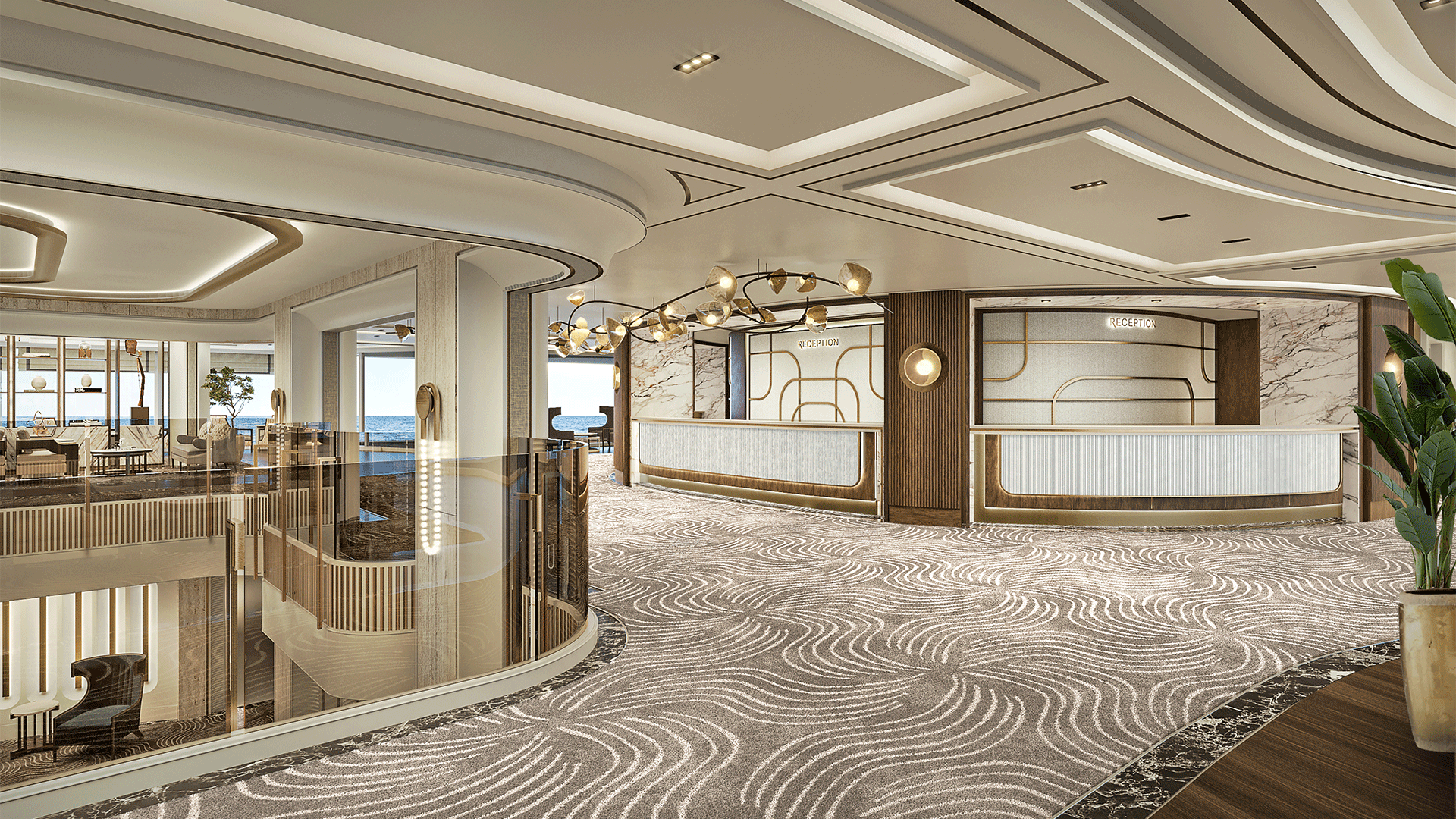
Reception
The reception area, also on deck 5, features pleated leather panels and a light fixture crafted from handblown glass and ceramic pearls. From the lifts, looking back towards Galileo’s Bar, walls are framed with paneling and artwork, creating a traditional yet modern aesthetic.
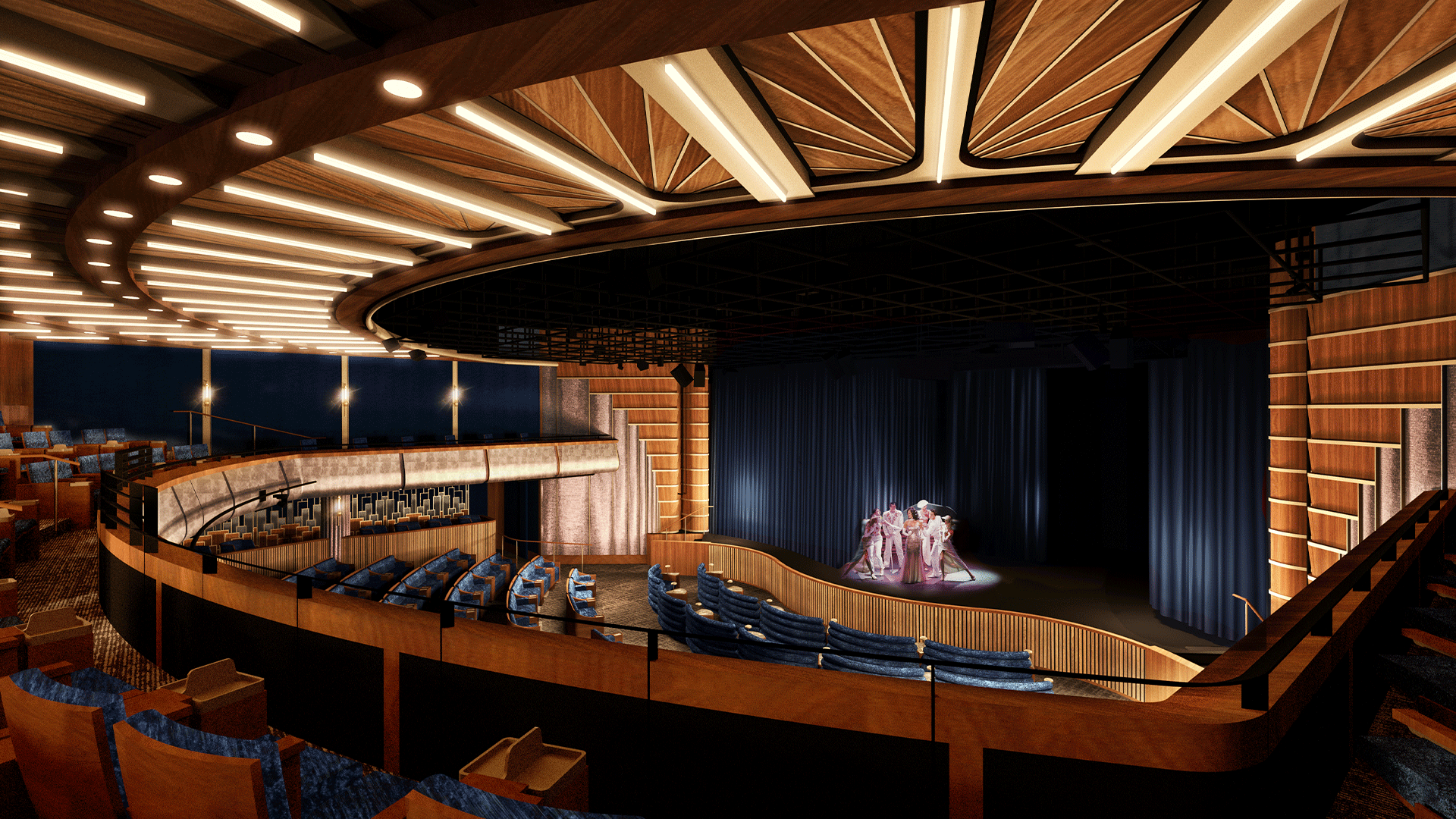
Constellation Theater
More information coming soon.
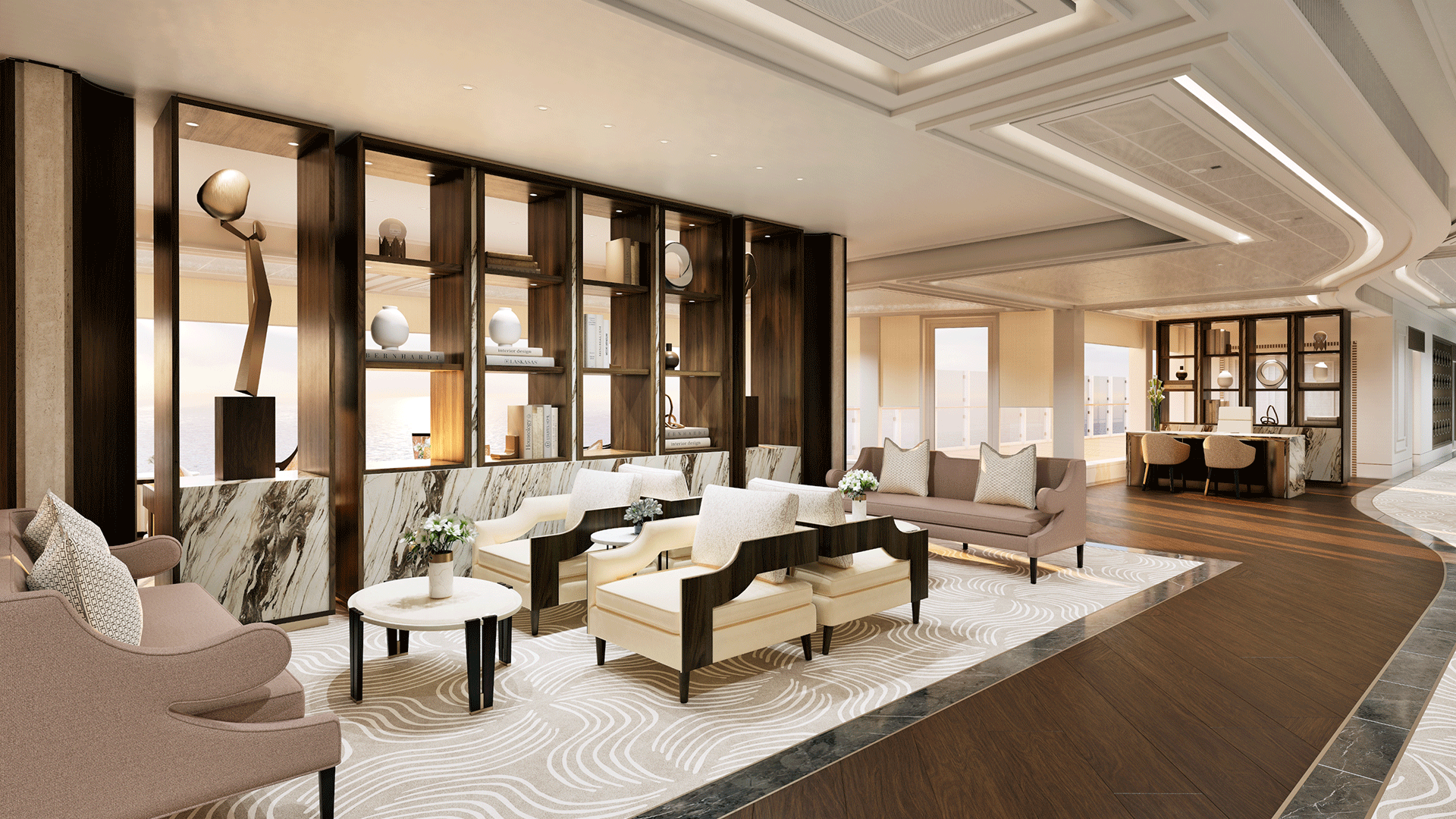
Lounge Area
More information coming soon.
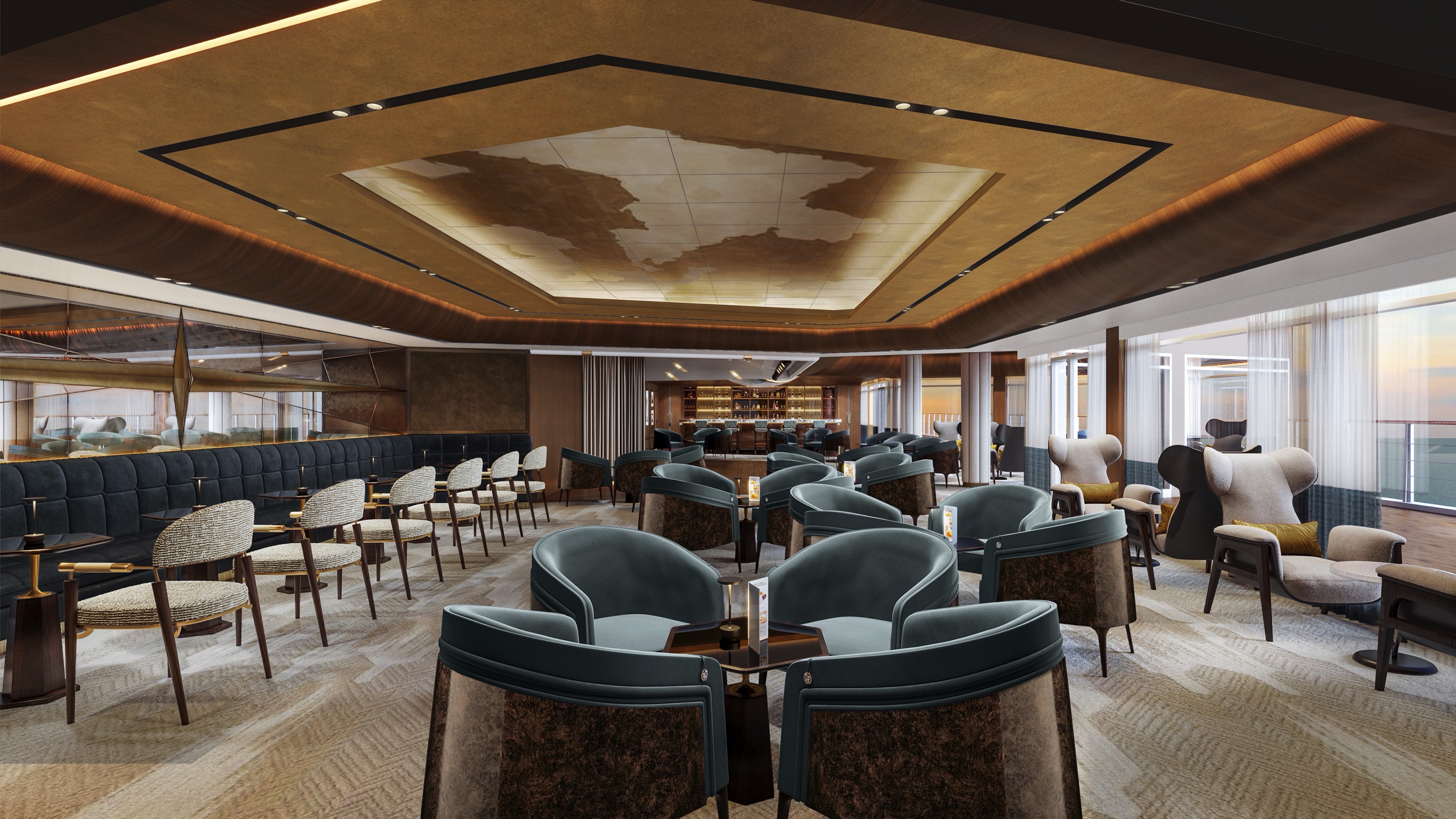
Meridian Lounge
More information coming soon.
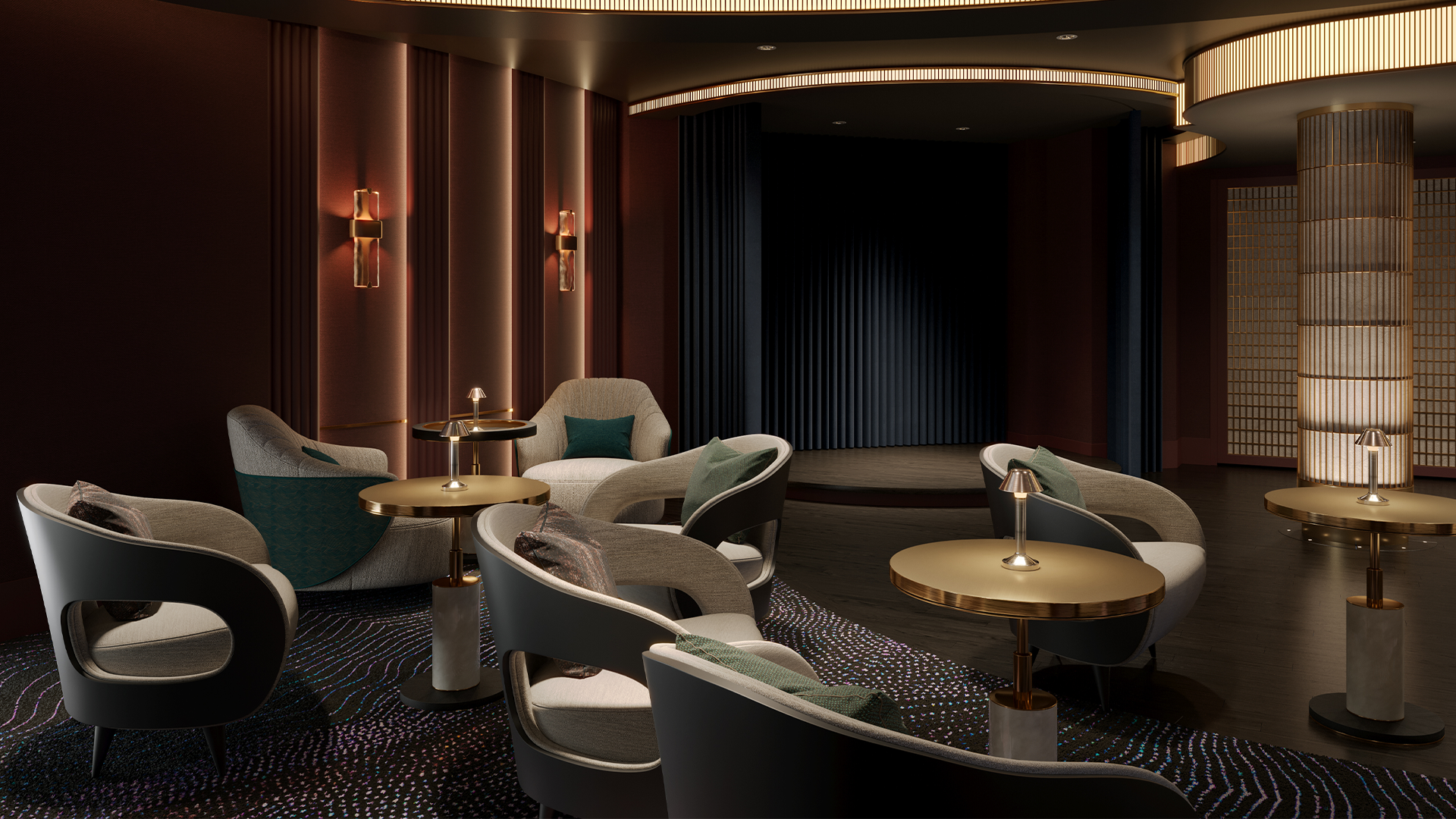
Prestige Lounge
More information coming soon.
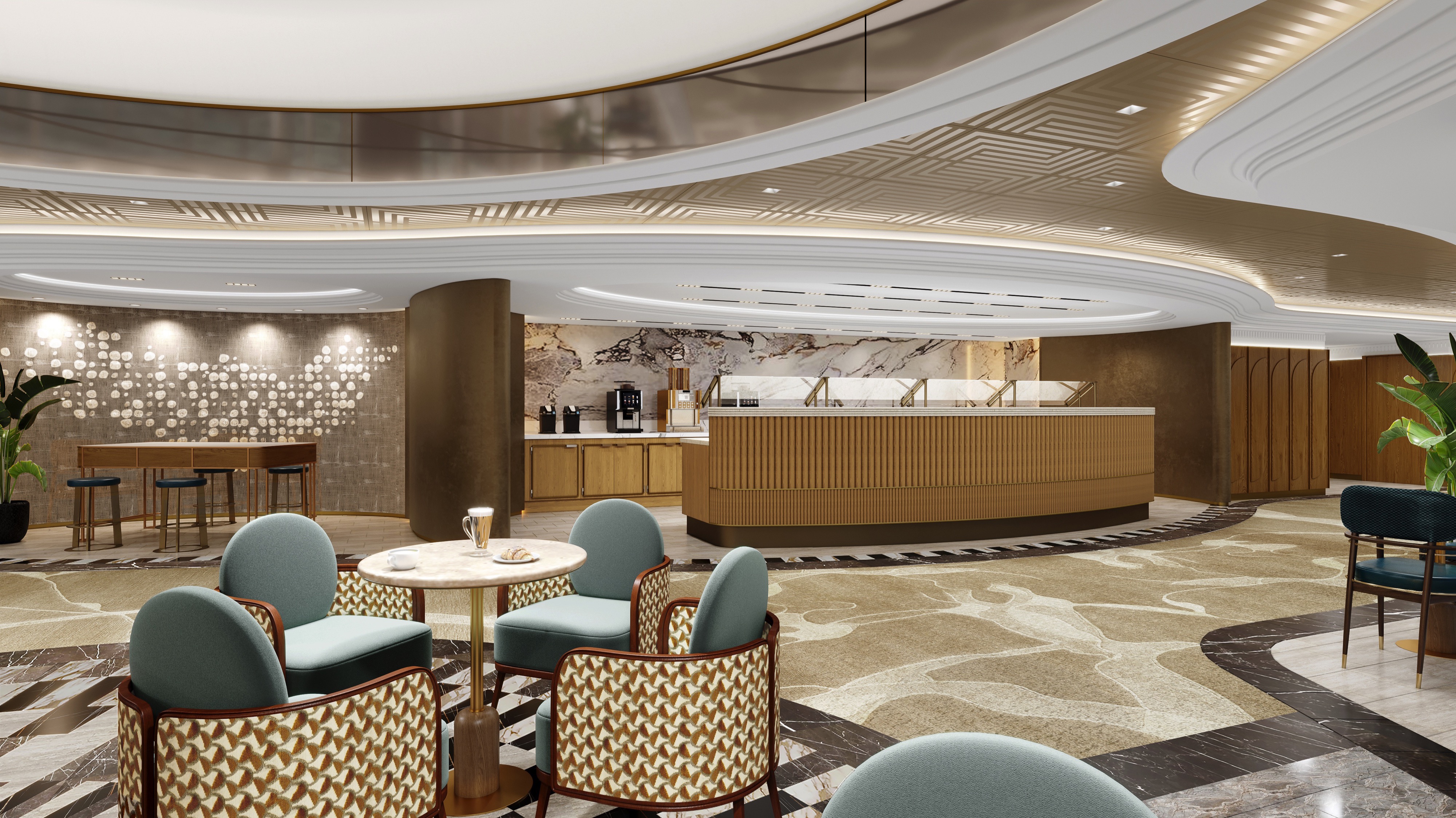
Coffee Connection
More information coming soon.
Priority Registration
Reservations open 25 June, but you can submit your early reservation request starting 11 June.
To register your interest in Seven Seas Prestige’s Inaugural Season, please call 023 8082 1390 or contact your travel advisor.
Internet Access
High-speed, unlimited WiFi is available on board all Regent Seven Seas Cruises® ships, powered by Starlink’s advanced satellite technology. From January 1, 2025, two complimentary logins per suite are included in the All-Inclusive Cruise Fare for guests in Deluxe Window, Veranda, Deluxe Veranda, and Serenity Suites, and four complimentary logins for guests in Concierge Suites and above.
Guests wishing to further enhance their WiFi connection onboard may do so by purchasing a streaming upgrade package with prices varying depending on the length of sailing:
- Voyage Length 1-29 Days: $14.99 per login, per day
- Voyage Length 30+ Days: $9.99 per login, per day
Service and speed will vary port to port.
If you are utilizing a mobile device that access the internet via a cellular carrier’s network (5G for example) instead of the ship’s wireless access, it will be treated as if you were using your cell phone and International roaming charges will apply. Any costs associated will be billed directly through your cell phone provider, and not through the ship.
Pregnancy, Children, Infants & Unaccompanied Minors
Infants must be six months of age as of the first day of the cruise. For voyages that have three or more consecutive days at sea, infants must be at least one year of age as of the first day of the cruise. Guests traveling with a young infant that does not meet the infant policy will be denied boarding. No refunds or other compensation shall be due from Regent Seven Seas Cruises to anyone as a result of the denial of boarding to an underage infant or any accompanying guests. Based on SOLAS requirements Regent Seven Seas Cruises cannot and will not make any exceptions to allow infants on any of their cruises which do not meet the minimum one year of age requirement. No waivers will be accepted. Please do not enquire about making any exceptions, as all requests will be denied. Any guest under the age of 18 must be accompanied by and occupy the same suite as an adult 18 years or older. Regent Seven Seas Cruises does not provide for the care, entertainment or supervision of children. Guests under the age of 16 are not permitted to use the spa or fitness facilities, even if supervised by an adult. Special promotional rates are available for children on select sailings. To be eligible, the child must be under the age of 18.
Wheelchair Accessible Suites
Yes, details of our wheelchair accessible suites can be found here.
For details on a prearranged rental program, please contact our authorized vendor:
Special Needs at Sea
Phone: +1-954-585-0575
Fax: +1-954-585-0577
www.specialneedsatsea.com
What's Included
FOR YOUR COMFORT
- Spacious oceanview suites, 99% with a private balcony
- Generous walk-in closets with ample storage space in 99% of suites
- Spacious marble & stone detailed bathrooms, many with double vanities
- Personalised service with industry leading staff-to-guest ratios
- Butler service in Penthouse suites & higher
FOR YOUR ENJOYMENT
- Unlimited shore excursions
- Unlimited beverages, fine wines, craft cocktails, speciality coffees & more
- Exquisite dining including all speciality restaurants at no added cost
- Customisable in-suite mini bar replenished daily with your preferences
- Open bars and lounges and dynamic entertainment and enrichment experiences
- Unlimited access to spa facilities
FOR YOUR CONVENIENCE
- Unlimited WiFi
- Pre-paid gratuities
- Valet laundry service allowing you to pack light and explore more
- 24-hour in-suite dining
- 1-night pre-cruise hotel in concierge suites & higher
- Experienced concierge staff to cater to “off-menu” personal requests
Laundry
All guests will now benefit from FREE Valet Laundry Service during their cruise. Enjoy the luxury and convenience of freshly washed, carefully pressed and folded laundry picked up and delivered to your suite throughout your voyage.
Medical Services
Each ship has a licensed and registered doctor and nurse for professional and emergency services, which are available at customary charges. The ships’ medical centers are designed to provide medical care for certain temporary illnesses and accidents, and are not intended or capable of providing on-going treatment of pre-existing medical conditions. For guests requiring oxygen equipment, an oxygen concentrator is the only form of oxygen equipment allowed aboard ship, and must be provided by the guest. Regent Seven Seas Cruises’ wheelchairs on board are for emergency purposes only.
Dress Code
Attire ranges from Casual to Formal Optional. Casual wear consists of resort-style outfits; some examples are jeans, shorts, t-shirts, and tennis shoes. Casual wear is appropriate for daytime both on board or ashore. Casual wear is not appropriate after 6:00 PM. On the night prior to disembarkation, guests may need to pack their luggage early due to morning flights the next day. With this in mind, on the last night of every voyage, we will relax the dress code for dinner to Casual.
Otherwise, the recommended onboard dress in the evenings is Elegant Casual. Dinner dress for ladies includes a skirt, or slacks with a blouse or sweater, a pant suit or dress; slacks and a collared shirt or sweater for gentlemen. Sport jackets and ties are optional. Casual wear, including jeans, is not to be worn at dinner.
On sailings of 16 nights or more, Formal and Semi-Formal attire is optional on two of the evenings. On the two Formal Optional evenings, guests are welcome to dress as per the elegant Casual dress code or opt for a more formal choice of clothing including gowns and cocktail dresses for ladies; tuxedos, dinner jackets or dark suits with tie for gentlemen.
Smoking Policy
For the comfort and safety of all of our Guests, smoking is not permitted in any enclosed dining area, certain public venues, elevators, the Theater, and all suites and balconies, and is only permitted in specific designated smoking areas. The use of electronic cigarettes is allowed within designated smoking areas only.
Cigar Smoking is only permitted in the Connoisseur Club on applicable ships and the designated area on the opposite side of the Pool Bar.
Pipe smoking is only permitted in the Connoisseur Club. Pipe smoking in open deck areas is considered an extreme fire hazard and is not permitted.
Failure to comply with the above smoking policy will result in guests being asked to leave the ship at their expense, without refund or credit for the unused portion of their cruise.
Alcohol Policy
The sale and consumption of alcoholic beverages will be limited to guests aged 21 years or older. However, with the exception of Hawaii, Alaska and New England voyages not leaving U.S. territorial waters, guests between the ages of 18 through 20 may purchase and personally consume wine and beer only while on board and with the consent of an accompanying parent. Authorization will be given only when the accompanying parent completes the Young Adult Alcoholic Beverage Waiver form. This form can be obtained and completed at the Reception Desk upon embarkation. While sailing on select international voyages, guests 18 years or older are permitted to consume alcoholic beverages without having to complete the Young Adult Alcoholic Beverage Waiver form. Guests are kindly reminded to consume alcohol in moderation. Regent Seven Seas Cruises reserves the right to prohibit and retain all liquor brought aboard the ship.
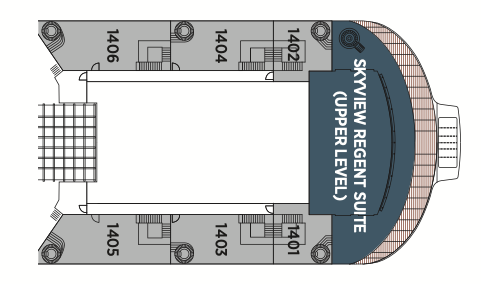
Deck 15
- Skyview Regent Suite
- Skyview Suites

Deck 14
- Skyview Regent Suite
- Skyview Luna Suite
- Skyview Sola Suite
- Skyview Aura Suite
- Skyview Regent Suite
- Azure
- Pacific Rim
- Solara Sports Deck
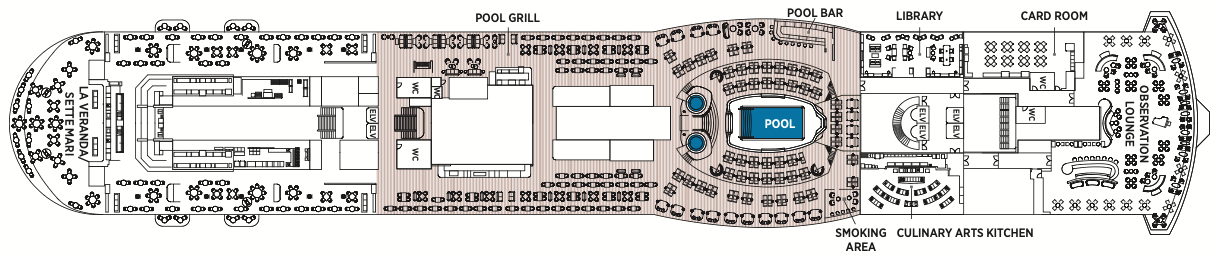
Deck 12
- Observation Lounge
- Card Room
- Library
- Culinary Arts Kitchen
- Pool Deck
- Pool
- Pool Grill/Pool Bar
- La Veranda
- Sette Mari

Deck 11
- Chartreuse
- Prime 7
- The Study
- Concierge Suites
- Penthouse Suites
- Prestige Suite
- Concierge Suites

Deck 10
- Signature Suite
- Penthouse Suites
- Concierge Suites
- Seven Seas Suite
- Prestige Suite
- Grand Suite
- Horizon Penthouse

Deck 9
- Signature Suite
- Penthouse Suites
- Concierge Suites
- Penthouse Suites
- Grand Loft Suite
- Grand Suite

Deck 8
- Horizon Penthouse
- Prestige Suite
- Penthouse Suites
- Serenity Suites
- Concierge Suites
- Grand Suites

Deck 7
- Prestige Suite
- Serenity Suites
- Penthouse Suite
- Concierge Suite
- Grand Suites
- Horizon Penthouse

Deck 6
- Prestige Suite
- Deluxe Veranda Suites
- Horizon Penthouse
- Serenity Suite
- Penthouse Suite
- Concierge Suite

Deck 5
- Constellation Theater (Upper Level)
- Concierge & Reception
- Cruise Sales
- Business Center
- Destinations Services
- Meridian Lounge
- Coffee Connection
- Compass Rose

Deck 4
- Constellation Theater (Lower Level)
- Connoisseur Lounge
- Boutique
- Galileo’s Bar
- The Casino
- Prestige Lounge
- Serene Spa & Wellness®
- Saunas
- Fitness Center

Itinerary
Italy’s vibrant capital lives in the present, but no other city on earth evokes its past so powerfully. For over 2,500 years, emperors, popes, artists, and common citizens have left their mark here. Archaeological remains from ancient Rome, art-stuffed churches, and the treasures of Vatican City vie for your attention, but Rome is also a wonderful place to practice the Italian-perfected il dolce far niente, the sweet art of idleness. Your most memorable experiences may include sitting at a caffè in the Campo de’ Fiori or strolling in a beguiling piazza.
Salerno is an Italian city located on the Gulf of Salerno. Famous for being home to the first medical university, Salerno is a great destination for anyone looking for gorgeous sea views filled with sunshine and Italian food.
Home to the Museo Regionale of Messina, known for featuring two of Caravaggio’s paintings, the city is also famous for having been the capital of the ancient kingdom of Sicily.
Backed by imposing mountains, tiny Kotor lies hidden from the open sea, tucked into the deepest channel of the Bokor Kotorska (Kotor Bay), which is Europe’s most southerly fjord. To many, this town is more charming than its sister UNESCO World Heritage Site, Dubrovnik, retaining more authenticity, but with fewer tourists and spared the war damage and subsequent rebuilding which has given Dubrovnik something of a Disney feel.Kotor’s medieval Stari Grad (Old Town) is enclosed within well-preserved defensive walls built between the 9th and 18th centuries and is presided over by a proud hilltop fortress. Within the walls, a labyrinth of winding cobbled streets leads through a series of splendid paved piazzas, rimmed by centuries-old stone buildings. The squares are now haunted by strains from buskers but although many now house trendy cafés and chic boutiques, directions are still given medieval-style by reference to the town’s landmark churches.In the Middle Ages, as Serbia’s chief port, Kotor was an important economic and cultural center with its own highly regarded schools of stonemasonry and iconography. From 1391 to 1420 it was an independent city-republic and later, it spent periods under Venetian, Austrian, and French rule, though it was undoubtedly the Venetians who left the strongest impression on the city’s architecture. Since the breakup of Yugoslavia, some 70% of the stone buildings in the romantic Old Town have been snapped up by foreigners, mostly Brits and Russians. Porto Montenegro, a new marina designed to accommodate some of the world’s largest super yachts, opened in nearby Tivat in 2011, and along the bay are other charming seaside villages, all with better views of the bay than the vista from Kotor itself where the waterside is congested with cruise ships and yachts. Try sleepy Muo or the settlement of Prčanj in one direction around the bay, or Perast and the Roman mosaics of Risan in the other direction.
Nothing can prepare you for your first sight of Dubrovnik. Lying 216 km (135 miles) southeast of Split and commanding a jaw-dropping coastal location, it is one of the world’s most beautiful fortified cities. Its massive stone ramparts and fortress towers curve around a tiny harbor, enclosing graduated ridges of sun-bleached orange-tiled roofs, copper domes, and elegant bell towers. Your imagination will run wild picturing what it looked like seven centuries ago when the walls were built, without any suburbs or highways around it, just this magnificent stone city rising out of the sea.In the 7th century AD, residents of the Roman city Epidaurum (now Cavtat) fled the Avars and Slavs of the north and founded a new settlement on a small rocky island, which they named Laus, and later Ragusa. On the mainland hillside opposite the island, the Slav settlement called Dubrovnik grew up. In the 12th century the narrow channel separating the two settlements was filled in (now the main street through the Old Town, called Stradun), and Ragusa and Dubrovnik became one. The city was surrounded by defensive walls during the 13th century, and these were reinforced with towers and bastions in the late 15th century.From 1358 to 1808 the city thrived as a powerful and remarkably sophisticated independent republic, reaching its golden age during the 16th century. In 1667 many of its splendid Gothic and Renaissance buildings were destroyed by an earthquake. The defensive walls survived the disaster, and the city was rebuilt in baroque style.Dubrovnik lost its independence to Napoléon in 1808, and in 1815 passed to Austria-Hungary. During the 20th century, as part of Yugoslavia, the city became a popular tourist destination, and in 1979 it was listed as a UNESCO World Heritage Site. During the war for independence, it came under heavy siege. Thanks to careful restoration, few traces of damage remain; however, there are maps inside the Pile and Ploče Gates illustrating the points around the city where damage was done. It’s only when you experience Dubrovnik yourself that you can understand what a treasure the world nearly lost
Water is the essence of Kvarner, and the region’s largest city expresses this simply. Whether in Croatian or Italian (Fiume) the translation of the name to English is the same: river. Although the history of Croatia’s third city goes back to the days of Imperial Rome, modern Rijeka evolved under the rule of Austria-Hungary. The historic core retains vestiges of the old Habsburg monarchy from the time when Rijeka served as the empire’s outlet to the Adriatic. During the 1960s, under Yugoslavia, the suburbs expanded rapidly. Rijeka is the country’s largest port, with a huge shipyard, massive dry-dock facilities, refineries, and other heavy industries offering large-scale employment. Since the breakup of Yugoslavia, however, Rijeka’s role as a shipping town has declined significantly. Much business shifted north to the smaller Slovene ports during the crippling wars of the 1990s, and although some has returned, the volume remains less than half that seen in 1980.
Dalmatia’s capital for more than 1,000 years, Zadar is all too often passed over by travelers on their way to Split or Dubrovnik. What they miss out on is a city of more than 73,000 that is remarkably lovely and lively despite—and, in some measure, because of—its tumultuous history. The Old Town, separated from the rest of the city on a peninsula some 4 km (2½ miles) long and just 1,640 feet wide, is bustling and beautiful: the marble pedestrian streets are replete with Roman ruins, medieval churches, palaces, museums, archives, and libraries. Parts of the new town are comparatively dreary, a testament to what a world war followed by decades of communism, not to mention a civil war, can do to the architecture of a city that is 3,000 years old. A settlement had already existed on the site of the present-day city for some 2,000 years when Rome finally conquered Zadar in the 1st century BC; the foundations of the forum can be seen today. Before the Romans came the Liburnians had made it a key center for trade with the Greeks and Romans for 800 years. In the 3rd century BC the Romans began to seriously pester the Liburnians, but required two centuries to bring the area under their control. During the Byzantine era, Zadar became the capital of Dalmatia, and this period saw the construction of its most famous church, the 9th-century St. Donat’s Basilica. It remained the region’s foremost city through the ensuing centuries. The city then experienced successive onslaughts and occupations—both long and short—by the Osogoths, the Croatian-Hungarian kings, the Venetians, the Turks, the Habsburgs, the French, the Habsburgs again, and finally the Italians before becoming part of Yugoslavia and, in 1991, the independent republic of Croatia. Zadar was for centuries an Italian-speaking city, and Italian is still spoken widely, especially by older people. Indeed, it was ceded to Italy in 1921 under the Treaty of Rapallo (and reverted to its Italian name of Zara). Its occupation by the Germans from 1943 led to intense bombing by the Allies during World War II, which left most of the city in ruins. Zadar became part of Tito’s Yugoslavia in 1947, prompting many Italian residents to leave. Zadar’s most recent ravages occurred during a three-month siege by Serb forces and months more of bombardment during the Croatian-Serbian war between 1991 and 1995. But you’d be hard-pressed to find outward signs of this today in what is a city to behold. There are helpful interpretive signs in English all around the Old Town, so you certainly won’t feel lost when trying to make sense of the wide variety of architectural sites you might otherwise pass by with only a cursory look.
Bari, capital of the province of Apulia, lies on southern Italy’s Adriatic coast. Its busy port is a leading commercial and industrial centre as well as a transit point for travellers catching ferries across the Adriatic to Greece. Bari comprises a new and an old town. To the north, on a promontory between the old and new harbours, lies the picturesque old town, or Citta Vecchia, with a maze of narrow, crooked streets. To the south is the spacious and regularly planned new town, which has developed considerably since 1930, when the Levant Fair was first held here. The heart of the modern town is Piazza della Liberta. The busy thoroughfare, Corso Vittorio Emanuele II, separates the new town from the old. At the eastern end of the Corso begins the Lungomare Nazario Sauro, a magnificent seafront promenade that runs along the old harbour. Bari and the Apulian region were long recognized for their strategic location, attracting a succession of colonizers such as the Normans, Moors and Spaniards, each leaving their mark.
Ground literally to ashes in World War II and wracked by a massive earthquake a decade later, the capital of Kefalonia once more shows pride in its native spirit and natural beauty. The vast harbor on Argostoli’s east side makes an especially attractive port for cruise ships full of visitors who never seem to tire of strolling the cobbled seaside promenade, sipping ouzos in cafés, and stocking up on the succulent Mediterranean fruits in the outdoor markets.
Milos or Melos is a volcanic Greek island in the Aegean Sea, just north of the Sea of Crete. Milos is the southwesternmost island in the Cyclades group. The Venus de Milo and the Asclepius of Milos were both found on the island, as were a Poseidon and an archaic Apollo now in Athens.
Although the fishing boats still go out in good weather, Mykonos largely makes its living from tourism these days. The summer crowds have turned one of the poorest islands in Greece into one of the richest. Old Mykonians complain that their young, who have inherited stores where their grandfathers once sold eggs or wine, get so much rent that they have lost ambition, and in summer sit around pool bars at night with their friends, and hang out in Athens in winter when island life is less scintillating. Put firmly on the map by Jackie O in the 1960s, Mykonos town—called Hora by the locals—remains the Saint-Tropez of the Greek islands. The scenery is memorable, with its whitewashed streets, Little Venice, the Kato Myli ridge of windmills, and Kastro, the town’s medieval quarter. Its cubical two- or three-story houses and churches, with their red or blue doors and domes and wooden balconies, have been long celebrated as some of the best examples of classic Cycladic architecture. Luckily, the Greek Archaeological Service decided to preserve the town, even when the Mykonians would have preferred to rebuild, and so the Old Town has been impressively preserved. Pink oleander, scarlet hibiscus, and trailing green pepper trees form a contrast amid the dazzling whiteness, whose frequent renewal with whitewash is required by law. Any visitor who has the pleasure of getting lost in its narrow streets (made all the narrower by the many outdoor stone staircases, which maximize housing space in the crowded village) will appreciate how its confusing layout was designed to foil pirates—if it was designed at all. After Mykonos fell under Turkish rule in 1537, the Ottomans allowed the islanders to arm their vessels against pirates, which had a contradictory effect: many of them found that raiding other islands was more profitable than tilling arid land. At the height of Aegean piracy, Mykonos was the principal headquarters of the corsair fleets—the place where pirates met their fellows, found willing women, and filled out their crews. Eventually the illicit activity evolved into a legitimate and thriving trade network. Morning on Mykonos town’s main quay is busy with deliveries, visitors for the Delos boats, lazy breakfasters, and street cleaners dealing with the previous night’s mess. In late morning the cruise-boat people arrive, and the shops are all open. In early afternoon, shaded outdoor tavernas are full of diners eating salads (Mykonos’s produce is mostly imported); music is absent or kept low. In mid- and late afternoon, the town feels sleepy, since so many people are at the beach, on excursions, or sleeping in their air-conditioned rooms; even some tourist shops close for siesta. By sunset, people have come back from the beach, having taken their showers and rested. At night, the atmosphere in Mykonos ramps up. The cruise-boat people are mostly gone, coughing three-wheelers make no deliveries in the narrow streets, and everyone is dressed sexy for summer and starting to shimmy with the scene. Many shops stay open past midnight, the restaurants fill up, and the bars and discos make ice cubes as fast as they can. Ready to dive in? Begin your tour of Mykonos town (Hora) by starting out at its heart: Mando Mavrogenous Square.
It’s no wonder that all roads lead to the fascinating and maddening metropolis of Athens. Lift your eyes 200 feet above the city to the Parthenon, its honey-color marble columns rising from a massive limestone base, and you behold architectural perfection that has not been surpassed in 2,500 years. But, today, this shrine of classical form dominates a 21st-century boomtown. To experience Athens—Athína in Greek—fully is to understand the essence of Greece: ancient monuments surviving in a sea of cement, startling beauty amid the squalor, tradition juxtaposed with modernity. Locals depend on humor and flexibility to deal with the chaos; you should do the same. The rewards are immense. Although Athens covers a huge area, the major landmarks of the ancient Greek, Roman, and Byzantine periods are close to the modern city center. You can easily walk from the Acropolis to many other key sites, taking time to browse in shops and relax in cafés and tavernas along the way. From many quarters of the city you can glimpse “the glory that was Greece” in the form of the Acropolis looming above the horizon, but only by actually climbing that rocky precipice can you feel the impact of the ancient settlement. The Acropolis and Filopappou, two craggy hills sitting side by side; the ancient Agora (marketplace); and Kerameikos, the first cemetery, form the core of ancient and Roman Athens. Along the Unification of Archaeological Sites promenade, you can follow stone-paved, tree-lined walkways from site to site, undisturbed by traffic. Cars have also been banned or reduced in other streets in the historical center. In the National Archaeological Museum, vast numbers of artifacts illustrate the many millennia of Greek civilization; smaller museums such as the Goulandris Museum of Cycladic Art Museum and the Byzantine and Christian Museum illuminate the history of particular regions or periods. Athens may seem like one huge city, but it is really a conglomeration of neighborhoods with distinctive characters. The Eastern influences that prevailed during the 400-year rule of the Ottoman Empire are still evident in Monastiraki, the bazaar area near the foot of the Acropolis. On the northern slope of the Acropolis, stroll through Plaka (if possible by moonlight), an area of tranquil streets lined with renovated mansions, to get the flavor of the 19th-century’s gracious lifestyle. The narrow lanes of Anafiotika, a section of Plaka, thread past tiny churches and small, color-washed houses with wooden upper stories, recalling a Cycladic island village. In this maze of winding streets, vestiges of the older city are everywhere: crumbling stairways lined with festive tavernas; dank cellars filled with wine vats; occasionally a court or diminutive garden, enclosed within high walls and filled with magnolia trees and the flaming trumpet-shaped flowers of hibiscus bushes. Formerly run-down old quarters, such as Thission, Gazi and Psirri, popular nightlife areas filled with bars and mezedopoleia (similar to tapas bars), are now in the process of gentrification, although they still retain much of their original charm, as does the colorful produce and meat market on Athinas. The area around Syntagma Square, the tourist hub, and Omonia Square, the commercial heart of the city about 1 km (½ mi) northwest, is distinctly European, having been designed by the court architects of King Otho, a Bavarian, in the 19th century. The chic shops and bistros of ritzy Kolonaki nestle at the foot of Mt. Lycabettus, Athens’s highest hill (909 feet). Each of Athens’s outlying suburbs has a distinctive character: in the north is wealthy, tree-lined Kifissia, once a summer resort for aristocratic Athenians, and in the south and southeast lie Glyfada, Voula, and Vouliagmeni, with their sandy beaches, seaside bars, and lively summer nightlife. Just beyond the city’s southern fringes is Piraeus, a bustling port city of waterside fish tavernas and Saronic Gulf views.
Ship features
Skyview Regent Suite
Nearly 9,000 square feet of ultra-luxury at sea, the Skyview Regent Suite offers unparalleled ocean views, a spa bath, private gym, an in-suite elevator, and so much more.
Ship renderings are artistic representations intended to provide a vision of the ship experience. Actual layouts, furnishings, and design elements may vary by deck, and specific location.
Skyview Suites
Introducing the Skyview Suites, one of twelve accommodation categories and available in three distinct layouts: Aura, Luna and Sola. These bespoke suites feature private in-suite elevators, second floor private terraces, the bespoke service of a personal butler, and so much more. Which will you choose?
Comprising 6 suites in total, the Skyview Aura Suite (2,024 sq. ft.), Skyview Luna Suite (1,728 sq. ft.), and Skyview Sola Suite (1,325 sq. ft.) will be situated on Decks 14 and 15 and offer a sophisticated, high-end residential feel. An in-suite elevator transports guests to a peaceful terrace deck with shaded areas and jetted tubs that provides stunning views and opportunities for al fresco dining. Creating a luxurious and timeless experience, each Skyview Suite has its own unique layout and character, with design elements that combine classical detailing, a color palette of cool greys with black accents and pops of ruby red, clean lines, plus luxurious materials. The living areas are styled with a refined tone-on-tone décor with jewel-hued accents, while the dining spaces feature custom millwork and sculptural furniture.
Ship renderings are artistic representations intended to provide a vision of the ship experience. Actual layouts, furnishings, and design elements may vary by deck, and specific location.
Grand Loft Suites
With its contemporary design, this double-story, 856-square-foot suite evokes the feel of a refined Lower Manhattan residence. A soaring double-height space and extraordinary window wall create jaw-dropping views from the upstairs bed, which faces directly toward the horizon.
Ship renderings are artistic representations intended to provide a vision of the ship experience. Actual layouts, furnishings, and design elements may vary by deck, and specific location.
Horizon Penthouse Suites
Featuring a beautifully appointed bedroom, full bath suite, and spacious living area — plus an oversized 182-263-square-foot balcony with outdoor dining, a plush sofa and sun loungers. These limited 15 suites allow the opportunity to enjoy a seamless blend of indoor elegance and open-air relaxation.
Ship renderings are artistic representations intended to provide a vision of the ship experience. Actual layouts, furnishings, and design elements may vary by deck, and specific location.
Signature Suites
Offering a total of 2,037 sq. ft. the Signature Suites are outfitted with a rich color palette and the finest fabrics across two spacious bedrooms and two bathrooms, along with a generous living room. A private wraparound balcony — one of the largest at sea at 1,023 sq. ft. — extends the living space outdoors, making it ideal for entertaining or simply soaking in the view.
Ship renderings are artistic representations intended to provide a vision of the ship experience. Actual layouts, furnishings, and design elements may vary by deck, and specific location.
Grand Suites
The Grand Suites feature clean lines, mid-century inspired furniture and a color palette that features neutrals with shades of green. The design highlights Italian artistry with textured fabrics and woven leather accents, creating a sophisticated and luxurious ambiance. At 1,214-1,417 sq. ft., the suite houses a private terrace as well as a dining room for in-suite meals.
Ship renderings are artistic representations intended to provide a vision of the ship experience. Actual layouts, furnishings, and design elements may vary by deck, and specific location.
Prestige Suites
At 813-1,354 sq. ft., the thoughtfully designed Prestige Suites are the embodiment of refined living at sea. The one-bedroom, one-and-a-half bathroom suites are designed with calming hues of cream, gray and brown. They feature a dining table for in-suite service, a spacious closet and an elegant bath.
Ship renderings are artistic representations intended to provide a vision of the ship experience. Actual layouts, furnishings, and design elements may vary by deck, and specific location.
Seven Seas Suites
Providing 721 sq. ft. of luxury, the Seven Seas Suites have been designed with a soothing color palette complemented by plush furnishings. The suite flows effortlessly from the living room to the dining area to the bedroom, with sliding glass doorways leading to a spacious private balcony. A magnificent bathroom sits adjacent to the oversized bedroom and large walk-in closet.
Penthouse Suites
This luxurious suite has been carefully designed to maximize space and comfort, with more than 600 square feet from door to balcony deck. As you make your way through the separated living and bedroom, you have the choice to section off the area with a pocket door for added privacy. Your Penthouse also features a spacious walk-through closet that offers ample storage.
Concierge Suites
Ranging from 440 to 485 sq. ft. the Concierge Suites aboard Seven Seas Prestige offer a sophisticated retreat complete with a bathroom and a spacious, furnished veranda. Guests also enjoy the added benefits of priority online dining and shore excursion reservations, plus a one-night pre-cruise hotel package.
Serenity Suites
At 440 sq. ft., the Serenity Suites feature bluish teal accents, built-in minibars and screening elements that separate the bedroom and bathroom. Clean lines and contemporary detailing create a relaxing and inviting atmosphere.
Deluxe Veranda Suites
The Deluxe Veranda Suites aboard Seven Seas Prestige offer 285-440 sq. ft. of refined comfort. Each features a private balcony and a European King-Sized Elite Slumber® Bed.
Azure
Unique mezze-style dining concept inspired by the Mediterranean’s varied cultural tapestry.
Chartreuse
Offering classic French fare with a modern twist.
Compass Rose
The largest specialty restaurant at sea, where you can customize your meal every night.
Pacific Rim
A dramatic Pan-Asian dining experience.
Prime 7
An intimate and elegant steakhouse.
La Veranda
Where guests to enjoy sumptuous breakfasts and lunch buffets.
Sette Mari at Le Veranda
Serving authentic Italian specialties and boasting the most expansive al fresco dining area ever seen aboard Regent.
Gourmet Explorer Tours
Our distinctive Gourmet Explorer Tours, offered exclusively aboard Seven Seas Explorer, allows guests the unique opportunity to experience the culinary culture of the world’s most delicious destinations. From savouring the authentic flavours of a region to learning new techniques in local cooking classes, guests can choose from a variety of optional tours that take them to local markets to find exotic spices, sample delicious wines at breathtaking estates and savour gourmet meals expertly prepared by renowned chefs. Due to their unique itineraries, Gourmet Explorer tours require a discounted, supplementary charge.
Regent Choice Shore Excursions
Take your experience to another level with the select itineraries and smaller group tours offered by our Regent Choice Shore Excursions. These unique opportunities require a discounted, supplementary charge and invite you to discover the heights of travel, from our Gourmet Explorer Tours to special experiences that take you off the beaten path.
As the name suggests, these excursions work a little harder to engage your explorer spirit. Unique itineraries and smaller groups create more personal experiences… and memories of a lifetime.
UNIQUE, UNPARALLELED EXPERIENCES
Soaring over Alaskan forests and mountains via helicopter en route to feeling the majesty of Mendenhall Glacier beneath your feet. Discover the best our world has to offer through the unparalleled experiences you’ll enjoy with Regent Choice Shore Excursions.
Enhance your shoreside experience with a Regent Choice Small Group tour. Hosting up to 16 guests, these tours provide a more intimate experience and allow for more personal engagement with your knowledgeable guide.
Starlight Atrium
Embodying a blend of old-world elegance and modern sophistication, the Starlight Atrium recalls an era of quality craftmanship and style, illuminated by a glass-enclosed ceiling that allows sunlight and starlight to grace the space.
Not only a place for quiet contemplation while enjoying a glass of Champagne, or practical matters with essential guest services, the Starlight Atrium’s generous space connects multiple guest amenities across decks 4 & 5, such as Galileo’s Bar, the Casino, Prestige Lounge, Meridian Lounge, Coffee Connection, concierge desk and reception.
On deck 5, alcoves with sculptural furniture and curated art offer breathtaking ocean views—the perfect place to watch the sun rise or slip beyond the horizon at the end of a perfect day. Designed with a neutral palette of dusty rose, taupe, and cream, combined with embellished trims and fringed pillows, the alcoves harken back to old-world detailing.
Galileo's Bar
Galileo’s Bar is strategically placed to serve both the Prestige Lounge and adjacent casino. The bar’s ceiling is a canvas displaying a contemporary masterpiece styled like an oil painting, framed by fretted metal detailing.
The base of the bar features fluted elements, and the bold, striped floor highlights the bar’s footprint, creating a focal point for the Starlight Atrium; it is the place for guests to indulge in complimentary premium beverages that come as standard with a Regent sailing.
From the bar, views of the spiral staircases extend back into the Starlight Atrium on both port and starboard sides. The walls, clad in a limestone texture, are adorned with sconces designed to resemble jewellery, adding a touch of glamour.
Reception
The reception area, also on deck 5, features pleated leather panels and a light fixture crafted from handblown glass and ceramic pearls. From the lifts, looking back towards Galileo’s Bar, walls are framed with paneling and artwork, creating a traditional yet modern aesthetic.
Constellation Theater
More information coming soon.
Lounge Area
More information coming soon.
Meridian Lounge
More information coming soon.
Prestige Lounge
More information coming soon.
Coffee Connection
More information coming soon.
Priority Registration
Reservations open 25 June, but you can submit your early reservation request starting 11 June.
To register your interest in Seven Seas Prestige’s Inaugural Season, please call 023 8082 1390 or contact your travel advisor.
Internet Access
High-speed, unlimited WiFi is available on board all Regent Seven Seas Cruises® ships, powered by Starlink’s advanced satellite technology. From January 1, 2025, two complimentary logins per suite are included in the All-Inclusive Cruise Fare for guests in Deluxe Window, Veranda, Deluxe Veranda, and Serenity Suites, and four complimentary logins for guests in Concierge Suites and above.
Guests wishing to further enhance their WiFi connection onboard may do so by purchasing a streaming upgrade package with prices varying depending on the length of sailing:
- Voyage Length 1-29 Days: $14.99 per login, per day
- Voyage Length 30+ Days: $9.99 per login, per day
Service and speed will vary port to port.
If you are utilizing a mobile device that access the internet via a cellular carrier’s network (5G for example) instead of the ship’s wireless access, it will be treated as if you were using your cell phone and International roaming charges will apply. Any costs associated will be billed directly through your cell phone provider, and not through the ship.
Pregnancy, Children, Infants & Unaccompanied Minors
Infants must be six months of age as of the first day of the cruise. For voyages that have three or more consecutive days at sea, infants must be at least one year of age as of the first day of the cruise. Guests traveling with a young infant that does not meet the infant policy will be denied boarding. No refunds or other compensation shall be due from Regent Seven Seas Cruises to anyone as a result of the denial of boarding to an underage infant or any accompanying guests. Based on SOLAS requirements Regent Seven Seas Cruises cannot and will not make any exceptions to allow infants on any of their cruises which do not meet the minimum one year of age requirement. No waivers will be accepted. Please do not enquire about making any exceptions, as all requests will be denied. Any guest under the age of 18 must be accompanied by and occupy the same suite as an adult 18 years or older. Regent Seven Seas Cruises does not provide for the care, entertainment or supervision of children. Guests under the age of 16 are not permitted to use the spa or fitness facilities, even if supervised by an adult. Special promotional rates are available for children on select sailings. To be eligible, the child must be under the age of 18.
Wheelchair Accessible Suites
Yes, details of our wheelchair accessible suites can be found here.
For details on a prearranged rental program, please contact our authorized vendor:
Special Needs at Sea
Phone: +1-954-585-0575
Fax: +1-954-585-0577
www.specialneedsatsea.com
What's Included
FOR YOUR COMFORT
- Spacious oceanview suites, 99% with a private balcony
- Generous walk-in closets with ample storage space in 99% of suites
- Spacious marble & stone detailed bathrooms, many with double vanities
- Personalised service with industry leading staff-to-guest ratios
- Butler service in Penthouse suites & higher
FOR YOUR ENJOYMENT
- Unlimited shore excursions
- Unlimited beverages, fine wines, craft cocktails, speciality coffees & more
- Exquisite dining including all speciality restaurants at no added cost
- Customisable in-suite mini bar replenished daily with your preferences
- Open bars and lounges and dynamic entertainment and enrichment experiences
- Unlimited access to spa facilities
FOR YOUR CONVENIENCE
- Unlimited WiFi
- Pre-paid gratuities
- Valet laundry service allowing you to pack light and explore more
- 24-hour in-suite dining
- 1-night pre-cruise hotel in concierge suites & higher
- Experienced concierge staff to cater to “off-menu” personal requests
Laundry
All guests will now benefit from FREE Valet Laundry Service during their cruise. Enjoy the luxury and convenience of freshly washed, carefully pressed and folded laundry picked up and delivered to your suite throughout your voyage.
Medical Services
Each ship has a licensed and registered doctor and nurse for professional and emergency services, which are available at customary charges. The ships’ medical centers are designed to provide medical care for certain temporary illnesses and accidents, and are not intended or capable of providing on-going treatment of pre-existing medical conditions. For guests requiring oxygen equipment, an oxygen concentrator is the only form of oxygen equipment allowed aboard ship, and must be provided by the guest. Regent Seven Seas Cruises’ wheelchairs on board are for emergency purposes only.
Dress Code
Attire ranges from Casual to Formal Optional. Casual wear consists of resort-style outfits; some examples are jeans, shorts, t-shirts, and tennis shoes. Casual wear is appropriate for daytime both on board or ashore. Casual wear is not appropriate after 6:00 PM. On the night prior to disembarkation, guests may need to pack their luggage early due to morning flights the next day. With this in mind, on the last night of every voyage, we will relax the dress code for dinner to Casual.
Otherwise, the recommended onboard dress in the evenings is Elegant Casual. Dinner dress for ladies includes a skirt, or slacks with a blouse or sweater, a pant suit or dress; slacks and a collared shirt or sweater for gentlemen. Sport jackets and ties are optional. Casual wear, including jeans, is not to be worn at dinner.
On sailings of 16 nights or more, Formal and Semi-Formal attire is optional on two of the evenings. On the two Formal Optional evenings, guests are welcome to dress as per the elegant Casual dress code or opt for a more formal choice of clothing including gowns and cocktail dresses for ladies; tuxedos, dinner jackets or dark suits with tie for gentlemen.
Smoking Policy
For the comfort and safety of all of our Guests, smoking is not permitted in any enclosed dining area, certain public venues, elevators, the Theater, and all suites and balconies, and is only permitted in specific designated smoking areas. The use of electronic cigarettes is allowed within designated smoking areas only.
Cigar Smoking is only permitted in the Connoisseur Club on applicable ships and the designated area on the opposite side of the Pool Bar.
Pipe smoking is only permitted in the Connoisseur Club. Pipe smoking in open deck areas is considered an extreme fire hazard and is not permitted.
Failure to comply with the above smoking policy will result in guests being asked to leave the ship at their expense, without refund or credit for the unused portion of their cruise.
Alcohol Policy
The sale and consumption of alcoholic beverages will be limited to guests aged 21 years or older. However, with the exception of Hawaii, Alaska and New England voyages not leaving U.S. territorial waters, guests between the ages of 18 through 20 may purchase and personally consume wine and beer only while on board and with the consent of an accompanying parent. Authorization will be given only when the accompanying parent completes the Young Adult Alcoholic Beverage Waiver form. This form can be obtained and completed at the Reception Desk upon embarkation. While sailing on select international voyages, guests 18 years or older are permitted to consume alcoholic beverages without having to complete the Young Adult Alcoholic Beverage Waiver form. Guests are kindly reminded to consume alcohol in moderation. Regent Seven Seas Cruises reserves the right to prohibit and retain all liquor brought aboard the ship.
Deck 15
- Skyview Regent Suite
- Skyview Suites
Deck 14
- Skyview Regent Suite
- Skyview Luna Suite
- Skyview Sola Suite
- Skyview Aura Suite
- Skyview Regent Suite
- Azure
- Pacific Rim
- Solara Sports Deck
Deck 12
- Observation Lounge
- Card Room
- Library
- Culinary Arts Kitchen
- Pool Deck
- Pool
- Pool Grill/Pool Bar
- La Veranda
- Sette Mari
Deck 11
- Chartreuse
- Prime 7
- The Study
- Concierge Suites
- Penthouse Suites
- Prestige Suite
- Concierge Suites
Deck 10
- Signature Suite
- Penthouse Suites
- Concierge Suites
- Seven Seas Suite
- Prestige Suite
- Grand Suite
- Horizon Penthouse
Deck 9
- Signature Suite
- Penthouse Suites
- Concierge Suites
- Penthouse Suites
- Grand Loft Suite
- Grand Suite
Deck 8
- Horizon Penthouse
- Prestige Suite
- Penthouse Suites
- Serenity Suites
- Concierge Suites
- Grand Suites
Deck 7
- Prestige Suite
- Serenity Suites
- Penthouse Suite
- Concierge Suite
- Grand Suites
- Horizon Penthouse
Deck 6
- Prestige Suite
- Deluxe Veranda Suites
- Horizon Penthouse
- Serenity Suite
- Penthouse Suite
- Concierge Suite
Deck 5
- Constellation Theater (Upper Level)
- Concierge & Reception
- Cruise Sales
- Business Center
- Destinations Services
- Meridian Lounge
- Coffee Connection
- Compass Rose
Deck 4
- Constellation Theater (Lower Level)
- Connoisseur Lounge
- Boutique
- Galileo’s Bar
- The Casino
- Prestige Lounge
- Serene Spa & Wellness®
- Saunas
- Fitness Center