
Itinerary
Sprawling Reykjavík, the nation’s nerve center and government seat, is home to half the island’s population. On a bay overlooked by proud Mt. Esja (pronounced eh-shyuh), with its ever-changing hues, Reykjavík presents a colorful sight, its concrete houses painted in light colors and topped by vibrant red, blue, and green roofs. In contrast to the almost treeless countryside, Reykjavík has many tall, native birches, rowans, and willows, as well as imported aspen, pines, and spruces.Reykjavík’s name comes from the Icelandic words for smoke, reykur, and bay, vík. In AD 874, Norseman Ingólfur Arnarson saw Iceland rising out of the misty sea and came ashore at a bay eerily shrouded with plumes of steam from nearby hot springs. Today most of the houses in Reykjavík are heated by near-boiling water from the hot springs. Natural heating avoids air pollution; there’s no smoke around. You may notice, however, that the hot water brings a slight sulfur smell to the bathroom.Prices are easily on a par with other major European cities. A practical option is to purchase a Reykjavík City Card at the Tourist Information Center or at the Reykjavík Youth Hostel. This card permits unlimited bus usage and admission to any of the city’s seven pools, the Family Park and Zoo, and city museums. The cards are valid for one (ISK 3,300), two (ISK 4,400), or three days (ISK 4,900), and they pay for themselves after three or four uses a day. Even lacking the City Card, paying admission (ISK 500, or ISK 250 for seniors and people with disabilities) to one of the city art museums (Hafnarhús, Kjarvalsstaðir, or Ásmundarsafn) gets you free same-day admission to the other two.
Day programme:
Arrive in the Icelandic capital and make your way to your designated hotel, which is included in your Charter Flight & Hotel Package. You will have the day to explore this fascinating city known for its stunning modern architecture, contemporary music and Viking history.
The name Kangerlussuaq means “Big Fjord” in the local Kalaallisut language. The settlement of about 500 people is located in western Greenland on flat land at the head of a fjord with the same name. Kangerlussuaq is the site of Greenland’s largest commercial airport and most of the economy here is dependent on the air transportation hub and tourism. The rugged lands around the settlement support terrestrial Arctic fauna including muskoxen, caribou, and Gyrfalcons.
Day programme:
After an early breakfast at the hotel, guests will transfer together to the airport and board our private charter f light to Kangerlussuaq, Greenland. This is a very small town that for decades served as Greenland’s primary airport. Upon arrival, you will be transferred to a very small harbor, where your Expedition Team will provide Zodiac shuttles to your awaiting ship. After a late-afternoon embarkation, we will set sail for the stunning Arctic wilderness.
Day programme:
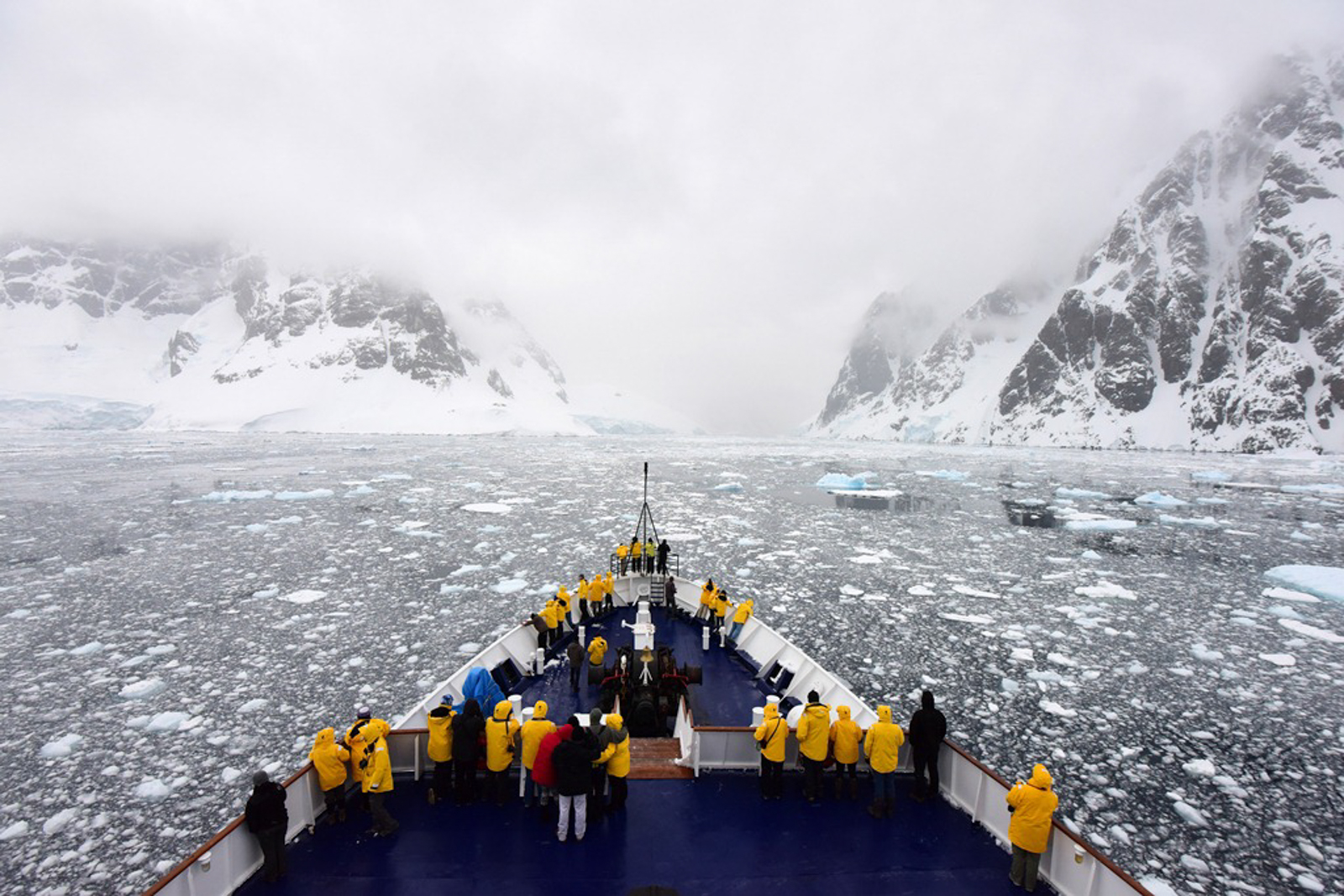
Upon leaving Kangerlussuaq, we set sail across the Davis Strait to the east coast of Baffin Island. Join us on the outer deck as we cast off, keeping an eye out for seabirds and marine life gliding alongside the ship. Have your binoculars at hand to scan for seabirds, including great black-backed gulls and black guillemots. There are many ways to spend your time aboard Ultramarine. Visit Tundra Spa and other onboard amenities, or attend educational presentations led by our polar experts—glaciologists, historians and other specialists. You’ll learn about northern communities and ways of life in preparation for our first community visit. There will also be mandatory briefings with our expedition team on how we’ll safely explore this remote and compelling Arctic region. You will also have time to relax in the Observation Lounge while spotting drifting ice, seabirds and other wildlife. From the outer decks, take in the wideopen panoramas of western Greenland while we cross the Arctic Circle at 66°33′ North.
Day programme:
We’re excited to be heading to Qikiqtarjuaq, fondly called Qik, a small Inuit hamlet located north of the Arctic Circle on Broughton Island, off the east coast of Baffin Island. Known as the iceberg capital of Nunavut, Qikiqtarjuaq sits at the northern entrance to the mountainous Auyuittuq National Park, which is home to narwhals, bowhead and orca whales, polar bears, seals and migratory birds. Community visits, arranged in collaboration with our local partners, enable guests to learn about on-the-ground culture, and purchase art and traditional handicrafts, such as parkas, boots and local art when available. As icebergs travel down the Davis Strait, many are naturally trapped at Qikiqtarjuaq. The surrounding waters are also home to ringed and harp seals, often surfacing between floes. A hike up to the hilltop offers sweeping views of the community and its coastal setting. You’ll also see inukshuks—carefully placed stone figures or cairns that have served as navigational guides and markers of important places, but also as expressions of spirit, memory, and connection to the land. Cruising further north along the mountainous east shore of Baffin Island, we’ll approach Isabella Bay, an important summer and fall feeding area for the largest concentration of bowhead whales in Canada. Bowheads are a truly remarkable Arctic leviathan, with research suggesting they can live more than 200 years—making them the longest-lived mammal on Earth. Isabella Bay is a marvel, its dramatic landscapes and wideopen horizons best experienced from the outer decks of Ultramarine. We’ll aim to launch the Zodiacs and explore the bay, binoculars at the ready. For our intrepid paddlers, our sea kayak and paddling programs may also be available here.
Day programme:
We’re excited to be heading to Qikiqtarjuaq, fondly called Qik, a small Inuit hamlet located north of the Arctic Circle on Broughton Island, off the east coast of Baffin Island. Known as the iceberg capital of Nunavut, Qikiqtarjuaq sits at the northern entrance to the mountainous Auyuittuq National Park, which is home to narwhals, bowhead and orca whales, polar bears, seals and migratory birds. Community visits, arranged in collaboration with our local partners, enable guests to learn about on-the-ground culture, and purchase art and traditional handicrafts, such as parkas, boots and local art when available. As icebergs travel down the Davis Strait, many are naturally trapped at Qikiqtarjuaq. The surrounding waters are also home to ringed and harp seals, often surfacing between floes. A hike up to the hilltop offers sweeping views of the community and its coastal setting. You’ll also see inukshuks—carefully placed stone figures or cairns that have served as navigational guides and markers of important places, but also as expressions of spirit, memory, and connection to the land. Cruising further north along the mountainous east shore of Baffin Island, we’ll approach Isabella Bay, an important summer and fall feeding area for the largest concentration of bowhead whales in Canada. Bowheads are a truly remarkable Arctic leviathan, with research suggesting they can live more than 200 years—making them the longest-lived mammal on Earth. Isabella Bay is a marvel, its dramatic landscapes and wideopen horizons best experienced from the outer decks of Ultramarine. We’ll aim to launch the Zodiacs and explore the bay, binoculars at the ready. For our intrepid paddlers, our sea kayak and paddling programs may also be available here.
Day programme:
This is an especially exciting day as you become one of the very few travelers to explore the majestic Icy Arm Fjord, which cuts almost 80 kilometers deep into northern Bafffin Island. Accessible only by water in summer months when the sea ice recedes, this rarely-visited fjord is known for its unrivalled landscape of towering cliffs and stunning glaciers, and is valued as much for its sheer remoteness as it is for its singularly pristine environment. Icy Arm Fjord epitomizes the raw beauty of unspoiled Arctic wilderness. We may observe polar bears, Arctic foxes, seals, walruses, as well as guillemots, kittiwakes and other Arctic-dwelling birds. Excitement grows on Day 6 as Ultramarine’s two twin-engine helicopters are made ready for flightseeing excursions. Prepare to view the remote Arctic terrain from the seat of a helicopter—camera at the ready. It’s also an excellent day for Zodiac cruises, which offer guests a sea-level intimacy with the the surrounding lands and waters. If weather conditions prevent heli flightseeing on this day, we will aim for another potential flight seeing opportunity at a different location.
Day programme:
At the top of Baffin Island sits TallurutiupImanga (also known as Lancaster Sound), a true Arctic oasis. Known by the Inuit and their predecessors for thousands of years, this channel and the surrounding lands are extremely rich in wildlife and history, both indigenous and European. The surrounding area affords several hiking opportunities. At Dundas Harbour, on Devon Island, you’ll visit an abandoned beachside outpost of the Royal Canadian Mounted Police. At Croker Bay, we’ll plan to cruise close enough to appreciate the splendor of glacial textures and calving ice, while always keeping a safe distance. Walrus frequent the waters here, so be sure to have your camera handy. Next we’ll head to the western end of Devon Island, on the north side of Tallurutiup-Imanga, and go ashore at windswept Beechey Island, which is home to Beechey Island National Historic Sites. Maintained by Parks Canada, these sites tell the story—or at least the part that’s still not shrouded in mystery—of Sir John Franklin’s much chronicled 1845- 46 expedition to explore the Northwest Passage. The island is small, only 2.5 kilometers (1.5 miles) at its widest point, but its shores are steep, and rise to a flat plateau 244 meters (800 feet) high. That’s where Franklin and his crew of 128 men spent the winter after embarking from England on two ships, HMS Erebus and HMS Terror. The ill-fated 1845-46 expedition—to navigate and chart the Northwest Passage—ended in tragedy for all 129 men and their two vessels. What happened to Franklin and his crew is the stuff of legend, and the focus for several search expeditions over the years, which discovered bodies, personal belongings of crew members, and handwritten notes that suggested starvation, deaths from hypothermia, scurvy, and lead poisoning from the tinned food supplies. Accounts by Inuit suggest the crew split up into small groups and subsequently perished. What is known for certain is that no one survived. The graves of three officers from HMS Erebus— John Hartnell, William Braine, and John Torrington— were discovered in 1851. You will have an opportunity to visit their graves, and honor the memory of the entire Franklin crew who braved daunting challenges to explore the Northwest Passage. Franklin’s story is an integral part of the history of Arctic exploration. The wrecks of Erebus and Terror were discovered in 2014 and 2016, respectively. We also hope to explore the shores of the uninhabited Prince Leopold Island, known primarily as a significant Migratory Bird Sanctuary and an Important Bird Area, where we aim to launch the Zodiacs for an immersive cruise at the foot of the bird cliffs. The island is renowned for its steep cliffs that host hundreds of thousands of nesting seabirds, including thick-billed murres, northern fulmars, and black guillemots during the summer months. Port Leopold, an abandoned Hudson’s Bay Company trading post dating back to 1937, sits on the northeast tip of nearby Somerset Island. It’s the closest landmark to Prince Leopold Island, situated about 13 kilometers (8.1 miles) to the southwest. This site is closely tied to the history of Arctic exploration, including the search for the Franklin Expedition. Visitors can still see the remains of the original trading post, including the old store and the manager’s home.
Day programme:
At the top of Baffin Island sits TallurutiupImanga (also known as Lancaster Sound), a true Arctic oasis. Known by the Inuit and their predecessors for thousands of years, this channel and the surrounding lands are extremely rich in wildlife and history, both indigenous and European. The surrounding area affords several hiking opportunities. At Dundas Harbour, on Devon Island, you’ll visit an abandoned beachside outpost of the Royal Canadian Mounted Police. At Croker Bay, we’ll plan to cruise close enough to appreciate the splendor of glacial textures and calving ice, while always keeping a safe distance. Walrus frequent the waters here, so be sure to have your camera handy. Next we’ll head to the western end of Devon Island, on the north side of Tallurutiup-Imanga, and go ashore at windswept Beechey Island, which is home to Beechey Island National Historic Sites. Maintained by Parks Canada, these sites tell the story—or at least the part that’s still not shrouded in mystery—of Sir John Franklin’s much chronicled 1845- 46 expedition to explore the Northwest Passage. The island is small, only 2.5 kilometers (1.5 miles) at its widest point, but its shores are steep, and rise to a flat plateau 244 meters (800 feet) high. That’s where Franklin and his crew of 128 men spent the winter after embarking from England on two ships, HMS Erebus and HMS Terror. The ill-fated 1845-46 expedition—to navigate and chart the Northwest Passage—ended in tragedy for all 129 men and their two vessels. What happened to Franklin and his crew is the stuff of legend, and the focus for several search expeditions over the years, which discovered bodies, personal belongings of crew members, and handwritten notes that suggested starvation, deaths from hypothermia, scurvy, and lead poisoning from the tinned food supplies. Accounts by Inuit suggest the crew split up into small groups and subsequently perished. What is known for certain is that no one survived. The graves of three officers from HMS Erebus— John Hartnell, William Braine, and John Torrington— were discovered in 1851. You will have an opportunity to visit their graves, and honor the memory of the entire Franklin crew who braved daunting challenges to explore the Northwest Passage. Franklin’s story is an integral part of the history of Arctic exploration. The wrecks of Erebus and Terror were discovered in 2014 and 2016, respectively. We also hope to explore the shores of the uninhabited Prince Leopold Island, known primarily as a significant Migratory Bird Sanctuary and an Important Bird Area, where we aim to launch the Zodiacs for an immersive cruise at the foot of the bird cliffs. The island is renowned for its steep cliffs that host hundreds of thousands of nesting seabirds, including thick-billed murres, northern fulmars, and black guillemots during the summer months. Port Leopold, an abandoned Hudson’s Bay Company trading post dating back to 1937, sits on the northeast tip of nearby Somerset Island. It’s the closest landmark to Prince Leopold Island, situated about 13 kilometers (8.1 miles) to the southwest. This site is closely tied to the history of Arctic exploration, including the search for the Franklin Expedition. Visitors can still see the remains of the original trading post, including the old store and the manager’s home.
Day programme:
At the top of Baffin Island sits TallurutiupImanga (also known as Lancaster Sound), a true Arctic oasis. Known by the Inuit and their predecessors for thousands of years, this channel and the surrounding lands are extremely rich in wildlife and history, both indigenous and European. The surrounding area affords several hiking opportunities. At Dundas Harbour, on Devon Island, you’ll visit an abandoned beachside outpost of the Royal Canadian Mounted Police. At Croker Bay, we’ll plan to cruise close enough to appreciate the splendor of glacial textures and calving ice, while always keeping a safe distance. Walrus frequent the waters here, so be sure to have your camera handy. Next we’ll head to the western end of Devon Island, on the north side of Tallurutiup-Imanga, and go ashore at windswept Beechey Island, which is home to Beechey Island National Historic Sites. Maintained by Parks Canada, these sites tell the story—or at least the part that’s still not shrouded in mystery—of Sir John Franklin’s much chronicled 1845- 46 expedition to explore the Northwest Passage. The island is small, only 2.5 kilometers (1.5 miles) at its widest point, but its shores are steep, and rise to a flat plateau 244 meters (800 feet) high. That’s where Franklin and his crew of 128 men spent the winter after embarking from England on two ships, HMS Erebus and HMS Terror. The ill-fated 1845-46 expedition—to navigate and chart the Northwest Passage—ended in tragedy for all 129 men and their two vessels. What happened to Franklin and his crew is the stuff of legend, and the focus for several search expeditions over the years, which discovered bodies, personal belongings of crew members, and handwritten notes that suggested starvation, deaths from hypothermia, scurvy, and lead poisoning from the tinned food supplies. Accounts by Inuit suggest the crew split up into small groups and subsequently perished. What is known for certain is that no one survived. The graves of three officers from HMS Erebus— John Hartnell, William Braine, and John Torrington— were discovered in 1851. You will have an opportunity to visit their graves, and honor the memory of the entire Franklin crew who braved daunting challenges to explore the Northwest Passage. Franklin’s story is an integral part of the history of Arctic exploration. The wrecks of Erebus and Terror were discovered in 2014 and 2016, respectively. We also hope to explore the shores of the uninhabited Prince Leopold Island, known primarily as a significant Migratory Bird Sanctuary and an Important Bird Area, where we aim to launch the Zodiacs for an immersive cruise at the foot of the bird cliffs. The island is renowned for its steep cliffs that host hundreds of thousands of nesting seabirds, including thick-billed murres, northern fulmars, and black guillemots during the summer months. Port Leopold, an abandoned Hudson’s Bay Company trading post dating back to 1937, sits on the northeast tip of nearby Somerset Island. It’s the closest landmark to Prince Leopold Island, situated about 13 kilometers (8.1 miles) to the southwest. This site is closely tied to the history of Arctic exploration, including the search for the Franklin Expedition. Visitors can still see the remains of the original trading post, including the old store and the manager’s home.
Day programme:
As we position from Lancaster Sound down along the east coast of Baffin Island, spend time out on deck to soak in the scenery: expansive landscapes, jagged spires, and bird life. Today is also ideal to enjoy the onboard amenities—such as Tundra Spa—and deepening your knowledge through presentations by our polar experts.
The starkly beautiful Sam Ford Fjord area of Baffin Island has one of the most impressive concentrations of vertical rock walls to be found anywhere in the world. It is a 110-kilometer (68-mile) waterway lined with sheer cliffs that have attracted some of the world’s best (and most extreme) rock climbers to the region. The steep stone walls were formed by ancient glaciers that carved the landscape throughout the ages. However, the feature that makes the shoreline truly special is the way that many of these walls rise straight up from the dark waters of the deep fjord. Swimming these waters are marine mammals including narwhals and seals that once attracted Inuit hunters to this coast.
Day programme:
Well inside the Arctic Circle, Sam Ford Fjord is a standout Arctic adventure destination on Baffin Island’s northeast coast, and one of the world’s most spectacular big-wall playgrounds. A traditional Inuit hunting area, the fjord is a study in contrasts: sheer granite cliffs seem to rise straight up from the ocean below, reaching up to 457 meters (1,500 feet) above sea level. If weather conditions permit, this region offers fabulous Zodiac cruising, sea kayaking and paddling as well as opportunities to go ashore. With a bit of luck, we may see Arctic fox onshore, and we’ll keep our eyes peeled for polar bears during our off-shore excursions. Cruising the fjord in a Zodiac is a striking reminder of just how small we are. Winding along a 110- kilometer (68-mile) path, Sam Ford Fjord narrows to less than 3 kilometers (2 miles) wide as it meanders farther inland.
Day programme:
Prepare yourself for an awe-inspiring experience. Ilulissat, located in Disko Bay, is home to the UNESCO World Heritage Site of Ilulissat Icefjord, which is the thoroughfare for countless icebergs calved from one of the world’s fastest-moving glaciers, Sermeq Kujalleq. Locals have constructed a boardwalk leading to an elevated overlook, where you can view bergs of all sizes spread out before you. From this vantage point, it feels as though you’re standing where the town ends and the wilderness begins. Visitors say they’ve felt humbled by the sweeping vista of ice. You will also notice the Arctic cotton grass and summer wildflowers thriving in the long daylight hours. The inner harbor is a rare sight: icebergs drifting among fishing boats and skiffs. The town itself is well worth exploring, and has become one of Greenland’s top destinations. Recent years have brought growth— colorful homes now sit beside new restaurants, boutique hotels and small businesses. History buffs will be excited to know Ilulissat is the birthplace of Arctic explorer Knud Rasmussen, who traveled by dog sled from Greenland to Alaska (and briefly Siberia) during the Fifth Thule Expedition (1921–1924). Fluent in Kalaallisut, he learned from and documented the Circumpolar Inuit he met—making it one of the Arctic’s greatest expeditions. It was in these dramatic landscapes around Ilulissat that Rasmussen’s passion for exploration took root. As we approach town, watch out for whales, which frequent the iceberg-laden waters. Pride of place for our seasoned expedition team is Eternity Fjord, which is home to the tallest mountains in all of West Greenland. This a favorite spot for us to launch the Zodiacs to explore in-depth— where larger vessels can’t navigate. There are few settlements along this lengthy fjord, but you will quickly appreciate nature in its rawest form as you hike among the towering mountains, and photograph the colorful tundra and other dramatic landscapes. Another fascinating highlight is Maniitsoq, often called the “Venice of Greenland,” as it’s situated in an archipelago intersected by natural canals. Soaring, snow-capped mountains surround this small, rocky town, whose name means “the uneven place.” Playful humpback whales spend the summer in the surrounding waters, so we’ll keep our eyes peeled as we transit ashore by Zodiac.
Day programme:
Prepare yourself for an awe-inspiring experience. Ilulissat, located in Disko Bay, is home to the UNESCO World Heritage Site of Ilulissat Icefjord, which is the thoroughfare for countless icebergs calved from one of the world’s fastest-moving glaciers, Sermeq Kujalleq. Locals have constructed a boardwalk leading to an elevated overlook, where you can view bergs of all sizes spread out before you. From this vantage point, it feels as though you’re standing where the town ends and the wilderness begins. Visitors say they’ve felt humbled by the sweeping vista of ice. You will also notice the Arctic cotton grass and summer wildflowers thriving in the long daylight hours. The inner harbor is a rare sight: icebergs drifting among fishing boats and skiffs. The town itself is well worth exploring, and has become one of Greenland’s top destinations. Recent years have brought growth— colorful homes now sit beside new restaurants, boutique hotels and small businesses. History buffs will be excited to know Ilulissat is the birthplace of Arctic explorer Knud Rasmussen, who traveled by dog sled from Greenland to Alaska (and briefly Siberia) during the Fifth Thule Expedition (1921–1924). Fluent in Kalaallisut, he learned from and documented the Circumpolar Inuit he met—making it one of the Arctic’s greatest expeditions. It was in these dramatic landscapes around Ilulissat that Rasmussen’s passion for exploration took root. As we approach town, watch out for whales, which frequent the iceberg-laden waters. Pride of place for our seasoned expedition team is Eternity Fjord, which is home to the tallest mountains in all of West Greenland. This a favorite spot for us to launch the Zodiacs to explore in-depth— where larger vessels can’t navigate. There are few settlements along this lengthy fjord, but you will quickly appreciate nature in its rawest form as you hike among the towering mountains, and photograph the colorful tundra and other dramatic landscapes. Another fascinating highlight is Maniitsoq, often called the “Venice of Greenland,” as it’s situated in an archipelago intersected by natural canals. Soaring, snow-capped mountains surround this small, rocky town, whose name means “the uneven place.” Playful humpback whales spend the summer in the surrounding waters, so we’ll keep our eyes peeled as we transit ashore by Zodiac.
Day programme:
Prepare yourself for an awe-inspiring experience. Ilulissat, located in Disko Bay, is home to the UNESCO World Heritage Site of Ilulissat Icefjord, which is the thoroughfare for countless icebergs calved from one of the world’s fastest-moving glaciers, Sermeq Kujalleq. Locals have constructed a boardwalk leading to an elevated overlook, where you can view bergs of all sizes spread out before you. From this vantage point, it feels as though you’re standing where the town ends and the wilderness begins. Visitors say they’ve felt humbled by the sweeping vista of ice. You will also notice the Arctic cotton grass and summer wildflowers thriving in the long daylight hours. The inner harbor is a rare sight: icebergs drifting among fishing boats and skiffs. The town itself is well worth exploring, and has become one of Greenland’s top destinations. Recent years have brought growth— colorful homes now sit beside new restaurants, boutique hotels and small businesses. History buffs will be excited to know Ilulissat is the birthplace of Arctic explorer Knud Rasmussen, who traveled by dog sled from Greenland to Alaska (and briefly Siberia) during the Fifth Thule Expedition (1921–1924). Fluent in Kalaallisut, he learned from and documented the Circumpolar Inuit he met—making it one of the Arctic’s greatest expeditions. It was in these dramatic landscapes around Ilulissat that Rasmussen’s passion for exploration took root. As we approach town, watch out for whales, which frequent the iceberg-laden waters. Pride of place for our seasoned expedition team is Eternity Fjord, which is home to the tallest mountains in all of West Greenland. This a favorite spot for us to launch the Zodiacs to explore in-depth— where larger vessels can’t navigate. There are few settlements along this lengthy fjord, but you will quickly appreciate nature in its rawest form as you hike among the towering mountains, and photograph the colorful tundra and other dramatic landscapes. Another fascinating highlight is Maniitsoq, often called the “Venice of Greenland,” as it’s situated in an archipelago intersected by natural canals. Soaring, snow-capped mountains surround this small, rocky town, whose name means “the uneven place.” Playful humpback whales spend the summer in the surrounding waters, so we’ll keep our eyes peeled as we transit ashore by Zodiac.
The name Kangerlussuaq means “Big Fjord” in the local Kalaallisut language. The settlement of about 500 people is located in western Greenland on flat land at the head of a fjord with the same name. Kangerlussuaq is the site of Greenland’s largest commercial airport and most of the economy here is dependent on the air transportation hub and tourism. The rugged lands around the settlement support terrestrial Arctic fauna including muskoxen, caribou, and Gyrfalcons.
Day programme:
Today we’ll explore 50 kilometers (31 miles) above the Arctic Circle. Our destination is Kangerlussuaq, which is Greenlandic for “the long fjord.” At the end of this 180-kilometer (112 mile) fjord is a settlement bearing the same name. Fishing boats based in the town of Kangerlussuaq sail the full length of the fjord to access the ocean. The town is known for its natural beauty—and for previously being the home of the largest airport in Greenland. You will be ferried from ship to shore on one last Zodiac ride, then transferred to the airport where you will board your charter flight to Iceland’s Keflavik International Airport, approximately 45 minutes from Reykjavik. Upon arrival at the airport, you will be transferred to your included hotel for the night, which is part of the Charter Flight & Hotel package.
Sprawling Reykjavík, the nation’s nerve center and government seat, is home to half the island’s population. On a bay overlooked by proud Mt. Esja (pronounced eh-shyuh), with its ever-changing hues, Reykjavík presents a colorful sight, its concrete houses painted in light colors and topped by vibrant red, blue, and green roofs. In contrast to the almost treeless countryside, Reykjavík has many tall, native birches, rowans, and willows, as well as imported aspen, pines, and spruces.Reykjavík’s name comes from the Icelandic words for smoke, reykur, and bay, vík. In AD 874, Norseman Ingólfur Arnarson saw Iceland rising out of the misty sea and came ashore at a bay eerily shrouded with plumes of steam from nearby hot springs. Today most of the houses in Reykjavík are heated by near-boiling water from the hot springs. Natural heating avoids air pollution; there’s no smoke around. You may notice, however, that the hot water brings a slight sulfur smell to the bathroom.Prices are easily on a par with other major European cities. A practical option is to purchase a Reykjavík City Card at the Tourist Information Center or at the Reykjavík Youth Hostel. This card permits unlimited bus usage and admission to any of the city’s seven pools, the Family Park and Zoo, and city museums. The cards are valid for one (ISK 3,300), two (ISK 4,400), or three days (ISK 4,900), and they pay for themselves after three or four uses a day. Even lacking the City Card, paying admission (ISK 500, or ISK 250 for seniors and people with disabilities) to one of the city art museums (Hafnarhús, Kjarvalsstaðir, or Ásmundarsafn) gets you free same-day admission to the other two.
Day programme:
After breakfast in your included hotel in Reykjavik, you can transfer independently to the Keflavik International Airport for your onward journey or explore Iceland as prearranged.
Ship features

Ultra Suite
Located on Deck 6, with approximately 563 sq. ft. (52.3m2) of interior living space, and a 46 sq. ft. (4.3 m2) balcony. This suite is perfect for guests who want to travel without compromise. Our largest and most luxurious suite features the most sleeping, entertainment and storage space onboard the ship. It is perfect for families or travelers who want all the comforts of home onboard the ship.
Features: one double or two single beds in a private bedroom with walk-in closet, sitting area with sofa bed and additional walk-in hallway closet, private balcony, desk, refrigerator, TV, private bathroom with shower, bathtub and heated floors and separate powder room.
Standard Amenities: hair dryer, bathrobe, slippers, shampoo, conditioner, shower gel, complimentary water bottle.
Premium Amenities: upgraded bedding, in suite coffee, binoculars on loan.
Services: onboard WiFi credit*, included laundry**, in suite dining during scheduled meals, included spa package, upgraded hotel accommodation pre-/post-expedition where applicable, included arrival transfers where applicable.
Bed Config.
- 1 double or 2 single beds
*terms & conditions apply, WiFi may be limited in duration or data
**terms & conditions apply, limited number of laundry loads per voyage

Owner's Suite
Located on Deck 6, with approximately 446 sq. ft. (41.4 m2) of indoor living space and a 46.3 sq. ft. (4.3 m2) balcony. This suite is perfect for guests who want it all. A large, luxurious suite featuring a private bedroom, full bathroom, powder room, and two separate living spaces. This suite is perfect for families or couples who want all the comforts of home onboard the ship.
Features: one double or two single beds in a private bedroom with walk-in closet, sitting area with sofa bed and additional closet, private balcony, desk, refrigerator, TV, private bathroom with shower, bathtub and heated floors and separate powder room.
Standard Amenities: hair dryer, bathrobe, slippers, shampoo, conditioner, shower gel, complimentary water bottle.
Premium Amenities: upgraded bedding, in suite coffee, binoculars on loan.
Services: onboard WiFi credit*, included laundry**, in suite dining during scheduled meals, included spa package, upgraded hotel accommodation pre-/post-expedition where applicable, included arrival transfers where applicable.
Bed Config.
- 1 double or 2 single beds
*terms & conditions apply, WiFi may be limited in duration or data
**terms & conditions apply, limited number of laundry loads per voyage

Penthouse Suite
The only suite category to be located on Deck 7, with approximately 369 sq. ft. (34.3 m2) of indoor living space, and a 67 sq. ft. (6.2 m2) balcony. This suite is perfect for guests wanting to wake up to unobstructed polar views from the warmth and comfort of their bed onboard the ship. These suites offer the best of everything—views, spacious interiors, full bathrooms and generous balcony sizes—as well as easy access to the wellness centre.
Features: one double or two single beds, sitting area with sofa bed, private balcony, desk, refrigerator, TV, private bathroom with shower, bathtub and heated floors.
Standard Amenities: hair dryer, bathrobe, slippers, shampoo, conditioner, shower gel, complimentary water bottle.
Premium Amenities: upgraded bedding, in suite coffee.
Services: onboard WiFi credit*, included laundry**, in suite dining during scheduled meals.
Bed Config.
- 1 double or 2 single beds
*terms & conditions apply, WiFi may be limited in duration or data
**terms & conditions apply, limited number of laundry loads per voyage

Terrace Suite
Located on Deck 6, with approximately 350 sq. ft. (32.5 m2) of indoor living space, and a 100 sq. ft. (9.3 m2) balcony. This suite is perfect for guests wanting generous interiors with a wide layout and the largest balconies on the ship. Centrally located on Deck 6, guests will enjoy minimal movement and motion from the comfort of these suites.
Features: one double or two single beds, sitting area with sofa bed, private extra-wide balcony, desk, refrigerator, TV, private bathroom with shower, bathtub and heated floors.
Standard Amenities: hair dryer, bathrobe, slippers, shampoo, conditioner, shower gel, complimentary water bottle.
Premium Amenities: upgraded bedding, in suite coffee.
Services: onboard WiFi credit*, included laundry**, in suite dining during scheduled meals.
Bed Config.
- 1 double or 2 single beds
*terms & conditions apply, WiFi may be limited in duration or data
**terms & conditions apply, limited number of laundry loads per voyage

Deluxe Balcony Suite
Located on Decks 4 and 6, with approximately 299 sq. ft. (27.8 m2) of indoor living space, and a 70 sq. ft. (6.5 m2) balcony. This suite is perfect for guests wanting a larger living space, full bathroom, and a substantial balcony. Deluxe Balcony Suites are the first suite type to offer additional privacy in the bathroom with an enclosed toilet, a full bath and shower to make it easier for guests to get ready together in the morning.
Features: one double or two single beds, sitting area with sofa bed, private balcony, desk, refrigerator, TV, private bathroom with shower, bathtub and heated floors.
Standard Amenities: hair dryer, bathrobe, slippers, shampoo, conditioner, shower gel, complimentary water bottle.
Bed Config.
- 1 double or 2 single beds

Balcony Suite
Located on Decks 4 and 6, with approximately 226 sq. ft. (21 m2) of indoor living space, and a 52 sq. ft. (4.8 m2) balcony, this entry-level balcony suite is one of the largest available on a ship of this class. This suite is perfect for guests who are looking for both indoor and outdoor living spaces. There are four connecting suites in this category, making this an excellent option for families or groups wanting to stay connected to each other during their expedition.
Features: one double or two single beds, sitting area with sofa bed, private balcony, desk, refrigerator, TV, private bathroom with shower and heated floors.
Standard Amenities: hair dryer, bathrobe, slippers, shampoo, conditioner, shower gel, complimentary water bottle.
Bed Config.
- 1 double or 2 single beds

Explorer Suite
Located on Deck 3, and approximately 285 sq. ft. (26.5 m2). These suites are perfect for people traveling together or solo guests looking to share with like-minded individuals. This suite maximizes interior living space while still offering guests the opportunity to stay connected to the outdoors. Our entry-level twin suites are the largest available on a ship of this class.
Features: one double or two single beds, sitting area with sofa bed, picture window, desk, refrigerator, TV, private bathroom with shower and heated floors.
Standard Amenities: hair dryer, bathrobe, slippers, shampoo, conditioner, shower gel, complimentary water bottle.
Bed Config.
- 1 double or 2 single beds

Explorer Triple
Located on Deck 3, and approximately 285 sq. ft. (26.5 m2). This suite is perfect for guests traveling solo who want to share their experience with other like-minded travelers of the same gender, or for groups of three traveling together. Featuring three separate single beds, and amenities for each of the three guests.
Features: three single beds (two of which can be combined into a double bed), sitting area, picture window, desk, refrigerator, TV, private bathroom with shower and heated floors.
Standard Amenities: hair dryer, bathrobe, slippers, shampoo, conditioner, shower gel, complimentary water bottle.
Bed Config.
- 3 single beds, two of which can be converted to a double bed

Solo Panorama
Located on Deck 6, and approximately 132 sq. ft. (12.3 m2). This suite is perfect for solo guests who appreciate privacy and want to wake up to sweeping views from the comfort of their bed. These are the only solo suites with floor-to-ceiling windows available onboard any ship in its class.
Features: single bed, floor-to-ceiling window, desk, refrigerator, TV, private bathroom with shower and heated floors.
Standard Amenities: hair dryer, bathrobe, slippers, shampoo, conditioner, shower gel, complimentary water bottle.
Bed Config.
- 1 twin

Balena
Featuring table tops that accommodate 2 to 10, guests can enjoy a quiet dinner with a loved one or join a larger table of new friends. Guests will also enjoy views from every seat in addition to direct access to the wraparound deck.

Bistro 487
Guests can enjoy a meal in the Bistro which offers an indoor/outdoor dining experience. Perfect for enjoying the polar landscapes.

Ambassador Theater
A state-of-the-art, high-resolution LED screen wall in the main theater ensures high-definition viewing of presentations from your Expedition Team from any angle.

Ready Room
Designed for efficiency—with wider hallways, plenty of seating, and conveniently located bathrooms—our two ready rooms allow guests to quickly change in and out of their expedition gear.

Zodiac Cruising
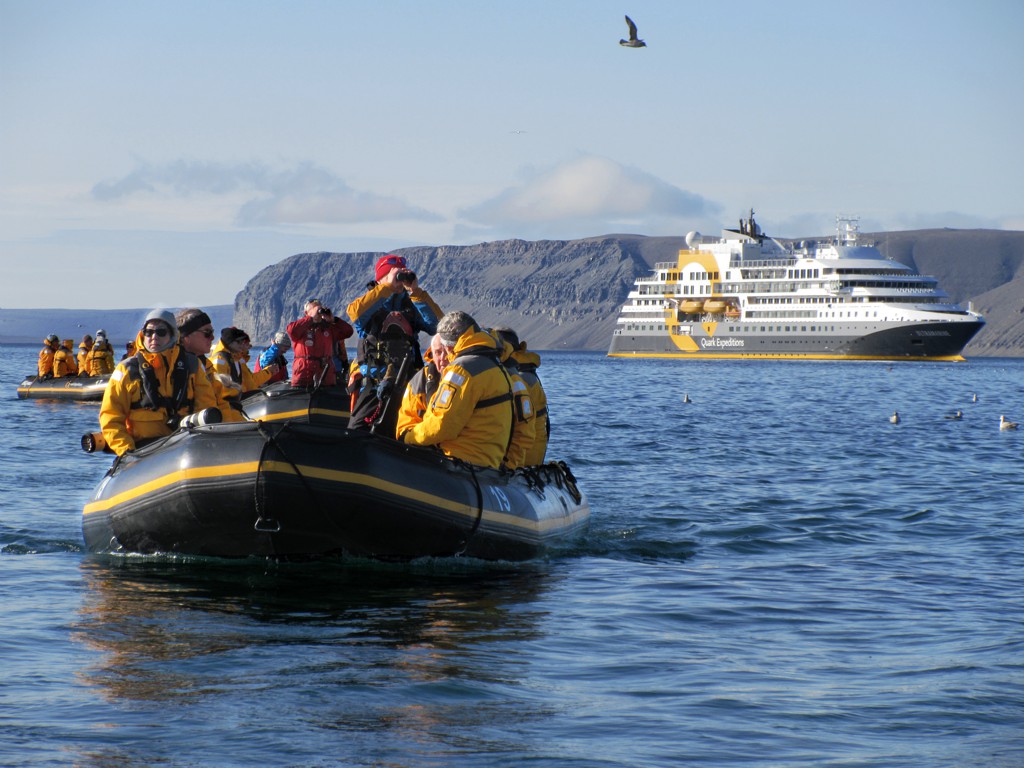
Zodiacs are used for transferring you ashore, transporting your luggage when necessary and for taking you ocean-level cruising among icebergs, whales and seabirds. During the expedition, you will visit remote and isolated sites that are accessible only by Zodiac.
These large, heavy-duty inflatable vessels are extremely safe and were specially designed for expedition work. Zodiacs are the workhorses of Polar expeditions. Separate air compartments retain a large reserve of buoyancy even if these sturdy boats are damaged. Their flat bottom design permits the craft to land directly onto the cobble and ice-strewn beaches that you will encounter on your Polar expedition.

Expedition Team
The perfect polar expedition doesn’t just happen. It takes a team of talented, knowledgeable and experienced professionals to bring it all together. Our Expedition Team is comprised of seasoned veterans with rich backgrounds in marine biology, history, glaciology, geology and more. With the highest staff-to-guest ratio in the industry, our Expedition Teams safely deliver your trip-of-a-lifetime to maximize your polar adventure every step of the way.

Twin Engine Helicopters
Two twin-engine helicopters operated from two helidecks allow more passengers to simultaneously experience new destinations accessible only by air, and to enjoy more unique aerial perspectives of the polar regions than on any other ship.

Flightseeing aboard Ultramarine
While polar landscapes are spectacular from the sea, they’re even more stunning from the air, a view you can enjoy while seated in one of the two twin-engine helicopters stationed on Ultramarine. Typically in groups of 7 to 9, you will experience an unforgettable aerial∘ tour of the Arctic during a 10- to 15-minute flightseeing excursion∘ that’s included in the cost of the voyage. Additional helicopter activities may also be available for purchase onboard. Please note: all helicopter operations are weather- and logistics-dependent.

Sea Kayaking
Sea kayaking is offered on all of our departures and you require no previous experience to enjoy this activity. Our sea kayaks are the ideal means by which to get some good exercise and explore the cliffs and shores of the various visitor sites around the archipelago. A typical cruise week offers great opportunities to go kayaking around secluded coves, shores, mangrove estuaries and beautiful beaches. Galapagos penguins, flightless cormorants, sea lions and many other animals can be seen up close on a kayak and even as they swim.
Polar Plunge
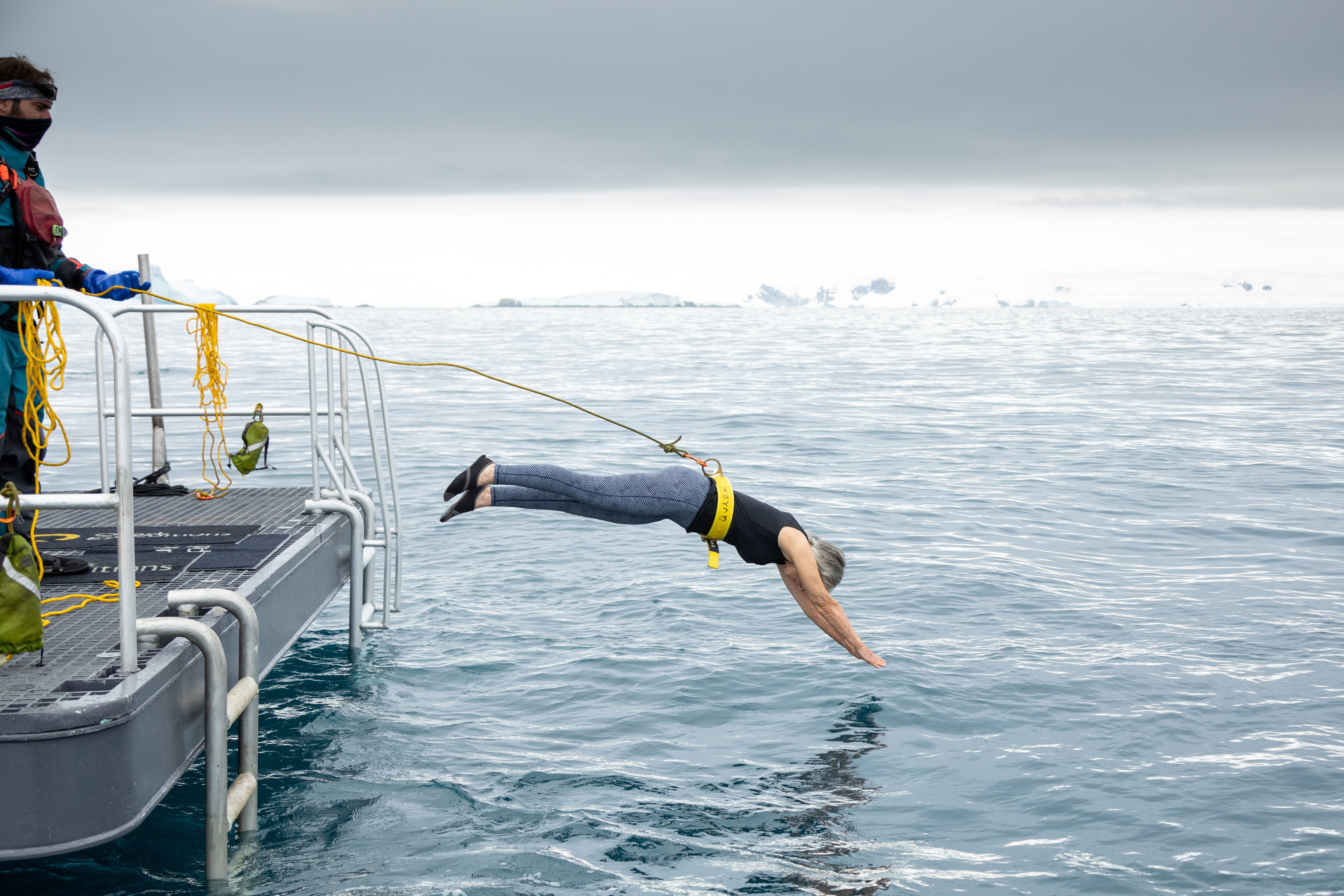
The Polar Plunge is scheduled once during each voyage. Throughout the journey, the Expedition Leader and Captain constantly monitor conditions in order to choose the optimal time and location. The Polar Plunge sometimes takes place onshore or, in many cases, from the gangway or Zodiac. All participants wear a tethered harness and plunge into the polar waters from the side of Zodiac or safety of the gangplank cheered on, of course, by fellow passengers and Expedition Team.
Safety is paramount—the onboard physician always attends the Polar Plunge. Guides in survival gear circle the area in Zodiacs as guests take their turn jumping or cannon-balling into the polar waters.
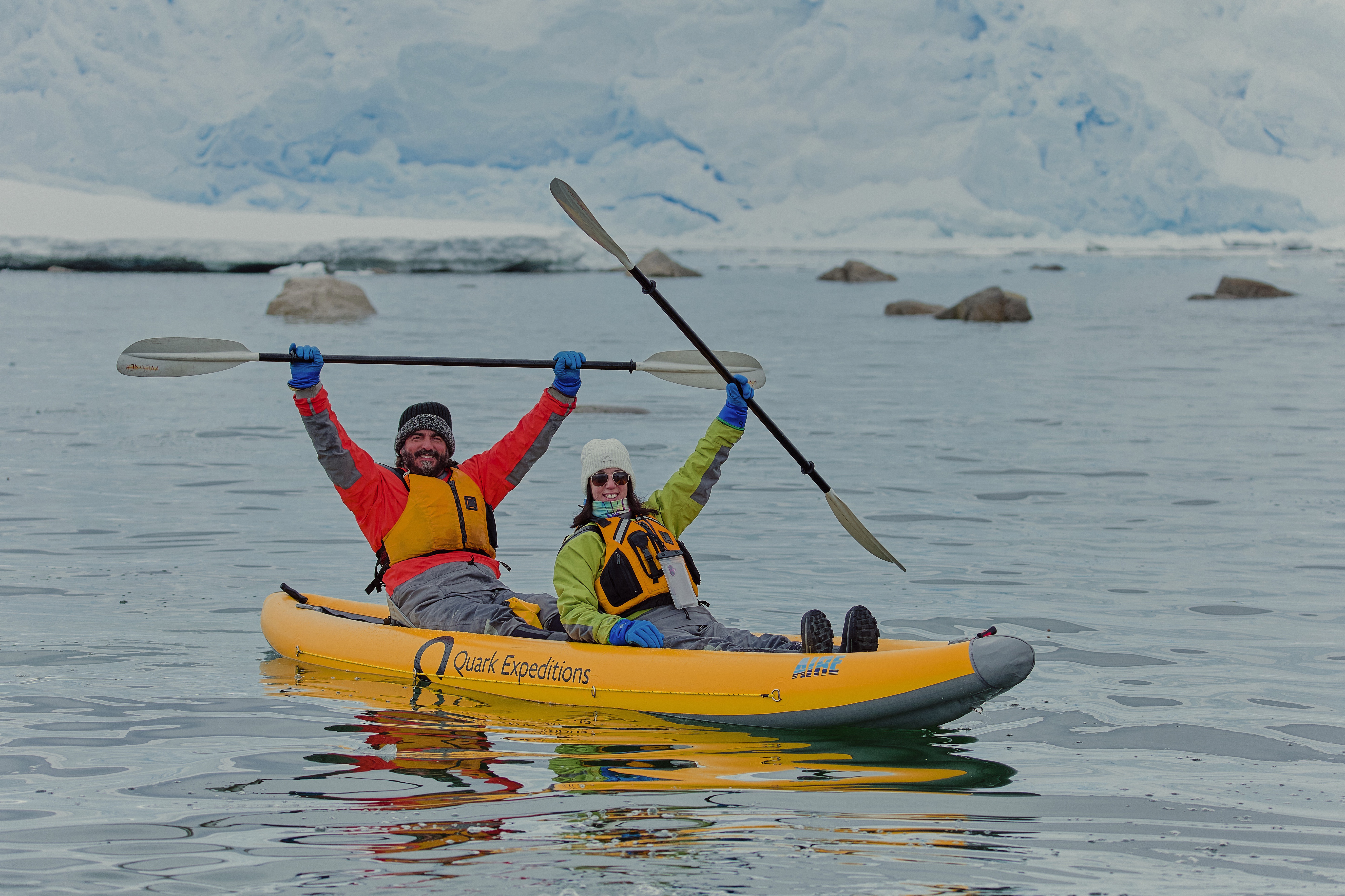
Paddling Excursion
Explore the ocean from a more intimate vantage point on a sit-on-top kayak. No experience is required to manoeuvre these very stable kayaks, allowing you to enjoy an unforgettable experience on the water, taking in breathtaking landscapes and wildlife. Whether it’s your first time in a kayak or you want greater flexibility to try other Adventure options, this shorter excursion is for you.
Paddling in the Polar Regions is highly weather-dependent and a one-time experience. Your kayak guides will attempt to take you out on the water for 1-1.5 hours of paddling. Offered on most voyages, spaces are limited. All equipment, guides and instructions are provided by Quark.
Pricing subject to change based on season. Please proceed to checkout or contact a Polar Travel Adviser for more details.

Camping
Imagine for a moment, staring at the stars in the indigo glow of an Antarctic night as you bed down for the night outside in the elements. The buzz of your daily life becomes a distant memory as you listen to the bray of penguin, the ethereal calls of the Weddell sea – even the exhalation of a humpback whale. And then you fall asleep.
Antarctic Camping with Quark Expeditions is an unforgettable experience. After dinner onboard, you’ll be escorted ashore by Zodiac to camp out on the snow for the night in your ready-to-roll bivy sack (tents can be used upon request). Once you decide on your spot, you set up camp and enjoy the peace as the Antarctic night unfolds.
Camping in Antarctica is limited to 50 participants, all of whom will be briefed beforehand on the principals of basic camping. Prior to you settling down for the night, Quark Expeditions staff will prepare the site, including setting up a perimeter in safe, flat to gently-sloping and beautiful site. You’re free to choose where (within the perimeters) you want to settle down for the night.

Hiking
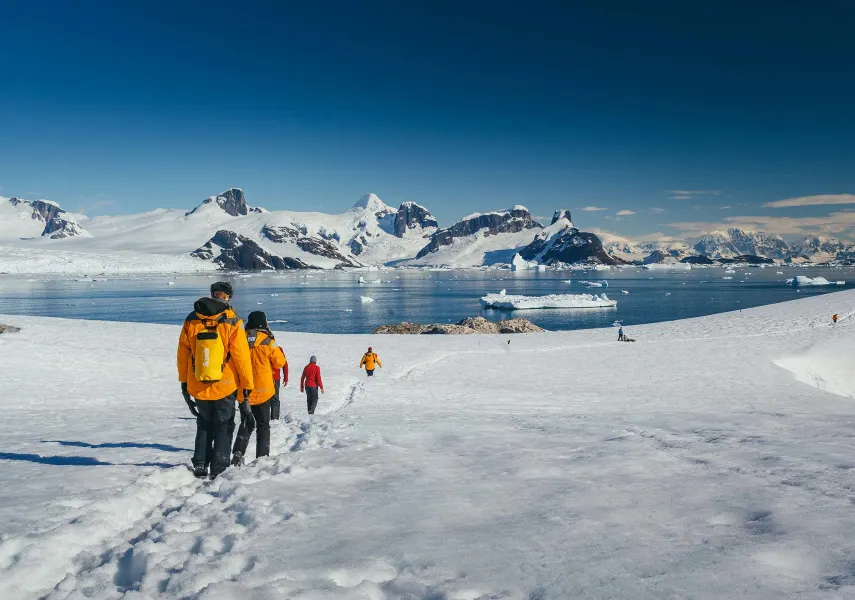
Hiking in the polar regions differs from your typical trail experience. Here, in a tree-less terrain, you are the tallest figure on the landscape as you walk over spongy tundra, crusty snow or sandy beaches in remotes parts of the Arctic and Antarctica. Stepping ashore anywhere in the polar regions means you’re not a distant observer.
Our organized hikes range from short jaunts to the top of lookouts or visits to see wildlife or longer walks of several kilometers over ice and rock and snow. Hiking excursions may last from two to three hours with plenty of time for photographs of wildlife, learning moments from your experienced guides, or just time to stand back and admire the incredible polar surroundings.
No experience is necessary but participants should be able to get in and out of a Zodiac and walk on uneven terrain. Hiking options are tailored to all interests and abilities, from those who want to contemplate the landscape in silence to photographers who want that perfect image to energetic travelers who want to summit a peak in the hopes of seeing wildlife in their natural habitat.

Exclusive Heli-Landing
Imagine setting foot in an area of the Antarctic that can only be safely accessed by helicopter. With a small group of fellow passengers and expert guides, you’ll board one of Ultramarine’s two twin-engine helicopters to soar off to an exclusive polar site where no ships can navigate. Expect stunning bird’s-eye views during your flight, and then, upon arrival, simply sit back, relax and take in the splendor of the Antarctic from “the best seat in the house”: glacial amphitheaters, breath-taking summits, and more. Traveling in groups of 12 with no more than 4 groups (48 guests) at a time on each landing, you’ll have time to relax and quietly reflect on the beauty of your polar surroundings, after which you’ll be picked up by the helicopters in the same location and returned to Ultramarine.
Each heli-landing experience is uniquely curated by our expedition team, taking conditions and location capacity into consideration.

Alpine Heli-Trekking
Let us take you on an active adventure high up in the Antarctic Peninsula. You’ll be part of an intimate group of adventurers to board one of Ultramarine’s two twin-engine helicopters for a trekking excursion in an area only safely accessed by air. The helicopter flight alone rewards guests with unforgettable views of the expansive polar landscape down below. On land, during an invigorating walk, hike or snowshoe trek (depending on conditions), you’ll be rewarded with equally stunning views of remote ridgelines, glaciated terrain, and snow-topped peaks. This once-in-a-lifetime heli-adventure will leave you marveling at the overwhelming beauty of the Antarctic.

Panorama Lounge and Bar
Enclosed in glass and featuring unobstructed views, the Panorama Lounge and Bar allows guests to relax indoors while staying connected to the awe-inspiring landscapes drifting by. It serves as a cozy gathering point where guests can sip a glass of wine, engage in great conversation, indulge in a board game, or socialize at the bar—and, later in the evening, bust a move on the dance floor.

Bridge
During your voyage you may be given access to the Bridge, where you can observe how the Captain and officers sail and navigate the ship.

Reception
A crew member is available at reception to assist you or answer any questions during posted hours. You can purchase internet or email access cards and phone cards here, arrange for a wake-up call or settle your accounts at the end of the voyage.

Polar Boutique
If you forgot any essentials or need a little souvenir from your voyage, the Polar Boutique on Deck 3 is our onboard gift shop. Opening hours will vary based on the daily expedition activities.
Gifts and souvenirs are great to bring home as mementos of your polar expedition. In addition to small souvenirs, our Polar Boutique offers a selection of expedition gear, including base layer clothing, waterproof pants, gloves and more.

Library
Located on Deck 7, the library offers a large collection of field guides, picture books and reference books, and also includes a selection of games for your entertainment. The Ultramarine collection includes books in multiple languages covering subjects like wildlife, history, marine biology, ecology and geology.

Tundra Spa
Offering a variety of treatments exclusively crafted for our guests, the spa and adjacent steam room allow passengers; to fully relax and unwind before their next off-ship adventure.

Tundra Sauna
Perfectly juxtaposed luxury: guests can rest and relax in the comfort and warmth of the sauna while enjoying the spectacular views outside.

Fitness Center
In the fully-equipped fitness center, featuring a separate yoga space with views to the outside.
Medical Facilities
Quark Expeditions provides an English-speaking doctor on board who manages a medical clinic stocked with a supply of common prescription medicines and basic first aid equipment.
If you are under regular treatment for any ailment, you must bring a sufficient supply of medicine. We recommend that you pack an extra two weeks’ supply of medication in case of emergency. We cannot accept responsibility for not having a specific brand or type of drug on board. Should you fall ill, the doctor will refer to the medical forms that you completed and returned to us; therefore it is vital that the information you provide is complete and accurate
Dress Code
To Wear on Board
- Comfortable casual clothing like lighter shirts, pants or jeans, etc. (in case the ship gets warm)
- Comfortable non-slip closed-toed, heelless shoes (flip flops, sandals or slip-on shoes should not be worn on board due to safety concerns)
- Workout attire (for the fitness center and other indoor activities)
- Swimsuit (for the Polar Plunge! Some vessels may also have a pool, hot tub, sauna and/or steam room. See your ship book for details.)
Just a reminder: no formal evening wear required on our voyages! (but if you want to you can bring a little something more dressy for the Captain’s Welcome and Farewell cocktail parties)
Additional Items
- Passport, visas, immunization records, travel documents, etc. as required
- Camera gear complete with charger, storage medium, transport & cleaning kit (lens cloth etc.) and extra batteries
- Waterproof cell phone case or rain sleeve for camera
- Earplugs and eye masks for sleeping
- Voltage converters and plug adapters (see ship book for details)
- Moisturizer for face and hands (skin dryness due to wind and temperature changes)
- Seasickness, indigestion, headache, or other medications
- Small amount of local currency (see pre-departure book for more details)
- Insect repellant
- Mosquito netting
For Shore Excursions & Hiking
In addition to the mandatory gear requirements (as above) for the transit from ship to shore, it is recommended to bring:
- Worn-in Hiking footwear: While Muck-boots are provided and encouraged for most shore excursions, additional hiking footwear (Goretex-lined boots or similar water-proof hiking boots) can add to your hiking comfort, especially if you are a keen hiker
- (Smart) Wool or synthetic hiking socks for above footwear (bring an extra pair)
- Lightweight and quick-dry, trekking pants that may or may not convert to zip-off shorts* (*depending on your thermo-regulation)
- Breathable waterproof pants* and rain jacket** for outdoor activities in inclement weather (*can be the same pair you use for Zodiac operations / ** can be outer shell of complimentary Quark 3in1 Parka)
- Comfortable long or short-sleeve shirt for hiking either synthetic/quick-dry or merino (smart) wool
- (Hiking) gloves (medium thickness, waterproof preferred)
- Hat, buff or scarf (for wind and weather protection)
- UV protection (hat, polarized sun glasses, sun block, lip balm)
- Collapsible Walking stick for hikes (if required). Quantities are available on every vessel to borrow.
- Additional reusable thermos or water bottle (in addition to the reusable collapsible water bottle provided)
By Sea & Air
All transfers ship to shore, helicopter flights & Zodiac/ship cruising
- Waterproof Pants (Mandatory for every Zodiac and helicopter ride. For Ultramarine guests who are participating in Helicopter flights, we recommend packing loose fitting rain pant style waterproof pants, rather than fitted ski pants. You will also be required to wear a drysuit, which our team will help you prepare for on the ship.)
- Base-layer wool or synthetic top*
- Base-layer wool or synthetic bottom*
- Mid-layer warm or fleece top*
- Mid-layer warm or fleece bottom*
- Warm hat that covers ears (bring an extra)
- Scarf, buff, or other face protection
- Warm wool or synthetic socks (keep a dry pair in your bag, and bring extras for layering)
- Waterproof gloves or mitts (bring an extra, lighter pair for hiking)
- Glove liners*
- Hand and feet warmers*
- Binoculars
- Polarized sunglasses with UV protection (bring an extra pair)
- Sunscreen
- Ski goggles (for Zodiac cruising on snowy or windy days)
- Waterproof, lightweight backpack or dry sack &/or rain sleeve for camera or a waterproof phone case (to keep camera & gear dry)
Smoking Policy
To protect the health and safety of its guests, Quark Expeditions® maintains a no smoking policy in the interior of the ship including cabins, near Zodiacs and on landings. Smoking on the ship is permitted in the designated smoking area only, which your Expedition∘ Team members will be happy to point out for you. Always make sure to extinguish cigarettes properly and dispose of them in the proper receptacle. Please, never throw cigarettes overboard.
Dietary Requirements & Allergies
If you do not eat meat there is a wide selection of vegetables, pasta, grains and fruit available. Quark Expeditions® is able to cater to most special dietary requests, as long as you clearly indicated your needs on the required expedition forms when you booked your voyage. Menus will be clearly labeled for vegetarian and gluten free options, but please do notify your server of the dietary restrictions you indicated on your form. We regret that kosher food cannot be prepared.
Wi-Fi & Communications
When you are not busy exploring the natural beauty of the Polar Regions, you may wish to connect with family and friends back home to share some of your voyage highlights. Guests on Quark Expeditions can now enjoy free Wi-Fi as part of our “Raise a Glass and Stay Connected Free” program. This complementary Wi-Fi service permits basic Internet browsing and voice applications.
Please note that we travel to some of the most remote parts of the world. As we utilize satellite equipment for our connection, Wi-Fi signal may be intermittent.
To access email or internet on your personal computer, tablet or smart phone, connect to the network on your device, where you can access our complimentary plan, or purchase Priority Wi-Fi.
Complimentary Wi-Fi
- Lower speeds
- Suitable for basic internet browsing, texting and voice calling using text and voice apps
- Some site filtering
- No charge
- One device logged in at a time
Priority Wi-Fi
- Higher speeds
- Suitable for larger data volume apps, video calling, video streaming (in lower resolutions) etc.
- See rates by logging in
- One device logged in at a time
Life at Sea
During days at sea, you’ll enjoy lectures and workshops presented by our Expedition Team and spend time on deck looking for seabirds and cetaceans. Other days are packed full with multiple landings, Zodiac cruises and activities. Exhausting or relaxing, smiles abound as do great meals from your onboard chefs!
We have a number of policies and procedures that help make sure things run smoothly on the Ultramarine, so take a look below to help get the most out of your time aboard.
SCHEDULE CHANGES
While a daily program will be posted, sometimes new opportunities present themselves on short notice – so expect the unexpected and enjoy knowing that staff members are always here to make sure your expedition is as memorable and enjoyable as possible!
SAFETY ON BOARD AND ASHORE
Your safety and security are a top priority for our Expedition Team and crew members. Knowing how to safely move about your ship, act ashore and handle both wet and dry landings will help ensure you have a hassle-free expedition. Please take time to read the instructions in this important safety section.
SAFETY WHILE ON DECK
Be careful while walking around the outer decks, as footing can be slippery. Always use the handrails and wear proper closed-toe, nonslip footwear. Slip-on sandals, slippers or flip flops are neither safe nor suitable for wearing on board.
STAIRS & DOORS
There are high steps in many doorways that lead to the outer decks, please watch your step and proceed with caution. When passing through doorways or walking in your room, do not place your hands around the edges of doors. Be aware that if doors are not closed or latched open properly, they present a danger and can open or close violently and unexpectedly as the ship moves across the sea.
SAFETY BRIEFING & LIFEBOAT DRILL
By international maritime law, you must participate in an emergency drill within 24 hours of sailing. Upon embarkation, you will have a safety briefing to outline appropriate behavior on board, and emergency procedures. Afterward, a drill will be conducted to familiarize you with your lifeboat, life vest and emergency evacuation route. This mandatory drill will be scheduled as soon as possible by the Expedition Leader. You will be provided with full details after you embark.
CONDUCT ASHORE
- For safety reasons, never walk alone while ashore. Always travel with someone else, or as part of a group.
- If weather conditions deteriorate the Captain will sound the return to ship signal (continuous short blasts). If you hear this, immediately return to the landing area or follow instructions from staff members.
- Do not litter. Take only photos and leave only footprints.
- Be punctual, as on time boarding and efficient landings mean we’ll have more time to explore at future landings.
HELICOPTER SAFETY
The Ultramarine provides an expedition adventure above that of many other ships – by taking you on helicopter excursions. Helicopters allow us to take you on aerial sightseeing adventures, to bays that are inaccessible to shore landings, as well as glaciers high atop mountains!
Please see your expedition brochure for details on whether helicopter activities are offered on your itinerary, as helicopter operations are not permitted in certain regions (for example, Svalbard and South Georgia). Weather conditions permitting, you will find that we make good use of the helicopter operations. As your safety is our first concern, a mandatory briefing will be held before the first helicopter excursion. You will be required to sign the Helicopter Waiver form before your first flight. Please note that the decision to fly is ultimately up to the Pilot in Command who will be working closely with the Captain and Expedition Leader.
You will be assigned to a small group for your flightseeing excursion. Please note that as weather factors and time constraints can shorten the time available for helicopter flights on any given day, no particular day or time can be guaranteed for flightseeing, and all helicopter operations are weather- and logistics-dependent.
DRESS APPROPRIATELY FOR SAFETY
There is some possibility that you could be stranded ashore or on the ice for a period of hours until conditions improve for your helicopter to return. In the unlikely event that you are grounded for a long duration, the Expedition Team will prepare a base camp with a large tent for shelter and emergency supplies. Be sure to always dress warmly in layers, including your Quark Expeditions® parka as your outer layer which is weatherproof in case this eventuality occurs. Bring along extra clothes and water in a small waterproof backpack on each of your helicopter rides.
ADVENTURE TAKES TIME
Be aware that even in the best conditions, it may take six hours for 100 people to make a 20-minute helicopter flight inland. For efficient operations, weather, or refueling and maintenance, the helicopter may not be available for you to return immediately.
PROCEDURES FOR BOARDING A HELICOPTER:
- Dress warmly for all excursions.
- Follow instructions from the Helicopter Team on life jacket procedures during helicopter excursions.
- Watch your footing on deck, walk slowly and deliberately.
- Stay clear of the helicopter deck.
- Remain at the muster area well away from the helicopter deck until instructed by the Helicopter Team.
- When in a hurry, slow down – the noise of the helicopter can be unsettling.
- An Helicopter Team member will always direct you to the helicopter doors.
- Always approach and leave the helicopter from the front.
- Never approach and leave the helicopter unsupervised.
- Beware of the down-draft.
- Ensure that your belongings are properly secured.
- Carry long items, such as tripods or walking sticks, below your waistline.
Cabin Information
SHOWERS AND TOILETS
Each cabin has a private bathroom with shower and heated floors, toilet and wash basin. Shampoo, conditioner and shower gel are provided for your use.
ELECTRIC CURRENT
The electrical supply on board is 220 volts, 50 Hz. Passengers coming from the USA and Canada may need to bring a small 220v/110v converter. Before you buy a converter, check your electronics, as most modern cameras, computers and devices are already compatible to use 220/110 volts.
The electrical outlets found in your cabin and around the ship accept standard European two round pin plugs, so you may need to bring a travel adapter. You’ll also find a USB outlet at each bedside, and some in the public presentation spaces.
Please be aware that the electricity supply may not be sufficient to power your electronic devices at all times. It is recommended that you check the voltage of your device before plugging it in, as the device may be damaged if the incoming voltage is higher than that for which it is manufactured. Please see www.quarkexpeditions.com/en/terms-and-conditions for more information.
HAIRDRYERS
There is a hair dryer included in each cabin.
BATHROBES
The bathrobes in your cabins are on loan for you to enjoy for the duration of your expedition.
VALUABLES
Please store your valuables in the safe in your cabin. We recommend you travel with as few valuables as possible.
LAUNDRY
A complete list of laundry fees will be provided on board. Laundry is collected each morning; please allow 48 hours for your laundry to be returned. Ironing services are also available at a minimal charge. We encourage you to take advantage of the laundry services, as it will mean you can pack fewer articles of clothing. If you prefer to hand wash small items in your cabin, please remember to bring environmentally friendly detergent.
Onboard Procedures
WATER
All passengers receive an eco-friendly, reusable water bottle in their cabin upon arrival. There are water filling stations throughout the ship.
ONBOARD ACCOUNTS
To make things as stress-free as possible, items you purchase from the Polar Boutique, lounge or bar (including drinks) are charged to your ship account. Cabin charges can also include laundry, postage, communication charges and adventure options booked on board (space permitting). Payments of shipboard accounts are made towards the end of the expedition, at the reception area. The US dollar is the standard currency on board. You can use cash, Visa, MasterCard or American Express credit cards to pay your shipboard account. Personal checks are not accepted.
Note: If you are sharing a cabin and would like separate accounts, you must advise reception.
BRIDGE VISITS
During your voyage you may be given access to the Bridge, where you can observe how the Captain and officers sail and navigate the ship. However, the Captain and Bridge officers do restrict access during arrivals and departures from port and during times of complicated navigation. As the Bridge is an important working area on the ship, we ask that you keep noise to a minimum to avoid distracting the officers from conducting their jobs efficiently. Understandably, Bridge etiquette includes a ‘no eating, drinking or smoking’ policy.
ELEVATOR
The onboard elevator system is available for travel between decks. However, for your safety this elevator will be shut down during any periods of inclement weather.
Expedition Brochures
Find Ultramarines itineraries here.

Deck 8
- Helipad

Deck 7
- Panorama Bar & Lounge
- Library
- Sauna
- Tundra Spa
- Fitness Centre
- Bistro 487
- Studio
- Penthouse Suite

Deck 6
- Bridge
- Deluxe Balcony Suite
- Balcony Suite
- Terrace Suite
- Owner’s Suite
- Ultra Suite
- Solo Panorama

Deck 5
- Balena Restaurant
- Ambassadors Theatre

Deck 4
- Balcony Suite
- Deluxe Balcony Suite

Deck 3
- Explorer Suite
- Explorer Triple
- Reception
- Polar Boutique
- Expedition Desk
- Clinic

Deck 2
- Ready Room
- Zodiacs
- Zodiacs Embarkation