Itinerary
Valparaíso’s dramatic topography—45 cerros, or hills, overlooking the ocean—requires the use of winding pathways and wooden ascensores (funiculars) to get up many of the grades. The slopes are covered by candy-color houses—there are almost no apartments in the city—most of which have exteriors of corrugated metal peeled from shipping containers decades ago. Valparaíso has served as Santiago’s port for centuries. Before the Panama Canal opened, Valparaíso was the busiest port in South America. Harsh realities—changing trade routes, industrial decline—have diminished its importance, but it remains Chile’s principal port. Most shops, banks, restaurants, bars, and other businesses cluster along the handful of streets called El Plan (the flat area) that are closest to the shoreline. Porteños (which means “the residents of the port”) live in the surrounding hills in an undulating array of colorful abodes. At the top of any of the dozens of stairways, the paseos (promenades) have spectacular views; many are named after prominent Yugoslavian, Basque, and German immigrants. Neighborhoods are named for the hills they cover. With the jumble of power lines overhead and the hundreds of buses that slow down—but never completely stop—to pick up agile riders, it’s hard to forget you’re in a city. Still, walking is the best way to experience Valparaíso. Be careful where you step, though—locals aren’t very conscientious about curbing their dogs.
Day itinerary:
Since time immemorial Valparaiso has inspired writers, poets, musicians and artists alike. If the city is still a little rough around the edges, this only adds to its bohemian ambience; the architecture, style, street art, nightlife, and live music scenes of Valparaiso are some of the best in the world. Add colourful clifftop homes to the mix and you’ll soon see why Valpariaso is many people’s favourite Chilean city. The city was founded in 1536 by Spanish conquistador Juan de Saavedra, who named the city after his birthplace. Many of the colonial buildings he implemented are still standing today, despite the rain, wind, fire and several earthquakes (one of which almost levelled the city in 1906). Quirky architecture also abounds; poetry lovers and amateur architects will no doubt want to make the 45 km trip south to Chilean poet laureate (and Nobel Prize winner) Pablo Neruda’s ship-shaped house and museum for a taste of the extraordinary. The city and region are also extremely well known for their love of good food and wine. The vineyards of the nearby Casablanca Valley – first planted in the early 1980s – have earned worldwide recognition in a relatively short space of time. However, Chile’s viticulture history does date back much farther than that. De Saavedra brought grape vines on his voyage to South America in order to make his own wine and this led to a new grape brandy being created, Pisco. Today give any Chilean a Pisco and wherever they are in the world, they will be home.
For most of its history, windy Puerto Montt was the end of the line for just about everyone traveling in the Lake District. Now the Carretera Austral carries on southward, but for all intents and purposes Puerto Montt remains the region’s last significant outpost, a provincial city that is the hub of local fishing, textile, and tourist activity.Today the city center is full of malls, condos, and office towers—it’s the fastest-growing city in Chile—but away from downtown, Puerto Montt consists mainly of low clapboard houses perched above its bay, the Seno de Reloncaví. If it’s a sunny day, head east to Playa Pelluco or one of the city’s other beaches. If you’re more interested in exploring the countryside, drive along the shore for a good view of the surrounding hills.
Day itinerary:
For most of its history, windy Puerto Montt was the end of the line for just about everyone traveling in the Lake District. Now the Carretera Austral carries on southward, but for all intents and purposes Puerto Montt remains the region’s last significant outpost, a provincial city that is the hub of local fishing, textile, and tourist activity.Today the city center is full of malls, condos, and office towers—it’s the fastest-growing city in Chile—but away from downtown, Puerto Montt consists mainly of low clapboard houses perched above its bay, the Seno de Reloncaví. If it’s a sunny day, head east to Playa Pelluco or one of the city’s other beaches. If you’re more interested in exploring the countryside, drive along the shore for a good view of the surrounding hills.
Tortel is a commune located in Southern Patagonia, a spectacular wilderness region of rugged mountains, glaciers, rivers and forests of infinite beauty. The uneven geography of Tortel shapes a unique landscape, characterized by an archipelagic area with numerous islands and channels. Tortel is known as the “footbridge city” for the unique beauty of its wooden walkways that connect the piers and houses of this quaint place through bridges and stairs, built from cypress wood, that run for four and a half miles around the cove and that respect the rich vegetation that grows under them. Even though it is the sixth largest commune in Chile, it has the lowest population of all with roughly 531 people. The history of the town dates back to 1520 when it was inhabited by nomadic Kawesqar, now extinct. Its definitive foundation was in 1955, after numerous attempts to populate the area. In 2001, it was declared by the Chilean government as a Picturesque Zone of National Heritage.
Day itinerary:
Tortel is a commune located in Southern Patagonia a spectacular wilderness region of rugged mountains glaciers rivers and forests of infinite beauty. The uneven geography of Tortel shapes a unique landscape characterized by an archipelagic area with numerous islands and channels. Tortel is known as the “footbridge city” for the unique beauty of its wooden walkways that connect the piers and houses of this quaint place through bridges and stairs built from cypress wood that run for four and a half miles around the cove and that respect the rich vegetation that grows under them. Even though it is the sixth largest commune in Chile it has the lowest population of all with roughly 531 people. The history of the town dates back to 1520 when it was inhabited by nomadic Kawesqar now extinct. Its definitive foundation was in 1955 after numerous attempts to populate the area. In 2001 it was declared by the Chilean government as a Picturesque Zone of National Heritage.
Day itinerary:
English Narrows refers to a narrow passage at the southern end of the Messier Channel in Chile’s Region XI, Aysen del General Carlos Ibanez del Campos. The region is Chile’s least populated and a few kilometers south of English Narrows is Puerto Eden, the only settlement along the entire Chilean Inside Passage. With Wellington Island to the west and surrounded by Chile’s largest national park, Bernardo O’Higgins National Park, the narrow passage is at times 180 meters wide, while the entire length is given as 18 kilometers. Low-lying islands and steep mountains are seen on both sides and the Magellanic subpolar forest with its evergreen trees of the genus Nothofagus has taken hold where possible. The strong currents require to pass English Narrows at slack tide and although most of the Messier Channel leading to English Narrows is quite deep, a shipwreck sitting on a bank some 20 kilometers north of the entrance to English Narrows shows why pilots are required by law in Chile.
Day itinerary:
Within Bernardo O’Higgins National Park the Pio XI Glacier (also known as Brüggen Glacier after the German geologist Johannes Brüggen) is found at the terminus of the 23 nautical miles long Eyre Fjord, one of the fjords coming from the northeast and the Southern Patagonian Ice Field. The fjord and its shores were formerly used by the nomadic Kaweskar to hunt, while the glacier was one of their sacred sites. Pio XI Glacier is the largest western outflow of the Southern Patagonian Ice Field and is South America’s longest glacier and the largest in the Southern Hemisphere outside of Antarctica. One of the few advancing glaciers, its front has a width of 4.5 kilometers, a height of approximately 80 meters and shows several central moraines, indicating that Greve Glacier and Occidental Glacier to the north once joined the glacial tongue. Approaching the glacier by ship and by Zodiac safe distances will be maintained, as the glacier shows extensive mudflats on its southeastern side leading to Exmouth Fjord and calvings can always occur. The rocky shore shows signs of Nothofagus trees and the temperate Magellanic rain forest where the extremely rare and endangered South Andean deer, locally known as the huemul, has been sighted. Chilean and Peale’s dolphins and the endangered southern river otters have been recorded, and South American sea lions can be seen. Among the birds expected are Imperial Shags, South American Terns, Brown-hooded Gulls, Kelp Gulls, Kelp Geese, and Fuegian Steamer Ducks.
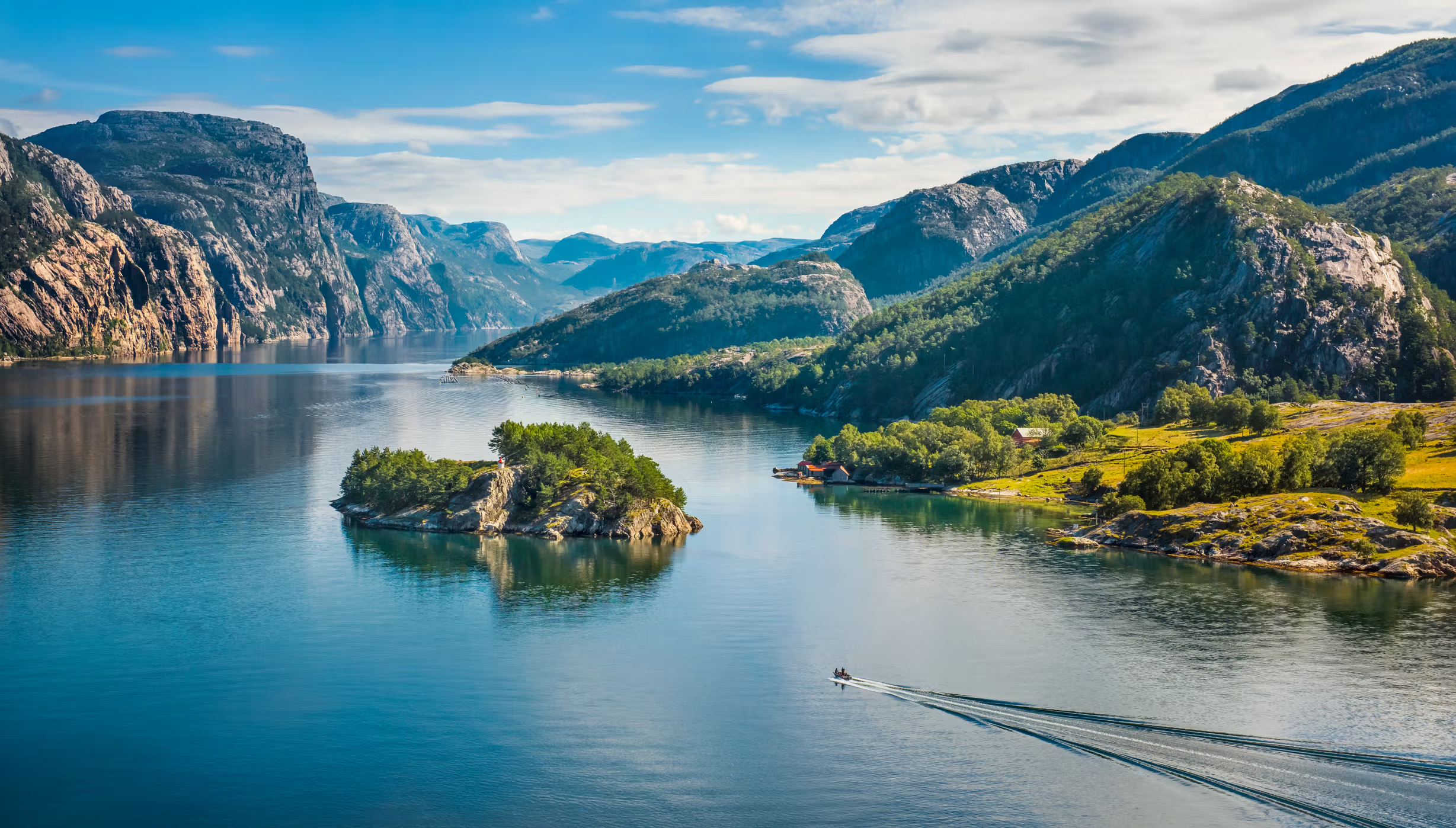
Strewn through the coast of Chile, these beautiful fjords are world renowned for being one of the most awe-inspiring places on earth. Snow-capped volcanoes nestle majestically alongside rolling valleys of ice and frosty glaciers. Rugged beauty, breathtaking scenery not to mention diverse and profuse wildlife abounds – expect to watch whales from the deck, see playful Magellan Penguins and perhaps even spot the rare Andean Condor. Affectionately named “The End of the World” by the Spaniards who discovered the region in eighteenth century in a quest to Christianise South America, these extraordinary waterways not only encompass a medley of jagged mountains and iceberg strewn bays, but feature a kaleidoscopic spectrum of unexpected colour that offers photographic opportunities like no other destination.
Day itinerary:
Strewn through the coast of Chile, these beautiful fjords are world renowned for being one of the most awe-inspiring places on earth. Snow-capped volcanoes nestle majestically alongside rolling valleys of ice and frosty glaciers. Rugged beauty, breathtaking scenery not to mention diverse and profuse wildlife abounds – expect to watch whales from the deck, see playful Magellan Penguins and perhaps even spot the rare Andean Condor. Affectionately named “The End of the World” by the Spaniards who discovered the region in eighteenth century in a quest to Christianise South America, these extraordinary waterways not only encompass a medley of jagged mountains and iceberg strewn bays, but feature a kaleidoscopic spectrum of unexpected colour that offers photographic opportunities like no other destination.
Impenetrable forests, impassable mountains, and endless fields of ice define Chilean Patagonia, and meant that the region went largely unexplored until the beginning of the 20th century. Located in the southernmost part of the country, this area is still sparsely inhabited, though you will find a few populated places—like the colorful provincial city of Punta Arenas, which looks like it’s about to be swept into the Strait of Magellan. Some unique wildlife, particularly colonies of elephant seals and penguins, call this breathtaking topography home. To the north is Parque Nacional Torres del Paine, the country’s most magnificent natural wonder, and whose snow-covered peaks seem to rise vertically from the plains below. The vistas, such as the fantastic Avenue of the Glaciers, are breathtaking; along this stretch of the Beagle Channel, you can pass six tremendous glaciers all within a stone’s throw of each other.Cruise SightsPunta Arenas. Founded a little more than 150 years ago, Punta Arenas (Sandy Point) was Chile’s first permanent settlement in Patagonia. Plaza Muñoz Gamero, the central square, is surrounded by evidence of that early prosperity: buildings whose then-opulent brick exteriors recall a time when this was one of Chile’s wealthiest cities. The newer houses here have colorful tin roofs, best appreciated when seen from a high vantage point such as the Mirador Cerro la Cruz. Although the city as a whole may not be particularly attractive, look for details: the pink-and-white house on a corner, the bay window full of potted plants, parking attendants wearing the regional blue and yellow colors, and schoolchildren in identical naval pea coats that remind you that the city’s fate is tied to the sea.The Museo Naval y Marítimo extols Chile’s high-seas prowess, particularly concerning Antarctica. Its exhibits are worth a visit for anyone with an interest in ships and sailing, merchant and military alike. Part of the second floor is designed like the interior of a ship, including a map and radio room. Pedro Montt 989. Admission charged.Housed in what was once the mansion of the powerful Braun-Menéndez family, the Museo Regional de Magallanes is an intriguing glimpse into the daily life of a wealthy provincial family at the beginning of the 20th century. Lavish Carrara marble hearths, English bath fixtures, and cordovan leather walls are among the original accoutrements. The museum also has an excellent group of displays depicting Punta Arenas’s past, from the first European contact to the town’s decline after the opening of the Panama Canal. The museum is half a block north of the main square. Magallanes 949. Admission charged.The resplendent 1895 Palacio Sara Braun is a national landmark and an architectural showpiece of southern Patagonia. Designed by a French architect, the house was built from materials and by craftsmen imported from Europe during the four years of construction. The city’s central plaza and surrounding buildings soon followed, ushering in the region’s golden era. Noteworthy are the lavish bedrooms, magnificent parquet floors, marble fireplaces, and hand-painted ceilings. Don’t miss the portraits of Braun and her husband José Nogueira in the music room. Afterwards, head to the cellar for a drink or snack in the warm public tavern (a good portion of the mansion is leased to a hotel). Plaza Muñoz Gamero 716. Admission charged.Commonly referred to simply as “El Salesiano,” the Museo Salesiano de Maggiorino Borgatello is operated by Italian missionaries whose order arrived in Punta Arenas in the 19th century. The Salesians, most of whom spoke no Spanish, proved to be daring explorers. Traveling throughout the region, they collected the artifacts made by indigenous tribes that are currently on display. Av. Bulnes 398. Admission charged.Isla Magdalena. Punta Arenas is the launching point for a boat trip to the Isla Magdalena to see the more than 100,000 Magellanic penguins at the Monumento Natural Los Pingúinos. A single trail, marked off by rope, is accessible to humans. The boat trip to the island, in the middle of the Estrecho de Magallanes, takes about two hours. Make sure to bring along warm clothing, even in summer; the island can be chilly, particularly if a breeze is blowing across the water.Parque Nacional Torres del Paine. Some 12 million years ago, lava flows pushed up through the thick sedimentary crust that covered the southwestern coast of South America, cooling to form a granite mass. Glaciers then swept through the region, grinding away all but the ash-gray spires that rise over the landscape of one of the world’s most beautiful natural phenomena, now the Parque Nacional Torres del Paine (established in 1959). Snow formations dazzle along every turn of road, and the sunset views are spectacular.Among the 2,420-square-km (934-square-mi) park’s most beautiful attractions are its lakes of turquoise, aquamarine, and emerald green waters. Another draw is its unusual wildlife. Creatures like the guanaco (a woollier version of the llama) and the ñandú (resembling a small ostrich) abound. They are used to visitors and don’t seem to be bothered by the proximity of automobile traffic and the snapping of cameras. Predators, like the gray fox, make less frequent appearances. You may also spot the dramatic aerobatics of a falcon and the graceful soaring of the endangered condor. The beautiful puma is especially elusive, but sightings have become more common. Admission charged.Pingúinera de Seno Otway. The road to this penguin sanctuary begins 30 km (18 mi) north of Punta Arenas. Magellanic penguins, which live up to 20 years in the wild, return to their birthplace here every year to mate with the same partner. For about 2,000 penguin couples—no single penguins make the trip—home is this desolate and windswept land off the Otway Sound. In late September, the penguins begin to arrive from the southern coast of Brazil and the Falkland Islands. They mate and lay their eggs in early October, and brood their eggs in November. Offspring hatch between mid-November and early December. If you’re lucky, you may catch sight of one of the downy gray chicks that stick their heads out of the burrows when their parents return to feed them. Otherwise you might see scores of the ungainly adult penguins waddling to the ocean from their nesting burrows. They swim for food every eight hours and dive up to 100 feet deep. The penguins depart from the sound in late March. Note that the sanctuary is a 1-km (1/2-mi) walk from the parking lot. It gets chilly, so bring a windbreaker. Admission charged.Reserva Nacional Laguna Parillar. This 47,000-acre reserve lies west of Puerto Hambre, a tranquil fishing village, and is centered around a shimmering lake in a valley flanked by hills. It’s a great place for a picnic, and there are a number of well-marked paths that offer sweeping vistas over the Estrecho de Magallanes. About 2 km (1 mi) west of Puerto Hambre is a small white monolith that marks the geographical center of Chile, the midway point between Chile’s northern port Arica and the South Pole.Cruise ShoppingWool may no longer be king of the economy, but vast flocks of sheep still yield a high-quality product that is woven into the clothing here. Leather products are also common, but the prices are not necessarily low. About 3 km (2 mi) north of Punta Arenas is the Zona Franca (Av. Bulnes). This duty-free zone is where people from all around the region come for low-priced electronics and other consumer items.
Day itinerary:
Welcome to Chile’s City at the End of The World – a wind-whipped, fractured land of islands, glacial fjords and mountains, which drop away towards Antarctica. A hardy city, where the temperature hovers in single figures throughout much of the year, Punta Arenas nevertheless offers a warm welcome and refuge, ahead of – and following – epic adventures and expeditions south across the Drake Passage. Captain Scott stopped here in 1904 – testing the postal service sending 400 letters of his successful return – and the city welcomed the rescued Ernest Shackleton and his Endurance crew to these shores in 1916. Punta Arenas is a remote place, but with custom-free status, and more than 120,000 people calling it home it’s also surprisingly cosmopolitan. The commercial centre of Magallanes Punta Arenas is fueled by Chilean oil and gas – and establishing itself as a global centre for Antarctic research, with teams from various countries basing themselves here. The town is built around the Plaza de Armas, its central square – be sure to kiss the toe of the Monumento del Indio Patagon statue, said to guarantee you good luck on your return. Look down across this colourful city, stretching out to meet the waters of the Straits of Magellan, from the viewpoint at Cerro De La Cruz. Natural wonders abound in the region, whether it’s Alberto de Agostini National Park’s glacial sculptures, or Torres del Paine National Park’s soaring mountains, rushing waterfalls and picturesque lakes. Offshore, in the Strait of Magellan, you can find the birdlife sanctuary of Magdalena Island – an uninhabited island, where hundreds of thousands of penguins march and crowds of cormorants and gulls call out.
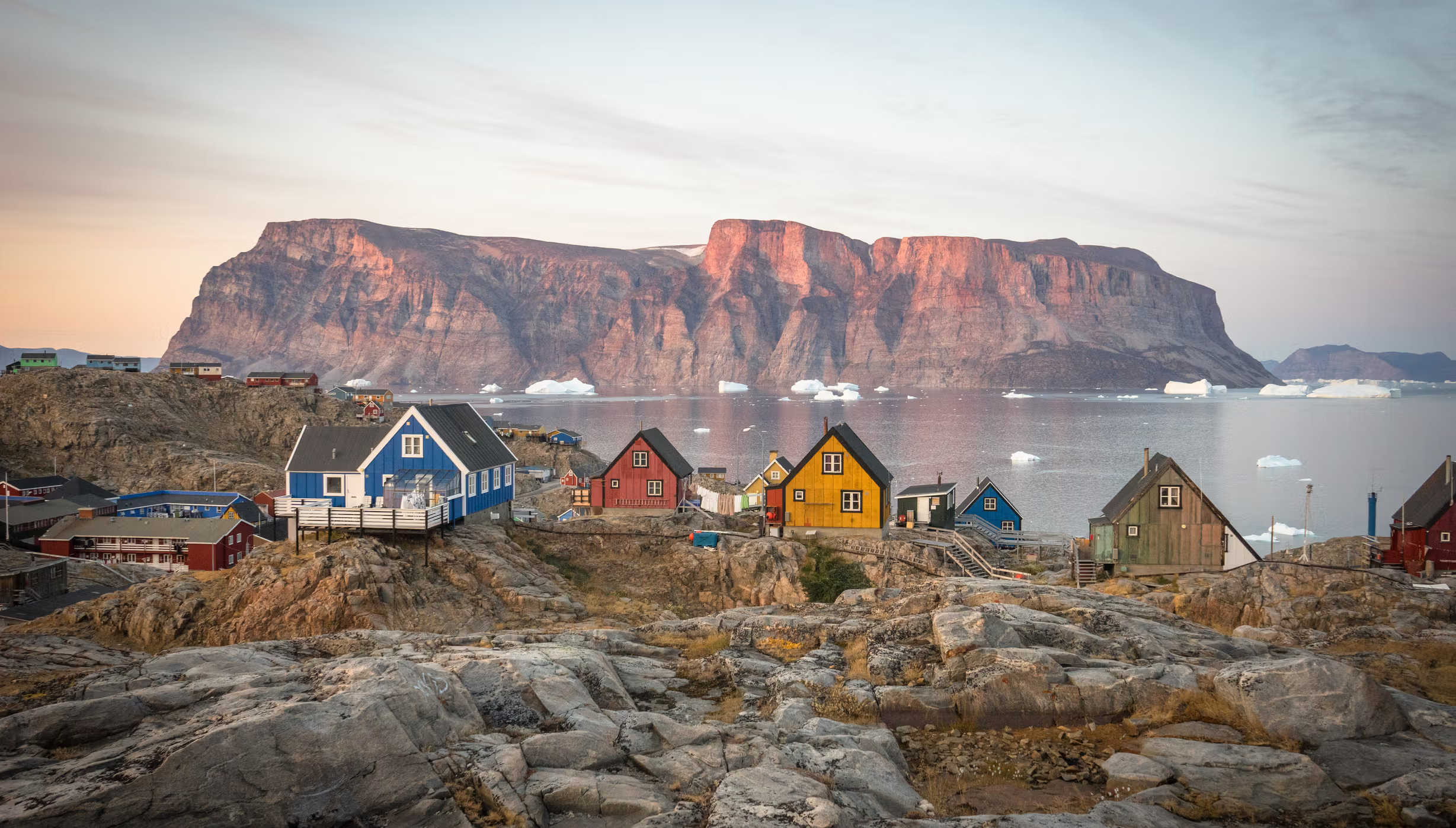
At 55 degrees latitude south, Ushuaia (pronounced oo-swy-ah) is closer to the South Pole than to Argentina’s northern border with Bolivia. It is the capital and tourism base for Tierra del Fuego, the island at the southernmost tip of Argentina.Although its stark physical beauty is striking, Tierra del Fuego’s historical allure is based more on its mythical past than on rugged reality. The island was inhabited for 6,000 years by Yámana, Haush, Selk’nam, and Alakaluf Indians. But in 1902 Argentina, eager to populate Patagonia to bolster its territorial claims, moved to initiate an Ushuaian penal colony, establishing the permanent settlement of its most southern territories and, by implication, everything in between.When the prison closed in 1947, Ushuaia had a population of about 3,000, made up mainly of former inmates and prison staff. Today the Indians of Darwin’s “missing link” theory are long gone—wiped out by diseases brought by settlers and by indifference to their plight—and the 60,000 residents of Ushuaia are hitching their star to tourism.The city rightly (if perhaps too loudly) promotes itself as the southernmost city in the world (Puerto Williams, a few miles south on the Chilean side of the Beagle Channel, is a small town). You can make your way to the tourism office to get your clichéd, but oh-so-necessary, “Southernmost City in the World” passport stamp. Ushuaia feels like a frontier boomtown, at heart still a rugged, weather-beaten fishing village, but exhibiting the frayed edges of a city that quadrupled in size in the ’70s and ’80s and just keeps growing. Unpaved portions of Ruta 3, the last stretch of the Pan-American Highway, which connects Alaska to Tierra del Fuego, are finally being paved. The summer months (December through March) draw more than 120,000 visitors, and dozens of cruise ships. The city is trying to extend those visits with events like March’s Marathon at the End of the World and by increasing the gamut of winter activities buoyed by the excellent snow conditions.A terrific trail winds through the town up to the Martial Glacier, where a ski lift can help cut down a steep kilometer of your journey. The chaotic and contradictory urban landscape includes a handful of luxury hotels amid the concrete of public housing projects. Scores of “sled houses” (wooden shacks) sit precariously on upright piers, ready for speedy displacement to a different site. But there are also many small, picturesque homes with tiny, carefully tended gardens. Many of the newer homes are built in a Swiss-chalet style, reinforcing the idea that this is a town into which tourism has breathed new life. At the same time, the weather-worn pastel colors that dominate the town’s landscape remind you that Ushuaia was once just a tiny fishing village, snuggled at the end of the Earth.As you stand on the banks of the Canal Beagle (Beagle Channel) near Ushuaia, the spirit of the farthest corner of the world takes hold. What stands out is the light: at sundown the landscape is cast in a subdued, sensual tone; everything feels closer, softer, and more human in dimension despite the vastness of the setting. The snowcapped mountains reflect the setting sun back onto a stream rolling into the channel, as nearby peaks echo their image—on a windless day—in the still waters.Above the city rise the last mountains of the Andean Cordillera, and just south and west of Ushuaia they finally vanish into the often-stormy sea. Snow whitens the peaks well into summer. Nature is the principal attraction here, with trekking, fishing, horseback riding, wildlife spotting, and sailing among the most rewarding activities, especially in the Parque Nacional Tierra del Fuego (Tierra del Fuego National Park).
Day itinerary:
A southerly frontier – on the cusp of wild nature and extraordinary adventures – the excitement in Ushuaia is palpable. Prepare for memorable exploits amid the extremes of this southerly location – as you adventure into the colossal scenery of the fractured Tierra del Fuego and beyond. Known as the ‘End of the World’ Ushuaia looks out across the Beagle Channel, and is surrounded by the Martial Mountains to the north. Despite its remote location, Ushuaia is a surprisingly busy and lively resort, with lots to keep its visitors entertained. For many people, Ushuaia is their last glimpse of anything resembling a city, before they jump off the map into the wilderness, to answer the call of immense national parks or Antarctic expeditions. One of the most dramatic landscapes on the planet – Argentina’s land of fire, National Park Tierra del Fuego, is a place of titanic natural forces and limitless beauty. Snow-covered mountains poke the sky, while glaciers spill down between peaks, and gaping fjords open up. With incredible wildlife – from penguins to whales – the park offers some of South America’s most amazing hiking opportunities and panoramas. When it comes to food in Ushuaia, locals cook up fierce flavours using the freshest ingredients. King crab is one of the most popular dishes, while sea bass – hauled freshly from the waters – and mounds of meaty mussels – known as cholgas – are also on the menu here.
Day itinerary:
Sailing the legendary Drake Passage is an experience that few are ever lucky enough to experience. The southern tip of the Americas already feels like a wild enough environment – but the sensation of watching the distant cliffs of the peninsular known as the ‘End of the World’ fade into the horizon, is one that’s equal parts epic, eerie and magical. Set sail, to slowly drop off the bottom of the map from Cape Horn, and voyage on an expedition down into the icy underworld of Antarctica. Drake Passage is an extraordinary voyage of romantic ocean faring legend, as you aim for Antarctica’s icy realm. On arrival, skyscraper sized icebergs salute you, as you traverse the waters of this continent where snow and ice dwelling creatures like penguins and whales roam undisturbed. Your first sight of this most-unexplored place will most likely be the South Shetland Islands. Walk in the footsteps of some of history’s greatest and bravest explorers as you explore famed, snow-covered landmasses like Elephant and Deception Island. If the journey across Drake Passage sounds daunting, don’t worry – even in rough seas you’re never alone, and will often be accompanied on this spine-tingling adventure by soaring albatrosses and maybe even a protective pod of humpbacks and hourglass dolphins or two. Converging warm and cool ocean currents attract some spectacular animal life to the passage.
Day itinerary:
Sailing the legendary Drake Passage is an experience that few are ever lucky enough to experience. The southern tip of the Americas already feels like a wild enough environment – but the sensation of watching the distant cliffs of the peninsular known as the ‘End of the World’ fade into the horizon, is one that’s equal parts epic, eerie and magical. Set sail, to slowly drop off the bottom of the map from Cape Horn, and voyage on an expedition down into the icy underworld of Antarctica. Drake Passage is an extraordinary voyage of romantic ocean faring legend, as you aim for Antarctica’s icy realm. On arrival, skyscraper sized icebergs salute you, as you traverse the waters of this continent where snow and ice dwelling creatures like penguins and whales roam undisturbed. Your first sight of this most-unexplored place will most likely be the South Shetland Islands. Walk in the footsteps of some of history’s greatest and bravest explorers as you explore famed, snow-covered landmasses like Elephant and Deception Island. If the journey across Drake Passage sounds daunting, don’t worry – even in rough seas you’re never alone, and will often be accompanied on this spine-tingling adventure by soaring albatrosses and maybe even a protective pod of humpbacks and hourglass dolphins or two. Converging warm and cool ocean currents attract some spectacular animal life to the passage.
Some 770 kilometers (478 miles) south of Cape Horn, the South Shetland Islands are usually the first land seen in Antarctica. Separated from the Antarctic Peninsula by the Bransfield Strait, nine major islands make up the group. The region was the first to be exploited by sealers in the early 19th century, and because of its proximity to South America, it still is the most visited by scientists and tourists. Chinstrap, Adelie, Gentoo and Macaroni Penguins all breed here. In addition, because it is the warmest part of the continent, large moss beds as well as orange, black, grey and green lichens grow –even hair grass and pearlwort manage to survive. Leopard seals, Weddell seals, crabeater seals, Southern elephant seals and Antarctic fur seals can be seen in the water and on the beaches.
Day itinerary:
The ice-coated Antarctic Peninsula forms perhaps the most accessible region of mainland Antarctica lying a mere 480-miles away from South America across the fabled waters of Drakes Passage. Lying close to the northwestern tip of the Antarctic Peninsula separated by the Bransfield Strait, the South Shetland Islands fall under the jurisdiction of the Antarctic Treaty, suspending claims on their sovereignty. Several countries maintain research bases here and with plump elephant seals and crowds of Gentoo, Chinstrap, and Adelie Penguins also calling the islands home it can even feel a little crowded at times. King George Island is the largest and most hospitable island hosting the majority of the research stations – some of which are populated all-year-round by tiny hardy crews. Don’t be fooled though these islands offer extraordinary adventure in one of the most remote locations on earth. The triple peaks of Mount Foster tower above the archipelago. Hike the luna landscapes within and even dip into the improbably warm geothermally-heated waters of Pendulum Cove. Elephant Island meanwhile is written deep into the annals of Antarctic expedition legend as the site where Ernest Shackleton and the stricken crew of the Endurance miraculously survived a harsh Antarctic winter in 1916.
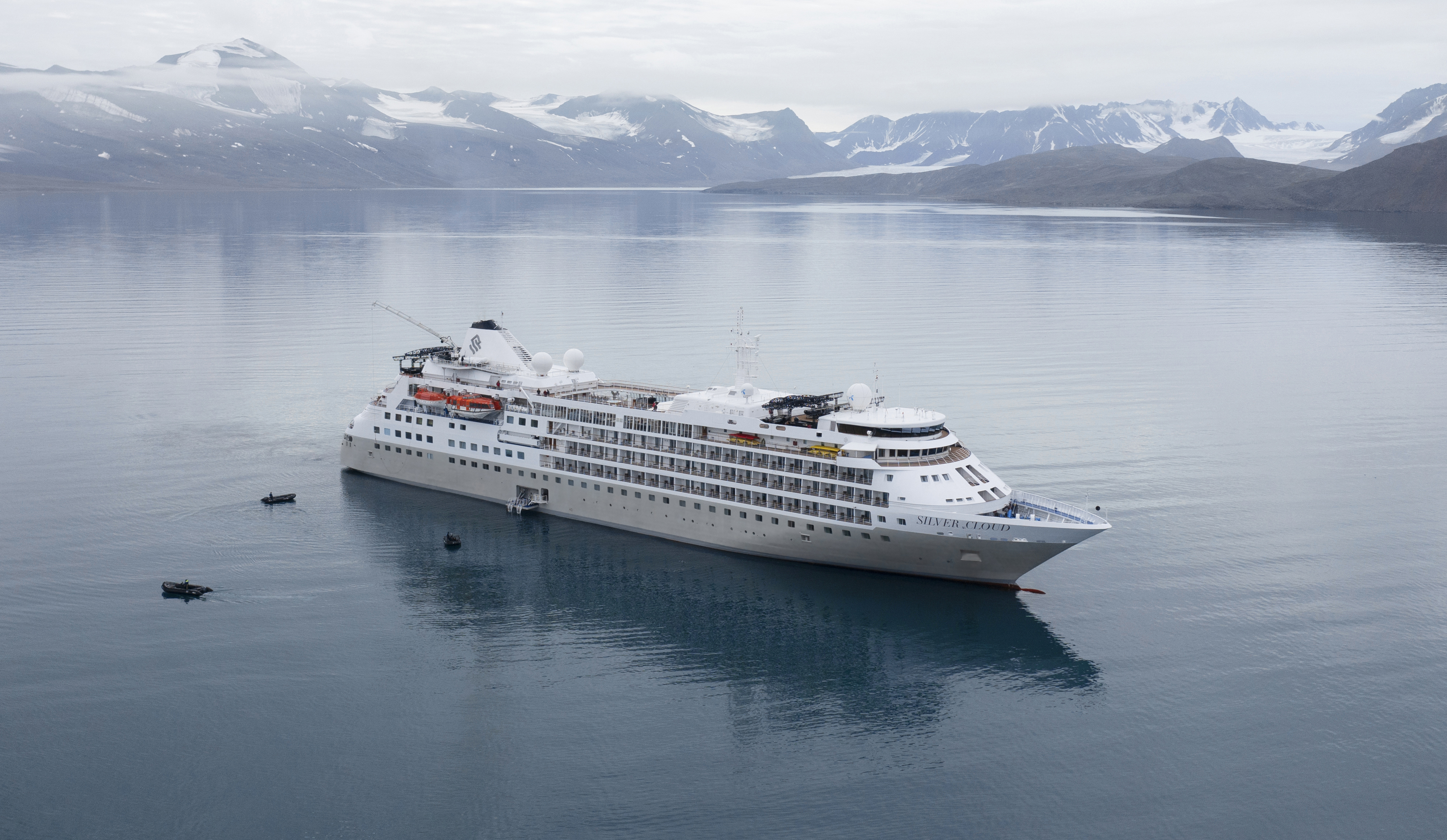
Remote and otherworldly, Antarctic is irresistible for its spectacular iceberg sculptures and calving glaciers, and for the possibility of up-close encounters with marine mammals and the iconic penguins. The Antarctic Peninsula – the main peninsula closest to South America – has a human history of almost 200 years, with explorers, sealers, whalers, and scientists who have come to work, and eventually intrepid visitors coming to enjoy this pristine and remote wilderness. It is a region of protected bays, unscaled snow-capped mountains, vast glaciers and a few places where whalers or scientists have worked. Just as irresistible are the many Gentoo and Chinstrap Penguin colonies, the seals basking on ice floes, the whales and orcas.
Day itinerary:
The Antarctic Peninsula unravels upwards towards South America reaching out a beckoning finger to the adventurous who dare to explore this untamed realm. Stretching up from the heart of the world’s southernmost continent the Antarctic Peninsula lies a mere 620 mile from Tierra del Fuego and for many offers a spectacular first taste of the snow-blanketed landscapes and colossal ice sculptures which make up Earth’s least-explored continent. Unseen by humans until 1820 – a blink of an eye ago in relative terms – this is an adventure sure to make your hairs stand on end as you experience the thrill of the truly unknown and extraordinary. The vast peninsula is sprinkled with research bases which are at the frontline of human scientific endeavour pushing to study and understand this unique landscape, its exceptional wildlife and the impact that humans are having on this pristine continent. Witness cathedral-sized icebergs up close and blue-hued glaciers slowly slipping from imposing locations.
Remote and otherworldly, Antarctic is irresistible for its spectacular iceberg sculptures and calving glaciers, and for the possibility of up-close encounters with marine mammals and the iconic penguins. The Antarctic Peninsula – the main peninsula closest to South America – has a human history of almost 200 years, with explorers, sealers, whalers, and scientists who have come to work, and eventually intrepid visitors coming to enjoy this pristine and remote wilderness. It is a region of protected bays, unscaled snow-capped mountains, vast glaciers and a few places where whalers or scientists have worked. Just as irresistible are the many Gentoo and Chinstrap Penguin colonies, the seals basking on ice floes, the whales and orcas.
Day itinerary:
The Antarctic Peninsula unravels upwards towards South America reaching out a beckoning finger to the adventurous who dare to explore this untamed realm. Stretching up from the heart of the world’s southernmost continent the Antarctic Peninsula lies a mere 620 mile from Tierra del Fuego and for many offers a spectacular first taste of the snow-blanketed landscapes and colossal ice sculptures which make up Earth’s least-explored continent. Unseen by humans until 1820 – a blink of an eye ago in relative terms – this is an adventure sure to make your hairs stand on end as you experience the thrill of the truly unknown and extraordinary. The vast peninsula is sprinkled with research bases which are at the frontline of human scientific endeavour pushing to study and understand this unique landscape, its exceptional wildlife and the impact that humans are having on this pristine continent. Witness cathedral-sized icebergs up close and blue-hued glaciers slowly slipping from imposing locations.
Remote and otherworldly, Antarctic is irresistible for its spectacular iceberg sculptures and calving glaciers, and for the possibility of up-close encounters with marine mammals and the iconic penguins. The Antarctic Peninsula – the main peninsula closest to South America – has a human history of almost 200 years, with explorers, sealers, whalers, and scientists who have come to work, and eventually intrepid visitors coming to enjoy this pristine and remote wilderness. It is a region of protected bays, unscaled snow-capped mountains, vast glaciers and a few places where whalers or scientists have worked. Just as irresistible are the many Gentoo and Chinstrap Penguin colonies, the seals basking on ice floes, the whales and orcas.
Day itinerary:
The Antarctic Peninsula unravels upwards towards South America reaching out a beckoning finger to the adventurous who dare to explore this untamed realm. Stretching up from the heart of the world’s southernmost continent the Antarctic Peninsula lies a mere 620 mile from Tierra del Fuego and for many offers a spectacular first taste of the snow-blanketed landscapes and colossal ice sculptures which make up Earth’s least-explored continent. Unseen by humans until 1820 – a blink of an eye ago in relative terms – this is an adventure sure to make your hairs stand on end as you experience the thrill of the truly unknown and extraordinary. The vast peninsula is sprinkled with research bases which are at the frontline of human scientific endeavour pushing to study and understand this unique landscape, its exceptional wildlife and the impact that humans are having on this pristine continent. Witness cathedral-sized icebergs up close and blue-hued glaciers slowly slipping from imposing locations.
Remote and otherworldly, Antarctic is irresistible for its spectacular iceberg sculptures and calving glaciers, and for the possibility of up-close encounters with marine mammals and the iconic penguins. The Antarctic Peninsula – the main peninsula closest to South America – has a human history of almost 200 years, with explorers, sealers, whalers, and scientists who have come to work, and eventually intrepid visitors coming to enjoy this pristine and remote wilderness. It is a region of protected bays, unscaled snow-capped mountains, vast glaciers and a few places where whalers or scientists have worked. Just as irresistible are the many Gentoo and Chinstrap Penguin colonies, the seals basking on ice floes, the whales and orcas.
Day itinerary:
The Antarctic Peninsula unravels upwards towards South America reaching out a beckoning finger to the adventurous who dare to explore this untamed realm. Stretching up from the heart of the world’s southernmost continent the Antarctic Peninsula lies a mere 620 mile from Tierra del Fuego and for many offers a spectacular first taste of the snow-blanketed landscapes and colossal ice sculptures which make up Earth’s least-explored continent. Unseen by humans until 1820 – a blink of an eye ago in relative terms – this is an adventure sure to make your hairs stand on end as you experience the thrill of the truly unknown and extraordinary. The vast peninsula is sprinkled with research bases which are at the frontline of human scientific endeavour pushing to study and understand this unique landscape, its exceptional wildlife and the impact that humans are having on this pristine continent. Witness cathedral-sized icebergs up close and blue-hued glaciers slowly slipping from imposing locations.
Some 770 kilometers (478 miles) south of Cape Horn, the South Shetland Islands are usually the first land seen in Antarctica. Separated from the Antarctic Peninsula by the Bransfield Strait, nine major islands make up the group. The region was the first to be exploited by sealers in the early 19th century, and because of its proximity to South America, it still is the most visited by scientists and tourists. Chinstrap, Adelie, Gentoo and Macaroni Penguins all breed here. In addition, because it is the warmest part of the continent, large moss beds as well as orange, black, grey and green lichens grow –even hair grass and pearlwort manage to survive. Leopard seals, Weddell seals, crabeater seals, Southern elephant seals and Antarctic fur seals can be seen in the water and on the beaches.
Day itinerary:
The ice-coated Antarctic Peninsula forms perhaps the most accessible region of mainland Antarctica lying a mere 480-miles away from South America across the fabled waters of Drakes Passage. Lying close to the northwestern tip of the Antarctic Peninsula separated by the Bransfield Strait, the South Shetland Islands fall under the jurisdiction of the Antarctic Treaty, suspending claims on their sovereignty. Several countries maintain research bases here and with plump elephant seals and crowds of Gentoo, Chinstrap, and Adelie Penguins also calling the islands home it can even feel a little crowded at times. King George Island is the largest and most hospitable island hosting the majority of the research stations – some of which are populated all-year-round by tiny hardy crews. Don’t be fooled though these islands offer extraordinary adventure in one of the most remote locations on earth. The triple peaks of Mount Foster tower above the archipelago. Hike the luna landscapes within and even dip into the improbably warm geothermally-heated waters of Pendulum Cove. Elephant Island meanwhile is written deep into the annals of Antarctic expedition legend as the site where Ernest Shackleton and the stricken crew of the Endurance miraculously survived a harsh Antarctic winter in 1916.
Day itinerary:
Sailing the legendary Drake Passage is an experience that few are ever lucky enough to experience. The southern tip of the Americas already feels like a wild enough environment – but the sensation of watching the distant cliffs of the peninsular known as the ‘End of the World’ fade into the horizon, is one that’s equal parts epic, eerie and magical. Set sail, to slowly drop off the bottom of the map from Cape Horn, and voyage on an expedition down into the icy underworld of Antarctica. Drake Passage is an extraordinary voyage of romantic ocean faring legend, as you aim for Antarctica’s icy realm. On arrival, skyscraper sized icebergs salute you, as you traverse the waters of this continent where snow and ice dwelling creatures like penguins and whales roam undisturbed. Your first sight of this most-unexplored place will most likely be the South Shetland Islands. Walk in the footsteps of some of history’s greatest and bravest explorers as you explore famed, snow-covered landmasses like Elephant and Deception Island. If the journey across Drake Passage sounds daunting, don’t worry – even in rough seas you’re never alone, and will often be accompanied on this spine-tingling adventure by soaring albatrosses and maybe even a protective pod of humpbacks and hourglass dolphins or two. Converging warm and cool ocean currents attract some spectacular animal life to the passage.
Day itinerary:
Puerto Williams is a Chilean city located on Navarino Island on the southern shores of the Beagle Channel. It claims to be the “southernmost city in the world”, however owing to its small size – 2500 residents approximately – the much larger Argentinean city of Ushuaia, which sits on the northern side of the same channel, also claims that title. The surrounding scenery is magnificent. The wild windswept mountains rise above the tree line and are regularly dusted with snow. The city itself has the dramatic backdrop called “Dientes de Navarino” (literally “teeth of Navarino”), which rival the famous Torres del Paine further to the north. The area was originally used by the Yaghan people, hunter-gatherers who despite enduring the harsh regional climate, could not weather the arrival of Europeans. The current city was established as a naval base in 1953 and honours the British-Chilean naval commander John Williams Wilson of the 16th century. Initially it served to protect territorial possessions and fishing rights of the area, as well as offering logistical support to Antarctic bases. More recently it has become a departure point for scientific and tourism trips to the Antarctic region. In contrast to the bustle and traffic of a very commercial Ushuaia, Puerto Williams offers a quieter, more relaxed experience. It charms the visitor with a small village feel, complete with rustic buildings and the homely smell of drifting wood smoke. A haven of peace at the end of the world.
Day itinerary:
Puerto Williams is a Chilean city located on Navarino Island on the southern shores of the Beagle Channel. It claims to be the “southernmost city in the world”, however owing to its small size – 2500 residents approximately – the much larger Argentinean city of Ushuaia, which sits on the northern side of the same channel, also claims that title. The surrounding scenery is magnificent. The wild windswept mountains rise above the tree line and are regularly dusted with snow. The city itself has the dramatic backdrop called “Dientes de Navarino” (literally “teeth of Navarino”), which rival the famous Torres del Paine further to the north. The area was originally used by the Yaghan people, hunter-gatherers who despite enduring the harsh regional climate, could not weather the arrival of Europeans. The current city was established as a naval base in 1953 and honours the British-Chilean naval commander John Williams Wilson of the 16th century. Initially it served to protect territorial possessions and fishing rights of the area, as well as offering logistical support to Antarctic bases. More recently it has become a departure point for scientific and tourism trips to the Antarctic region. In contrast to the bustle and traffic of a very commercial Ushuaia, Puerto Williams offers a quieter, more relaxed experience. It charms the visitor with a small village feel, complete with rustic buildings and the homely smell of drifting wood smoke. A haven of peace at the end of the world.
Ship features
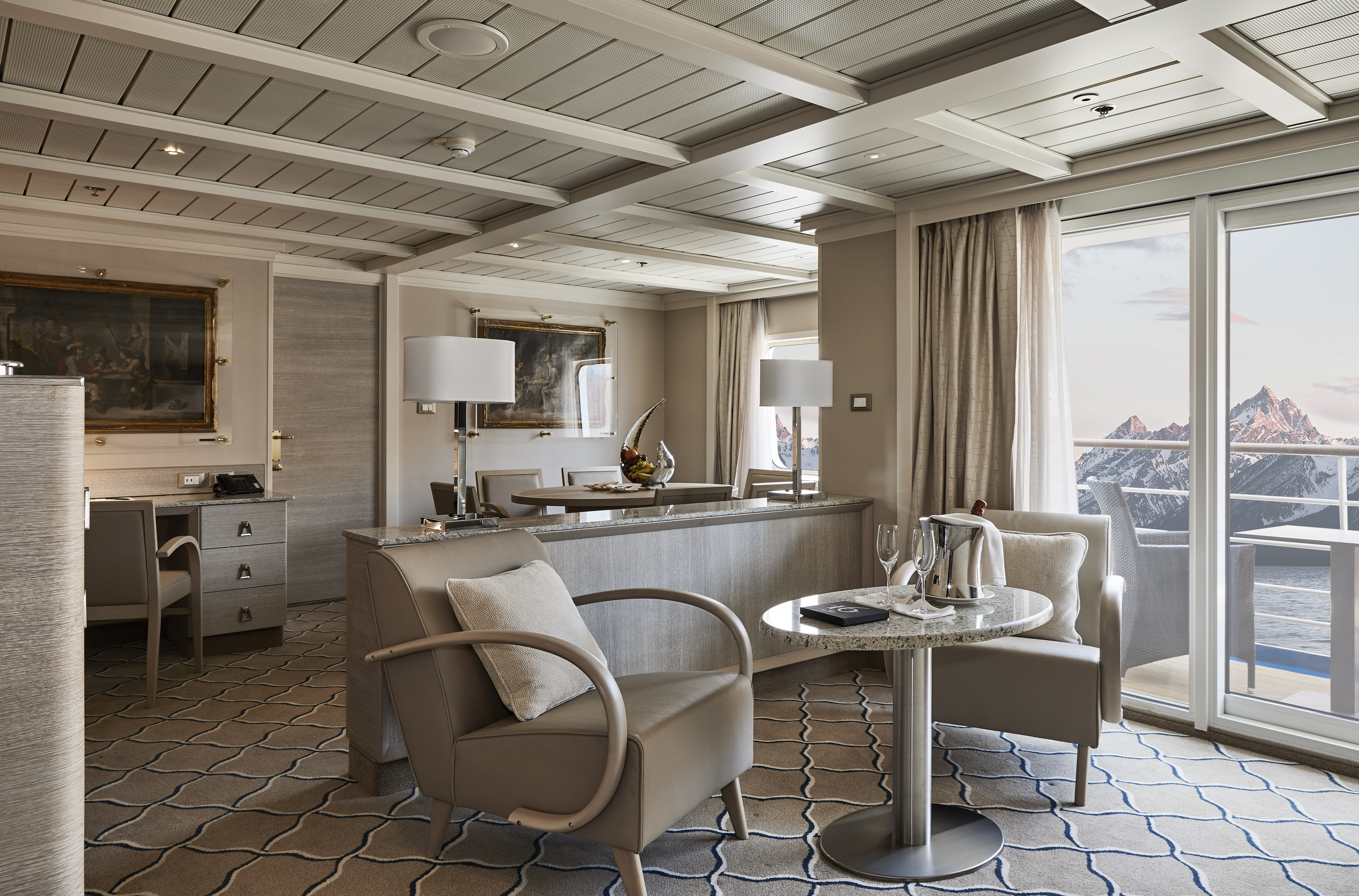
Owner's Suite
This stylish apartment offers the superlative in levels of space, comfort, and service on board. A perfect mix of expedition experience with luxury lifestyle. Available in a one-bedroom configuration or as two bedrooms by adjoining with a Vista Suite.
One bedroom: up to 55 sq m (8 sq m)
Two bedrooms: 77 sq m (8 sq m)
Images are intended as a general reference. Features, materials, finishes and layout may be different than shown.
Please note that the 3rd guest will sleep on a comfortable sofa bed in the reception area of the suite.
Essentials
- Deck(s): 7
- Section: Mid-Ship
Characteristics
- Veranda
- Separate dining area
- Living room with sitting area
- Standard vanity
- Separate shower
- Whirlpool bath
- Walk-in wardrobe with personal safe
Furniture
- King size bed
- Writing desk
- Vanity table
- Luxury bed mattresses
Media & Communication
- Unlimited Premium Wi-Fi
- 2 large flat screen TVs with Interactive Media Library
- Sound system with bluetooth connectivity
- Direct dial telephone
- Wall mounted USB-C mobile device chargers
- Dual voltage 110/220 outlets
Onboard Services
- Butler service
- Complimentary laundry, pressing & wet cleaning
- Dinner for two in La Dame, one evening per voyage,
- Two hours of worldwide phone use, per voyage segment
- Champagne on arrival
Amenities
- Espresso machine
- Tea kettles
- Pillow menu
- Refrigerator and bar setup stocked with your preferences
- Plush bathrobe
- Luxury bath amenities
- Umbrella
- Hair Dryer
- Slippers
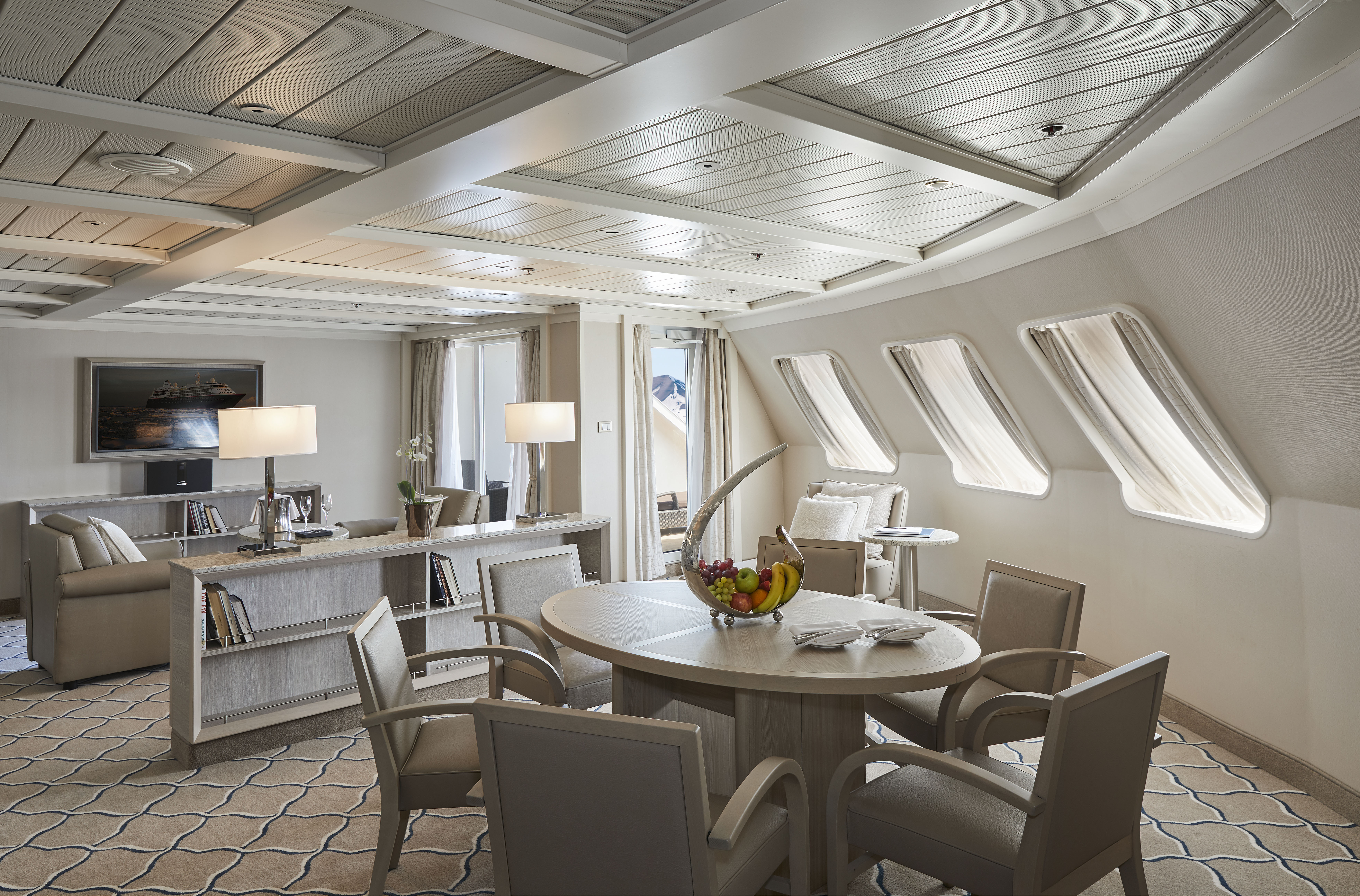
Grand Suite
Expertly designed and exquisitely appointed. The ideal space for sharing stories with fellow explorers and new friends. With enough space to roam both inside and outside, this suite is perfect for relaxing and recounting the highlights of your day. Available in a one-bedroom configuration or as two bedrooms by adjoining with a Veranda Suite.
One bedroom: 95 sq m (14 sq m)
Images are intended as a general reference. Features, materials, finishes and layout may be different than shown.
Please note that the third guest will sleep on a comfortable sofa bed in the reception area of the suite.
Two bedrooms: 122 sq m (18.5 sq m)
Images are intended as a general reference. Features, materials, finishes and layout may be different than shown.
Please note that the 3rd guest will sleep on a comfortable sofa bed in the reception area of the suite.
Essentials
- Deck(s): 7
- Section: Forward
Characteristics
- Veranda
- Separate dining area
- Living room with sitting area
- Standard vanity
- Separate shower
- Whirlpool bath
- Walk-in wardrobe with personal safe (Wardrobe closet in suite 702 & 703)
Furniture
- King size bed
- Writing desk
- Vanity table
- Luxury bed mattresses
Media & Communication
- Unlimited Premium Wi-Fi
- 2 large flat screen TVs with Interactive Media Library
- Sound system with bluetooth connectivity
- Direct dial telephone
- Wall mounted USB-C mobile device chargers
- Dual voltage 110/220 outlets
Onboard Services
- Butler service
- Complimentary laundry, pressing & wet cleaning
- Dinner for two in La Dame, one evening per voyage,
- Two hours of worldwide phone use, per voyage segment
- Champagne on arrival
Amenities
- Espresso machine
- Tea kettles
- Pillow menu
- Refrigerator and bar setup stocked with your preferences
- Plush bathrobe
- Luxury bath amenities
- Umbrella
- Hair Dryer
- Slippers
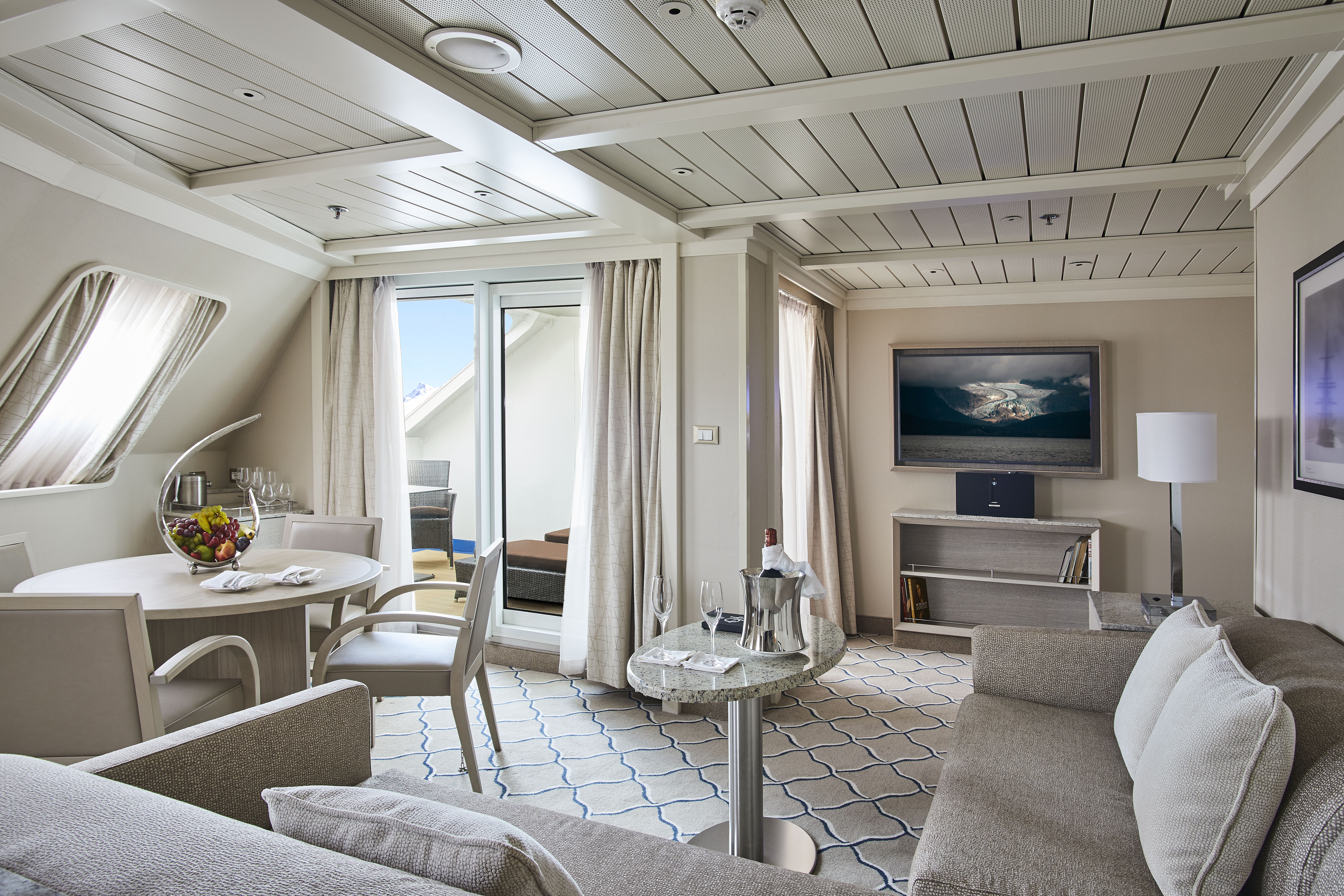
Royal Suites
Stately. Commanding and majestic. Perfect for relaxing after a days’ exploring and looking through your photos. With lectures streamed live to your room, this is the pinnacle of good living at sea. Available in a one-bedroom configuration or as two bedrooms by adjoining with a Veranda Suite.
One bedroom: 69 sq m (12 sq m)
Two bedrooms: 96 sq m (16.5 sq m)
Images are intended as a general reference. Features, materials, finishes and layout may be different than shown.
Please note that the third guest will sleep on a comfortable sofa bed in the reception area of the suite.
Essentials
- Deck(s): 6
- Section: Forward
Characteristics
- Veranda
- Separate dining area
- Living room with sitting area
- Standard vanity
- Separate shower
- Whirlpool bath
- Walk-in wardrobe with personal safe
Furniture
- King size bed
- Writing desk
- Vanity table
- Luxury bed mattresses
Media & Communication
- Unlimited Premium Wi-Fi
- 2 large flat screen TVs with Interactive Media Library
- Sound system with bluetooth connectivity
- Direct dial telephone
- Wall mounted USB-C mobile device chargers
- Dual voltage 110/220 outlets
Onboard Services
- Butler service
- Complimentary laundry, pressing & wet cleaning
- Dinner for two in La Dame, one evening per voyage,
- Two hours of worldwide phone use, per voyage segment
- Champagne on arrival
Amenities
- Espresso machine
- Tea kettles
- Pillow menu
- Refrigerator and bar setup stocked with your preferences
- Plush bathrobe
- Luxury bath amenities
- Umbrella
- Hair Dryer
- Slippers
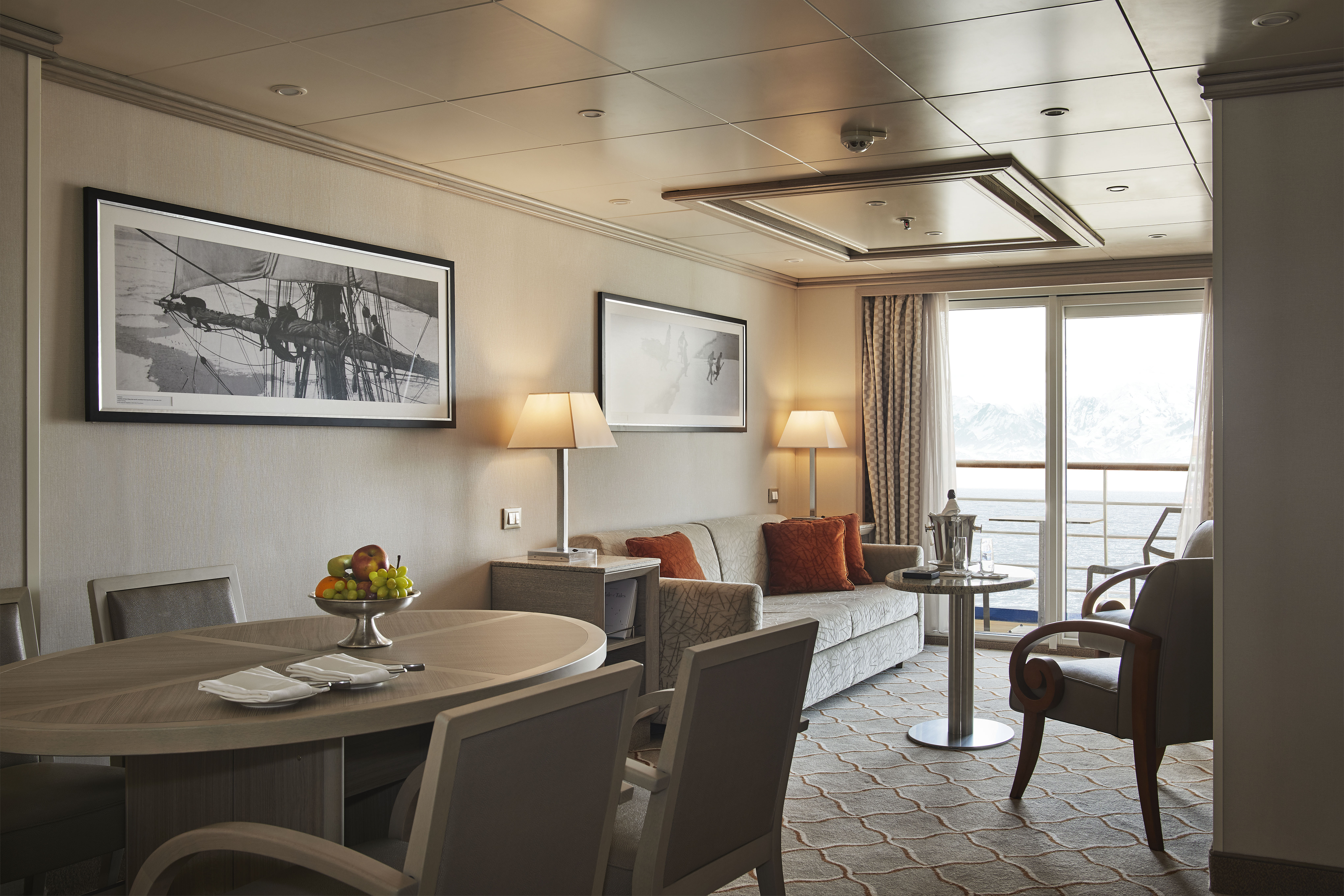
Silver Suite
Stylish and sophisticated with larger verandas, excellent for taking pictures and bird-watching. Situated midship, this suite is perfection in design and comfortable living. A huge walk-in wardrobe, a beautiful marbled bathroom, and a spacious living area complete the picture. Silver Suites accommodate three guests.
One bedroom: 54 sq m (8 sq m)
Images are intended as a general reference. Features, materials, finishes and layout may be different than shown.
Please note that the 3rd guest will sleep on a comfortable sofa bed in the reception area of the suite.
Essentials
- Deck(s): 6, 7
- Section: Mid-Ship
Characteristics
- Veranda
- Separate dining area
- Living room with sitting area
- Standard vanity
- Separate shower (2 bathrooms with shower)
- Walk-in wardrobe with personal safe
Furniture
- Queen size bed
- Writing desk
- Vanity table
- Luxury bed mattresses
Media & Communication
- Unlimited Premium Wi-Fi
- 2 large flat screen TVs with Interactive Media Library
- Sound system with bluetooth connectivity
- Direct dial telephone
- Wall mounted USB-C mobile device chargers
- Dual voltage 110/220 outlets
Onboard Services
- Butler service
- Complimentary laundry, pressing & wet cleaning
- Champagne on arrival
Amenities
- Espresso machine
- Tea kettles
- Pillow menu
- Refrigerator and bar setup stocked with your preferences
- Plush bathrobe
- Luxury bath amenities
- Umbrella
- Hair Dryer
- Slippers
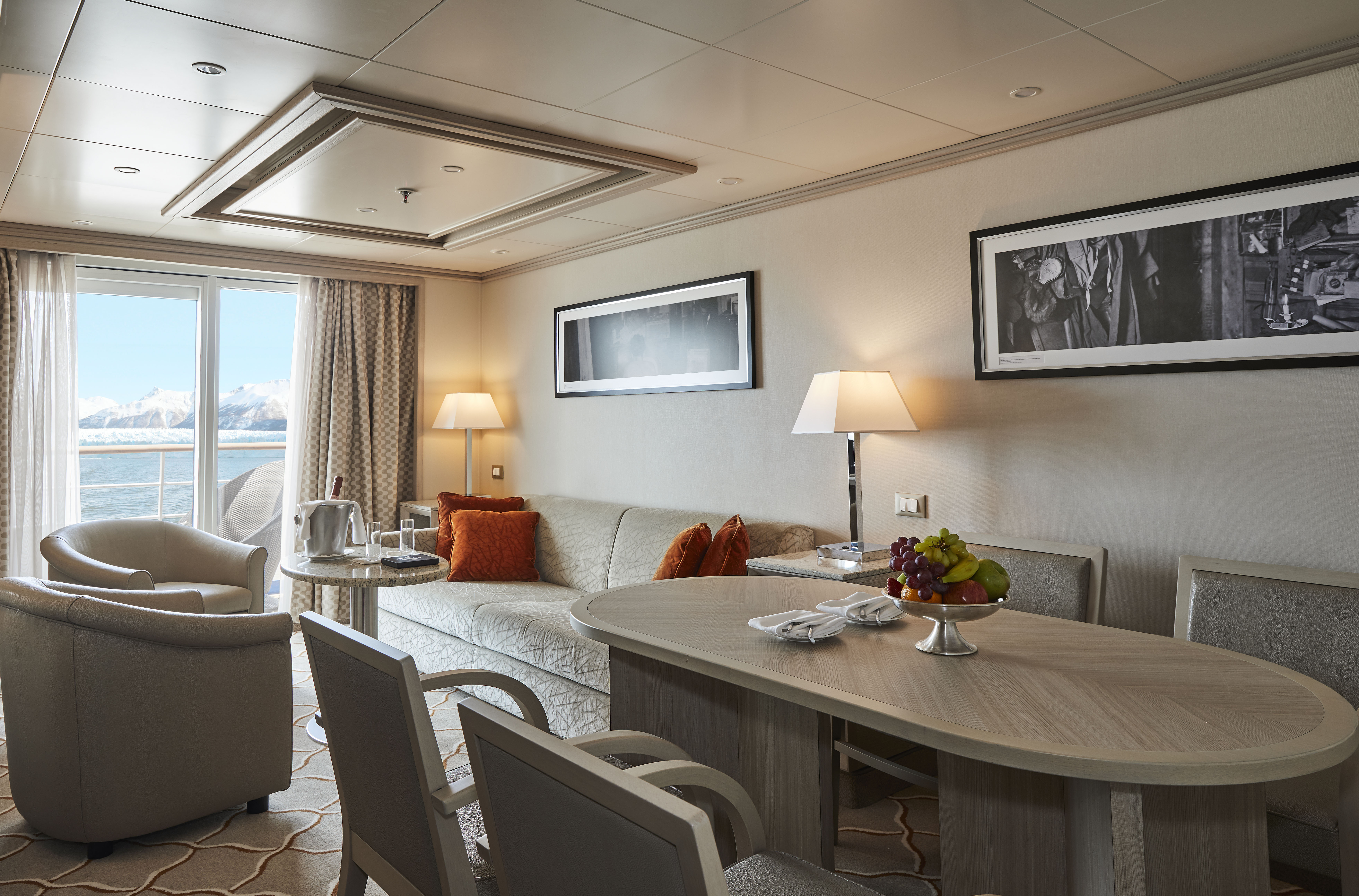
Medallion Suite
With a room configuration that favors watching the sun rise from the comfort of your bed and losing yourself in the mesmerizing seascapes, this suite is the perfect answer to adventure cruising. A large walk-in wardrobe and an expansive living room make the Medallion Suite your home away from home on the high seas. Medallion Suites accommodate three guests.
One bedroom: 48 sq m (7.6 sq m )
Images are intended as a general reference. Features, materials, finishes and layout may be different than shown.
Please note that the 3rd guest will sleep on a comfortable sofa bed in the reception area of the suite.
Essentials
- Deck(s): 5, 6, 7
- Section: Mid-Ship
Characteristics
- Veranda
- Separate dining area
- Living room with sitting area
- Standard vanity
- Separate shower
- Walk-in wardrobe with personal safe
Furniture
- Queen size bed
- Writing desk
- Vanity table
- Luxury bed mattresses
Media & Communication
- Unlimited Premium Wi-Fi
- 2 large flat screen TVs with Interactive Media Library
- Sound system with bluetooth connectivity
- Direct dial telephone
- Wall mounted USB-C mobile device chargers
- Dual voltage 110/220 outlets
Onboard Services
- Butler service
- Complimentary laundry, pressing & wet cleaning
- Champagne on arrival
Amenities
- Espresso machine
- Tea kettles
- Pillow menu
- Refrigerator and bar setup stocked with your preferences
- Plush bathrobe
- Luxury bath amenities
- Umbrella
- Hair Dryer
- Slippers
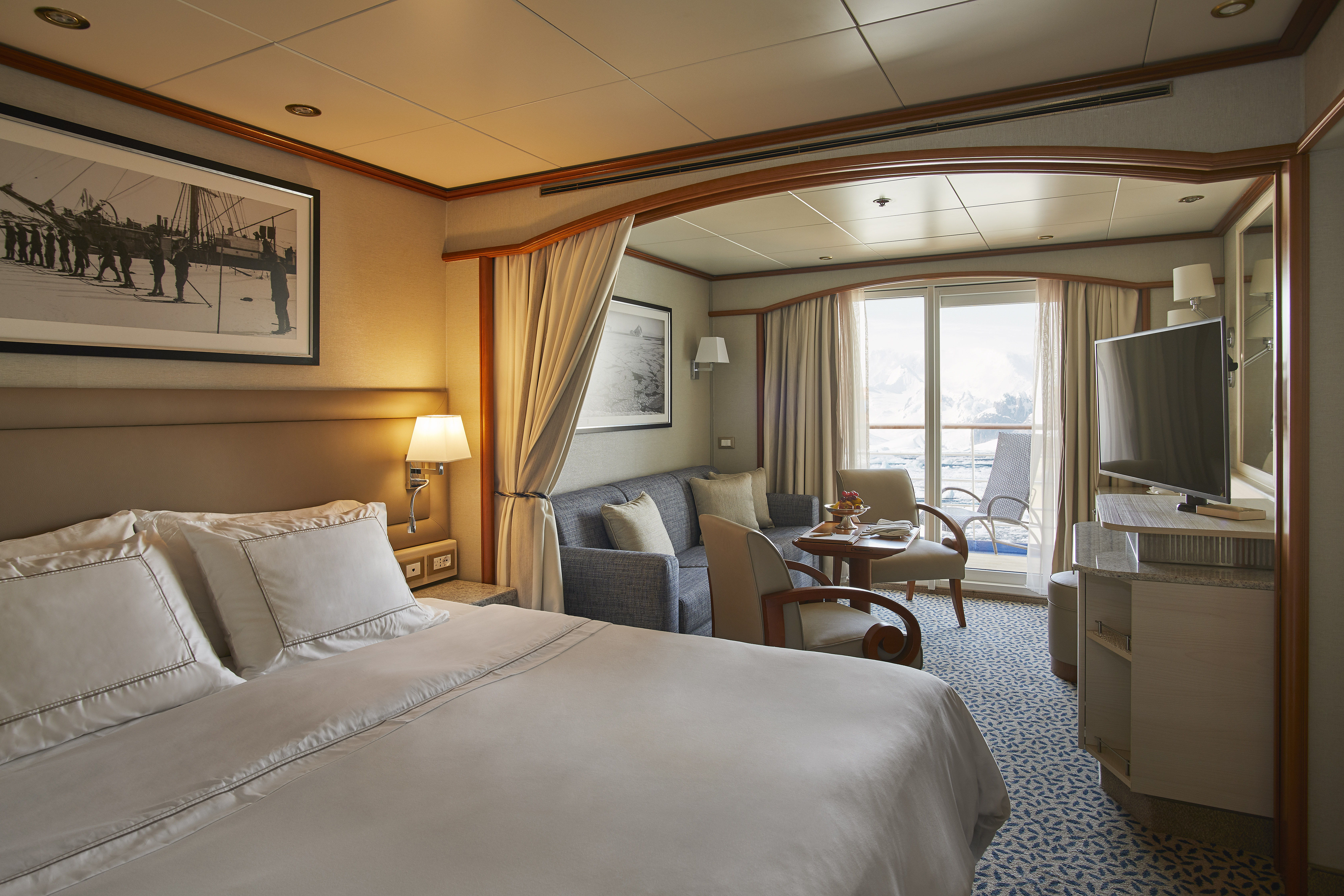
Deluxe Veranda Suite
A Silversea signature, with a preferred central location, the Veranda Suite is spacious and welcoming. Floor-to-ceiling glass doors open onto a furnished private teak veranda from where you can contemplate anything from the midnight sun to an Antarctic sunrise. The Deluxe Veranda Suite offers a preferred central location with identical accommodation to a Veranda Suite.
One bedroom: 27 sq m (4.5 sq m)
Two bedrooms: 27 sq m (4.5 sq m)
Images are intended as a general reference. Features, materials, finishes and layout may be different than shown.
Essentials
- Deck(s): 5, 6, 7
- Section: Aft, Forward
Characteristics
- Veranda
- Sitting area
- Standard vanity
- Separate shower
- Some with full-size bath
- Walk-in wardrobe with personal safe
Furniture
- Queen size bed
- Writing desk
- Luxury bed mattresses
Media & Communication
- Unlimited Standard Wi-Fi
- 1 large flat screen TV with Interactive Media Library
- Direct dial telephone
- Wall mounted USB-C mobile device chargers
- Dual voltage 110/220 outlets
- Onboard Services
- Butler service
- Champagne on arrival
Amenities
- Espresso machine
- Tea kettles
- Pillow menu
- Refrigerator and bar setup stocked with your preferences
- Plush bathrobe
- Luxury bath amenities
- Umbrella
- Hair Dryer
- Slippers
Veranda Suite
A Silversea signature, the Veranda Suite is spacious and welcoming. Floor-to-ceiling glass doors open onto a furnished private teak veranda from where you can contemplate anything from the midnight sun to an Antarctic sunrise. Some Veranda Suites accommodate three guests (suites 505 to 510 and 605 to 610).
One bedroom: 27 sq m (4.5 sq m)
Images are intended as a general reference. Features, materials, finishes and layout may be different than shown.
Please note that the 3rd guest will sleep on a comfortable sofa bed in the reception area of the suite.
Essentials
- Deck(s): 5, 6, 7
- Section: Aft, Forward
Characteristics
- Veranda
- Sitting area
- Standard vanity
- Separate shower
- Some with full-size bath
- Walk-in wardrobe with personal safe
Furniture
- Queen size bed
- Writing desk
- Luxury bed mattresses
Media & Communication
- Unlimited Standard Wi-Fi
- 1 large flat screen TV with Interactive Media Library
- Direct dial telephone
- Wall mounted USB-C mobile device chargers
- Dual voltage 110/220 outlets
Onboard Services
- Butler service
- Champagne on arrival
Amenities
- Espresso machine
- Tea kettles
- Pillow menu
- Refrigerator and bar setup stocked with your preferences
- Plush bathrobe
- Luxury bath amenities
- Umbrella
- Hair Dryer
- Slippers
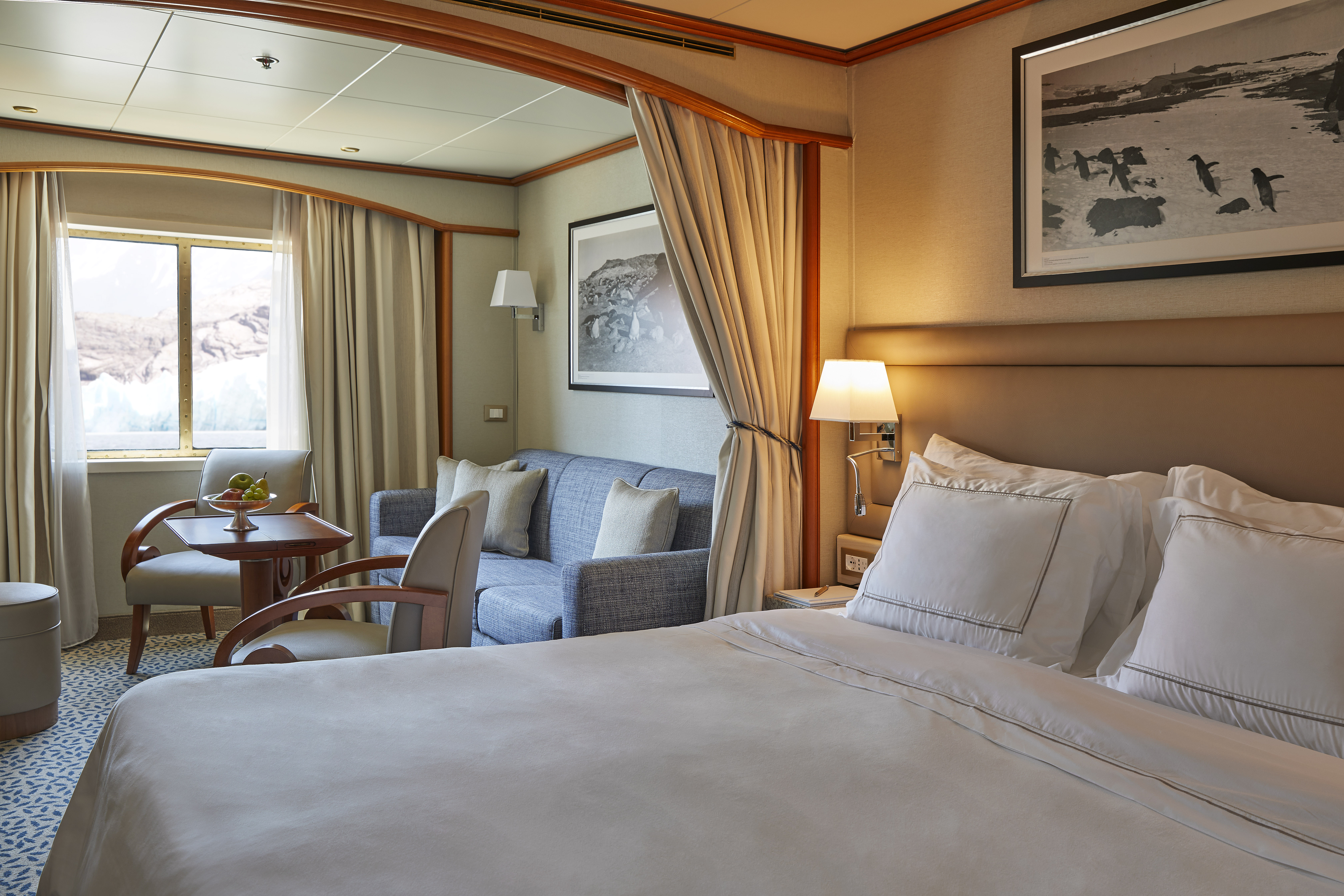
Vista Suite
Your home away from home while you embrace the intrepid explorer within. The suite’s seating area has plenty of room to relax while you go over your notes, ready for the next adventure. Large picture windows frame panoramic ocean views, ideal for appraising the local wildlife.
One bedroom: 22 sq m
Wheelchair accessible suites: 449 and 451
Images are intended as a general reference. Features, materials, finishes and layout may be different than shown.
Essentials
- Deck(s): 4
- Section: Aft, Forward
Characteristics
- Window
- Sitting area
- Standard vanity
- Separate shower
- Some with full-size bath
- Walk-in wardrobe with personal safe
Furniture
- Queen size bed
- Writing desk
- Luxury bed mattresses
Media & Communication
- Unlimited Standard Wi-Fi
- 1 large flat screen TV with Interactive Media Library
- Direct dial telephone
- Wall mounted USB-C mobile device chargers
- Dual voltage 110/220 outlets
Onboard Services
- Butler service
- Champagne on arrival
Amenities
- Espresso machine
- Tea kettles
- Pillow menu
- Refrigerator and bar setup stocked with your preferences
- Plush bathrobe
- Luxury bath amenities
- Umbrella
- Hair Dryer
- Slippers
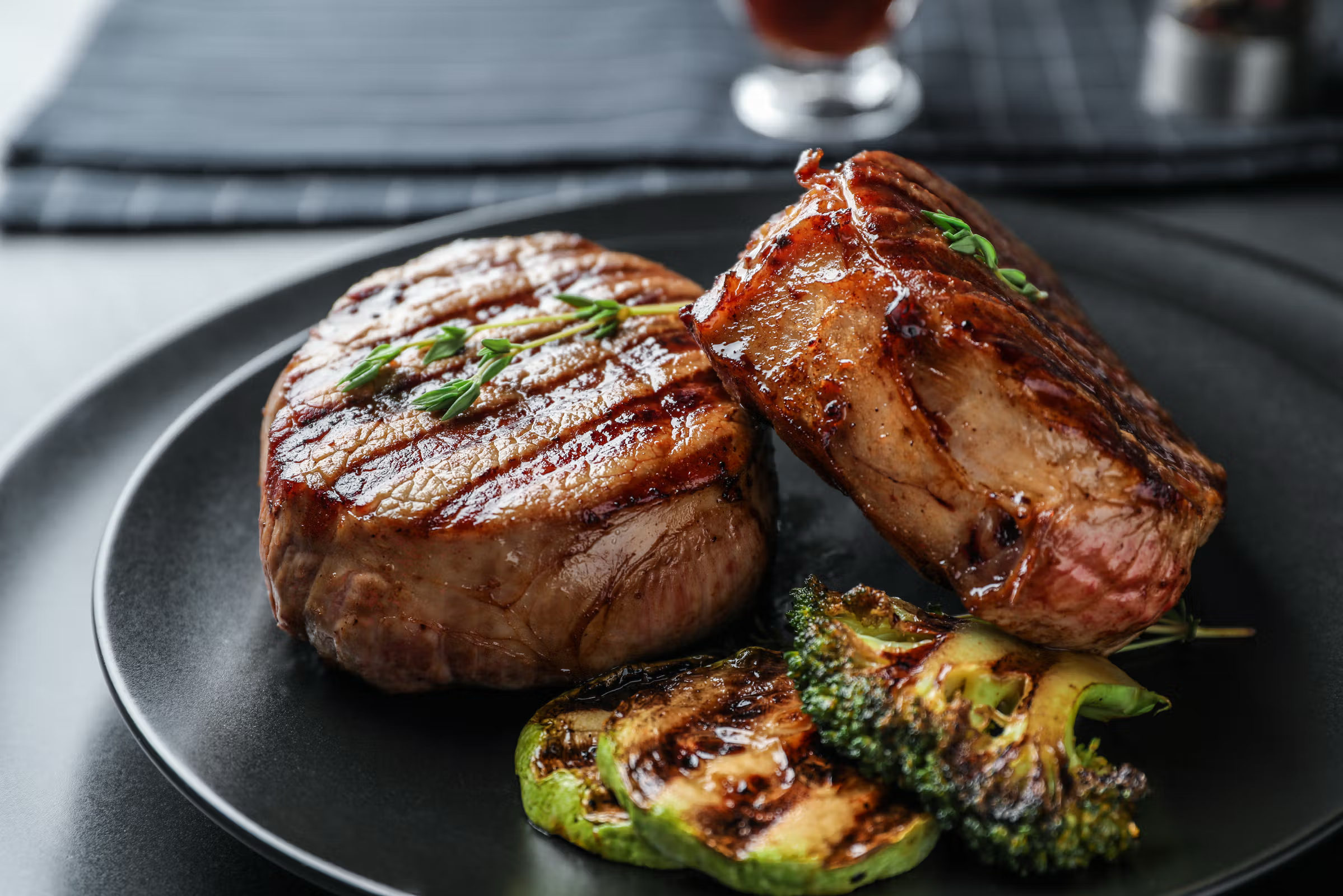
The Grill
A poolside al fresco favorite, The Grill is casual by day and captivating by night. Dig in to crisp salads and grilled classics during lunch, then return after sunset for masterfully seasoned and seared cuts paired with balmy sea breezes.
Dress code: Casual
Casual wear consists of pants, blouses, or casual dresses for women; open-neck shirts and slacks for men are appropriate.
Images are intended as a general reference. Features, materials, finishes and layout may be different than shown.
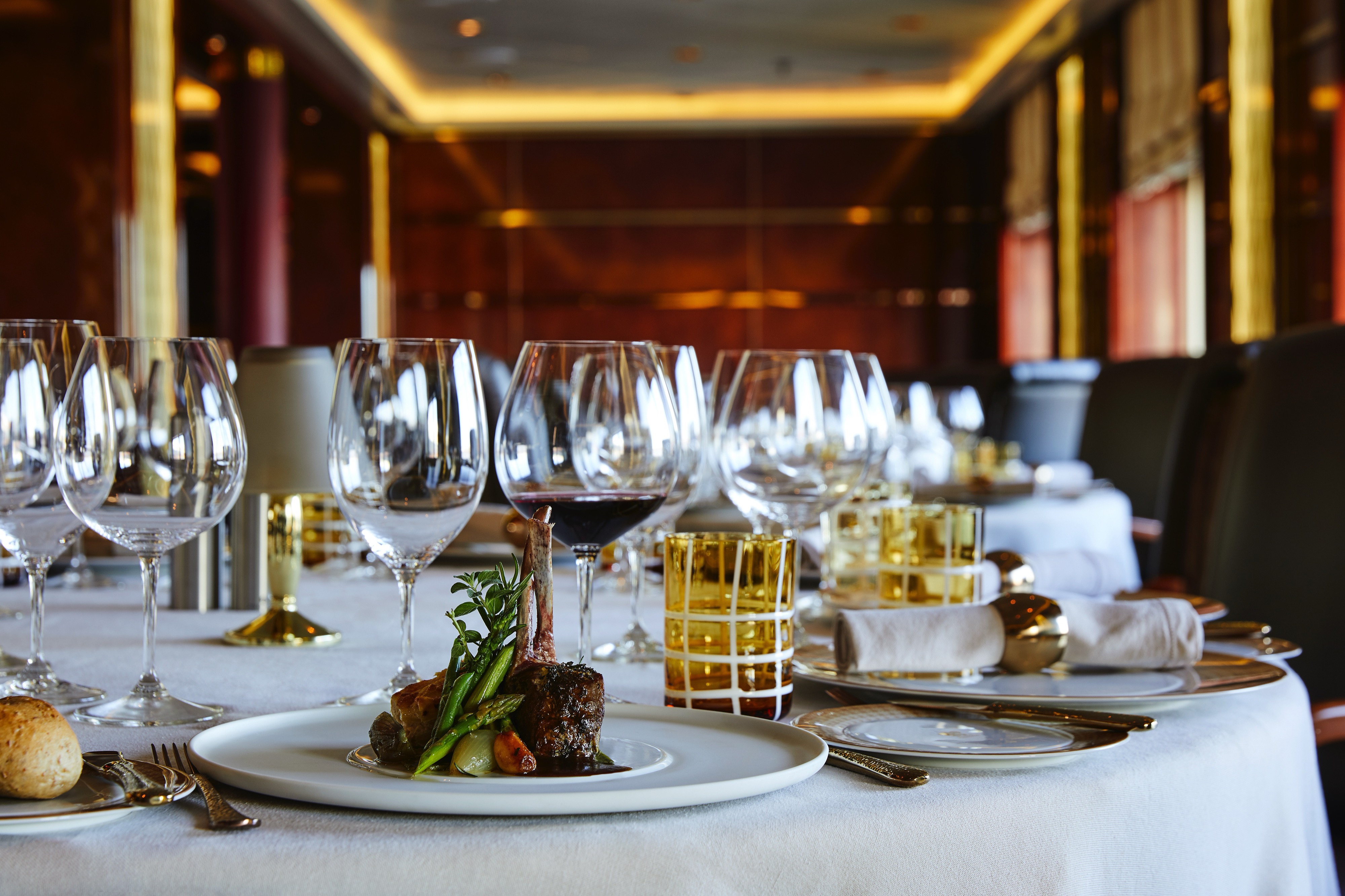
La Dame
Experience the pinnacle of French gastronomy at La Dame, where sophistication meets tradition. Here, an exclusive tasting menu unfolds course by course — each plate a study in masterful technique, seasonal ingredients, and modern refinement. From classic Kir Royales to exquisite signatures such as Dover sole à la Grenobloise, this is haute cuisine at its finest.
Per guest reservation fee of US$60. Please visit My Silversea to make your reservations.
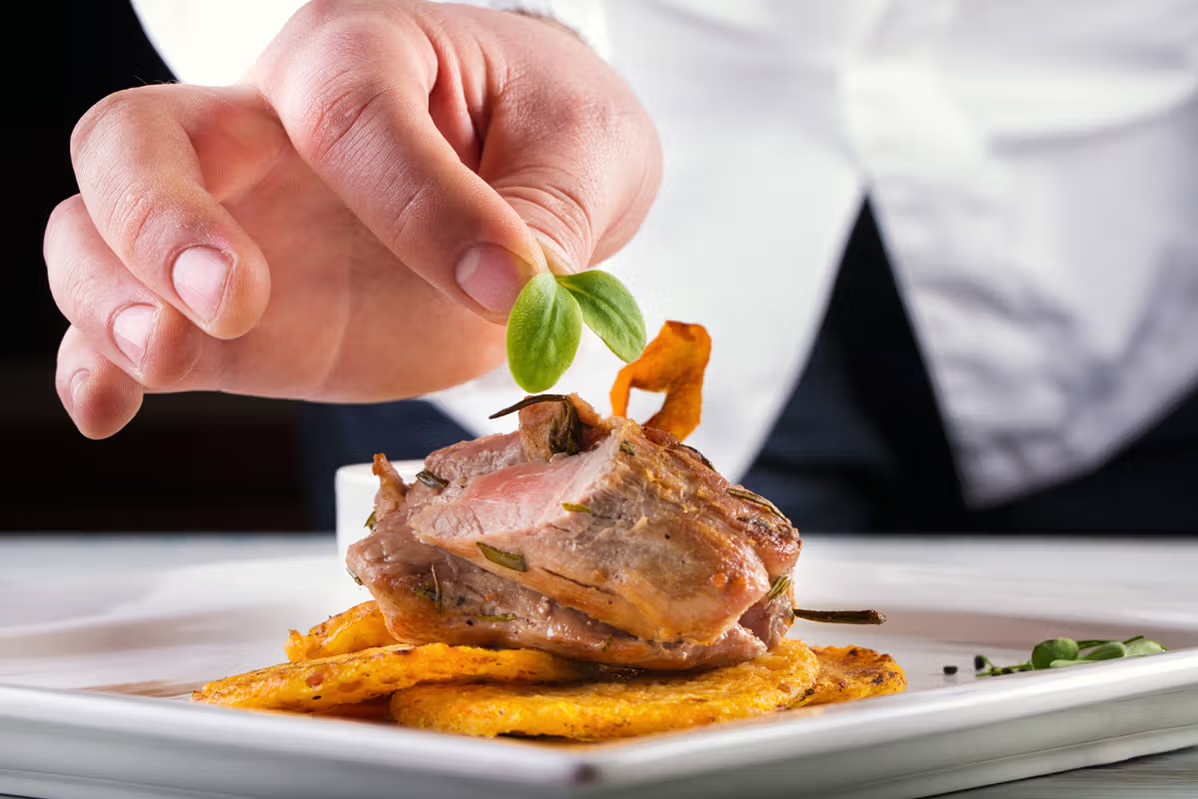
Le Terrazza
La Terrazza elevates casual dining by day and delivers an authentic Italian experience by night. During the breakfast and lunch buffets, our master chefs prepare global favorites at live stations. As evening falls, handmade pastas and classic seafood dishes are the centerpiece — every impeccable bite paired with fine wines from around the world.
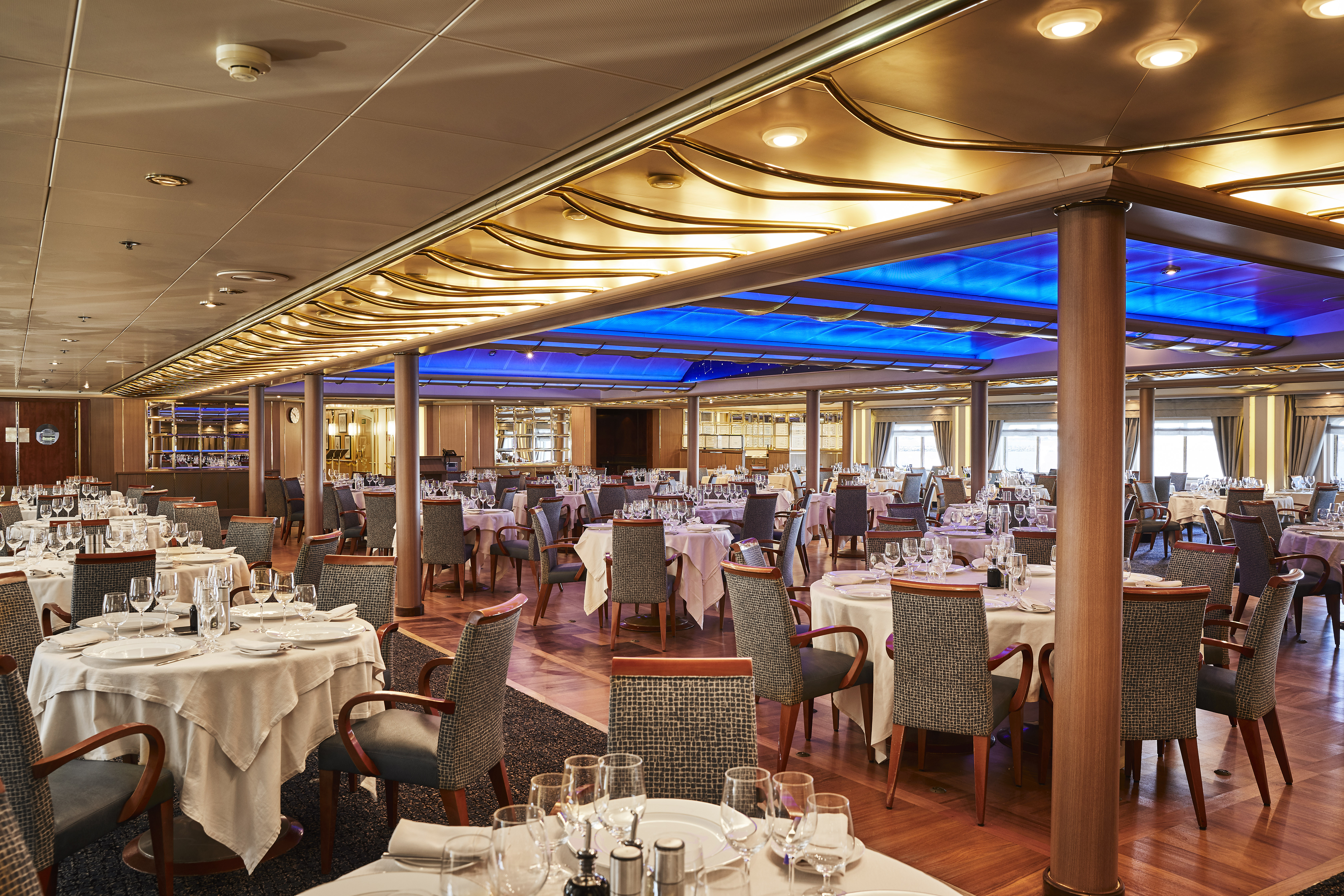
The Restaurant
The Restaurant transforms dining into an extraordinary journey of taste. Indulge in international delicacies, refined classics, and destination-driven creations that reflect the flavors of the region you’re exploring. From breakfast favorites to imaginative evening courses, every meal draws inspiration from your voyage.
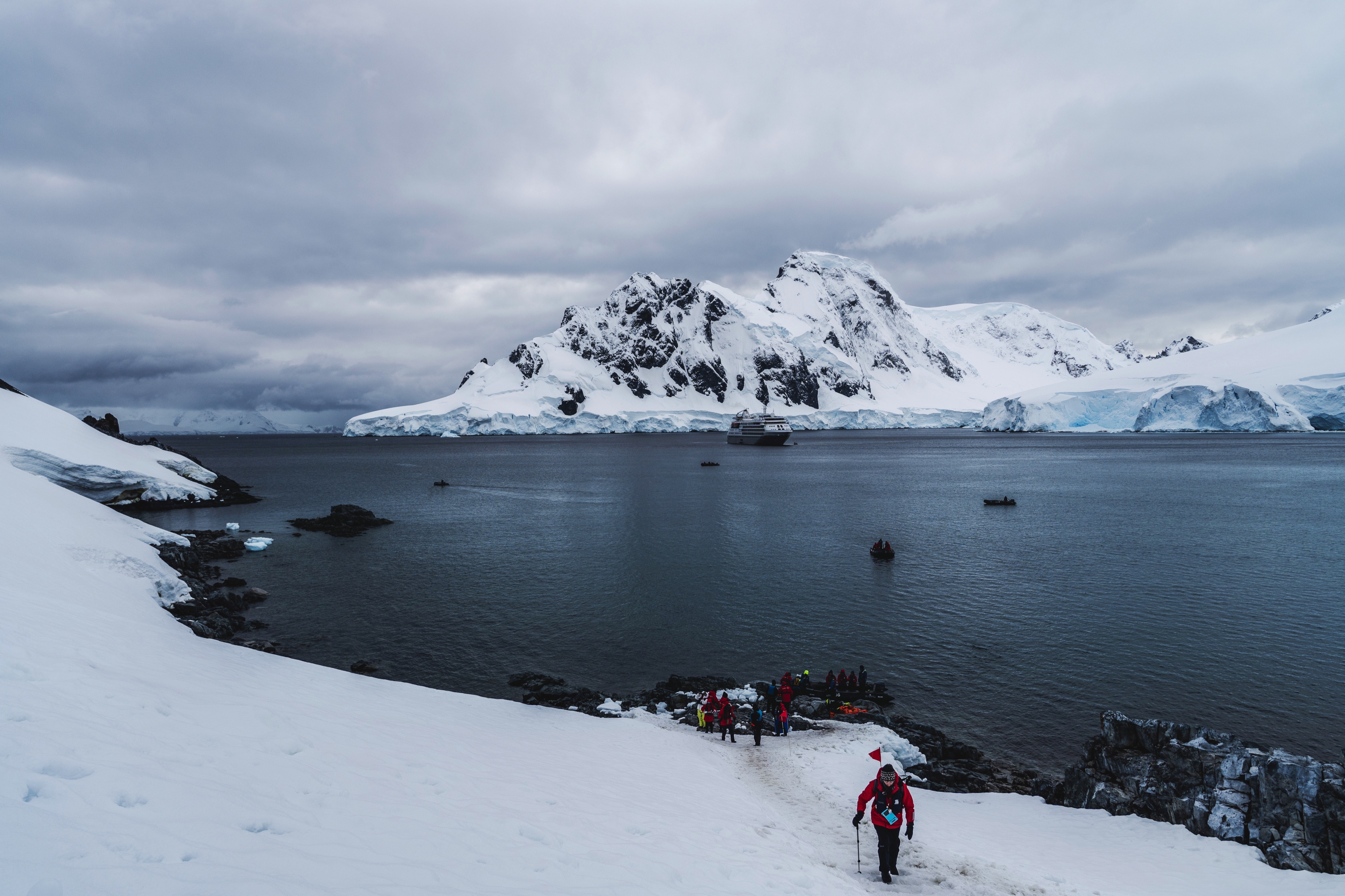
Shore Excursions
Local Immersion, Lasting Impressions
Authentic Cultural Connections
Every destination tells a story — and Silversea Shore Excursions reveal these stories inviting you to venture beyond the ordinary. Enjoy privileged access to cultural treasures and natural wonders often out of reach for independent travelers. Each excursion is thoughtfully designed by experts to foster genuine connections with local communities, customs, and landscapes. From intimate small-group adventures and signature S.A.L.T. Experiences to personalized private tours, we offer diverse options to match your interests and desired level of immersion — making every moment meaningful and memorable.
Choose your experience, write your own story
Highlight Experiences
Seamless tours of iconic sites
Explore iconic landmarks and cultural treasures with our Highlight Experiences, half or full-day adventures led by expert guides. Enjoy seamless, hassle-free journeys to must- see attractions — perfect for guests seeking a convenient, turnkey experience.
Signature Experiences
Smaller tours, crafted by Silversea
These immersive Signature Experiences offer privileged access and personalized interactions with local experts. These experiences are perfect for those seeking meaningful, social exploration who want to connect with destinations through authentic dining and slow travel.
Private Experiences
Exclusive tours for your group
Create your own exclusive adventure with a dedicated vehicle, driver, and guide. Explore at your pace, linger, or spontaneously discover new sites. Available at most ports for half- or full-day bookings, Private Experiences are ideal for families seeking privacy and flexibility.
Custom Experiences
Tailor-made tours designed for you
Enjoy personalized Custom Experiences tailored to your interests, with exclusive access and specialized guides. Our team handles every detail, ensuring unforgettable moments that exceed your expectations—crafted entirely around your pace and preferences.
Overland Experiences
Mid-cruise, inland tours
Venture inland on two- to three-day journeys to iconic sites like the Taj Mahal or Angkor Wat. With flights, stays, and guided access included, these immersive journeys offer rare experiences beyond the coast — all with the signature Silversea service.
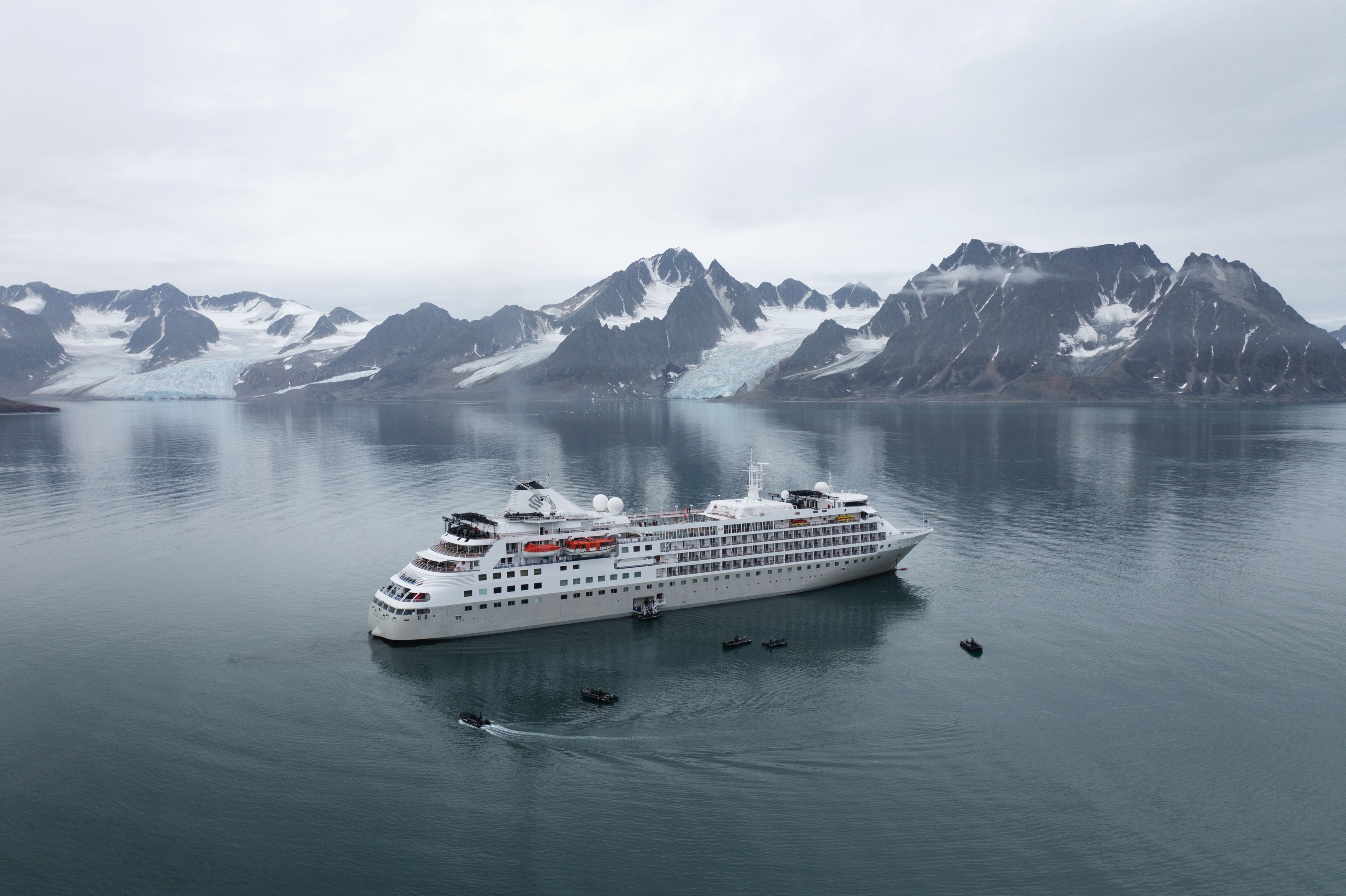
Zodiac Adventures
Zodiac® boats are used almost daily to access remote areas. These small, rigid-inflatable vessels navigate narrow inlets, islets, and ice floes with precision, designed for safety and reliability, they ensure a secure and efficient explorations.
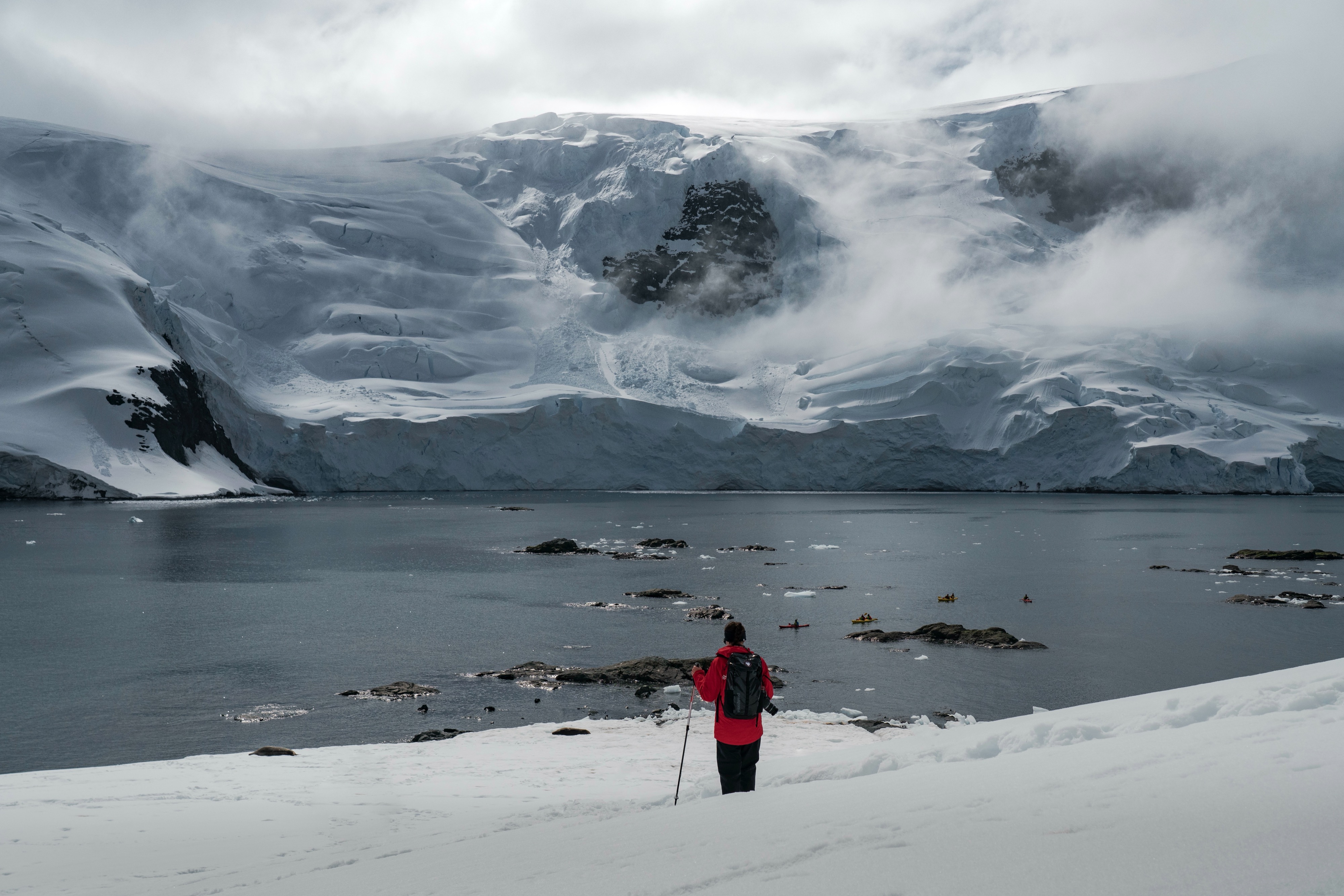
Hiking Exploration
Hike across pristine landscapes, where the great polar explorers went before you, to unveil incredible vistas, observe penguin colonies, discover unique vegetation, and encounter local communities.
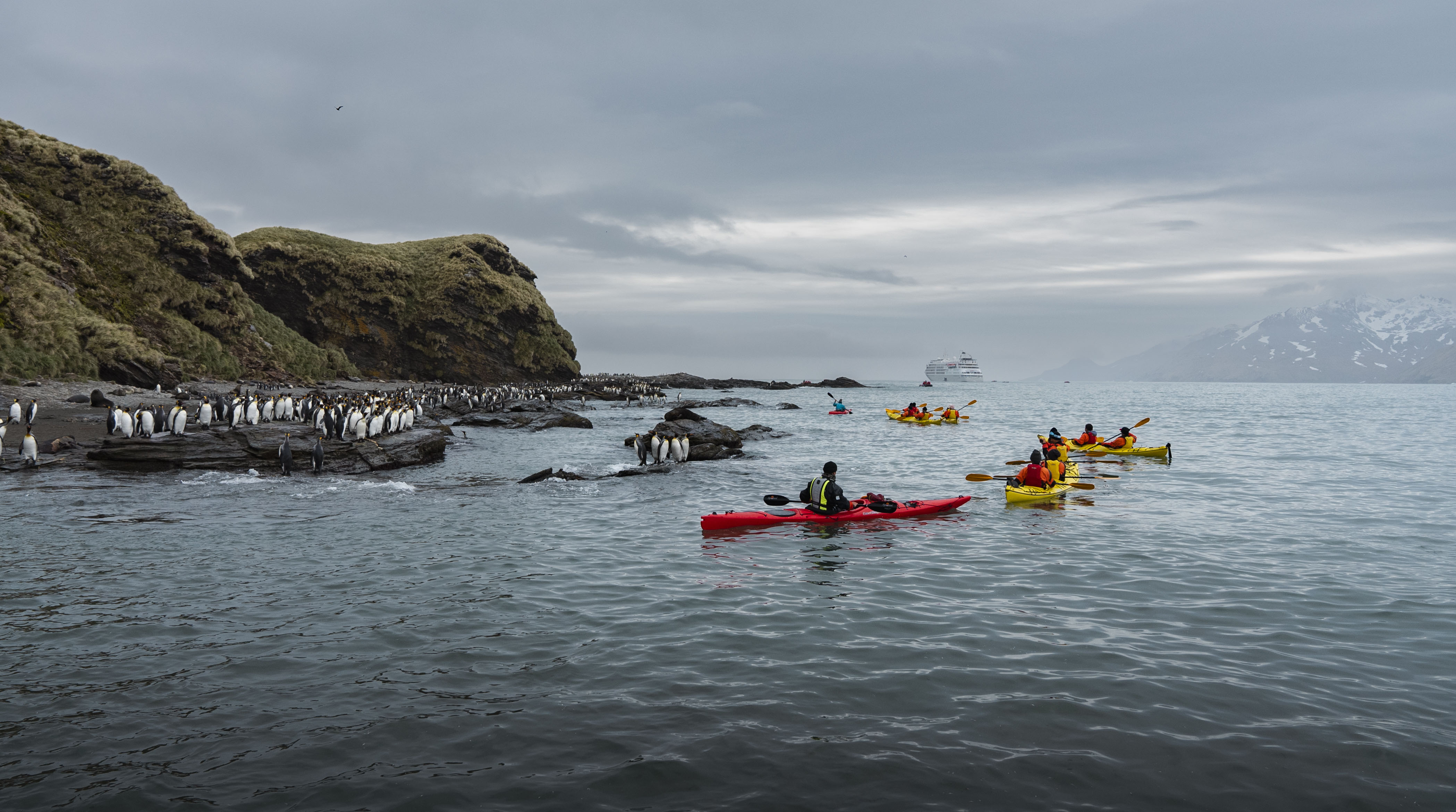
Kayaking Exploration
There’s nothing like floating alongside a glacier in silence or having a curious seal glide beside you. Under the guidance of our certified kayak instructors, you’ll experience all this and more.
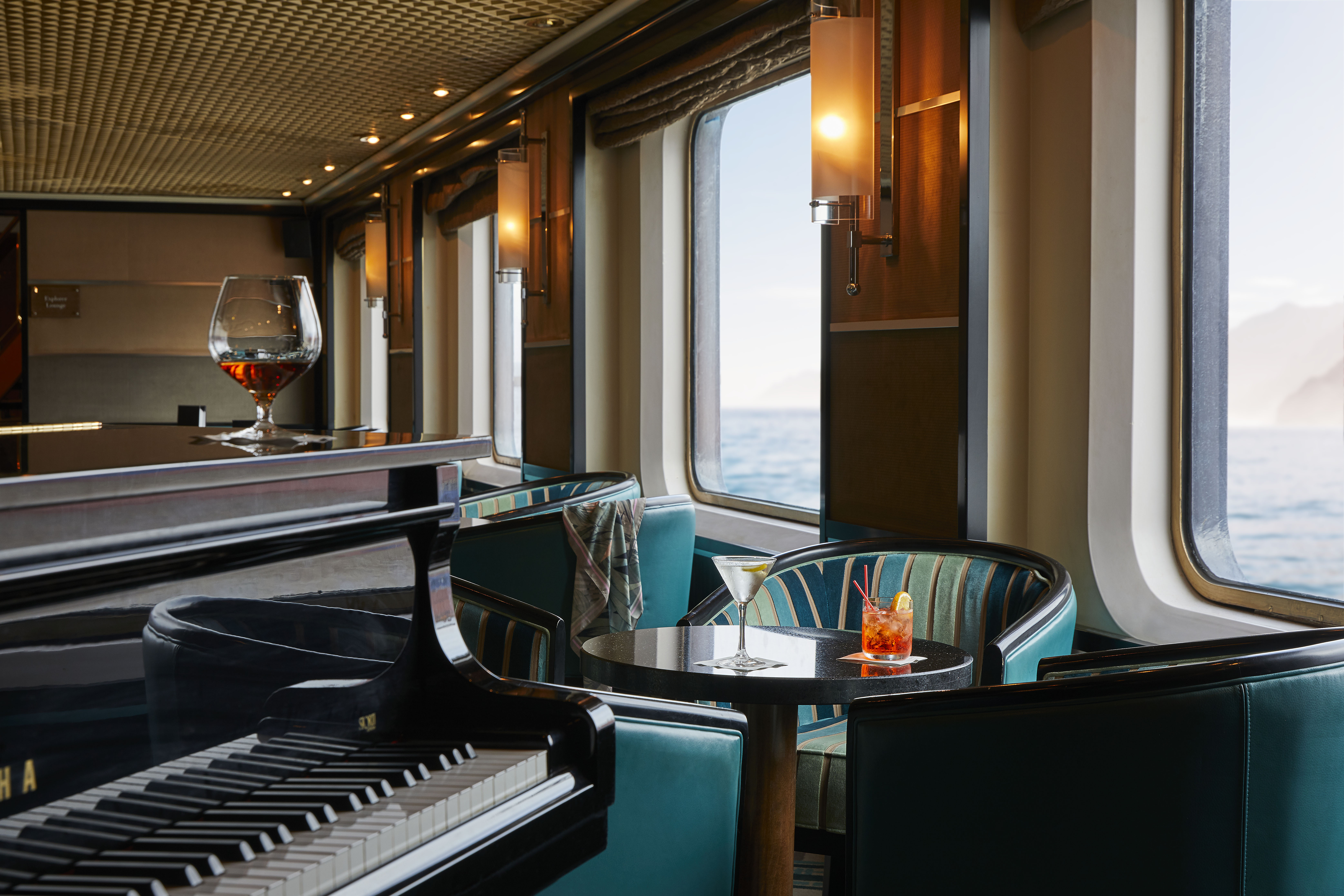
Dolce Vita
Surrender to a world of Italian elegance where the art of aperitivo takes pride of place. Ideal for connecting over spritzes, negronis, and light bites, here each evening feels like a celebration. As laughter lingers, crystal glasses clink, and live piano notes ripple through the air, Dolce Vita compels you to savor the sweetness of life on board.
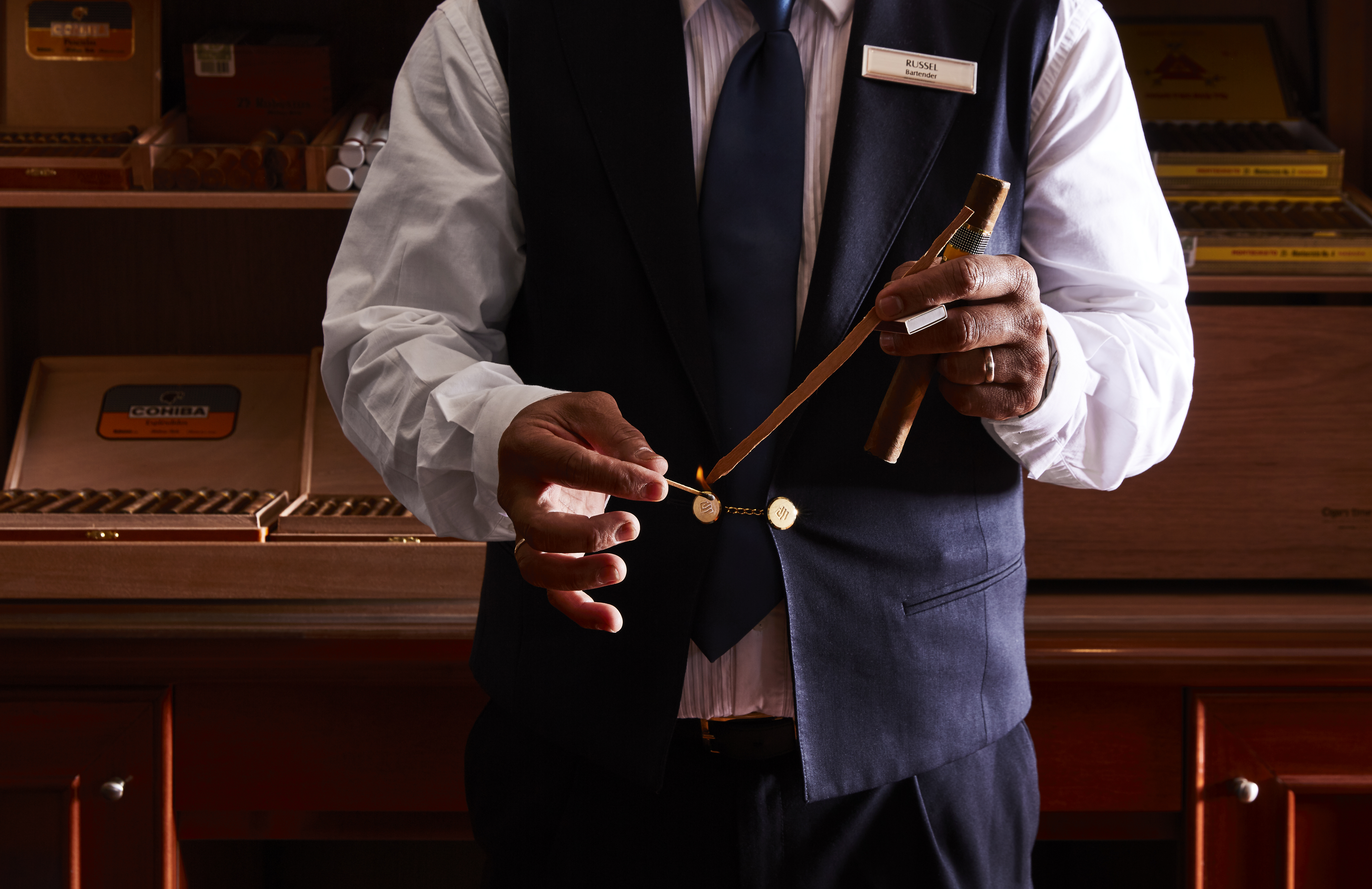
Connoisseur's Corner
As evening stretches into night, Connoisseur’s Corner offers a stylish refuge for those who appreciate the time-honored rituals of smoke and spirit. Sink into tufted leather chairs with a hand-rolled cigar and a glass of one of our finest cognacs or whiskeys. Indoors or under the stars, every moment is marked by pure indulgence.
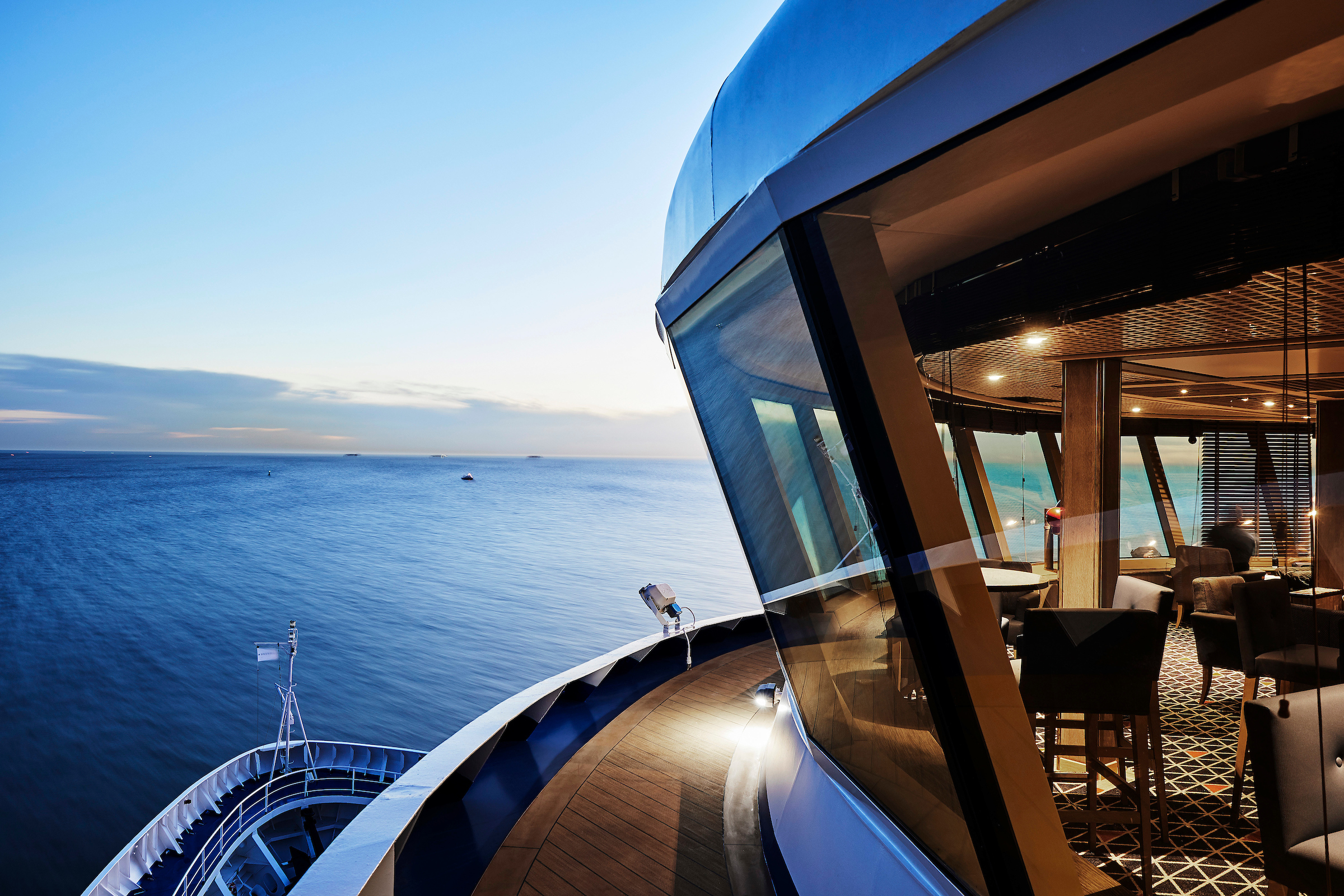
Observation Lounge
Wrapped in glass and bathed in light, the Observation Lounge offers a serene escape high above the sea. Borrow a book from the in-house library, pour yourself a coffee or tea from the self-service bar, and curl into an armchair to watch the world drift by. This is a sanctuary for reflection, relaxation, and stories — both written and still in the making.
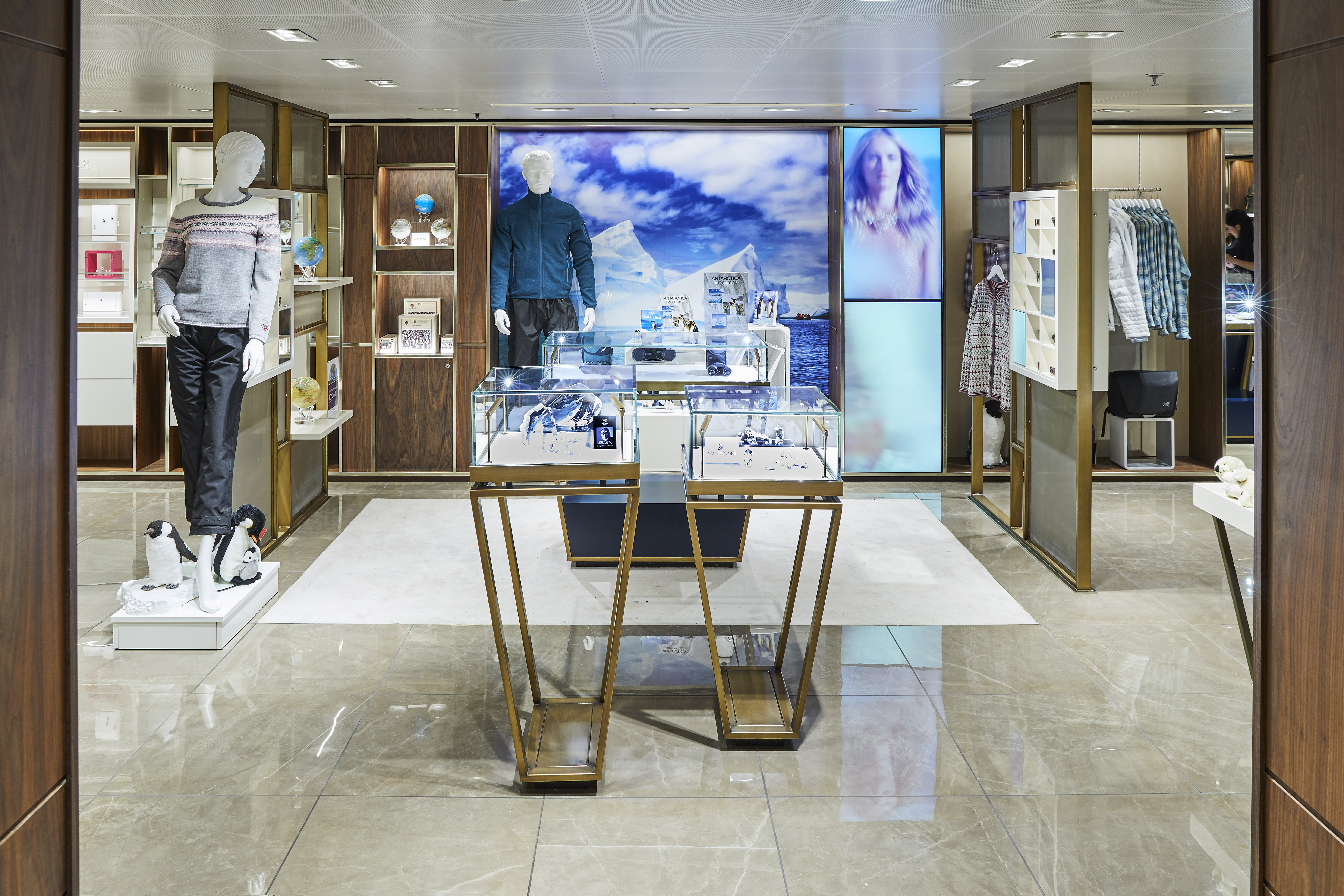
Boutique
Exceptional shopping experiences do not end in the cosmopolitan cities we visit. Silversea’s striking new shipboard boutiques, reimagined and redesigned, are stunning modern design spaces befitting the finest creations from legendary designers. Carefully selected partners on board Silversea’s duty-free boutiques offer our guests a carefully curated selection of cutting-edge fashions, jewelry, accessories, fine perfumes, cosmetics, and Silversea Logo collection, all at duty-free prices.
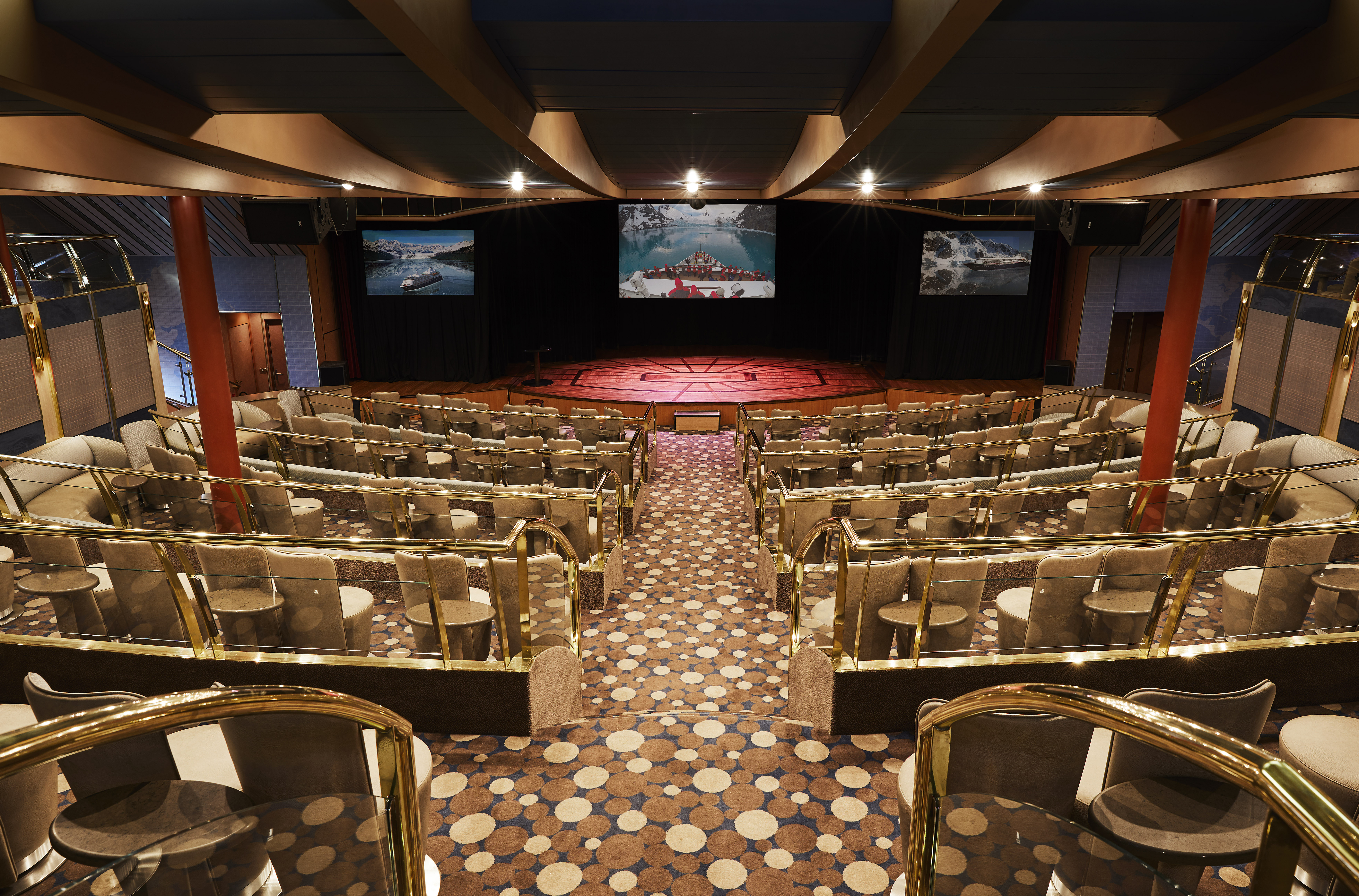
Explorer Lounge
Unique to our Expedition ships, the Explorer Lounge is a versatile venue that adapts to the rhythm of your journey. Comfortable seating and refined refreshments create an atmosphere where learning and leisure meld seamlessly. From lectures and presentations to live entertainment and special events, this is a space where discovery thrives.
Panorama Lounge
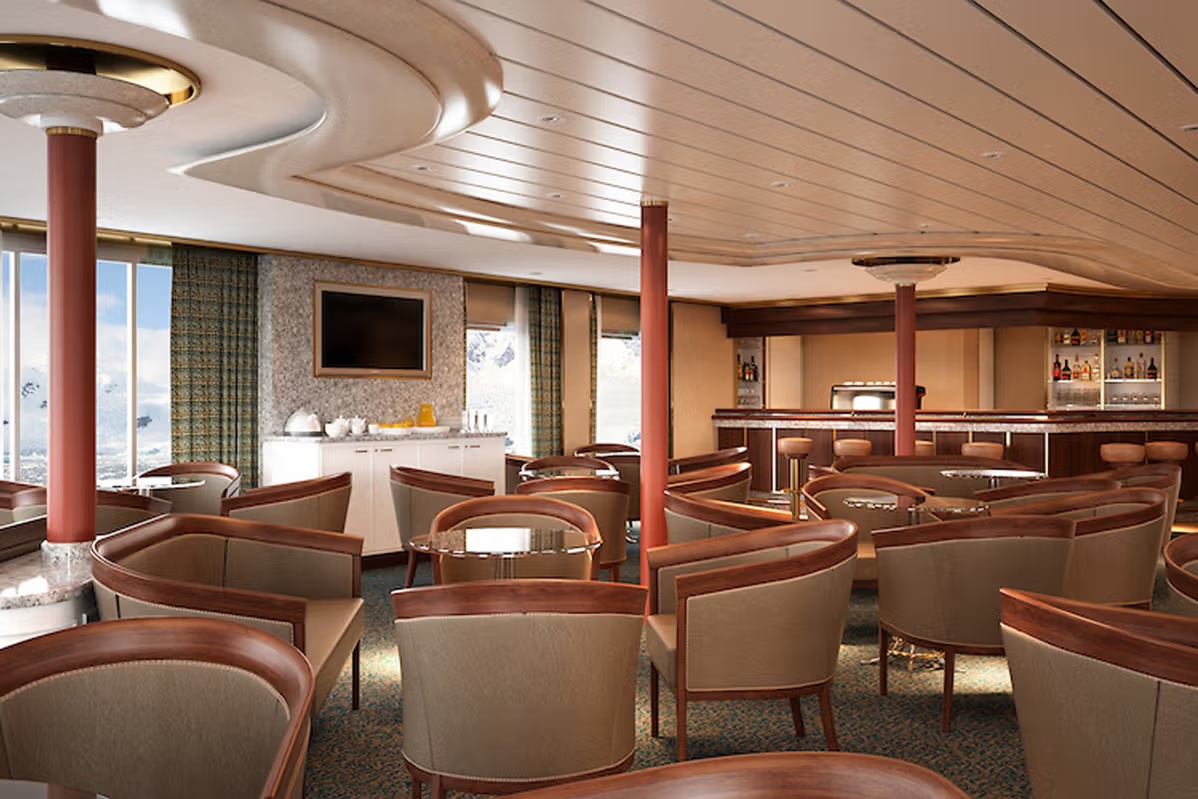
True to its name, Panorama Lounge surrounds you with sweeping views from every angle. Sunlight pours through wraparound windows by day, framing horizons that shift like watercolors. Evenings hum with piano chords and DJ beats that carry you late into the night. And all of it pairs wonderfully with cocktails handcrafted to match your mood.

Photo Studio
The Photo Studio offers a multitude of options to take your pictures from your camera to your walls. A vibrant, creatively inspiring space where you can not only master the art of digital photography with master classes in editing and Adobe Lightroom and Photoshop, but also an editing suite where you can print images (including postcard, panorama, and A2-sized prints). State-of-the-art equipment for both Mac and PC users, highly technological printers, plus a dedicated photo manager to guide you through the many techniques to help you define yourself as a serious photographer. Even the smartphone photographer can become pro-level with specialized training on how to use your camera phone to its best possible advantage. Fees apply.
Reception
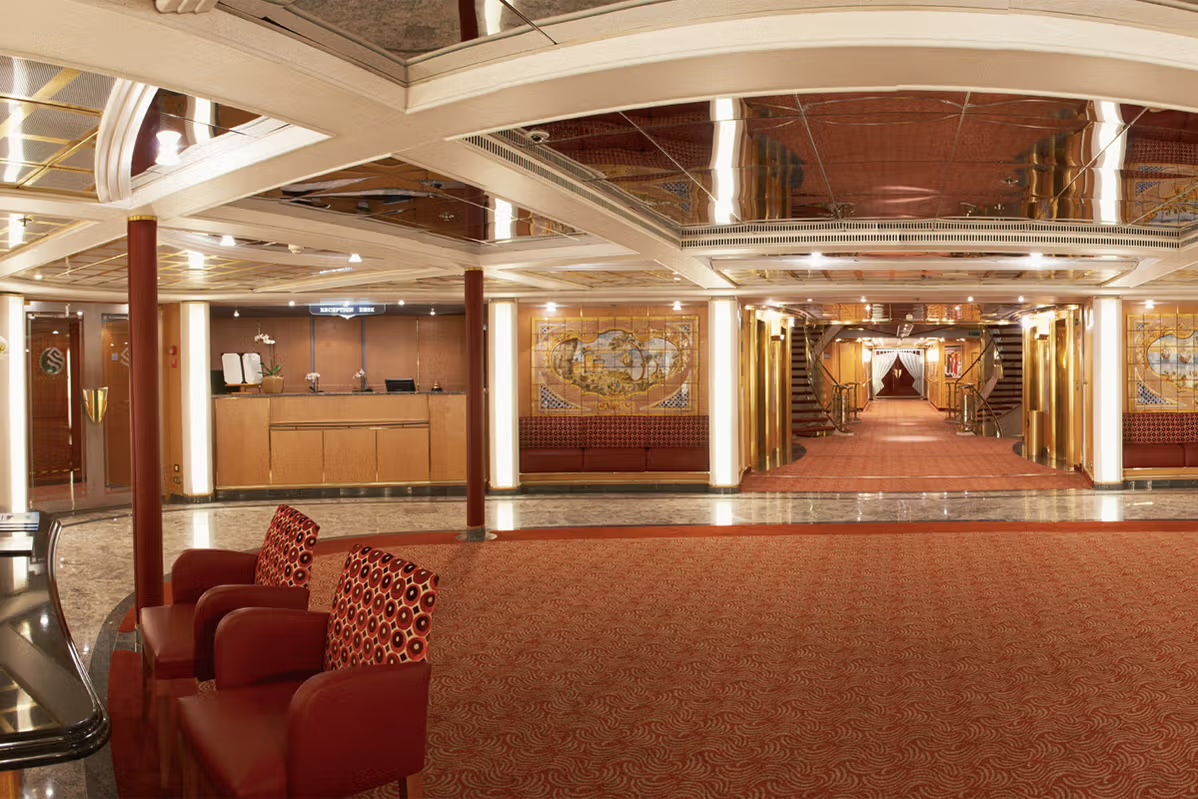
This central lobby area welcomes guests to speak with our receptionist if they have a question or require any service. Assistance is available 24 hours a day. The Cruise Consultant may also be indispensable when planning your next Silversea voyage, or if you wish to extend your current voyage for a day, a week, a month … Like having your own personal onboard Silversea professional, the Cruise Consultant will help you to select the perfect voyage, reserve your preferred suite, and provide immediate confirmation.
Zagara Beauty Salon
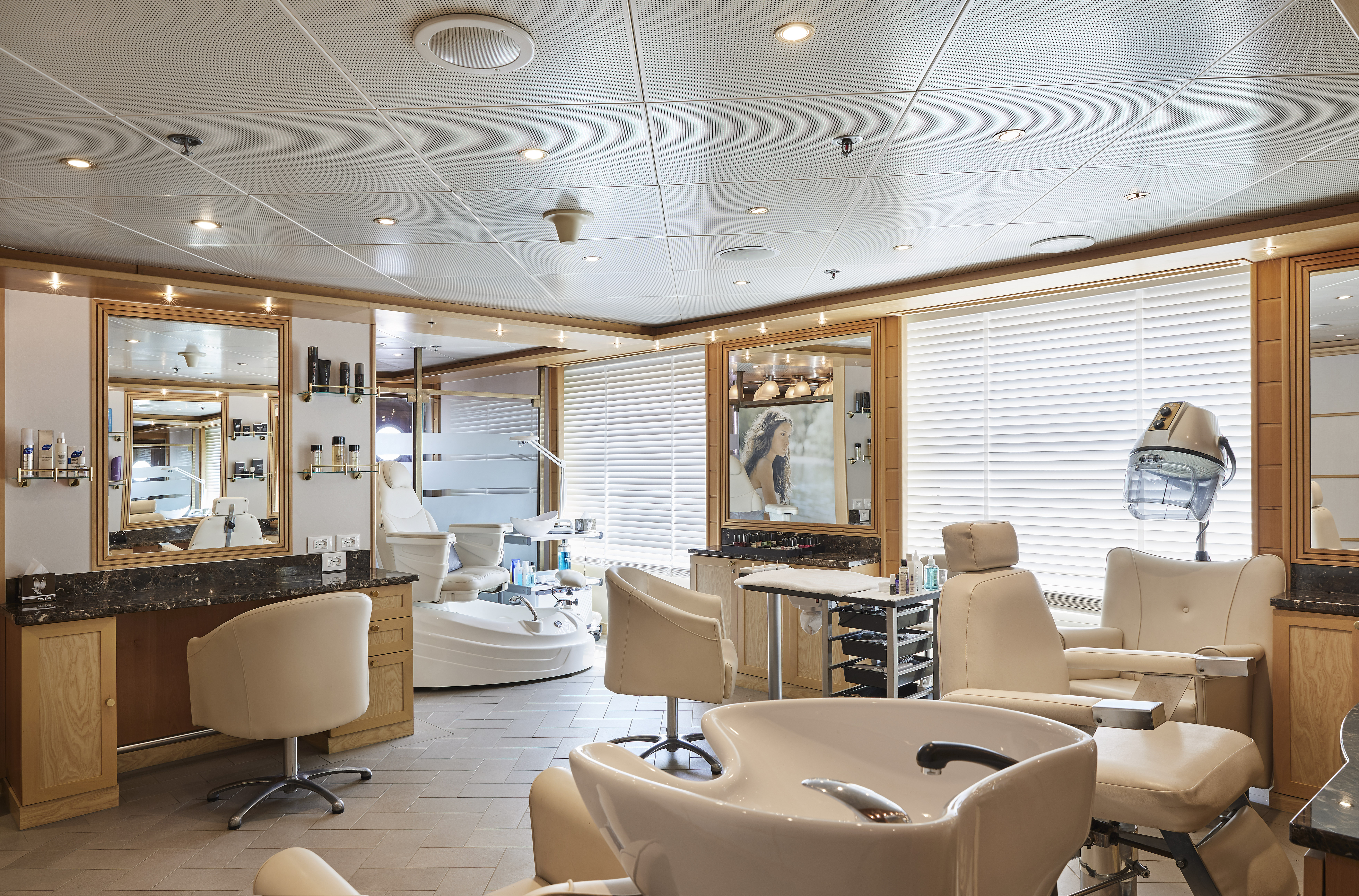
Relax your body and mind in this luxury cruise ship’s soothing spa sanctuary. Indulge in a wide range of invigorating therapies, including facials, body wraps, and massages. Appointments for spa services may be made on board the ship, or in advance via My Voyage. Men’s and women’s saunas and steam rooms are perfect for relaxing before your spa treatment or after your workout.
Fitness Centre
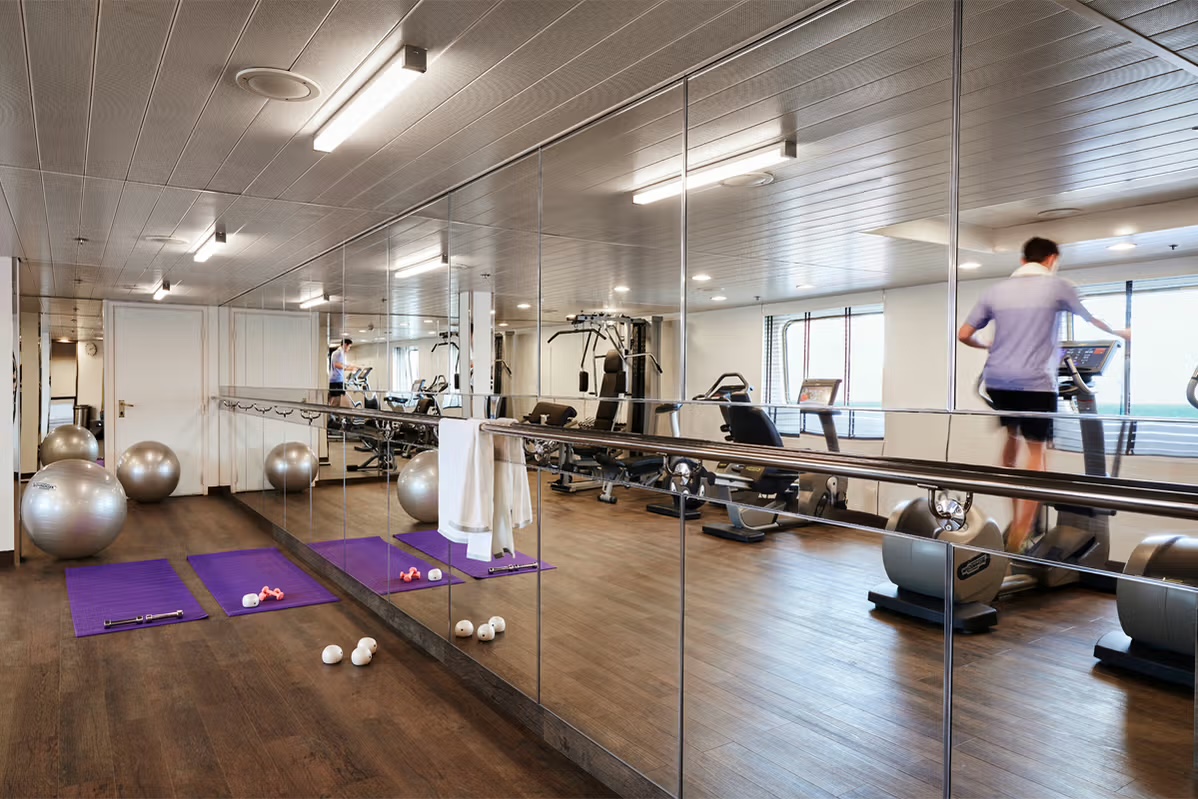
The Fitness Center on board this luxury cruise ship is equipped with free weights, weight machines, state-of-the-art treadmills, elliptical trainers, and recumbent and upright bicycles. Classes in aerobics, yoga, Pilates, and circuit training are led by the onboard fitness trainer and are always complimentary. Personal training, body composition analysis, and specialty classes are available at an additional charge on board all luxury cruises.
Images are intended as a general reference. Features, materials, finishes and layout may be different than shown.
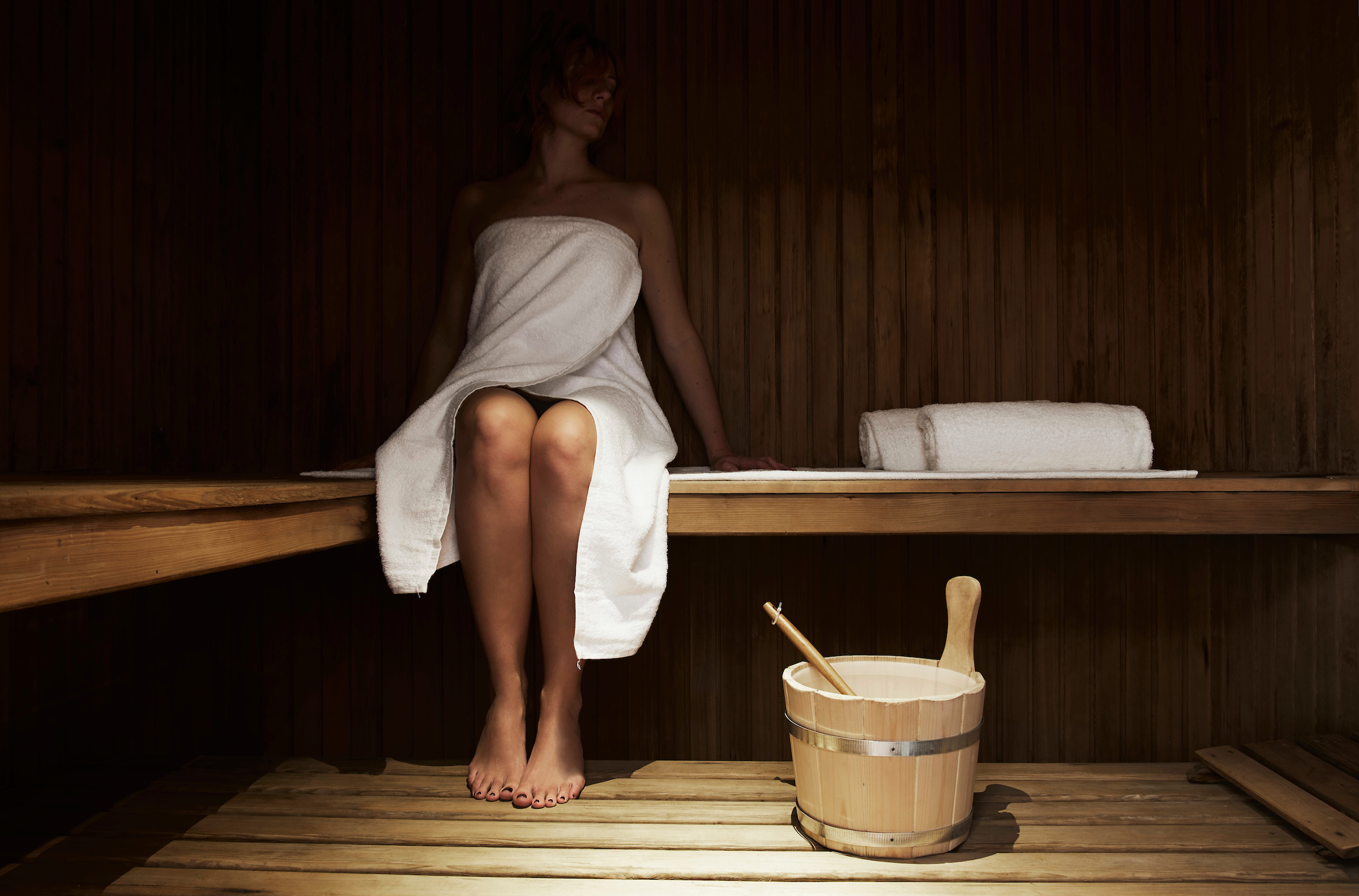
Zagara Beauty Spa
Relax your body and mind in this luxury cruise ship’s soothing spa sanctuary. Indulge in a wide range of invigorating therapies, including facials, body wraps, and massages. Appointments for spa services may be made on board the ship, or in advance via My Voyage. Men’s and women’s saunas and steam rooms are perfect for relaxing before your spa treatment or after your workout.
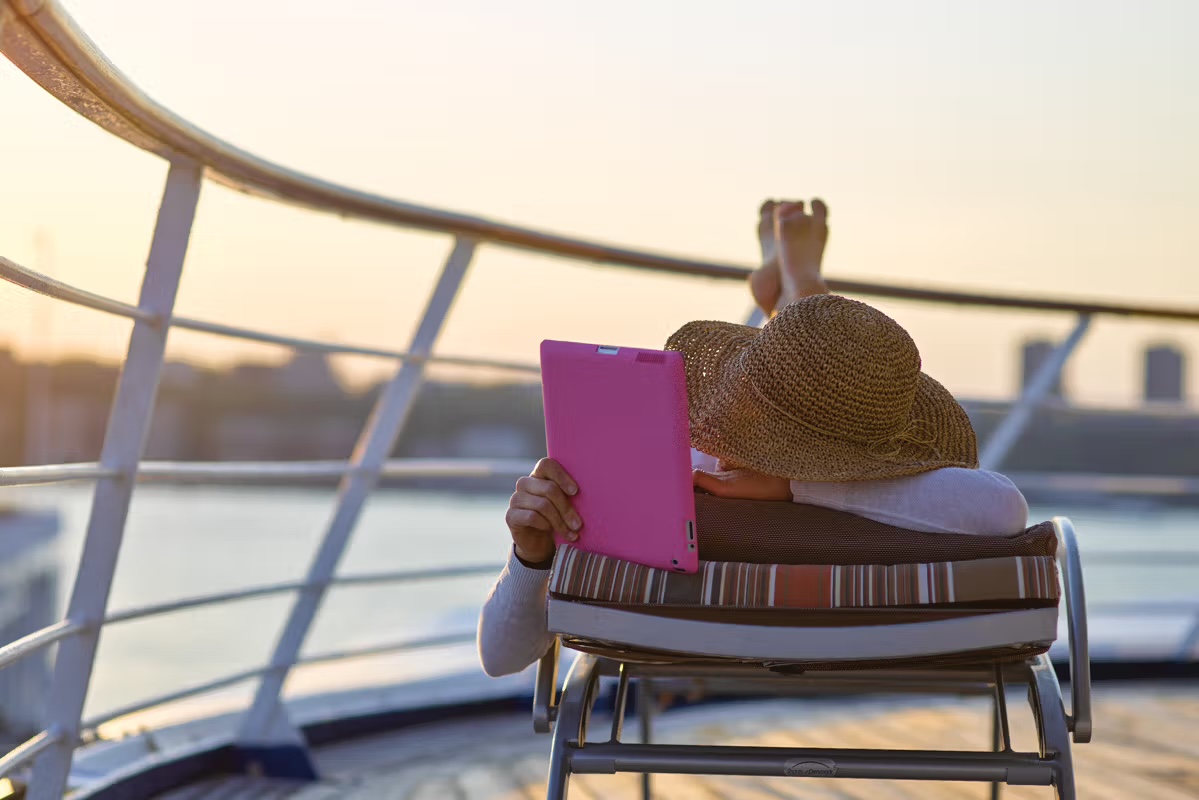
Pool Deck
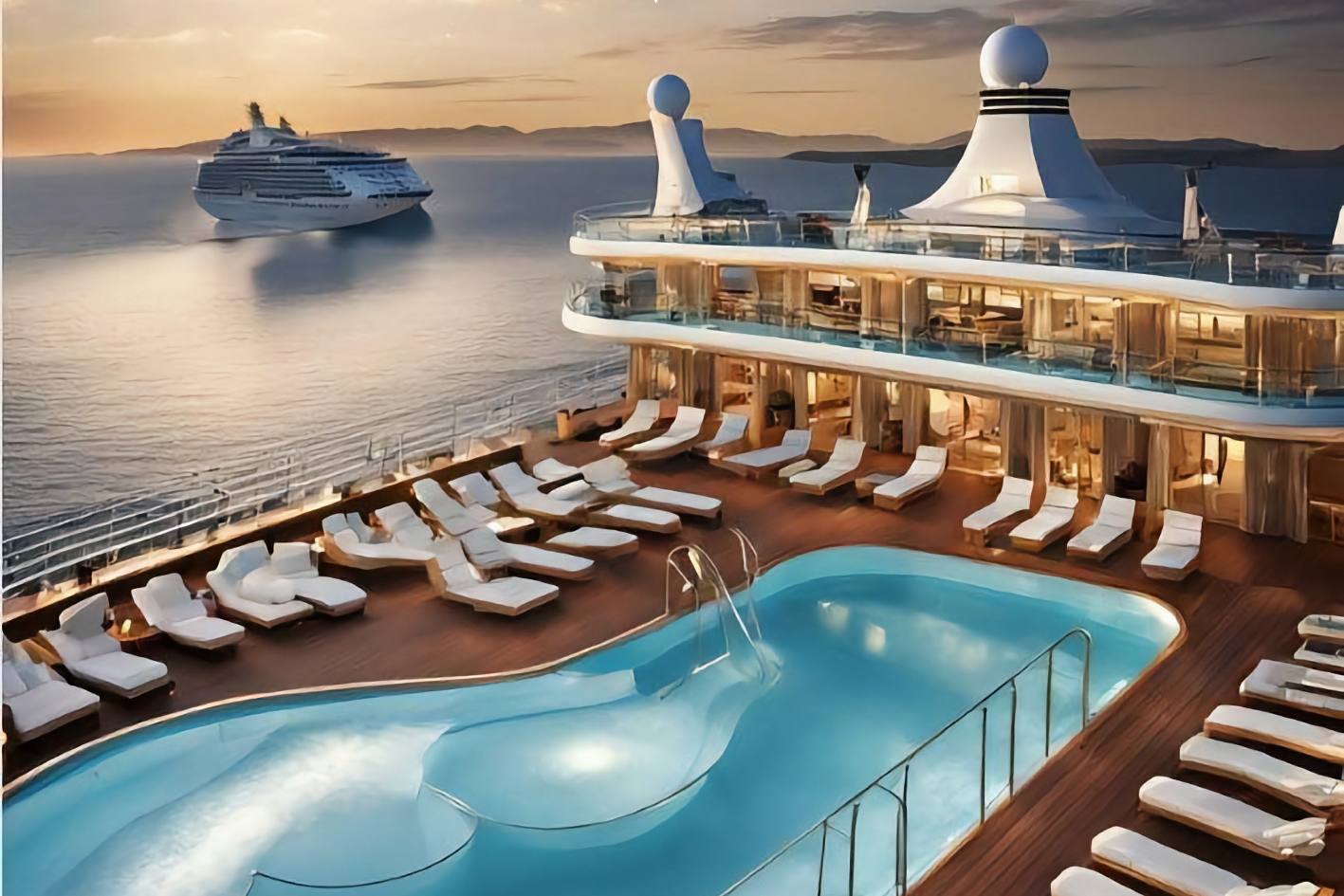
Chaise lounges arranged in the sun or shade. Bubbling whirlpools. The pool water is refreshing in warmer climates and heated for cooler weather. Attentive staff is at the ready with an oversize towel as you emerge from the pool, with your favorite beverage at just the right moment. This is expedition cruising as you have never experienced it before. What better way to watch the icebergs?
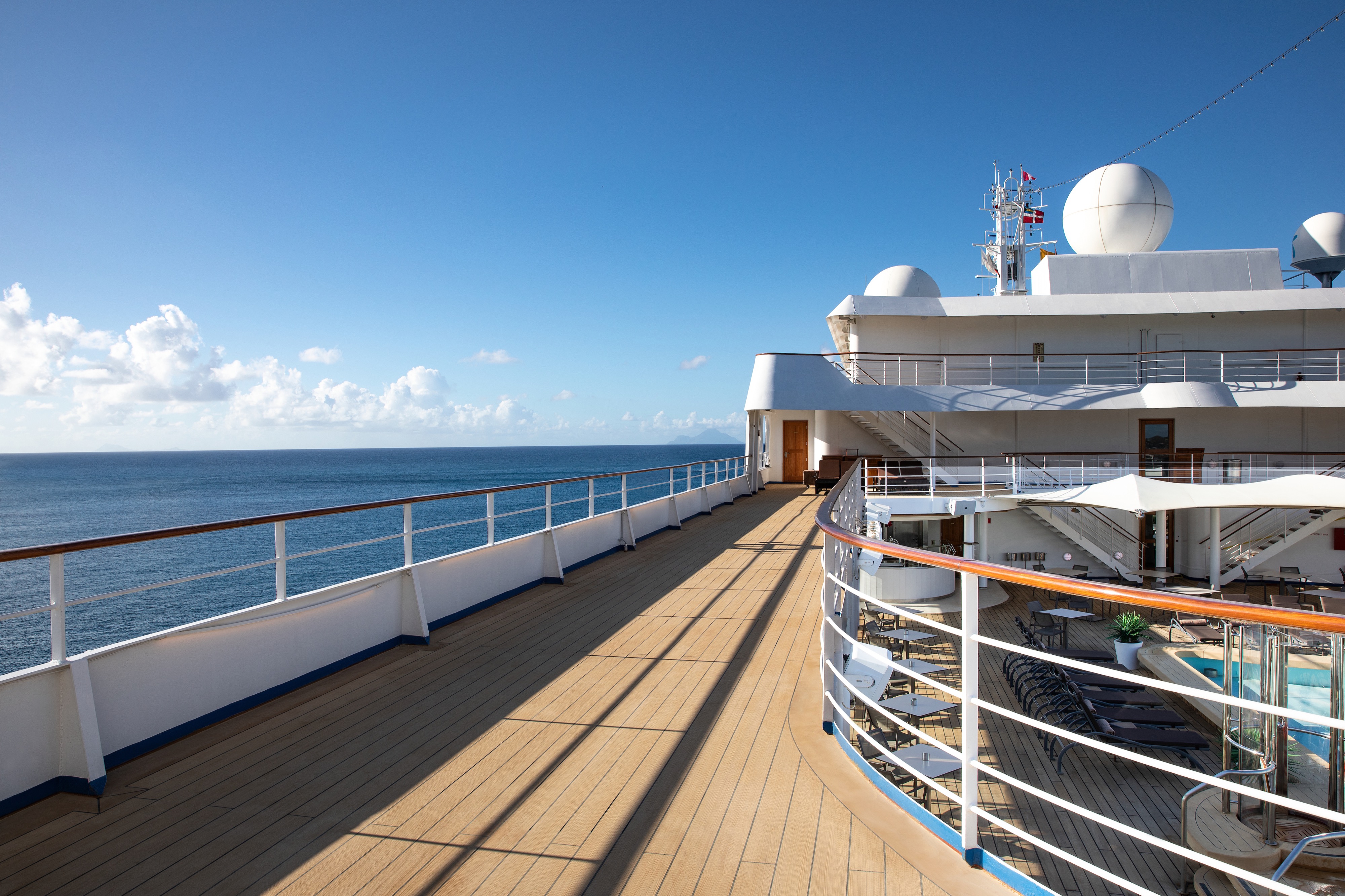
Jogging Track
A jogging track is available for guests, running the entire outside edge of the deck.
Expedition Activities
Every Silversea Expedition features complimentary expedition activities led by the Expedition Team. Activities such as Zodiac cruises, kayaking, snorkeling, and hiking vary daily for each itinerary. They are dependent on weather and sea conditions and designed for most levels of interest and physical ability.
Age Requirements for Expedition Activities:
- Zodiac Cruises: Minimum age 5 years, accompanied by an adult.
- Snorkeling: Minimum age 12 years, accompanied by an adult.
- Kayaking: Minimum age 14 years when accompanied by an adult, or16 years to participate solo.
As Silversea does not provide childcare services, an adult family member must remain onboard with any child who does not meet the minimum age requirements.
Dress Code
ONBOARD DRESS CODE
To help you prepare for your voyage, we’ve gathered everything you need to know about what to pack and what to wear while onboard.
Find about more in regards to what to pack here.
ASHORE DRESS CODE
The right gear is essential for enjoying the whole experience of your Silversea Expedition without the limitations of weather and other conditions of each remote destination. Clothing that can be layered to accommodate different temperatures is most versatile and comfortable.
The key to dressing for a warm climate is to wear light-colored, loosefitting clothing made of natural fibers. Bright yellows, reds, and whites might attract wasps in some areas when you’re out in the sun. To protect yourself from the sun, make sure to pack a Wide-brimmed hat with chin strap and polarized sunglasses.
Additionally, bring sleeved quick-drying rashguards for water activities, along with your swimwear. Closed-toe water shoes are necessary for wet landings. If you have any sensitive electronic equipment, it’s recommended that you bring appropriate protective cases.
A detailed packing list is provided here.
Medical Services
Each of our ships is equipped with a Medical Centre. Please refer to the Daily Chronicles for opening hours. When docked, supplementary emergency care may also be obtained through local medical facilities. Guests may be charged for medical services and for medications used for their medical treatment. The Medical Centre is not intended or designed to provide ongoing treatment for pre-existing conditions or for extended critical care, and Silversea is not responsible for the diagnosis, treatment or services furnished by shipboard medical personnel. Guests requiring oxygen for medical reasons are welcome to bring an oxygen concentrator onboard. Guests wishing to bring their own portable oxygen tanks must obtain prior written authorisation from Silversea, as restrictions may apply. (For additional details, see the Passage Contract.
Smoking Policy
At Silversea, the safety of all guests is paramount. To ensure a comfortable environment for all, smoking is prohibited in most public areas, guest suites, and suite balconies. However, cigarette, e-cigarette, cigar, pipe, and vaporizer smoking is permitted in the Connoisseur’s Corner (Deck 8).
Laundry Services
Complete valet services, including laundry, pressing and wet cleaning, are available and may be arranged through your butler. Customary charges will apply.
Guests sailing in Owner’s, Grand, Royal, Silver, Medallion suite have complimentary laundry, pressing and wet cleaning
Internet Access
All guests will be granted complimentary, unlimited standard Wi-Fi for one device at a time. Guests sailing in an Owner’s, Grand, Royal,Medallion or Silver suite will receive complimentary unlimited premium Wi-Fi for one device at a time. Standard Wi-Fi is provided at regular satellite speed — ideal for emailing, web surfing, chat or similar. It is not suitable for video, audio calls, or streaming. Premium Wi-Fi access is suitable for all kinds of applications, including video and audio call and streaming.
Premium Wi-Fi is available at an additional charge and will provide access for up to four devices simultaneously. You may use your own laptop to conveniently access the wireless internet and personal email services from the privacy of your own suite, and throughout the ship
Special Dietary Requirements
Silversea will make every attempt to accommodate guests with special dietary requirements. If you have any special needs, please note them on the Guest Information Form or have your travel agent fax Silversea
Special Services (+ 1 954-356-5881) or email: specialservices@silversea. com at least 120 days before sailing. Extra charges might apply.
Wheelchair Availability and Access
Silversea visits ports around the world, including some of the most remote locations available for cruise ships, which significantly vary their ability to accommodate guests with disabilities including those in wheelchairs.
Silversea will attempt to arrange alternative transportation for guests with limited mobility to access port facilities, where available. In each case, the
Master of the vessel make a final determination for all concerned guests regarding the advisability of providing such assistance or disembarking guests or mobility equipment taking into account all appropriate factors, including the port’s conditions, weather conditions, security conditions, and the equipment to be disembarked.
Staff and Travel Companions
Silversea is pleased to offer unmatched service at sea while offering reasonable assistance to guests who may require additional assistance during their voyage. Please note, however, that we are unable to provide staff fully dedicated to providing guests with wheelchair assistance.
Guests requiring full-time assistance will need to travel with a travel companion who will assist them.
Guests with Reduced Mobility
Itineraries on a Silversea expedition voyage offer many expedition activities that will require guests to have good mobility and be in good overall health.
Some expedition activities may require prolonged periods of physical activity, including standing, walking, hiking, climbing, swimming, diving, or negotiating uneven or slippery terrain. If at any point prior to booking or otherwise sailing on your voyage, you become concerned about your fitness to travel, please contact your local Silversea office, travel agent, or email us directly at specialservices@silversea.com to let us know.
Medical Facilties
The medical services and medication on board the Vessel is extremely limited and all guests are required to bring an adequate supply of any specific medication needed. All guests will be charged for use of the medical facilities. It is therefore recommended that guests have full travel insurance to cover any medical costs incurred onboard.
Special Assistance
Please note that you are required to complete the special assistance questionnaire found in My Silversea, Guest information Form, Special requests Tab at Silversea.com.
Health Questionnaire
During the boarding process, you will be asked to complete a health acknowledgment form.
Inoculations
Generally, inoculations are not required in most areas where Silversea travels. However, any requirements that may apply are subject to change so we recommend you verify current guidelines with your travel agent before departure. Please note that when travelling to countries which do require vaccinations, written verification will be needed. Before taking any trip overseas, it is wise to check with your doctor, especially if you are under a doctor’s care.
Prescription Medication
For your convenience and wellbeing, you must bring a sufficient supply of any prescription medicine you may need. Prescriptions cannot be refilled onboard, and usually cannot be refilled overseas. To prevent delays in clearing customs, it is also a good idea to travel with a doctor’s letter explaining your prescription medication is required for your continued health. It is also recommended that the medicine remains in its original container with the original pharmacy label intact.
Special Medical Conditions
At Silversea, your health and safety are our priority. If you have any medical conditions that may require our attention, or should you needoxygen for medical reasons while on board, we kindly ask you to provide a written notification at least 60 days before your voyage to the email address specialservices@silversea.com or Fax at 954-356-5881. If you prefer, you may mail Silversea Special Services, 1050 Caribbean Way, 5th floor, Miami FL 33131.
Please note that an oxygen concentrator is the only form of oxygen equipment that Silversea ships can accommodate. Guests wishing to bring their portable oxygen tanks must obtain prior written authorisation from Silversea, as restrictions may apply.
Baggage Allowance
Luggage allowance guidelines/fees vary by airline, airport and/or class of service. Airlines are strictly enforcing these policies and you may be required to pay additional charges at check-in should the weight and size of your luggage be outside the airline’s set policy and/or the number of pieces exceeds the free luggage allowance. Many airlines limit each piece of luggage to 23 kg (50 lbs) or less. Since the airlines change their policies frequently, we strongly recommend that you or your travel/agent contact the air carrier(s) directly for the most up-to-date baggage allowance policies and weight/size restrictions. These policies are updated regularly
Wetsuits
We have a selection of complimentary short sleeve wetsuits for adults and children.
Minors & Childcare
Silversea cruise guidelines state that children under the age of 18 must be accompanied by a parent or other responsible adult aged 21 or over, in the same or a connecting suite, for the duration of the voyage. Each suite that includes a minor must have at least one adult aged 21 or over present. If the adult accompanying the minor is not their parent, a Parental Consent Guardianship Form must be signed by a parent or legal guardian and received by Silversea prior to sailing. Please contact our Special Services Department at SpecialServices@Silversea.com for a Parental Consent Form.
Guests must be 21 years of age or older to purchase or consume alcohol. Silversea reserves the right to refuse service to anyone who, in its sole judgment, may be under the influence of alcohol or in any circumstance necessary to preserve the health and safety of guests and crew.
Silversea cannot accommodate infants less than six months of age and reserves the right to limit the number of children less than three years of age (Silver Endeavour, Silver Cloud, Silver Origin and Silver Wind cannot accommodate children under the age of 5 years). Parents are required to sign a notarized waiver prior to sailing to grant a valid booking for children ages between 6 months and 1 year old. A signed and notarized waiver will be required for all children of these ages.
Although Silversea accepts guests over the age of 6 months (over the age of 5 years for Silversea Expeditions), there are no special programs for children on board our ships, and Silversea does not provide childcare, entertainment, or supervision. Silversea reserves the right to limit the number of children less than 3 years of age.
Children under the age of 8 years are permitted to participate in suitable Shore Excursions or shuttle services only if the vehicles are equipped with the correct safety harness and seating equipment. Child harnesses and secure seating cannot be guaranteed. Silversea reserves the right to refuse children under 8 years old on any tour on the basis of safety. Guests may use their own approved safety seat, booster seat, or harness, provided it is compatible with the local touring vehicle and can properly secure the child.
To ensure guest safety and comfort, the following minimum ages apply to expedition activities:
- Zodiac Cruises: Minimum age 5 years, accompanied by an adult.
- Snorkeling: Minimum age 12 years, accompanied by an adult.
- Kayaking: Minimum age 14 years when accompanied by an adult, or 16 years to participate solo.
- Polar Plunge: Minimum age 12 years, accompanied by an adult.
As Silversea does not provide childcare services, an adult family member must remain onboard with any child who does not meet the minimum age requirements.
Zodiac Landing Craft
Zodiac boats are allowing you to explore places that would otherwise be inaccessible. To reach destinations where there are no piers and for islands surrounded by shallow waters, Zodiacs are the perfect solution. These rigid boats are specifically designed for nature study, and are very rugged, as well as safe, sturdy and durable. They are easy to board, whether at the ship or ashore, and are operated by highly trained crew. A Zodiac is an exceptionally buoyant rubber boat with an inflatable hull of multiple air-filled compartments, a feature that allows the Zodiac to float even should a compartment become deflated. A low centre of gravity makes Zodiacs very stable. Zodiacs are also agile, allowing them to easily come alongside the vessel, and to manoeuvre over reefs and between narrow passages. You will participate in a complete Zodiac familiarisation session upon embarkation during a briefing section held by the Expedition team. Please review these instructions carefully prior to your training session and throughout your Silversea Expedition. Guests will be divided into Zodiac disembarkation groups and will be disembarked in a rotating order. To avoid congestion and confusion, do not proceed to the disembarkation area until your group has been called.
- Silversea’s Zodiac drivers have all had extensive training and experience. They are experts in this aspect of your expedition voyage. Follow their instruction at all times when onboard.
- “Dry Landing” means you will disembark the Zodiac at a dock or other landing platform.
- “Wet Landing” means you will need to step into the water and wade to shore – wear rubber boots or reef/water shoes (for tropical voyages).
- You will be advised of the local weather conditions and the kind of landing (dry or wet) in order to dress with the appropriate clothing and footwear.
- Wear waterproof outerwear — regardless of whether a wet or dry landing.
- Wear the safety vest provided.
- Wear sun protection, especially a high-factor sunscreen and dark, polarised sunglasses.
- Pack your non-waterproof items (camera, binoculars, personal items, etc.) in zip-seal bags, and then place in your personal backpack or complimentary Silversea Expedition backpack.
- Wear your backpack on your back. All other equipment should be handed to the staff/crew member at the top of the gangway before boarding the boats. This will allow your hands to be free for boarding the Zodiac. You will receive your equipment again once you are in the boat and should place it on the floor in front of you so your hands are free to hold onto the ropes. This procedure will be reversed when exiting.
- When embarking and disembarking the Zodiac, firmly grasp the wrist of the staff/crew member that is waiting to assist you before stepping aboard/ashore.
- Remain seated at all times whilst aboard, until otherwise instructed.
All-Inclusive expedition cruising
Every Silversea Expedition is transformed by our expertise in navigating the most remote and remarkable destinations across the globe. Enjoy our all-inclusive onboard experience and unparalleled service from The Galápagos. Expeditions Experts prepare you for every excursion with conversational lectures and daily briefings — before leading you to the forefront of discovery on guided Zodiac, kayak, and hike tours. The nimble design of our ships allows for seamless entry into hidden coves, and vibrant coral reefs far beyond the path of traditional cruise routes — promising rare encounters with nature in its purest form. Throughout your voyage, enjoy 24-hour butler service and world-class dining, ensuring that every moment on board is defined by comfort, elegance, and exceptional service.

Deck 9
- Observation Lounge
- Zodiacs
- Jogging Track
- Open view to Swimming Pool

Deck 8
- Pool
- Pool Bar
- Pool Grill
- The Grill
- Panorama Lounge
- Connoisseurs’s Corner

Deck 7
- La Terrazza
- Zagara Beauty Spa
- Library
- Medallion Suite
- Silver Suites
- Veranda Suites
- Owners Suites
- Grand Suites

Deck 6
- Explorer Lounge
- Fitness Centre
- Reception/Guest Relations
- Expedition Office
- Lobby
- Future Cruise Sales
- Medallion Suite
- Deluxe Veranda Suites
- Silver Suites
- Royal Suites
- Veranda Suites

Deck 5
- Dolce Vita
- Lobby
- Boutique
- Photo Studio
- Deluxe Veranda Suites
- Veranda Suites
- Medallion Suites

Deck 4
- The Restaurant
- La Dame
- Launderette
- Vista Suites

Deck 3
- Medical Centre
- Changing Room