
Itinerary
Sprawling Reykjavík, the nation’s nerve center and government seat, is home to half the island’s population. On a bay overlooked by proud Mt. Esja (pronounced eh-shyuh), with its ever-changing hues, Reykjavík presents a colorful sight, its concrete houses painted in light colors and topped by vibrant red, blue, and green roofs. In contrast to the almost treeless countryside, Reykjavík has many tall, native birches, rowans, and willows, as well as imported aspen, pines, and spruces.Reykjavík’s name comes from the Icelandic words for smoke, reykur, and bay, vík. In AD 874, Norseman Ingólfur Arnarson saw Iceland rising out of the misty sea and came ashore at a bay eerily shrouded with plumes of steam from nearby hot springs. Today most of the houses in Reykjavík are heated by near-boiling water from the hot springs. Natural heating avoids air pollution; there’s no smoke around. You may notice, however, that the hot water brings a slight sulfur smell to the bathroom.Prices are easily on a par with other major European cities. A practical option is to purchase a Reykjavík City Card at the Tourist Information Center or at the Reykjavík Youth Hostel. This card permits unlimited bus usage and admission to any of the city’s seven pools, the Family Park and Zoo, and city museums. The cards are valid for one (ISK 3,300), two (ISK 4,400), or three days (ISK 4,900), and they pay for themselves after three or four uses a day. Even lacking the City Card, paying admission (ISK 500, or ISK 250 for seniors and people with disabilities) to one of the city art museums (Hafnarhús, Kjarvalsstaðir, or Ásmundarsafn) gets you free same-day admission to the other two.
Day programme:
Arrive in the Icelandic capital and make your way to the group hotel near Keflavik airport, included in your Charter Flight & Hotel Package. You will have the rest of the day to explore this fascinating city, known for its Norse history and stunning architecture. If you do plan to visit Reykjavik, allow for a one-hour transfer to and from the airport area.
Nuuk, meaning “the cape”, was Greenland’s first town (1728). Started as a fort and later mission and trading post some 240 kilometers south of the Arctic Circle, it is the current capital. Almost 30% of Greenland’s population lives in the town. Not only does Nuuk have great natural beauty in its vicinity, but there are Inuit ruins, Hans Egede’s home, the parliament, and the Church of our Saviour as well. The Greenlandic National Museum has an outstanding collection of Greenlandic traditional dresses, as well as the famous Qilakitsoq mummies. The Katuaq Cultural Center’s building was inspired by the undulating Northern Lights and can house 10% of Nuuk’s inhabitants.
Day programme:
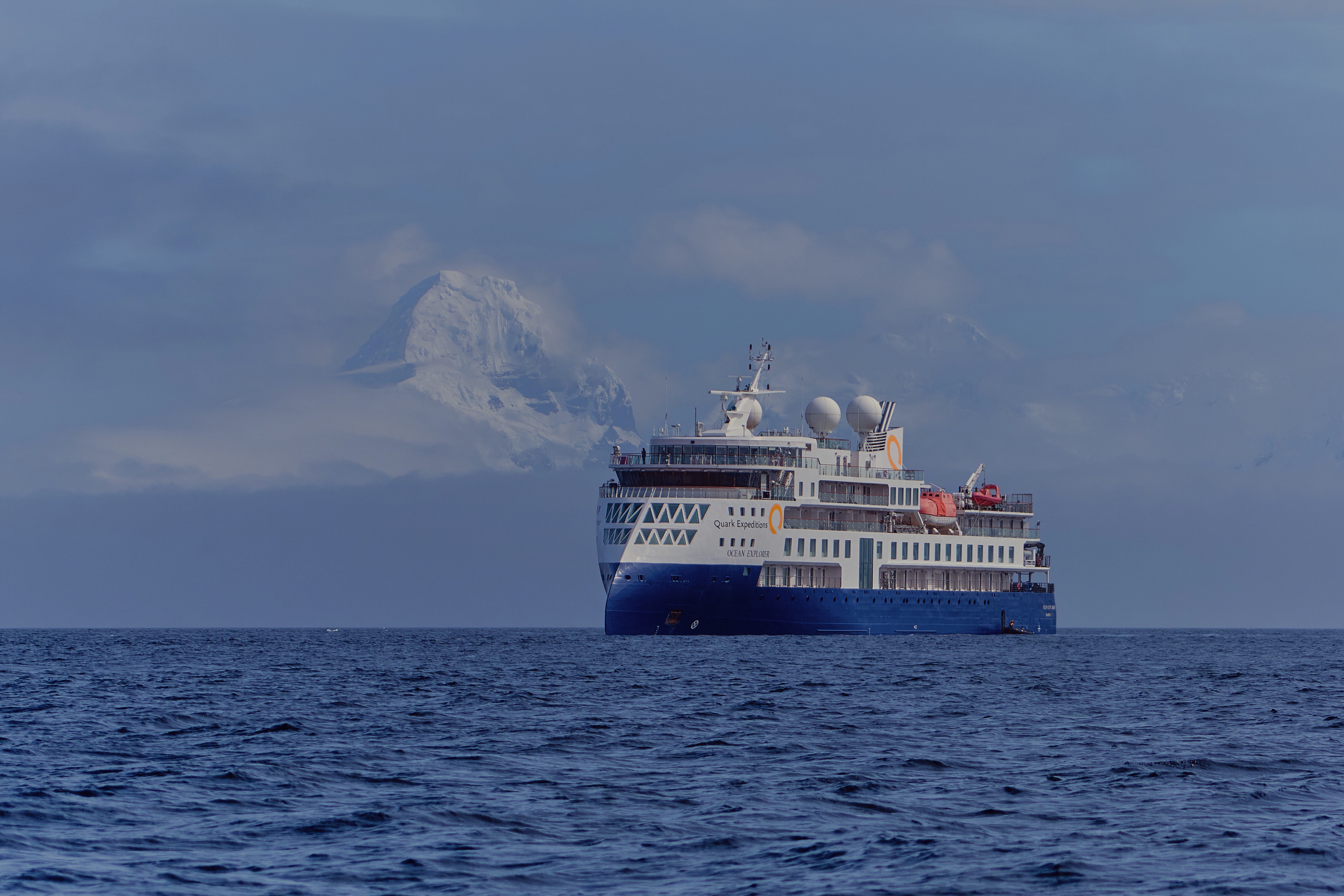
After breakfast, guests and their luggage will be transferred to the airport for the charter flight to Nuuk, the capital of Greenland. Upon arrival, guests will be transferred to their ship, Ocean Explorer.
Located just north of the Arctic Circle, Sisimiut is the northernmost town in Greenland where the port remains free of ice in the winter. Yet it is also the southernmost town where there is enough snow and ice to drive a dogsled in winter and spring. In Sisimiut, travelling by sled has been the primary means of winter transportation for centuries. In fact, the area has been inhabited for approximately 4,500 years. Modern Sisimiut is the largest business center in the north of Greenland, and is one of the fastest growing Greenlandic cities. Commercial fishing is the lead economy in the town‘s thriving industrial base.
Day programme:
Congratulations, you’ve crossed 66°33’ north latitude. On our first-off ship excursion in the Arctic, we’ll visit Sisimiut, a community rich with Greenlandic history and culture. As we approach via the inner harbor, you’ll spot locals coming and going from the marina, bringing halibut, shrimp and other seafood freshly harvested from Baffin Bay. Upon reaching shore, we’ll walk winding roads through this vibrant town dotted with colorful homes and Arctic cotton grass blooming under the summer sun. While the waterfront may be lively with boat traffic, life uphill moves at a relaxed, peaceful pace. You may hear children laughing, sled dogs barking, and locals exchanging greetings. Greenlandic dogs, often seen in kennels throughout town, reflect the deep bond between owners and their canine teams. As in any Arctic community, always ask before petting or approaching these working dogs. Today’s activities feature a locally guided town walk that includes admission to the museum, and a taste of local Greenlandic food. You will also be able to converse with locals who will be eager to learn about your part of the world. One scenic walk leads to the Taseralik Cultural House, beside Nalunnguarfiup Tasia, a small tranquil lake at the base of the 780-meter (2,550 feet) Nasaasaaq Mountain. You’ll walk the same paths locals use every day, experiencing not just the look of Sisimiut, but its rhythm, sounds and genuine sense of place. Guests can also book our Mountain Bike Adventure Option. Led by local partners, this biking tour includes the town harbor area as well as the tundra surrounding Sisimiut.
Day programme:
In September, Disko Bay is bathed in an ethereal autumn light—a phenomenon specific to the high latitudes. Giant icebergs drift with the currents, many of which can be seen in nearby Illulisat Icefjord, which was designated a UNESCO World Heritage Site in 2004 because of its outstanding natural beauty and its significance in understanding ice-cap glaciology. You’ll quickly realize that icebergs come in all shapes and sizes— some of them larger than Ocean Explorer. Disko Island shelters the expansive bay, where we hope to make landfall at or near the small community of Qeqertarsuaq. Colorfully painted homes dot the gentle rocky slopes of this quiet community, which moves at a pace set by the changing seasons, the tides, and the steady rhythm of small skiffs heading out from the harbor into the vast surrounding landscape. The sea horizon here feels endless. Icebergs drift past—some bound for Baffin Island, Labrador, or even Newfoundland—reminding us of our vast, interconnected world. From this point, we begin to leave behind the more populated regions of West Greenland and push farther northwards. Shortly after lunch, we set a course northward toward Ultima Thule—the extreme far north.
Day programme:
There’s a good chance you will wake up surrounded by icebergs and mountainous landscapes to the east. We continue our push north, arriving at the beautiful community of Upernavik around midday. Although much farther north than most Greenland communities, Upernavik is relatively large, with a population topping 1,000, most of whom live in brightly painted homes that climb the hillside from the sea. The signature quiet of the town amplifies the lap of waves on rock, barking sled dogs, children’s laughter, and the hum of ATVs. Down in the small harbor, you may see fishermen and hunters heading out or just returning from sea. Although Upernavik is an active harbor town, the pace is noticeably slower than in Sisimiut. There’s a deep connection to the sea and sea ice. Here, we’ll meet friendly, welcoming locals—proud of their home and local culture. We may visit the grave of Navarana, the wife of famous Arctic explorer Peter Freuchen, who was buried here in the 1920s. Navarana, a seasoned Arctic traveler, joined her husband and Knud Rasmussen on numerous expeditions, using her vast knowledge to guide them through the coastlines, ice, and cultures of northern Baffin Bay. We aim to leave Upernavik after dinner to continue our epic journey to the high north.
Day programme:
Today marks the northernmost point of our journey, in the region of Kap Alexander and Smith Sound—the famous narrow body of water separating Greenland and Canada by less than 55 kilometers (35 miles). On clear days, both coastlines may be visible from Smith Sound. This dynamic area is shaped by drifting sea ice from the Arctic Basin. Conditions vary daily—packed sea ice one day, open water the next. Your Expedition Team will navigate accordingly to make the most of our time in Kap Alexander. We may Zodiac cruise here, immersed in the remote, far-north landscapes—where drifting ice, resilient wildlife, and distant mountains of Greenland and Canada surround us. Shore landings may be possible in places few have ever set foot. In early September, migratory birds often gather, and other iconic Arctic species— polar bears, muskoxen, Arctic foxes, and belugas—are sometimes spotted. Wildlife is never guaranteed, but always worth watching for. Reaching this latitude is a rare privilege, and you’ll feel just how different it is here compared to regions 1,000 nautical miles to the south. While daylight hours still offer warmth by day and Northern Lights when darkness falls, you’ll sense the polar night approaching—ready to return and cloak this region in darkness for months. Here, time isn’t marked by conventional sunrises or weekdays, but by polar extremes. Take a moment to look north, deeper into Smith Sound, and let your imagination follow the Arctic wilderness as it stretches into the Arctic Basin and across the polar ice to Siberia. This is a place where nature—not the clock—sets the rhythm.
In AD 850, the Vikings established their parliament in Tórshavn, a name which translates as “Thor’s harbor.” It was named after Thor, the god of thunder and lightning in Norse mythology. The town became a center of trade for the island, and in fact was designated as the only legal place for the islanders to sell and buy products. This trade monopoly was abolished in 1856. Today it is the capital and largest city of the Faroe Islands, with fish-processing plants, a shipyard, and woolen products making up. It is considered to be one of the oldest capitals in Northern Europe.
Day programme:
Approaching Qaanaaq (home to fewer than 700 people) along Inglefield Fjord, near the entrance to Smith Sound, we’ll likely encounter large icebergs drifting or resting in the waters around town. The ship will navigate through this maze of ice to reach Greenland’s northernmost community—and the second northernmost town in the world (after Longyearbyen, Svalbard). But unlike Longyearbyen, which welcomes tens of thousands of visitors annually, Qaanaaq is far more remote and receives only a small fraction of that number. We’ll reach this community by Zodiac, arriving at the end of the pier where we’ll likely be greeted by smiling children— just as curious about us as we are about their High Arctic way of life. In town, you’re welcome to wander among the colorful homes, where you’ll meet friendly locals and see many working sled dogs. As mentioned above, always ask before petting these dogs, who spend much of their life out on the sea ice. In town, we urge you to visit Qaanaaq Katersugaasivia (Qaanaaq Museum), which showcases the ingenious tools of Inuit hunters—including collapsible barbed hooks crafted from ivory, bone and animal hide. Historic photographs offer a glimpse into life at these northern extremes, and the friendly museum staff are happy to answer questions. Locals may also share stories of life on the sea ice, where hunting and fishing remain vital to survival. The legacies of explorers like Knud Rasmussen, Robert Peary, and Peter Freuchen and his Greenlandic Inuit wife, Arctic guide Navarana, are also celebrated in this museum. For those keen to explore outdoors, short hikes above town may be possible, weather permitting, of course. Keep your camera ready to capture the sweeping views of endless landscapes and seascapes. While this itinerary includes several community visits, Qaanaaq often leaves the strongest impression in terms of its deep, ongoing relationship with the surrounding wilderness. Located hundreds of miles farther north than most settlements, Qaanaaq is difficult to reach by boat, helicopter or plane. As a result, the community continues to rely on traditional skills refined over centuries of adaptation to this high Arctic environment. Expect to see a mix of modern conveniences—as well as tried-and-true practices of past generations. For example, while skiffs with outboard motors are anchored off shore, you will also see traditional kayaks, propelled by hand-carved paddles, gliding through the water. As we sail south, many travelers leave with a deep appreciation for this remarkable, remote community— wishing they could stay just a little longer.
In the iceberg-laden waters surrounding the remote community of Uummannaq it is common to see whales. This area of Greenland is also known for its huge basalt mountains, and the small hunting and fishing village of Uummannaq rests at the foot of the heart-shaped Uummannaq Mountain, a name that translates to mean “in the shape of a seal’s heart”. The town of over 1200 people has a granite church and the country’s most northerly ferry terminal. The economy of Uummannaq revolves largely around the halibut/fish-processing factory.
Day programme:
We arrive in Uummannaq Fjord in the morning and cruise toward the community of Uummannaq, which, in Greenlandic, translates to “heartshaped,” inspired by the dramatic mountain that rises above the town. Visiting this remote community is a rare privilege. We reach town by Zodiac and may be greeted by locals—and the eversmiling chief of police. It’s been said that smiles in Uummannaq are as common as drifting icebergs. Winding roads take you past colorful homes before reaching a meadow of turf houses and a stone church. You can visit the local museum and artisan market for a glimpse of life in northern Greenland. Another nearby museum honors artist Rockwell Kent, who was inspired by the landscapes of Uummannaq Fjord and Disko Bay. You may choose to join a guided walk or explore on your own. Several homes may open for kaffemik—a social gathering with warm drinks, light snacks, and a chance for locals and visitors to connect. Rest assured, the people of Uummannaq will be curious about your part of the world. Shy smiles and translated conversations are natural parts of these authentic cultural exchanges—and often become some of the most memorable moments of your time in this remote Greenlandic community. A parting gift from one local fisherman: “Keep life simple—simple is beautiful.”
Day programme:
Today we’ll explore the northern regions of Disko Bay, possibly including the Eqi Glacier—known locally as Eqip Sermia. This tidewater glacier is a highlight for many reasons. Its wide glacial face makes it one of Greenland’s most active glaciers, regularly calving ice into the sea. You’ll likely see icebergs drifting in the bay, along with smaller pieces called brash ice. On quiet days, you can hear the ice popping and crackling—and if you’re lucky, the thunderous rumble of the calving glacier. Though the glacier is the main attraction, the surrounding landscapes make for interesting shore excursions. Whether you prefer a slow walk among the tundra, taking in autumn vegetation and sweeping views, or a more vigorous hike for elevated glacial vistas, the terrain suits all levels. Underfoot, expect a mix of rock and vegetation, and we’ll tread carefully to protect the fragile plant life that thrives during the brief Arctic summer.
Known as the birthplace of icebergs, the Ilulissat Icefjord produces nearly 20 million tons of ice each day. In fact, the word Ilulissat means “icebergs” in the Kalaallisut language. The town of Ilulissat is known for its long periods of calm and settled weather, but the climate tends to be cold due to its proximity to the fjord. Approximately 4,500 people live in Ilulissat, the third-largest town in Greenland after Nuuk and Sisimiut. Some people here estimate that there are nearly as many sled dogs as human beings living in the town that also boasts a local history museum located in the former home of Greenlandic folk hero and famed polar explorer Knud Rasmussen.
Day programme:
Ilulissat, located in Disko Bay, is home to the UNESCO World Heritage Site of Ilulissat Icefjord, which serves as the thoroughfare for countless icebergs calved from the world’s fastest-moving glacier, Sermeq Kujalleq. A small boardwalk leads to an elevated overlook, where you can view bergs of all sizes spread out before you. The overlook, a rocky outcropping, gives the feeling of standing at the edge of town and the beginning of a vast wilderness. Looking out over the ice evokes a humbling sense of scale. As you explore, notice the Arctic cotton grass and summer wildflowers thriving in theslong daylight hours. The inner harbor often holds evidence of the icefjord’s reach, with drifting icebergs mingling among fishing boats and skiffs. The town itself is well worth exploring, and has become one of Greenland’s top destinations. Recent years have brought growth— colorful homes now sit beside new restaurants, boutique hotels and small businesses. History buffs will be excited to know Ilulissat is the birthplace of Arctic explorer Knud Rasmussen, who traveled by dog sled from Greenland to Alaska (and briefly Siberia) during the Fifth Thule Expedition (1921–1924). Fluent in Kalaallisut, he moved slowly, learning from and documenting the Circumpolar Inuit he met—considered one of the Arctic’s greatest expeditions. The dramatic landscapes around Ilulissat inspired Rasmussen’s life of exploration. And as we approach town, watch out for whales, which occasionally frequent the iceberg-laden waters.
Itilleq is an idyllic little village located on a small island about ahalf a mile off the west coast of Greenland, and only about a mile north of theArctic Circle. It is one of the most picturesque villages in Greenland with itsquaint colorful houses surrounded by stunning rugged mountains and glaciers.Originally, the village of Itilleq was founded on another island in 1847, butwas later moved to its present location. The 100 people living here todaysurvive mainly on hunting and fishing, with a fish factory being the mainemployer.
Day programme:
The small settlement of Itilleq is a favorite among guests and Expedition Team members, thanks to the warm welcome we’ve received over the years. When it comes to community charm, Itilleq stands out. Approximately 100 residents live among brightly painted homes—greens, pinks, purples, baby blues, mustard yellows, and chocolate browns. Many people earn their living at sea, as evidenced by the small seafood processing building near the pier. Despite its size, the village is full of life, from respected elders to playful children. You may be invited to a kaffemik (where people socialize over coffee and cake), or follow a short dirt road to a viewpoint near the cemetery. The view into the f jord and surrounding mountains is worth the walk. Watch your step— lichens, succulents, and mushrooms thrive underfoot. A longstanding tradition is a friendly football (soccer) match with locals, including guests, staff, crew, and residents. It’s a fun, memorable experience—whether you’re on the f ield or cheering from the sidelines.
The name Kangerlussuaq means “Big Fjord” in the local Kalaallisut language. The settlement of about 500 people is located in western Greenland on flat land at the head of a fjord with the same name. Kangerlussuaq is the site of Greenland’s largest commercial airport and most of the economy here is dependent on the air transportation hub and tourism. The rugged lands around the settlement support terrestrial Arctic fauna including muskoxen, caribou, and Gyrfalcons.
Day programme:
Today, we disembark in Kangerlussuaq, formerly known as Søndre Strømfjord, and transfer you to your charter flight to Reykjavik, where you’ll spend the night in your included hotel, both of which are included in your Charter Flight & Hotel Package.
Sprawling Reykjavík, the nation’s nerve center and government seat, is home to half the island’s population. On a bay overlooked by proud Mt. Esja (pronounced eh-shyuh), with its ever-changing hues, Reykjavík presents a colorful sight, its concrete houses painted in light colors and topped by vibrant red, blue, and green roofs. In contrast to the almost treeless countryside, Reykjavík has many tall, native birches, rowans, and willows, as well as imported aspen, pines, and spruces.Reykjavík’s name comes from the Icelandic words for smoke, reykur, and bay, vík. In AD 874, Norseman Ingólfur Arnarson saw Iceland rising out of the misty sea and came ashore at a bay eerily shrouded with plumes of steam from nearby hot springs. Today most of the houses in Reykjavík are heated by near-boiling water from the hot springs. Natural heating avoids air pollution; there’s no smoke around. You may notice, however, that the hot water brings a slight sulfur smell to the bathroom.Prices are easily on a par with other major European cities. A practical option is to purchase a Reykjavík City Card at the Tourist Information Center or at the Reykjavík Youth Hostel. This card permits unlimited bus usage and admission to any of the city’s seven pools, the Family Park and Zoo, and city museums. The cards are valid for one (ISK 3,300), two (ISK 4,400), or three days (ISK 4,900), and they pay for themselves after three or four uses a day. Even lacking the City Card, paying admission (ISK 500, or ISK 250 for seniors and people with disabilities) to one of the city art museums (Hafnarhús, Kjarvalsstaðir, or Ásmundarsafn) gets you free same-day admission to the other two.
Day programme:
Today, after breakfast, make your way independently to the airport for your f light home, or continue your personal travel plans as prearranged.
Ship features
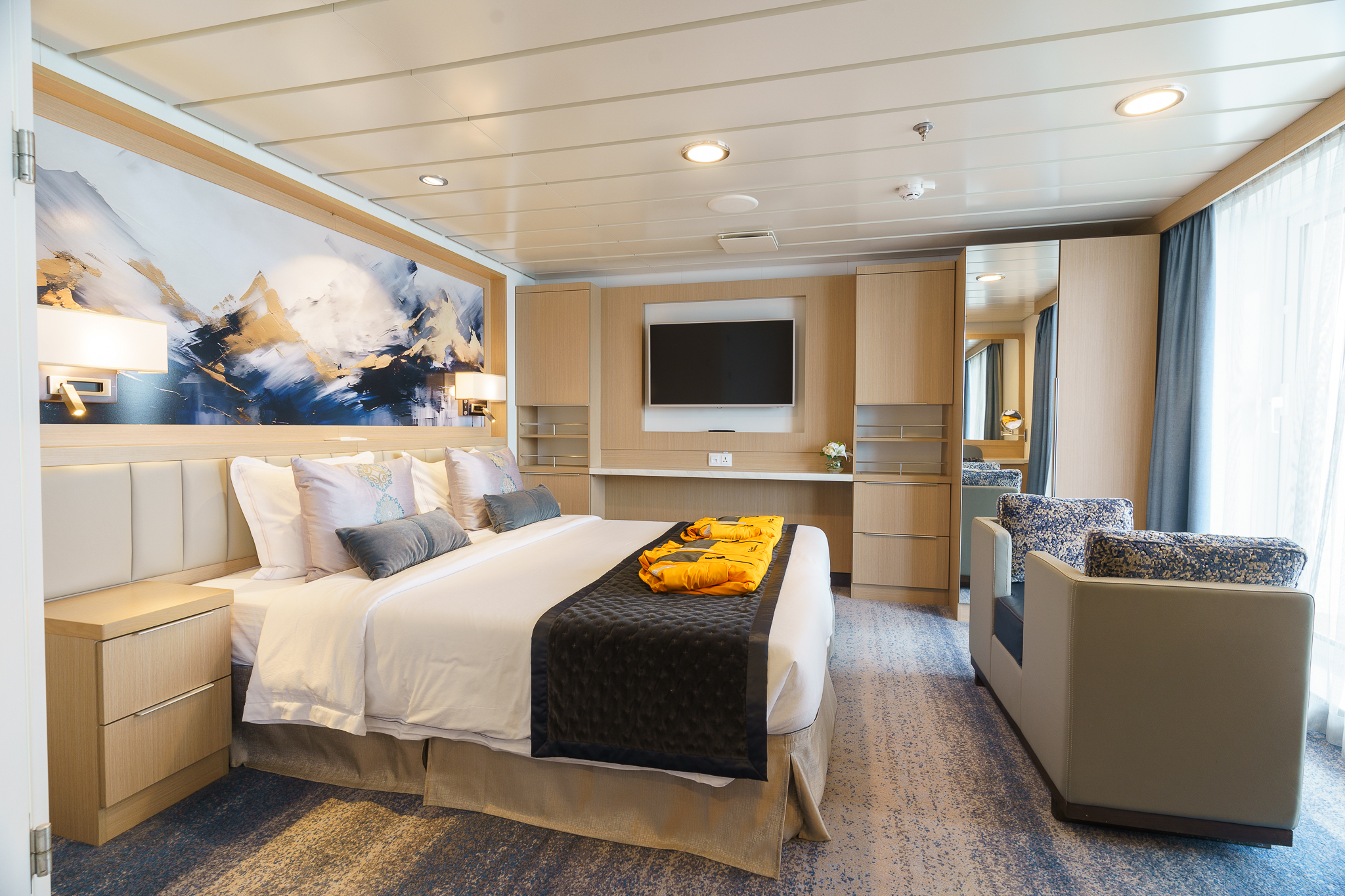
Owners Suite
This palatial, airy apartment offers stunning views from its large private veranda on the highest cabin level. The luxurious suite features a large master bedroom, living room and dining area and two large master bathrooms, among other amenities.
Bed Config.
Two rooms. One double bed made up of two twin berths fold out sofa bed
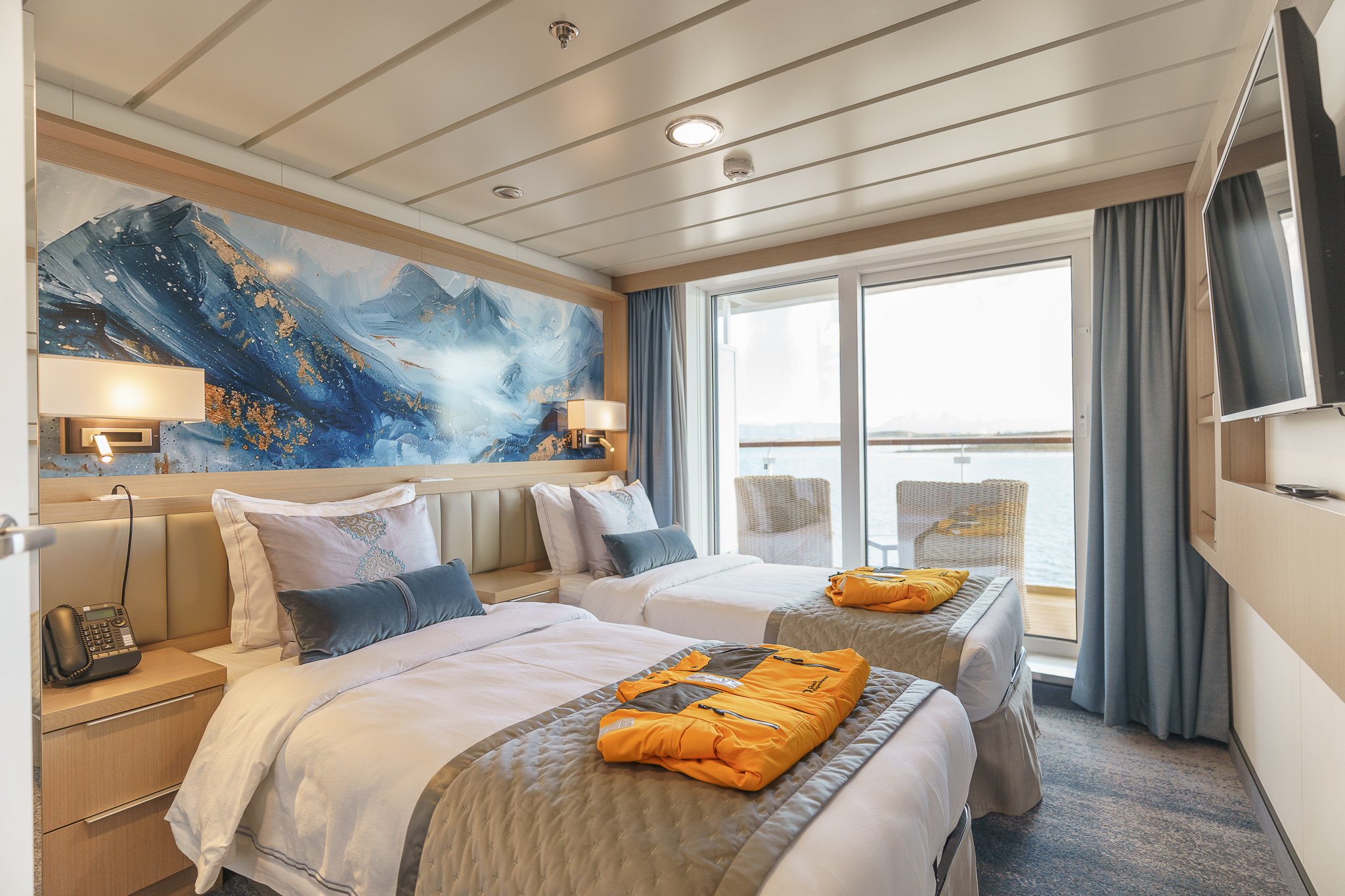
Junior Suite
Located on Deck 6 and approximately 298 sq. f. (27.7 sq. m,) in size. These 2-room suites have one double bed that can be configured into two singles in the inner bedroom and an outer sitting room furnished with a sofa-bed, and activity table for two. From the bedroom there a floor to ceiling glass view that opens to a double sized walkout balcony. There are also 2 TV’s, state of the art ‘infotainment’ system and private bathroom with bathtub, vanity and heated floor.
Bed Config.
Two rooms. One double bed made up of two twin berths fold out sofa bed
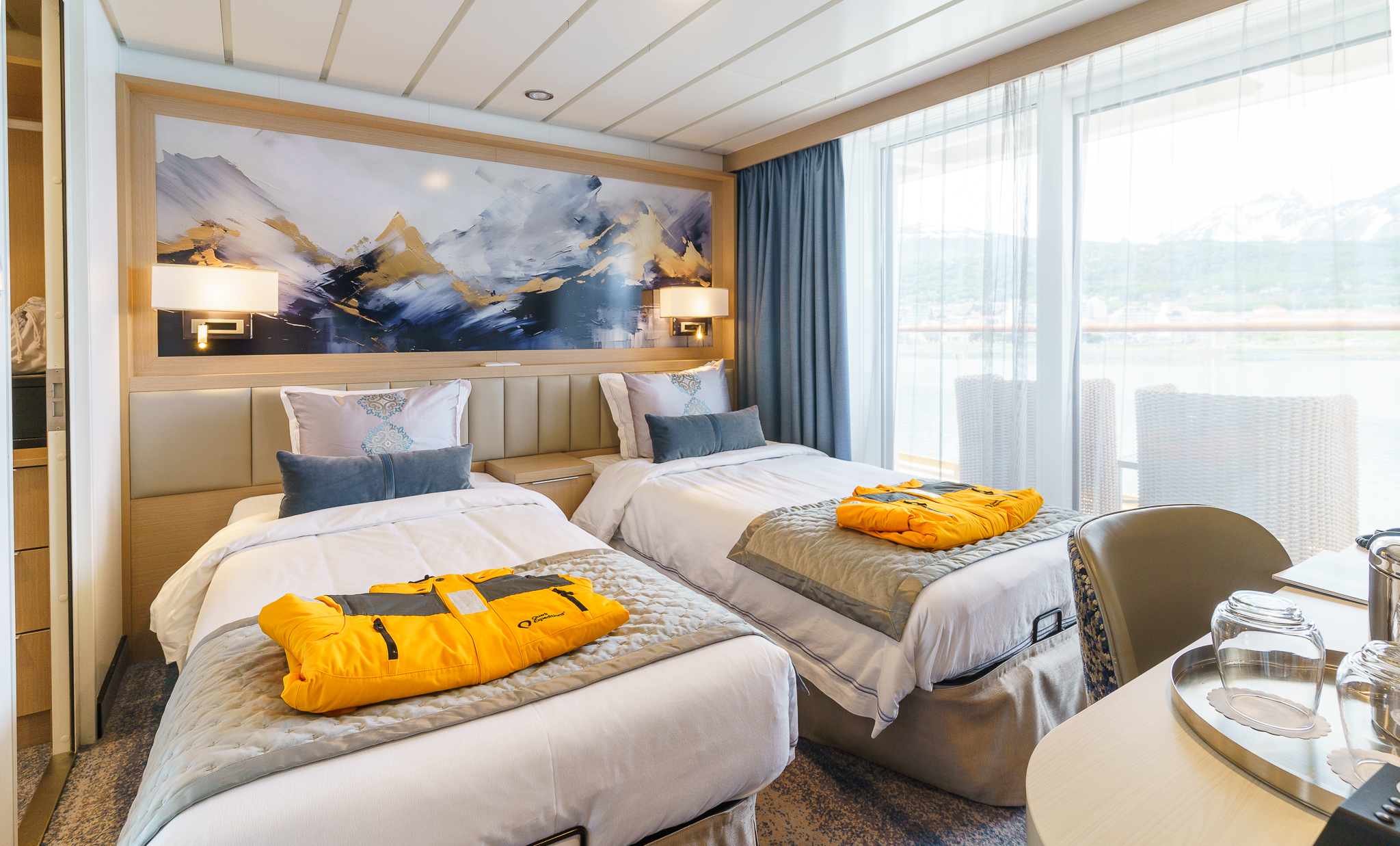
Penthouse Suite
This unique 2-room suite is located on Deck 7 and is approximately 269 sq. f (25.0 sq. m.) in size. It has one double bed that can be configured into two singles in the inner bedroom.and the outer sitting area is furnished with a sofa-bed. Walk-out from either room to a double sized balcony . There are also 2 TV’s, state of the art ‘infotainment’ system and private bathroom with shower, vanity and heated floor. And an additional powder room in the outside sitting area.
Bed Config.
Two rooms. One double bed made up of two twin berths fold out sofa bed
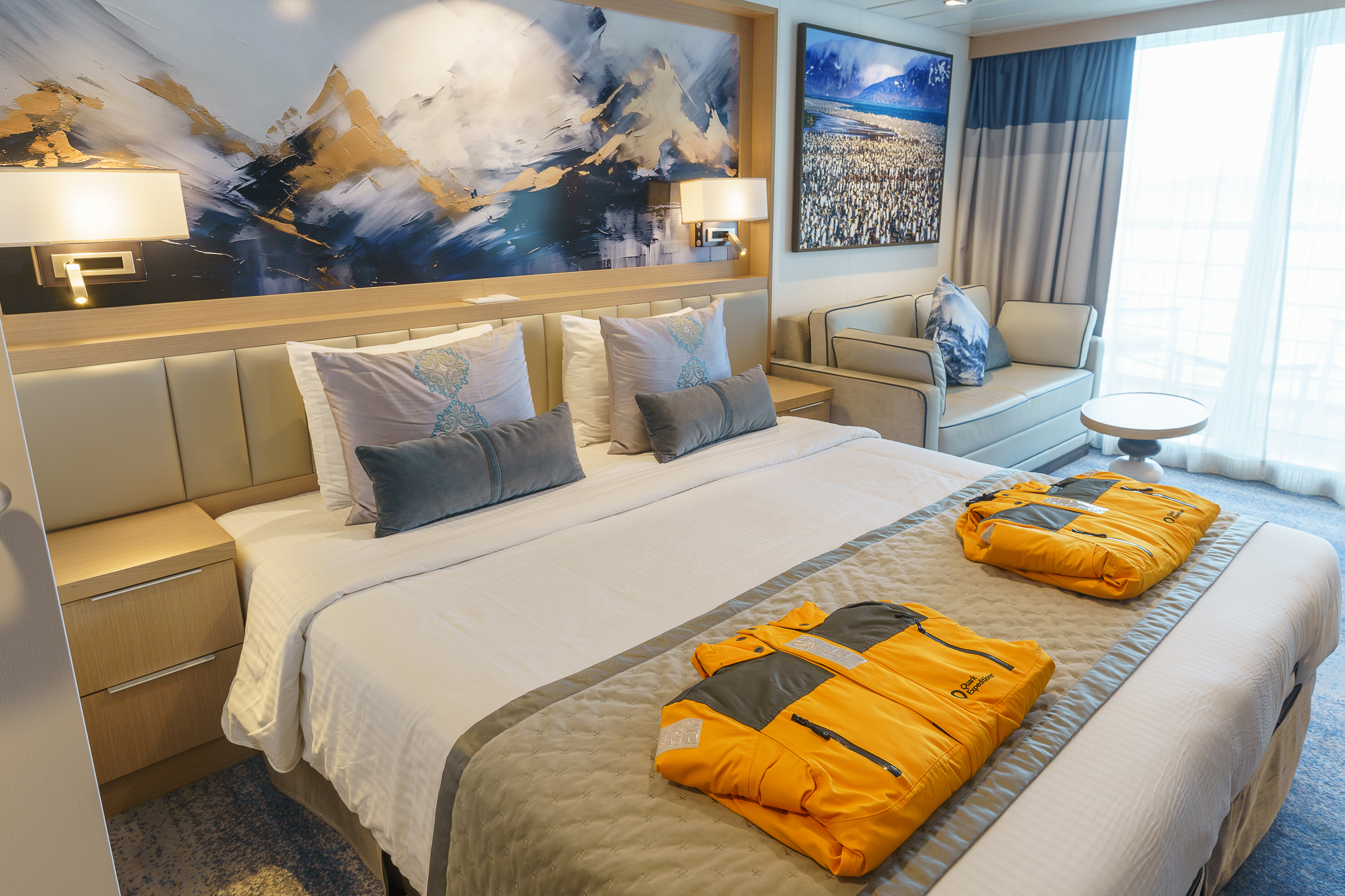
Veranda Suite
Located throughout the ship and approximately 205 sq. ft. (19.2 sq. m,) in size, these cabins have one double bed that can be configured into two singles, and seperate sitting area furnished with a sofa-bed. There is a floor to ceiling glass view that opens to a walkout balcony. There is also a desk and chair, TV, state of the art ‘infotainment’ system and private bathroom with shower, vanity and heated floor.
Bed Config.
One double bed made up of two twin berths and fold out sofa bed
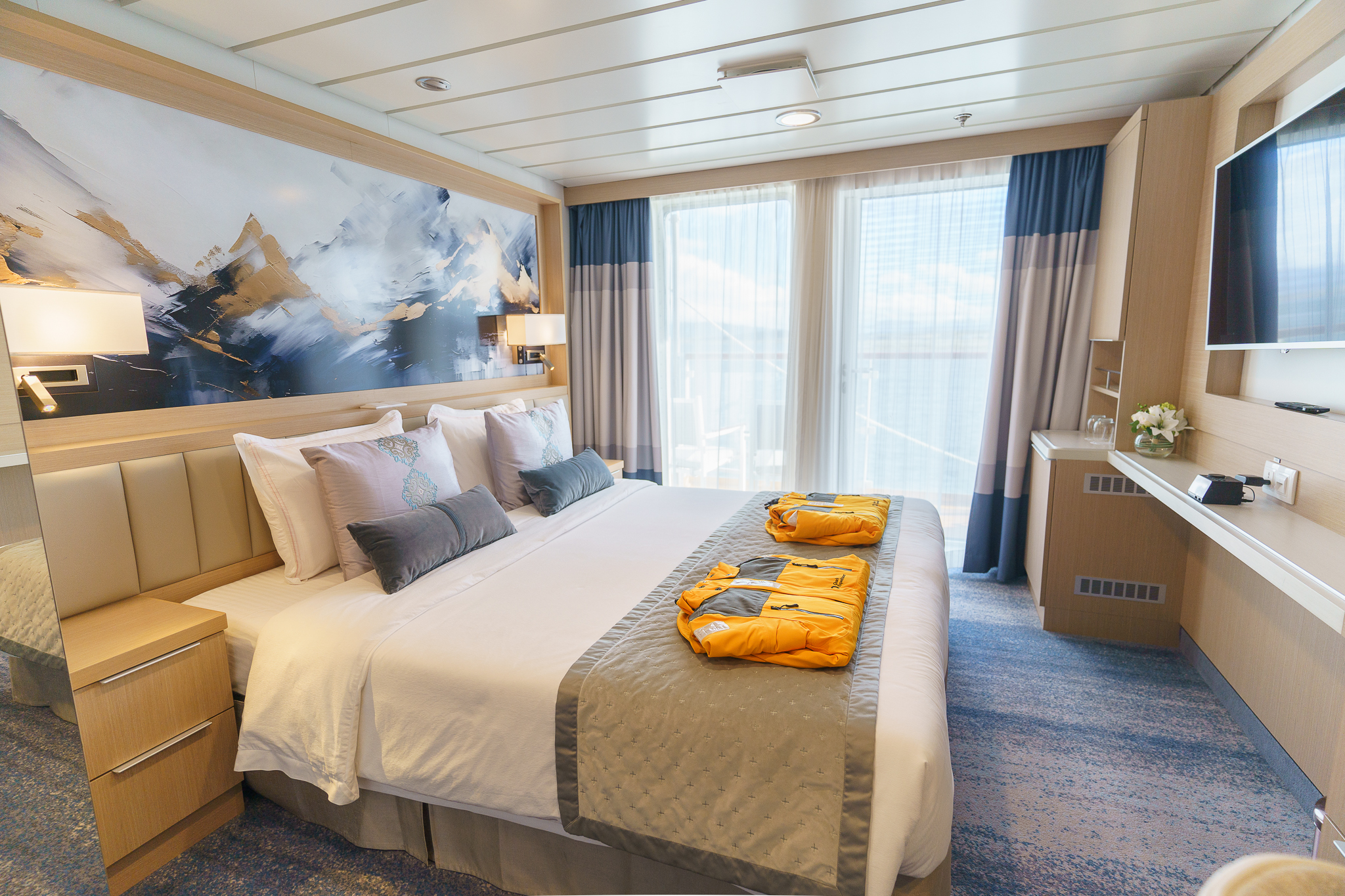
Veranda Stateroom
Located throughout the ship and approximately 208 sq. f. (19.3 sq. m,) in size, these cabins have one double bed that can be configured into two singles, and seperate sitting area furnished with two club chairs and a reading table. There is a floor to ceiling glass view that opens to a walkout balcony. There is also a desk and chair, TV, state of the art ‘infotainment’ system and private bathroom with shower, vanity and heated floor. Note: 611 and 612 do not have the club chairs and a reading table.
Bed Config.
One double bed made up of two twin berths
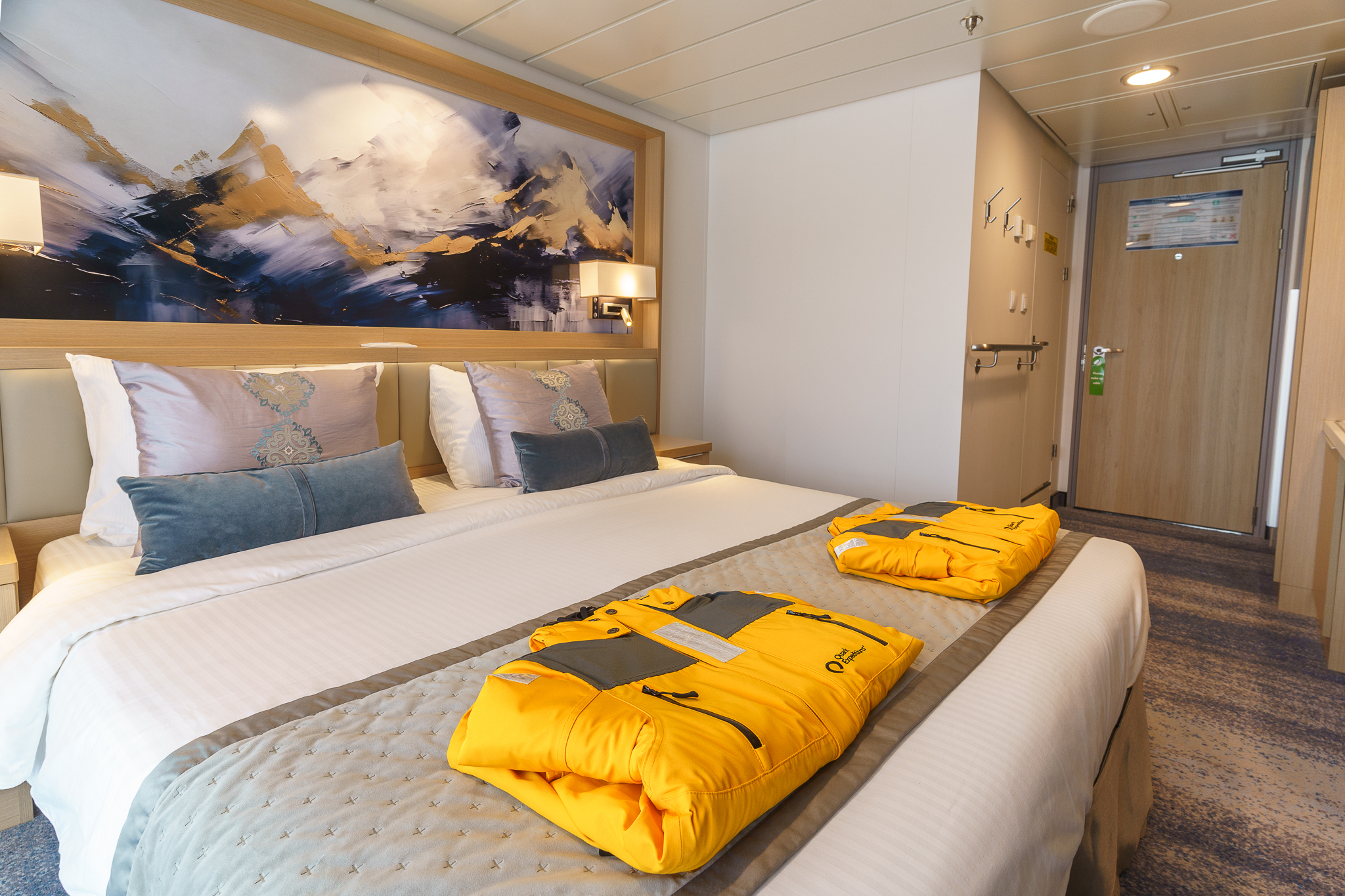
Deluxe Veranda Forward
Located on Deck 4 and approximately 182 sq. f. (16.9 sq. m,) in size, these cabins have one double bed that can be configured into two singles. There is a floor to ceiling glass view that opens to a walkout balcony. There is also a desk and chair, TV, state of the art ‘infotainment’ system and private bathroom with shower, vanity and heated floor.
Bed Config.
One double bed made up of two twin berths
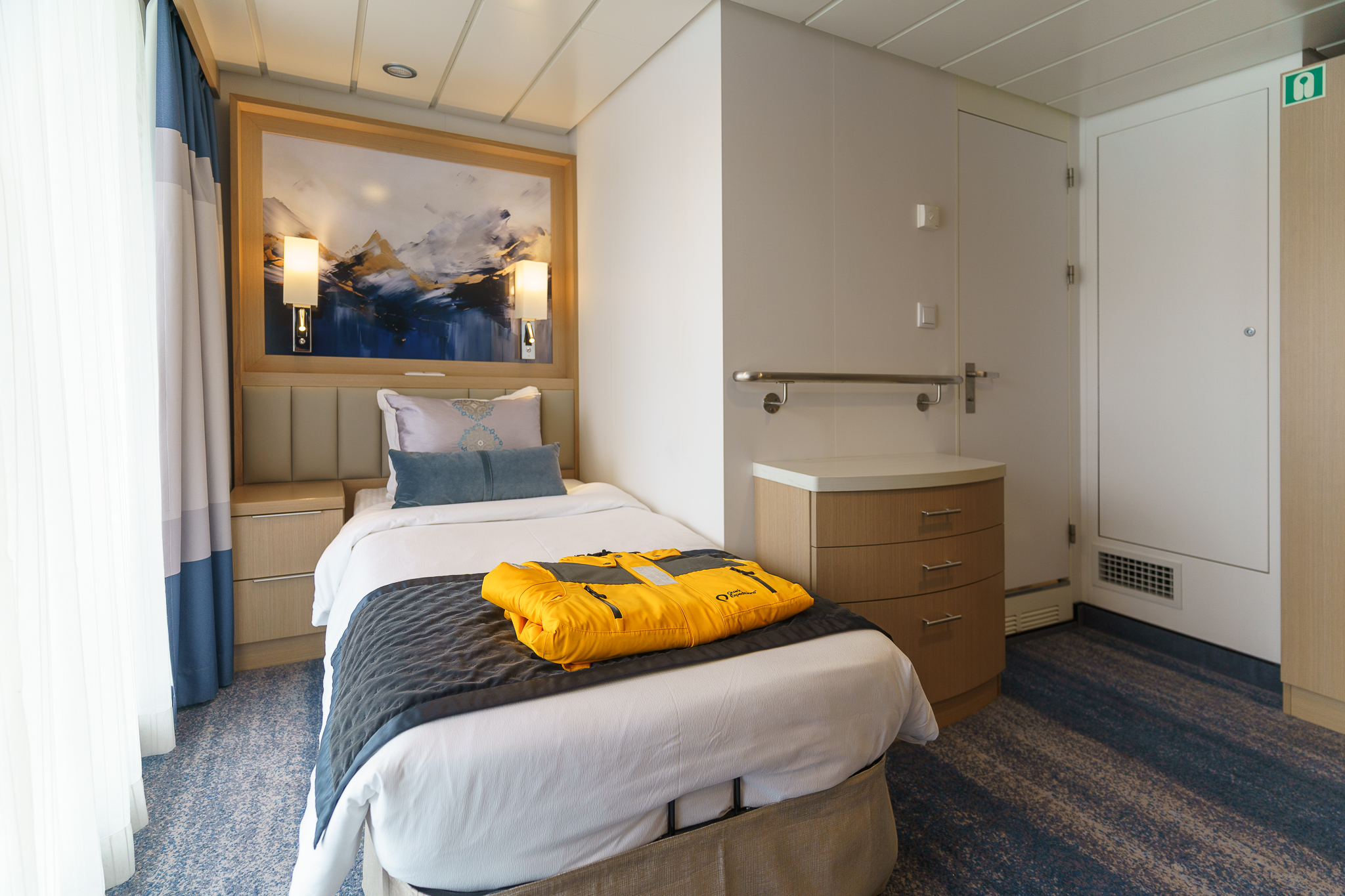
Studio Veranda Single
Designed for one. This unique cabin is located on Deck 7 and approximately 162 sq. f. (15.1 sq. m.). It has one twin bed with a floor to ceiling glass view that opens to a generous walkout balcony. There is also TV, state of the art ‘infotainment’ system and private bathroom with shower, vanity and heated floor.
Bed Config.
One twin single

Studio Single
Designed for one. These cabins are located on Deck 3 and approximately 166 sq. ft. (15,4 sq. m,) in size, with one double bed and a porthole view. There is also a desk and chair, TV, state of the art ‘infotainment’ system and private bathroom with shower, vanity and heated floor.
Bed Config.
One double bed made up of two twin berths
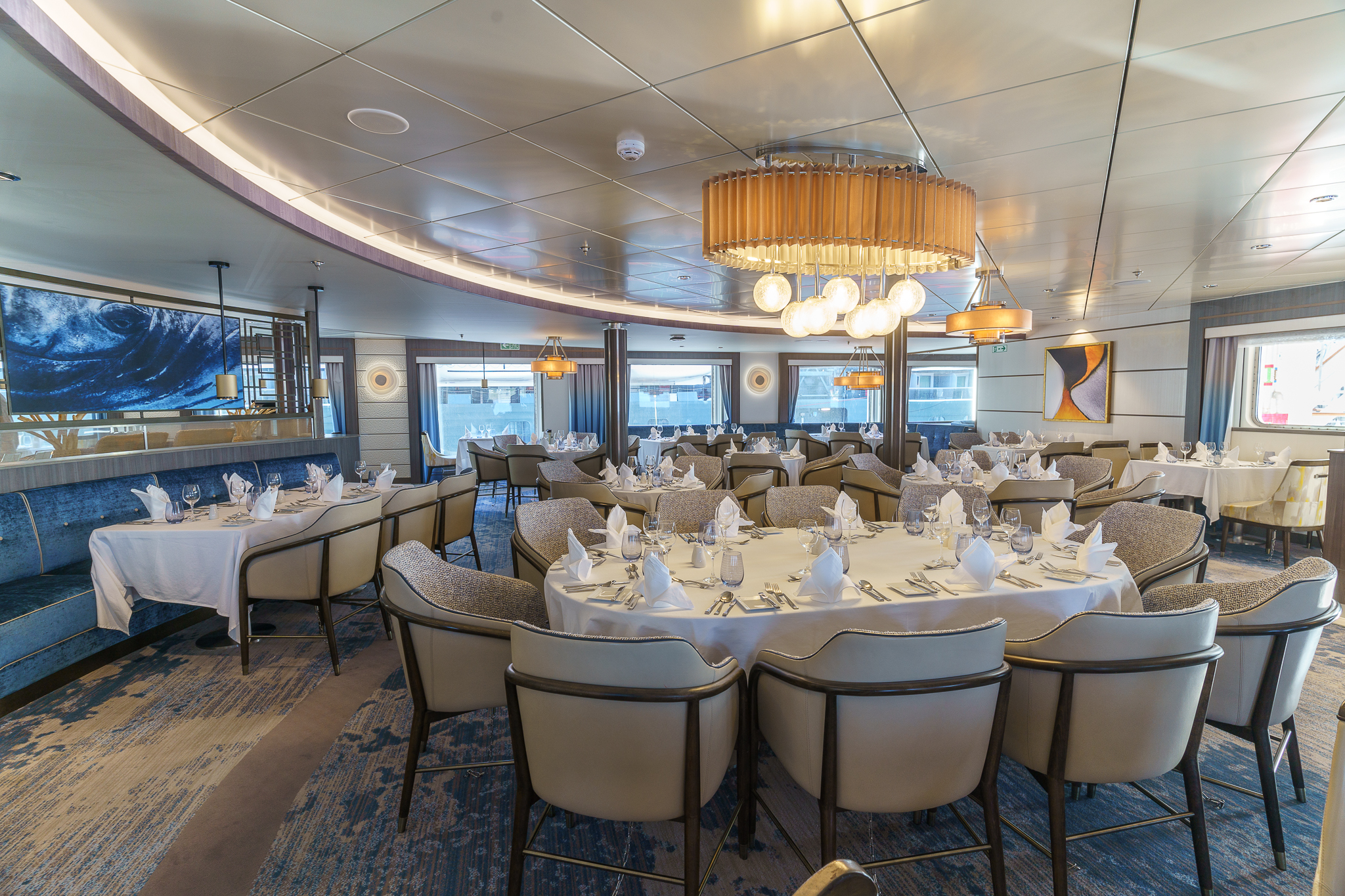
Main Dining Room
Contemporary meets cozy in this modern dining room with its stylish lighting and contemporary art. Located on Deck 5, the Main Dining Room seats 144 guests, and features expansive floor-to-ceiling windows that open onto the spectacular polar wilderness.
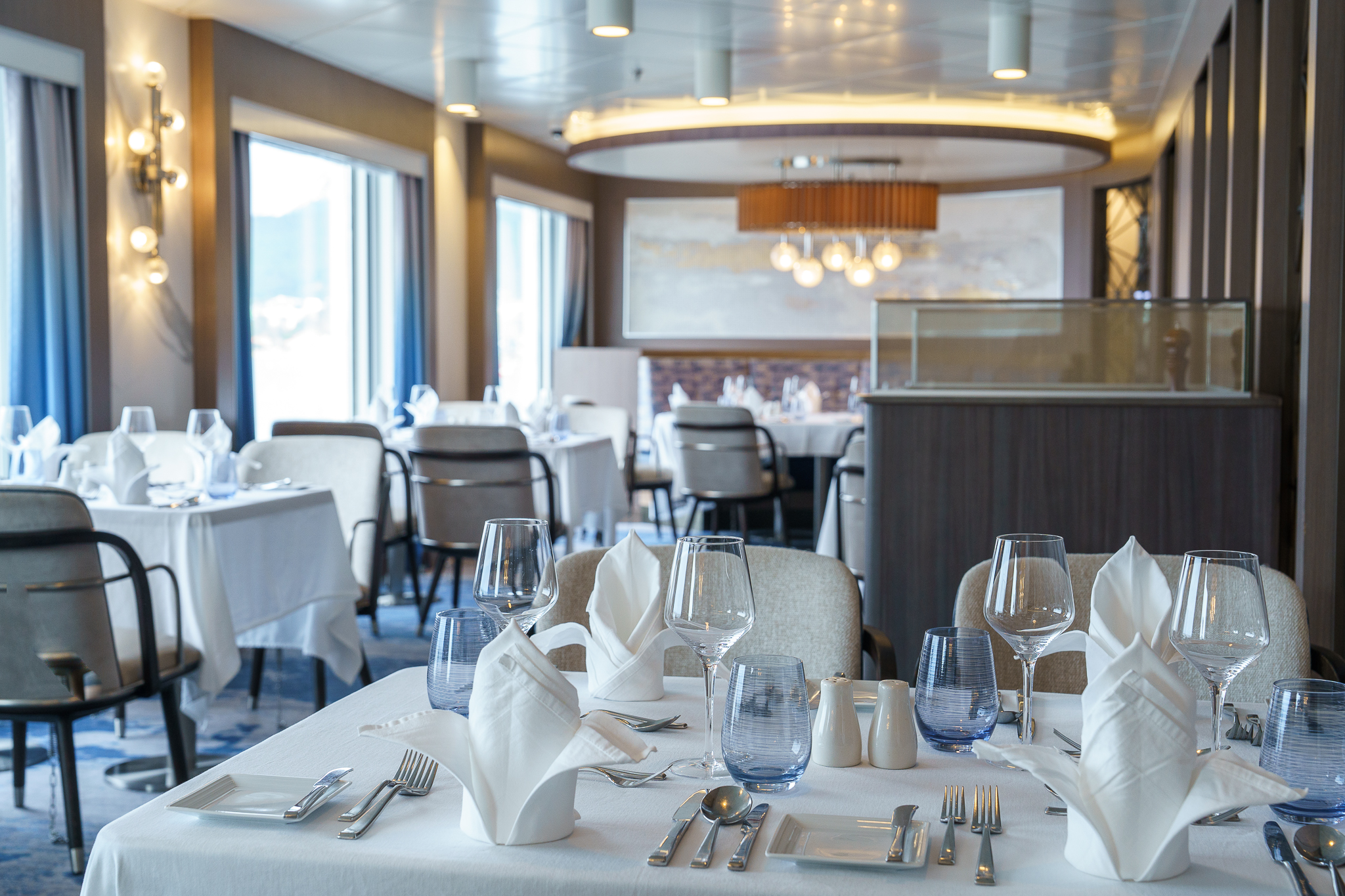
Private Dining Room
Tasteful and intimate. This stylish, private dining room on deck 5 provides a relaxed dining experience—with views of the polar landscape—for up to 36 guests.
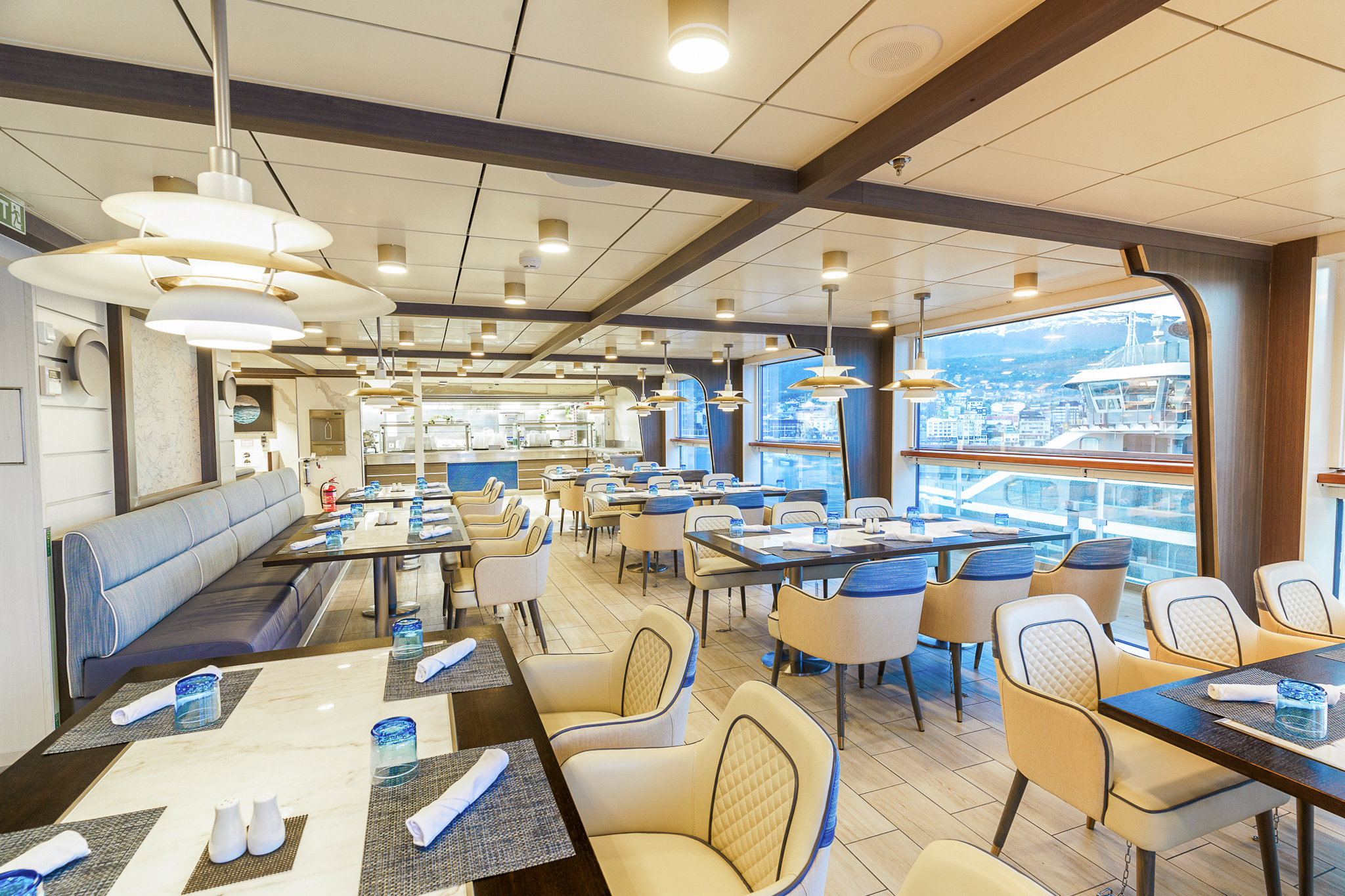
Observation Bistro
With its marine blue and off-white colors—is your go-to spot for lighter fare and graband-go snacks. This relaxed eatery seats up to 44 guests, who can take in full views of their polar surroundings and wildlife while enjoying a light bite.

Off-Ship Adventures
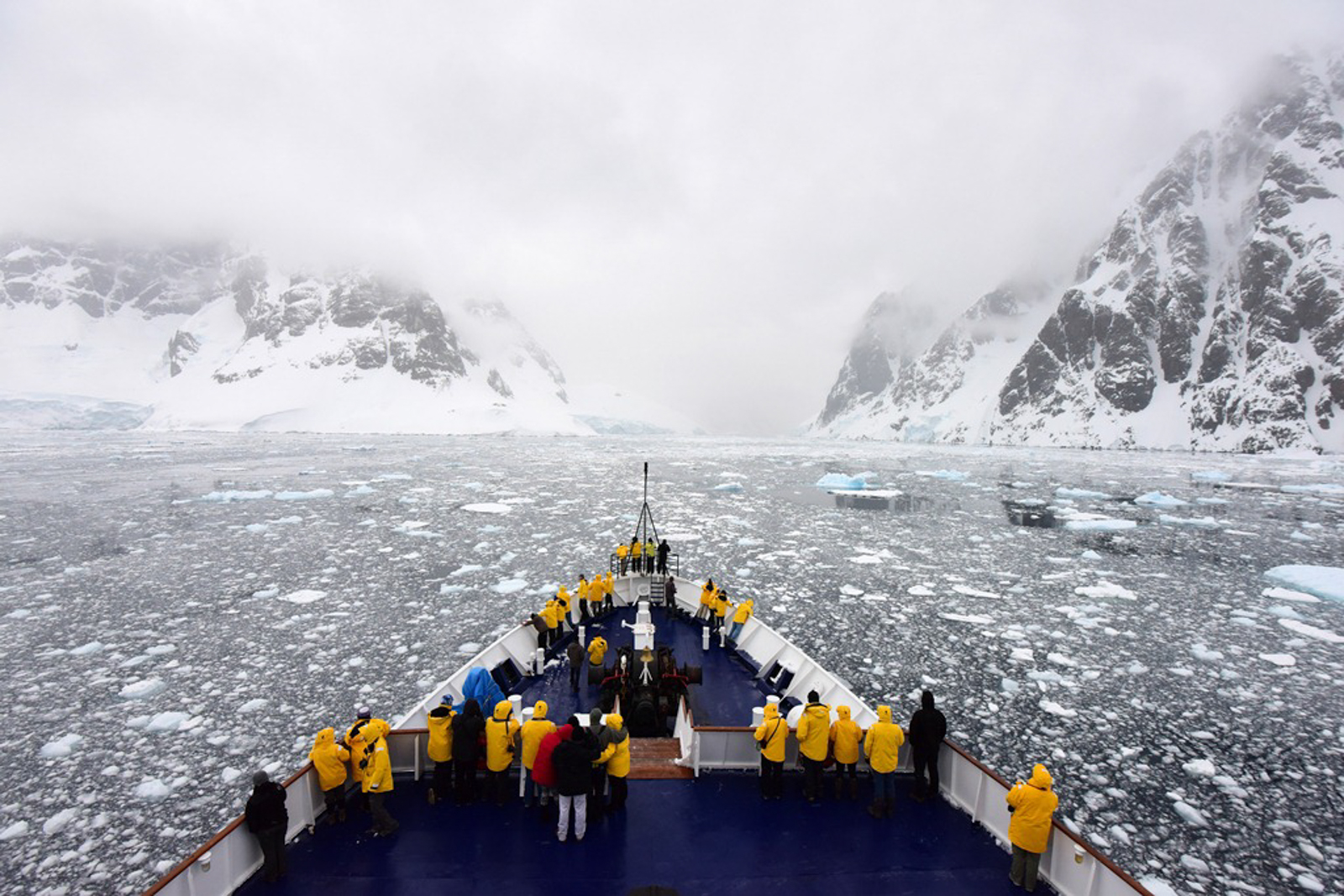
With four separate sea-level embarkation points and a fleet of 15 Zodiacs, Ocean Explorer offers a comprehensive breadth of off-ship activities including Zodiac cruising and paddling, allowing you to intimately connect with the polar wilderness.

Expedition Team
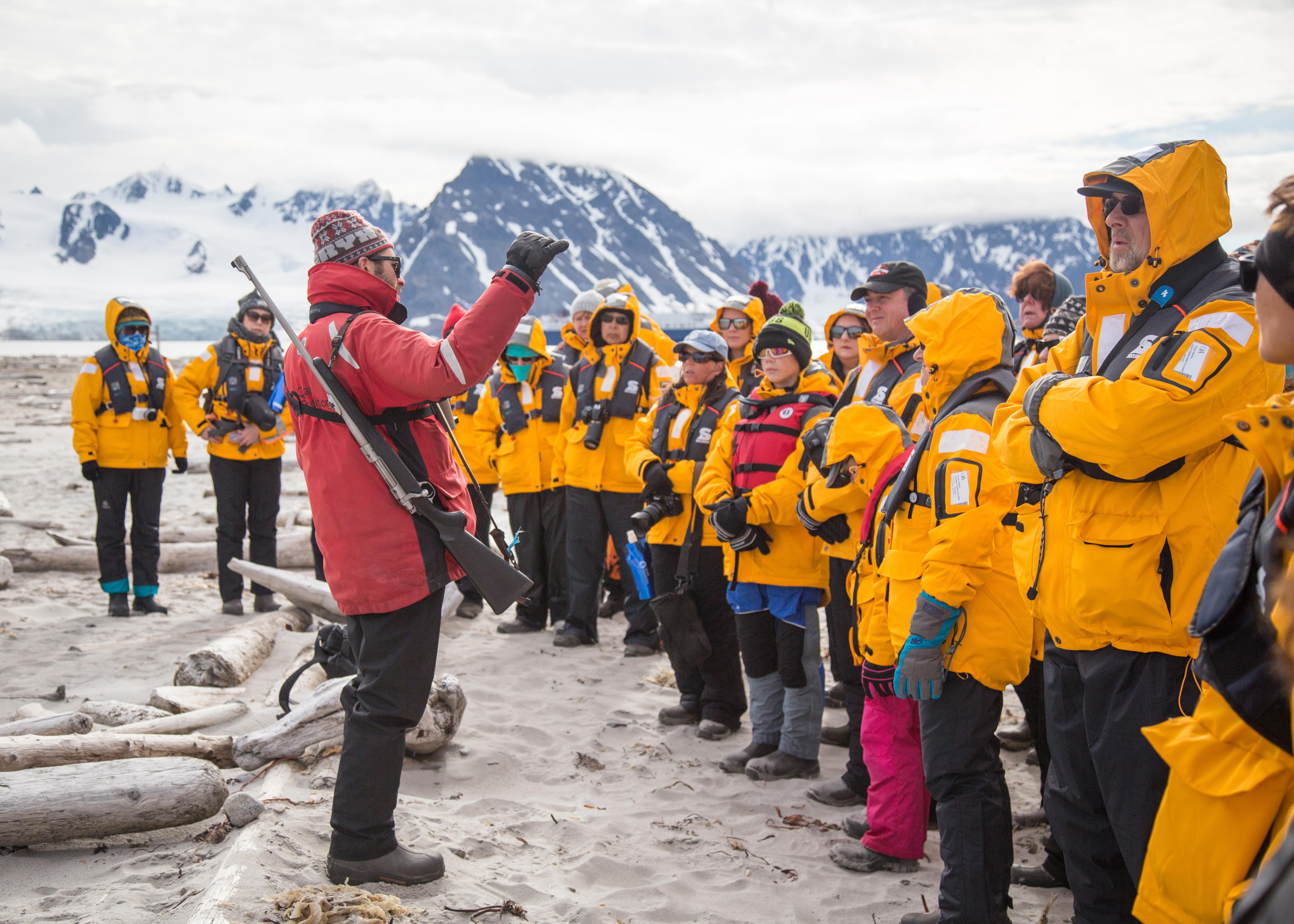
The perfect polar expedition doesn’t just happen. It takes a team of talented, knowledgeable and experienced professionals to bring it all together. Our Expedition Team is comprised of seasoned veterans with rich backgrounds in marine biology, history, glaciology, geology and more. With the highest staff-to-guest ratio in the industry, our Expedition Teams safely deliver your trip-of-a-lifetime to maximize your polar adventure every step of the way.

Zodiac Cruising
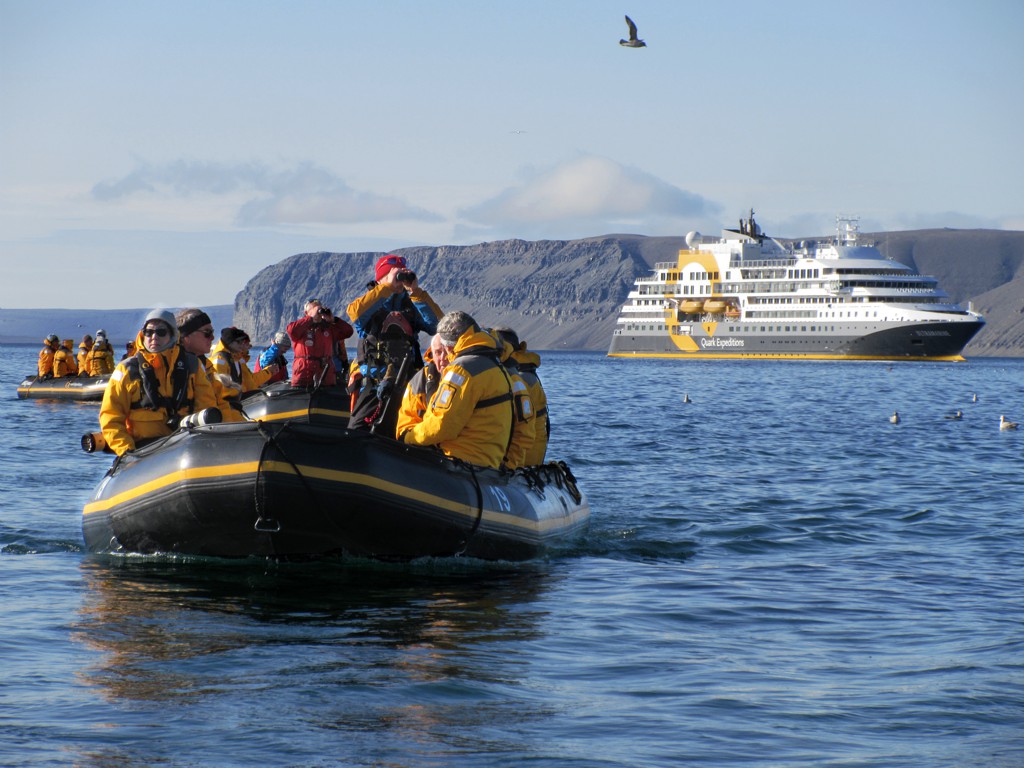
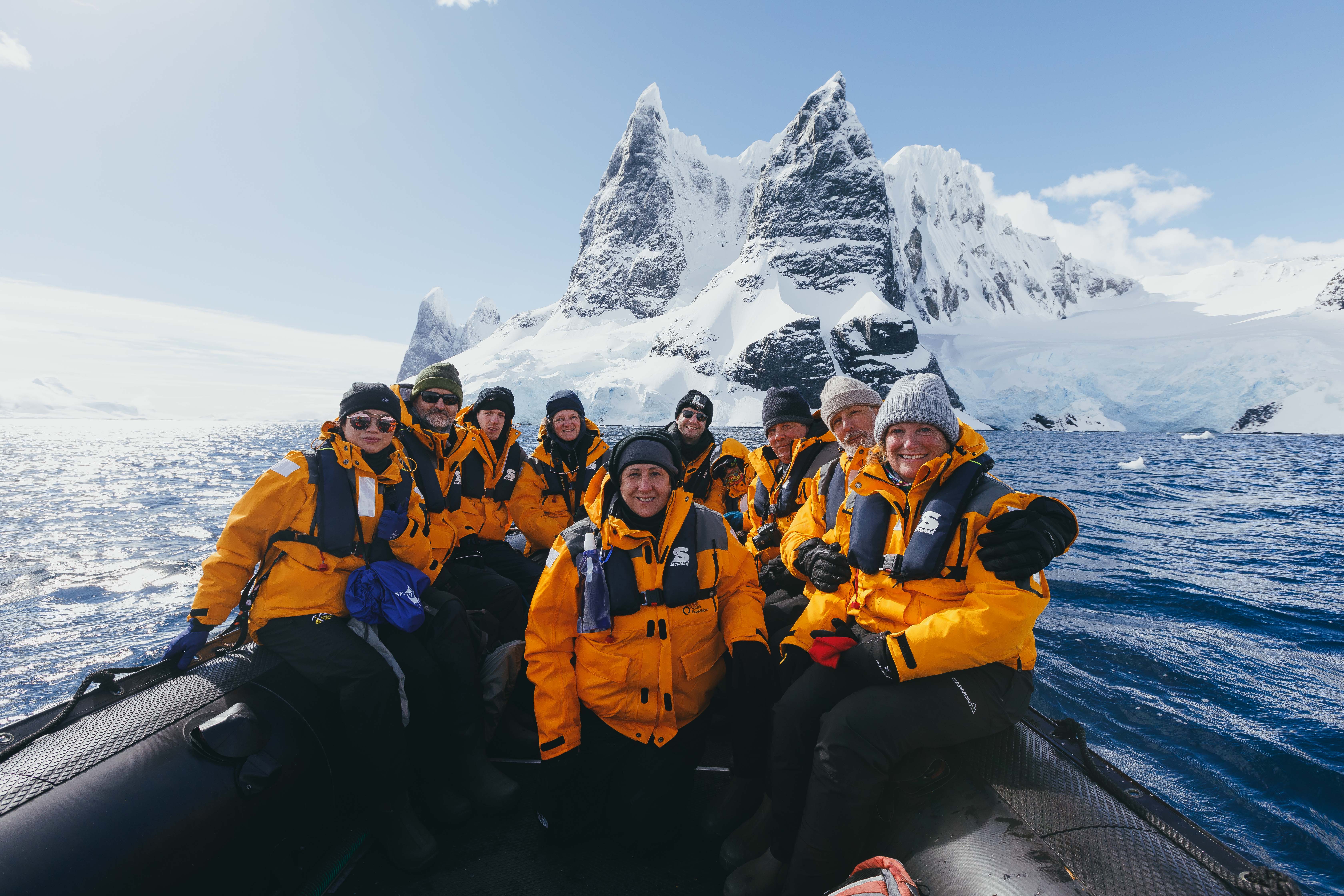
Zodiacs are used for transferring you ashore, transporting your luggage when necessary and for taking you ocean-level cruising among icebergs, whales and seabirds. During the expedition, you will visit remote and isolated sites that are accessible only by Zodiac.
These large, heavy-duty inflatable vessels are extremely safe and were specially designed for expedition work. Zodiacs are the workhorses of Polar expeditions. Separate air compartments retain a large reserve of buoyancy even if these sturdy boats are damaged. Their flat bottom design permits the craft to land directly onto the cobble and ice-strewn beaches that you will encounter on your Polar expedition.
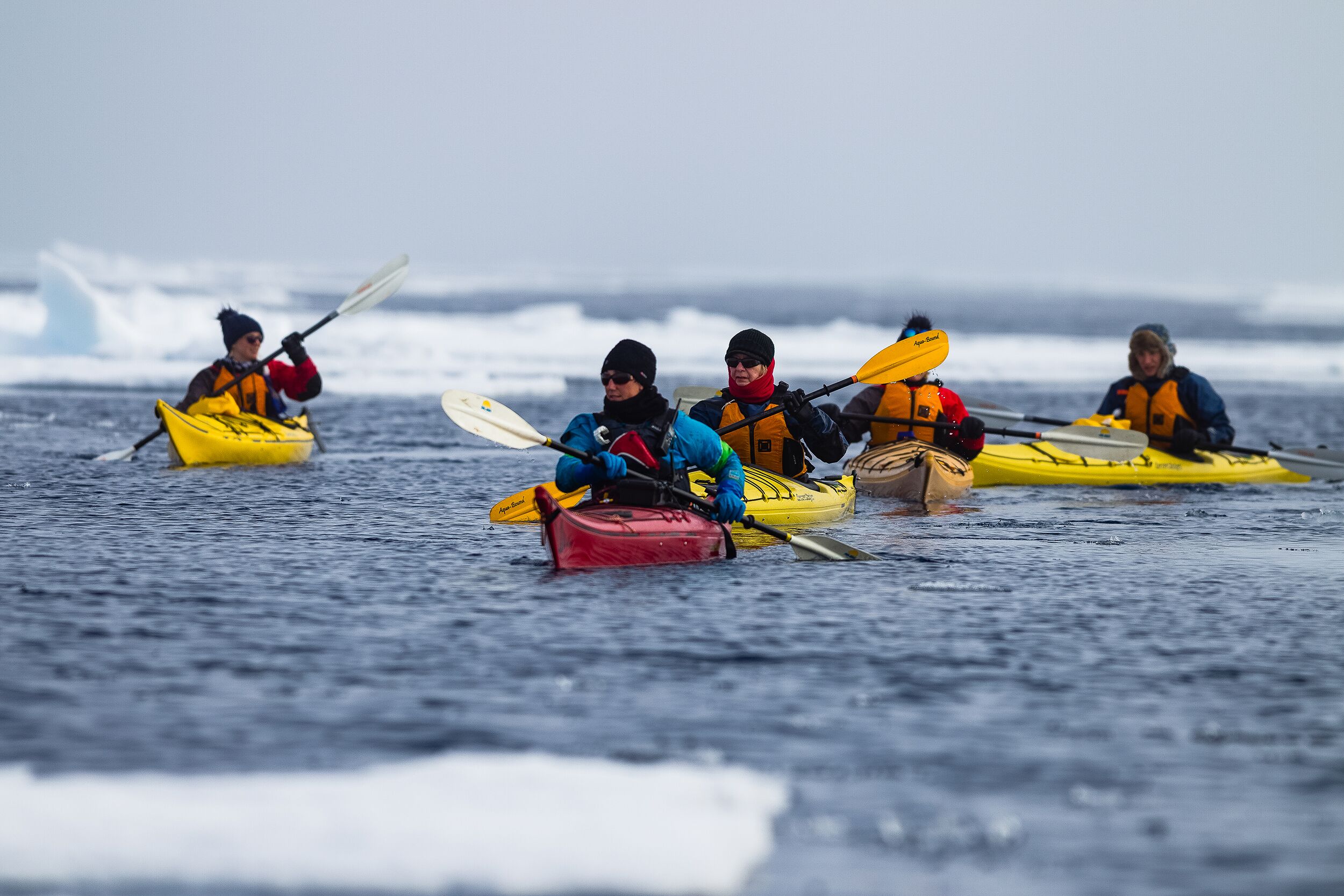
Sea Kayaking
The kayak adventure option is open to all levels of experience. However, it is highly recommended that you have some sea kayaking related experience prior to kayaking in the polar regions with Quark Expeditions. Our sea kayaks are the ideal means by which to slow down and connect with the pristine natural environments and surroundings.
Positioning yourself in the seat of a kayak is one of the most intimate ways travelers can connect with the polar regions—at water level, up close, where you can touch and feel every polar sensation imaginable. The Sea Kayak Program enables a small group of like-minded individuals to forge bonds as they explore fjords, glacial faces or mazes of sea ice.
Conditions and logistics permitting, your kayak guide(s) will endeavor to have you paddling as often as possible throughout the voyage. Typically, sea kayakers are shuttled by Zodiac from the ship to an ideal starting point, where the kayak excursion begins. Guests return to the ship by Zodiac at the end of their paddling experience. Some kayak excursions are designed so guests can go ashore and explore.

Stand-up Paddleboarding
Stand-up Paddleboarding, popularly known as SUPing, originated in Hawaii. Quark Expeditions is the first company to bring this watersport all the way to Antarctica.
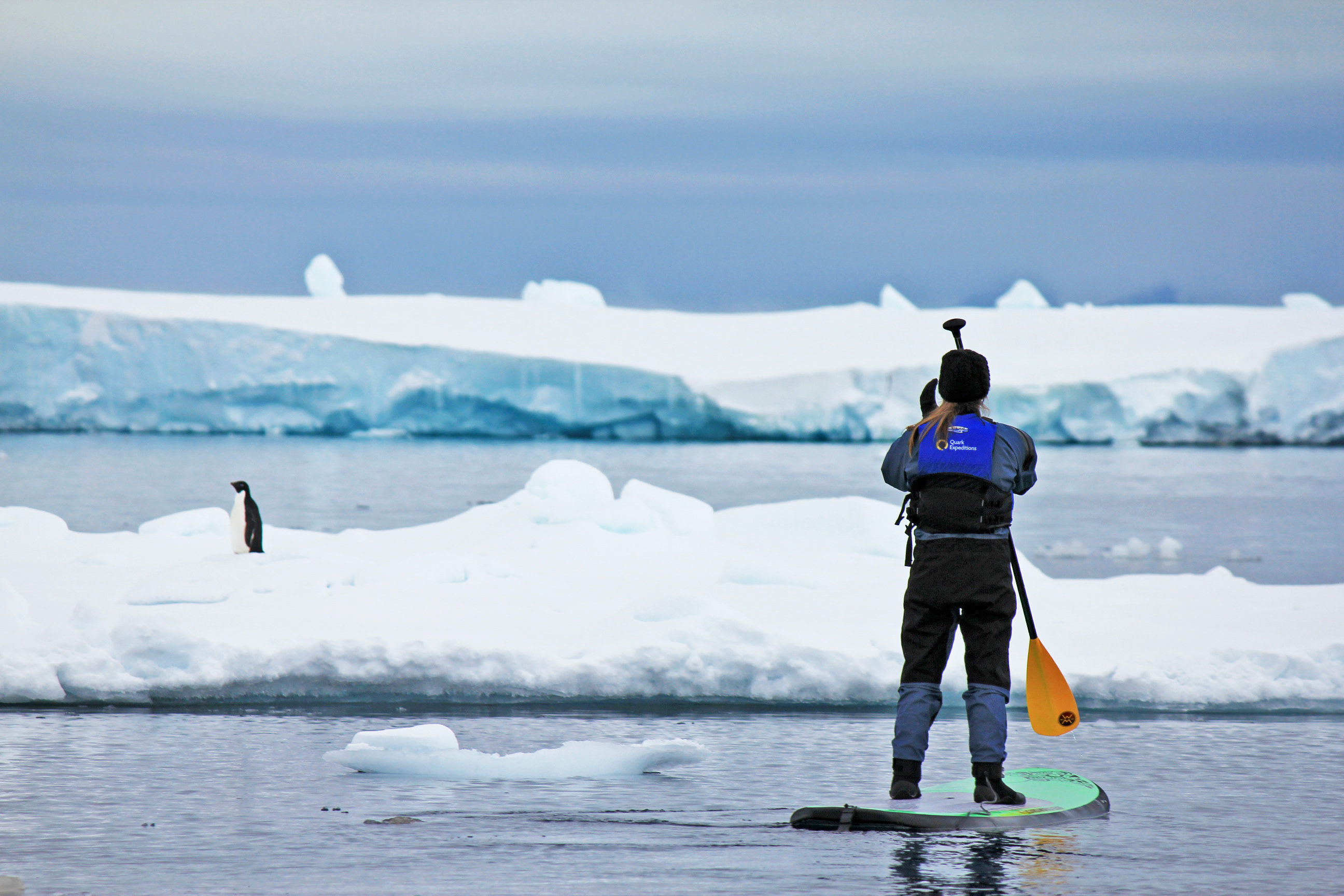
SUPing combines the immersive experience of kayaking but in a standing position. Participants, if they prefer, can kneel, sit or even lie down and stare up at the azure Antarctic sky. Because of their wide base and tail fins, SUP boards are quite stable, enabling participants – after a bit of practice – to stop staring at their feet and admire the surrounding scenery. Imagine seeing Gentoo penguins gliding below you, or making eye contact with a Weddell seal lying on a piece of ice as you paddle by.
Guests receive on-ship and on-water instruction from a qualified SUP guide. In addition, a safety driver (in a Zodiac) stays within range to offer assistance.
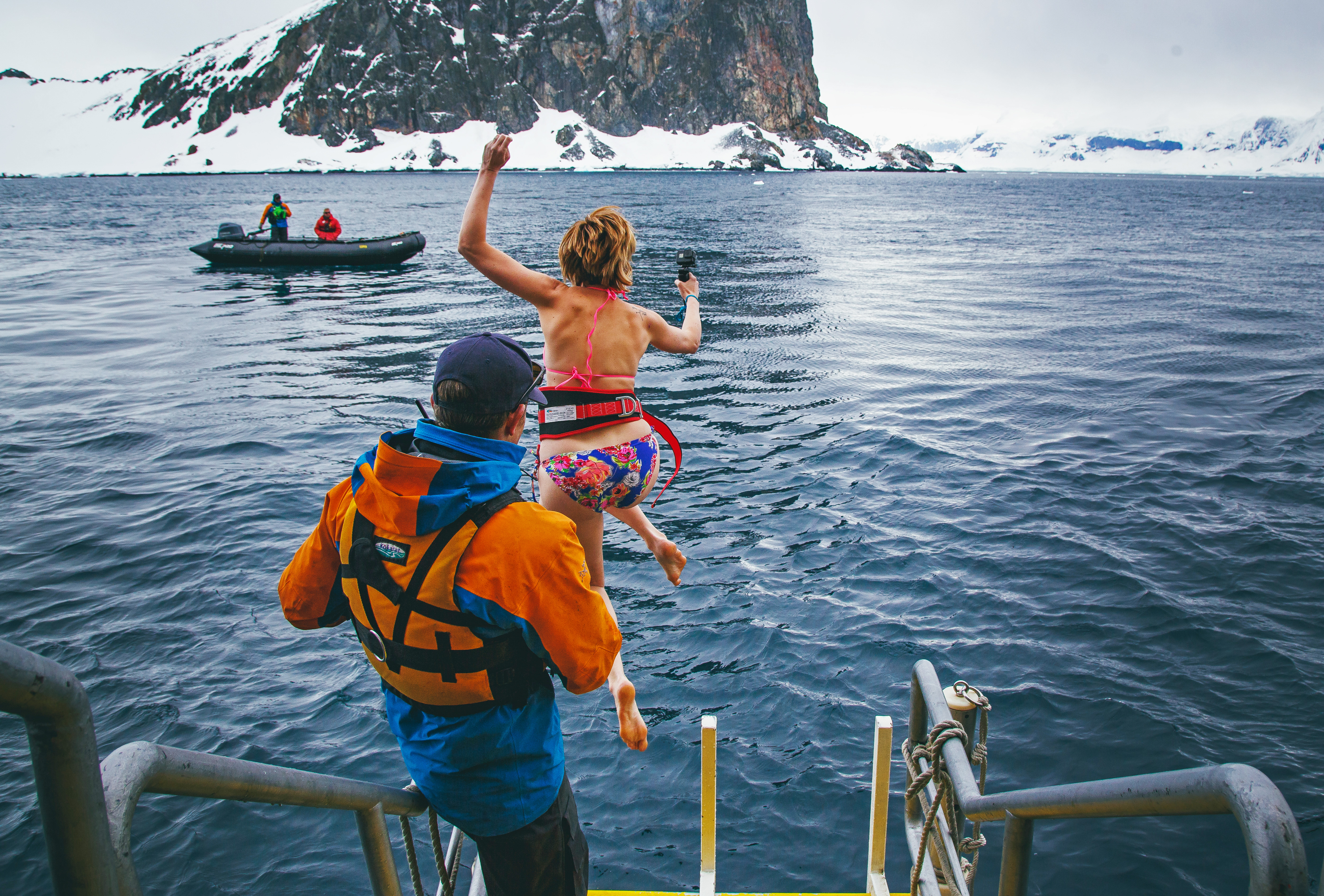
Polar Plunge
The Polar Plunge is scheduled once during each voyage. Throughout the journey, the Expedition Leader and Captain constantly monitor conditions in order to choose the optimal time and location. The Polar Plunge sometimes takes place onshore or, in many cases, from the gangway or Zodiac. All participants wear a tethered harness and plunge into the polar waters from the side of Zodiac or safety of the gangplank cheered on, of course, by fellow passengers and Expedition Team.
Safety is paramount—the onboard physician always attends the Polar Plunge. Guides in survival gear circle the area in Zodiacs as guests take their turn jumping or cannon-balling into the polar waters.

Hiking
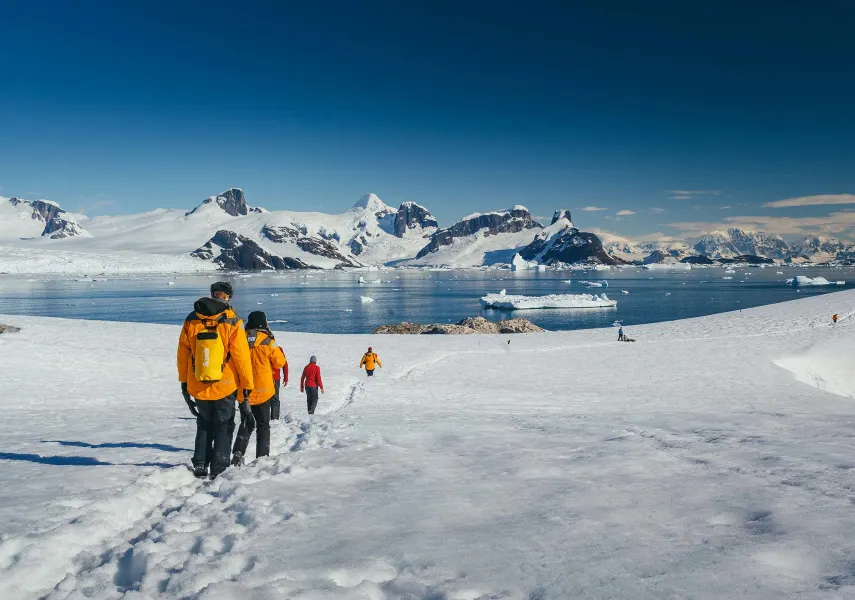
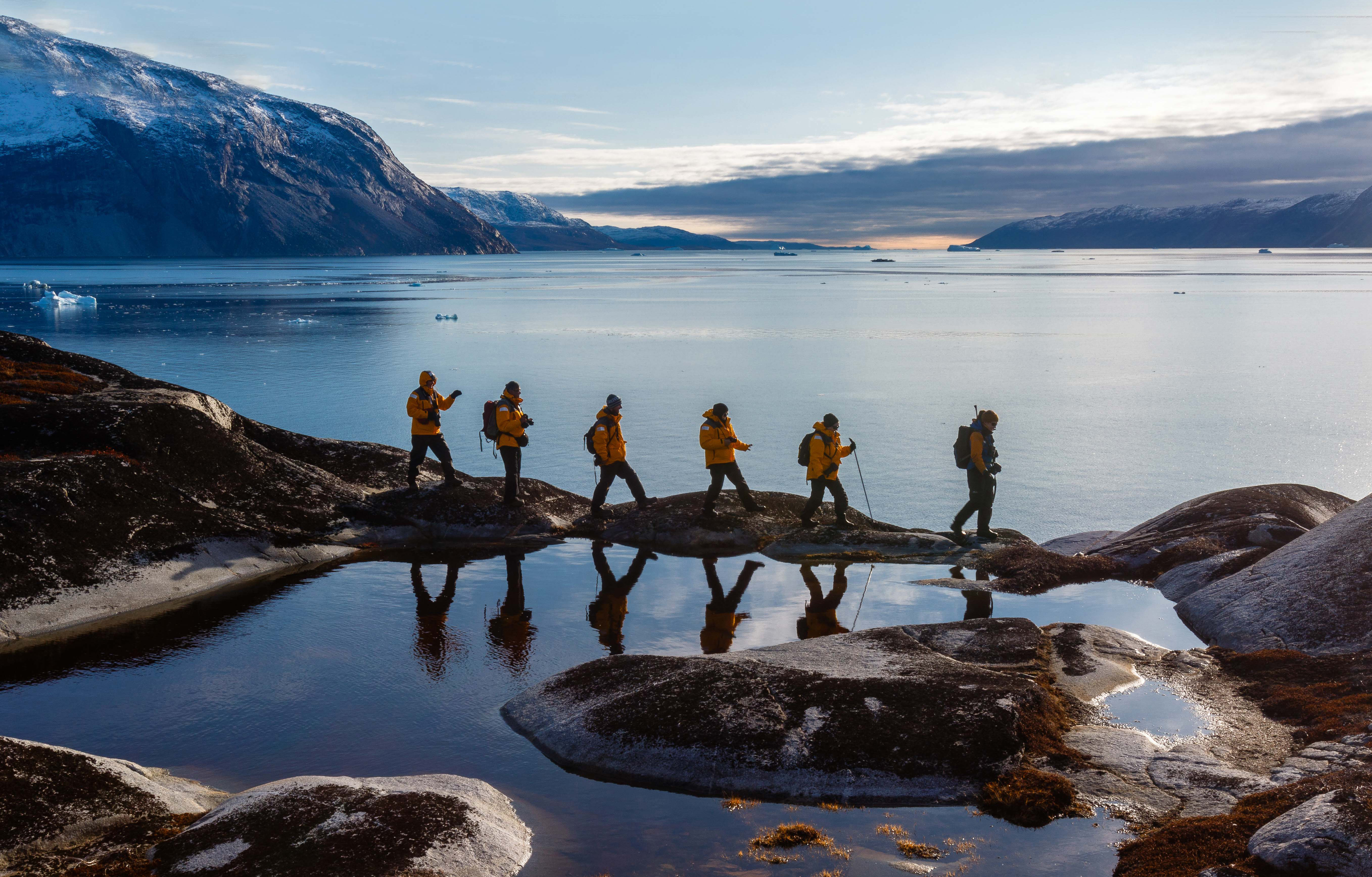
Hiking in the polar regions differs from your typical trail experience. Here, in a tree-less terrain, you are the tallest figure on the landscape as you walk over spongy tundra, crusty snow or sandy beaches in remotes parts of the Arctic and Antarctica. Stepping ashore anywhere in the polar regions means you’re not a distant observer.
Our organized hikes range from short jaunts to the top of lookouts or visits to see wildlife or longer walks of several kilometers over ice and rock and snow. Hiking excursions may last from two to three hours with plenty of time for photographs of wildlife, learning moments from your experienced guides, or just time to stand back and admire the incredible polar surroundings.
No experience is necessary but participants should be able to get in and out of a Zodiac and walk on uneven terrain. Hiking options are tailored to all interests and abilities, from those who want to contemplate the landscape in silence to photographers who want that perfect image to energetic travelers who want to summit a peak in the hopes of seeing wildlife in their natural habitat.
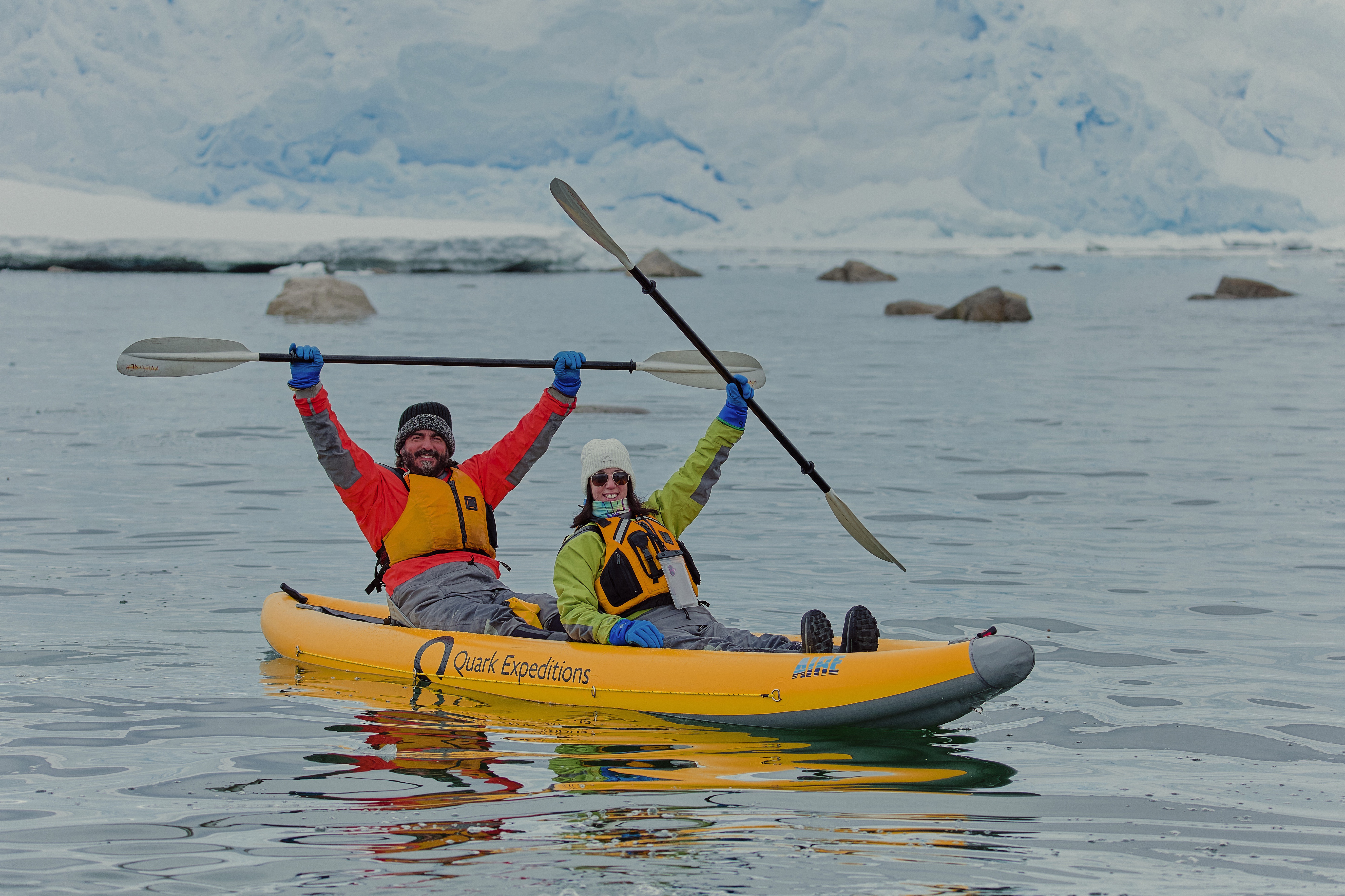
Paddling Excursion
Explore the ocean from a more intimate vantage point on a sit-on-top kayak. No experience is required to manoeuvre these very stable kayaks, allowing you to enjoy an unforgettable experience on the water, taking in breathtaking landscapes and wildlife. Whether it’s your first time in a kayak or you want greater flexibility to try other Adventure options, this shorter excursion is for you.
Paddling in the Polar Regions is highly weather-dependent and a one-time experience. Your kayak guides will attempt to take you out on the water for 1-1.5 hours of paddling. Offered on most voyages, spaces are limited. All equipment, guides and instructions are provided by Quark.
Pricing subject to change based on season. Please proceed to checkout or contact a Polar Travel Adviser for more details.
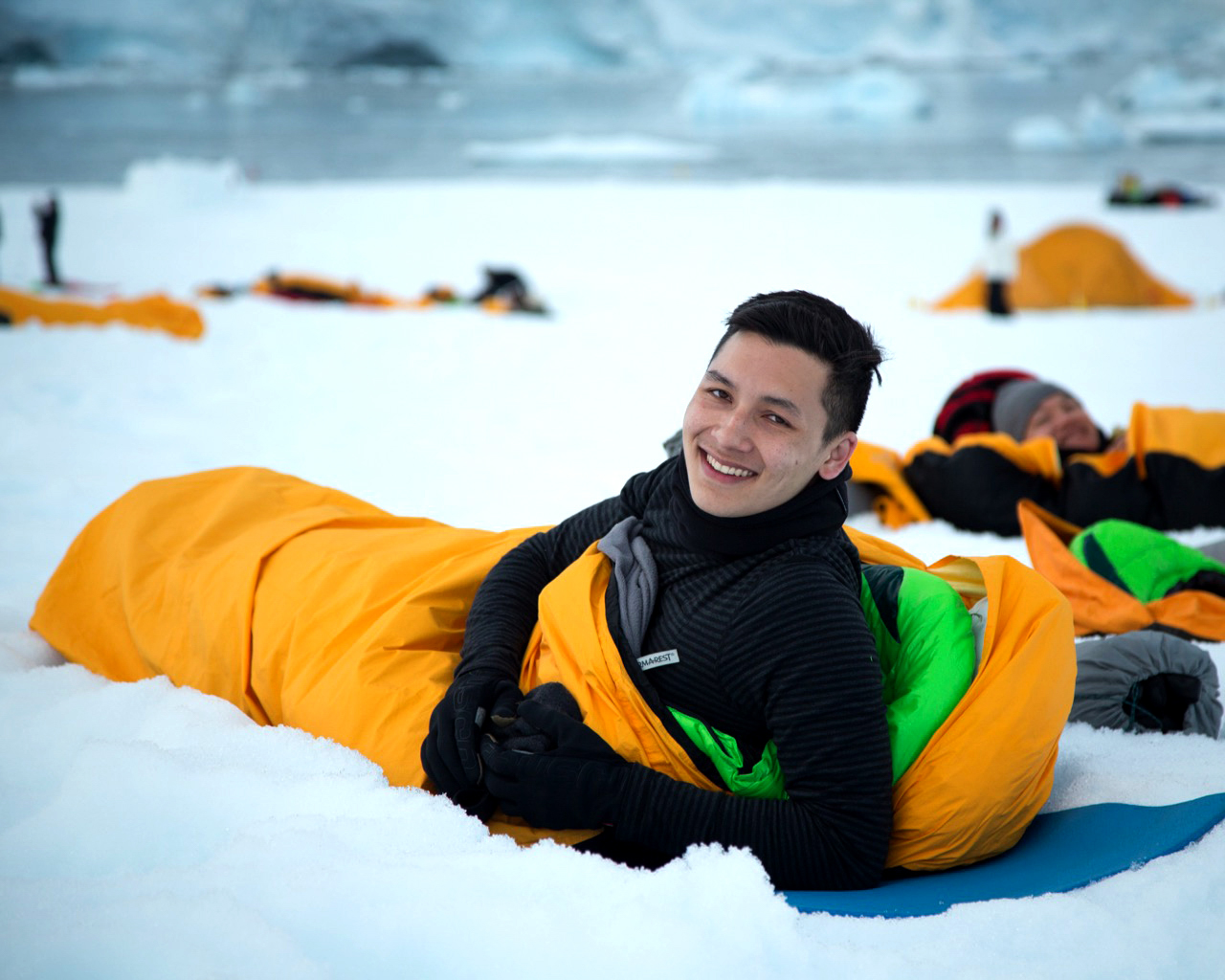
Camping
Imagine for a moment, staring at the stars in the indigo glow of an Antarctic night as you bed down for the night outside in the elements. The buzz of your daily life becomes a distant memory as you listen to the bray of penguin, the ethereal calls of the Weddell sea – even the exhalation of a humpback whale. And then you fall asleep.
Antarctic Camping with Quark Expeditions is an unforgettable experience. After dinner onboard, you’ll be escorted ashore by Zodiac to camp out on the snow for the night in your ready-to-roll bivy sack (tents can be used upon request). Once you decide on your spot, you set up camp and enjoy the peace as the Antarctic night unfolds.
Camping in Antarctica is limited to 50 participants, all of whom will be briefed beforehand on the principals of basic camping. Prior to you settling down for the night, Quark Expeditions staff will prepare the site, including setting up a perimeter in safe, flat to gently-sloping and beautiful site. You’re free to choose where (within the perimeters) you want to settle down for the night.
You’ll be equipped with the following:
- Mummy-style sleeping bag
- Bivy sack
- Insulated sleeping pad
- Sleeping bag liner
- 3 or 4 season tent provided upon request (pending availability)
- Quark Expeditions Parka
- Waterbottle (Small collapsible reusable water bottles provided onboard upon embarkation)
- Muck Boots (insulated waterproof boots provided onboard upon embarkation)
Other recommended gear:
- Base and mid-layer clothing
- Warm hat
- Warm gloves
- Hand-warmers
- Camera and accessories
- Backpack
- Eye mask if you wish complete darkness
- Need a pillow? Roll up your parka!
- Essential medication and or supplements
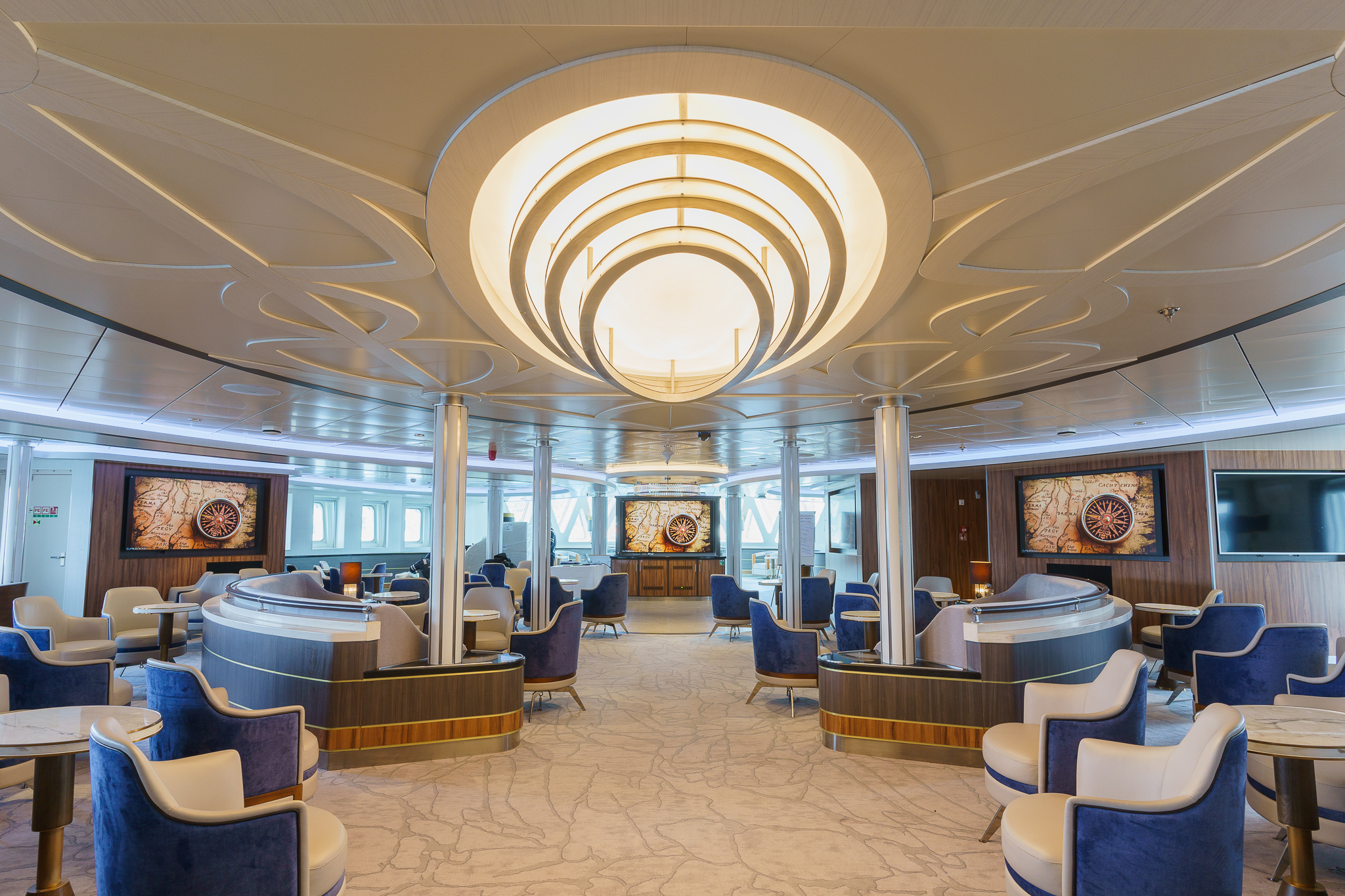
Explorer Lecture Lounge
Enjoy daily chats with and presentations by our world-class onboard polar experts—expedition guides, specialists, photography guides and other special guests who will introduce you to the fascinating history, biology, ornithology, glaciology and geology of the region, and much, much more.
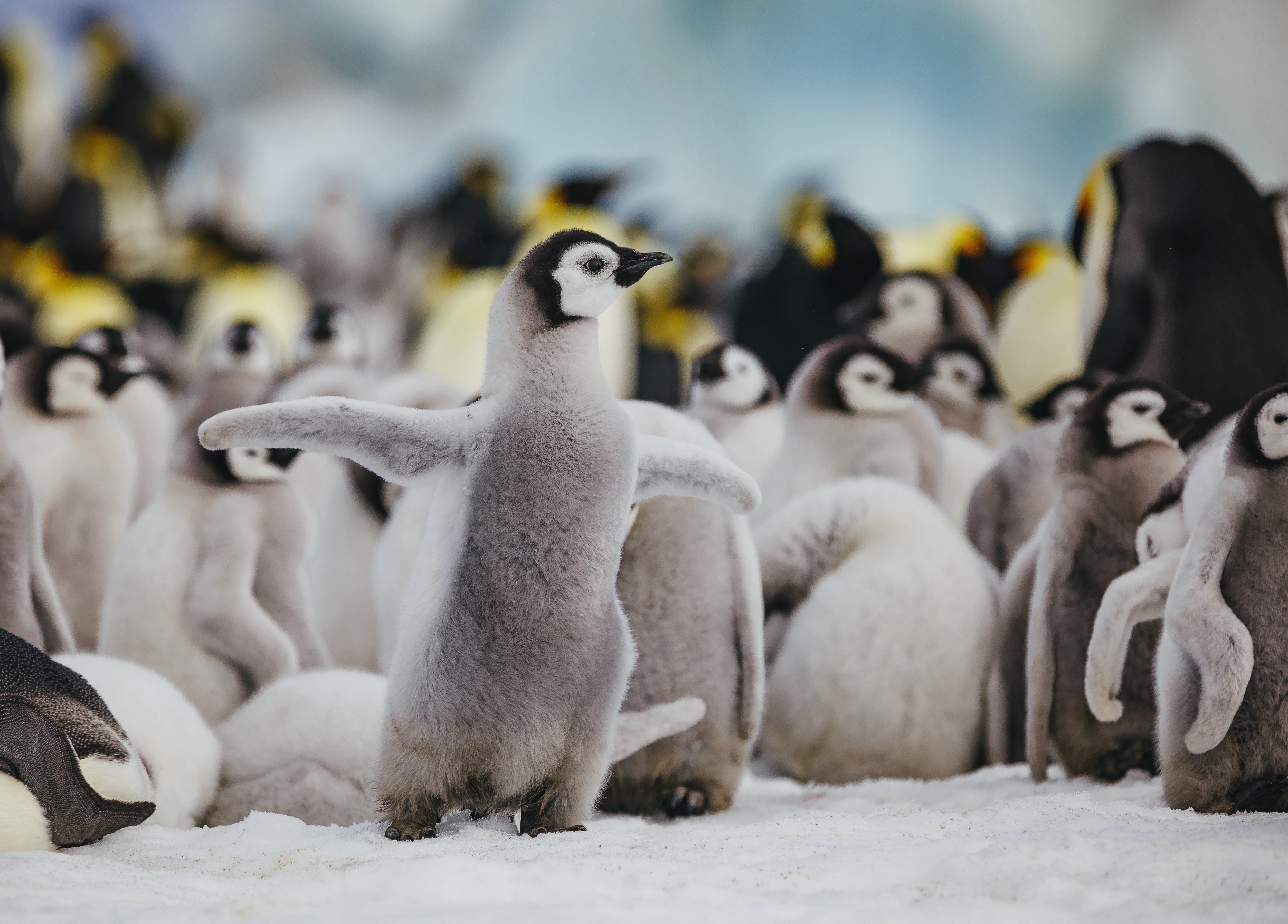
Photography
Documenting your voyage so you can take the memories home is a rewarding experience. Our photography guides will help you hone your skills to capture the beauty of the polar regions.
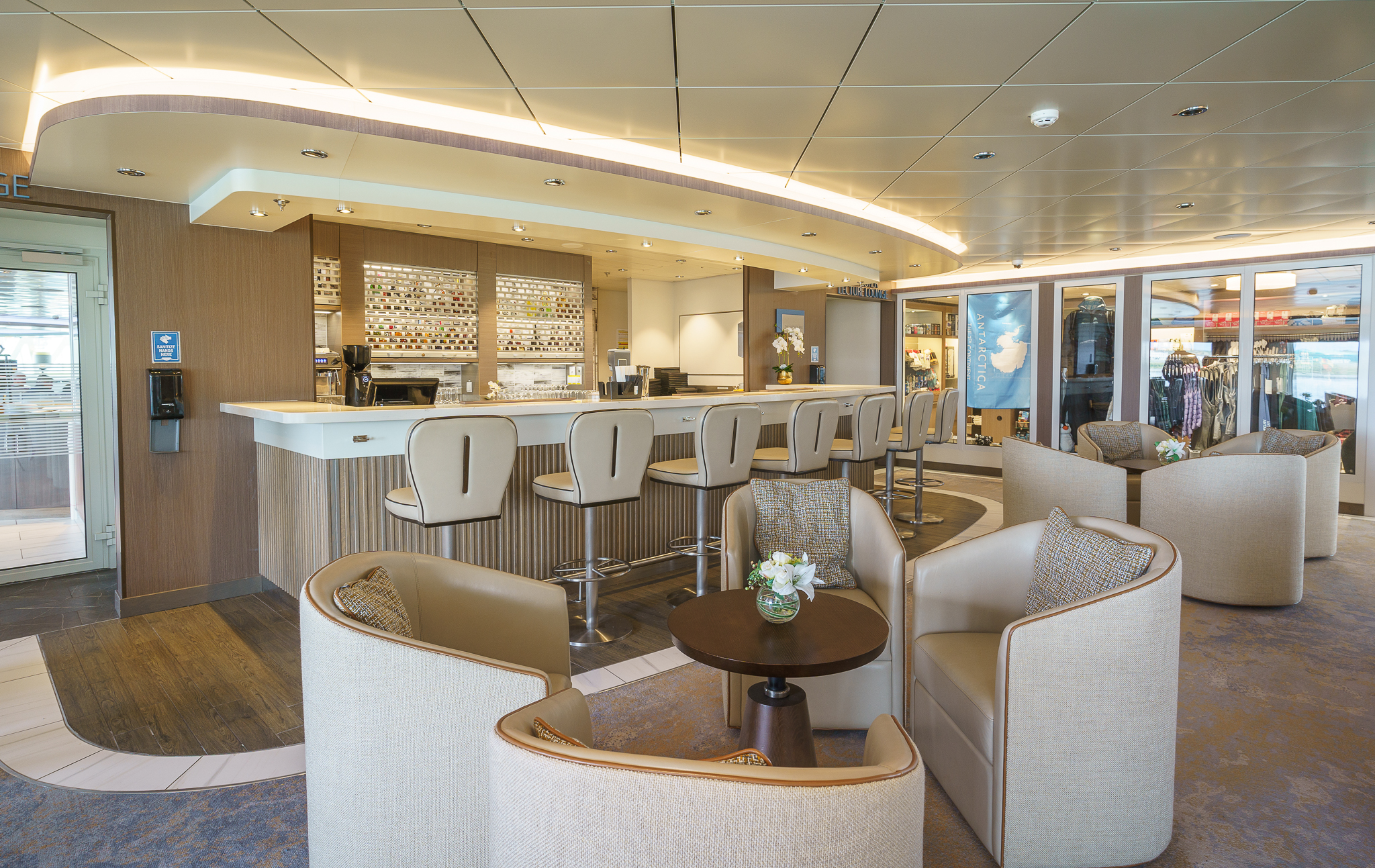
The Latitude Bar
A popular social hub on Deck 5, the beautifully-lit Latitude Bar—with its lush sofas and faux marble-topped end tables—is large enough to seat 46 and is ideal for enjoying a quiet drink on your own or hanging out with friends.
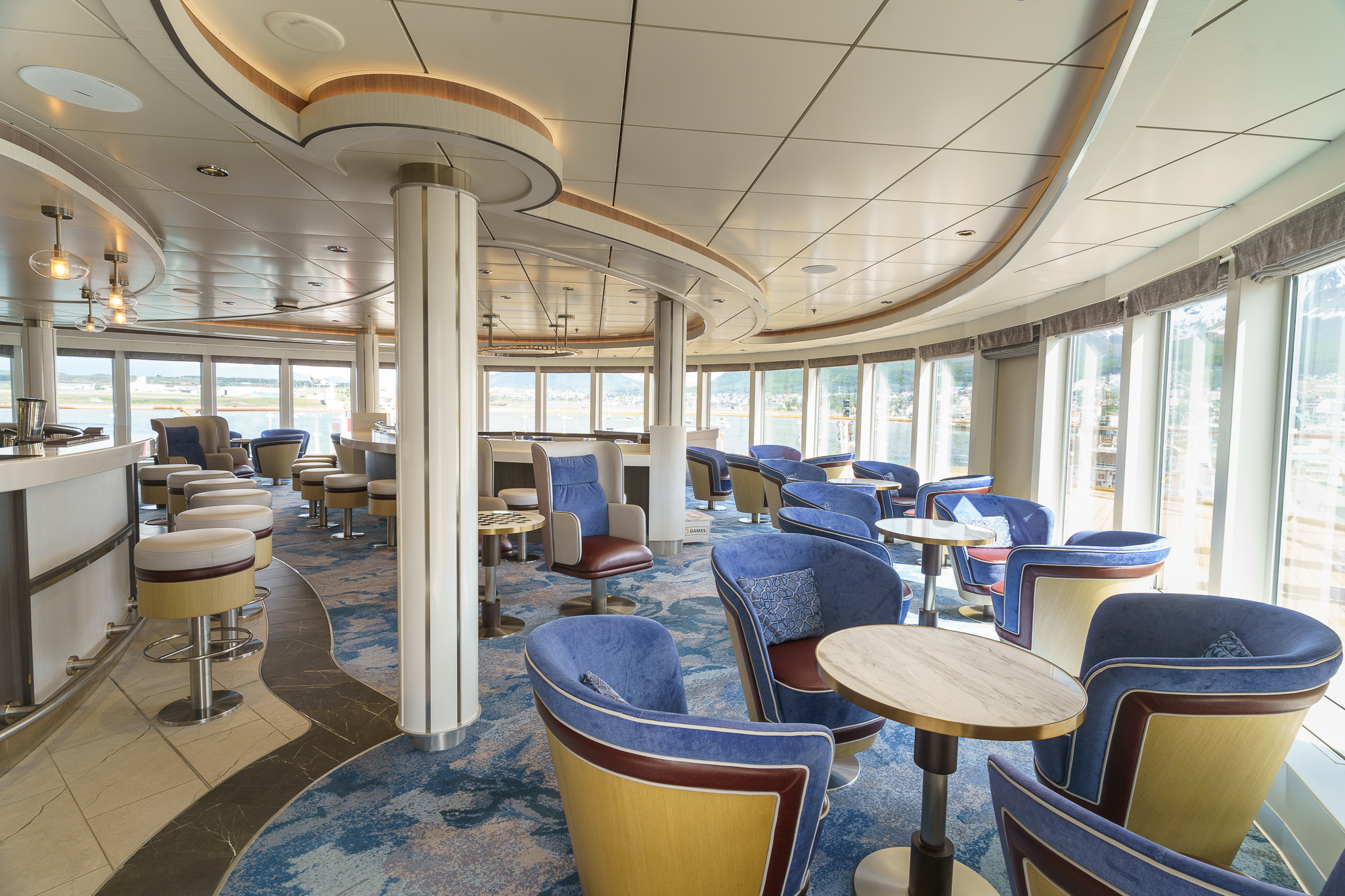
Observation Lounge
This stylish lounge at the top of the ship guarantees incredible views. Guests also frequent this spacious lookout on Deck 8 to enjoy cocktails and conversation with fellow travelers. Seats 63.

Discovery Library
Located on Deck 6 at the top of the gorgeous atrium staircase, this beautiful Library with floor-to-ceiling glass, accommodates up to 47 people
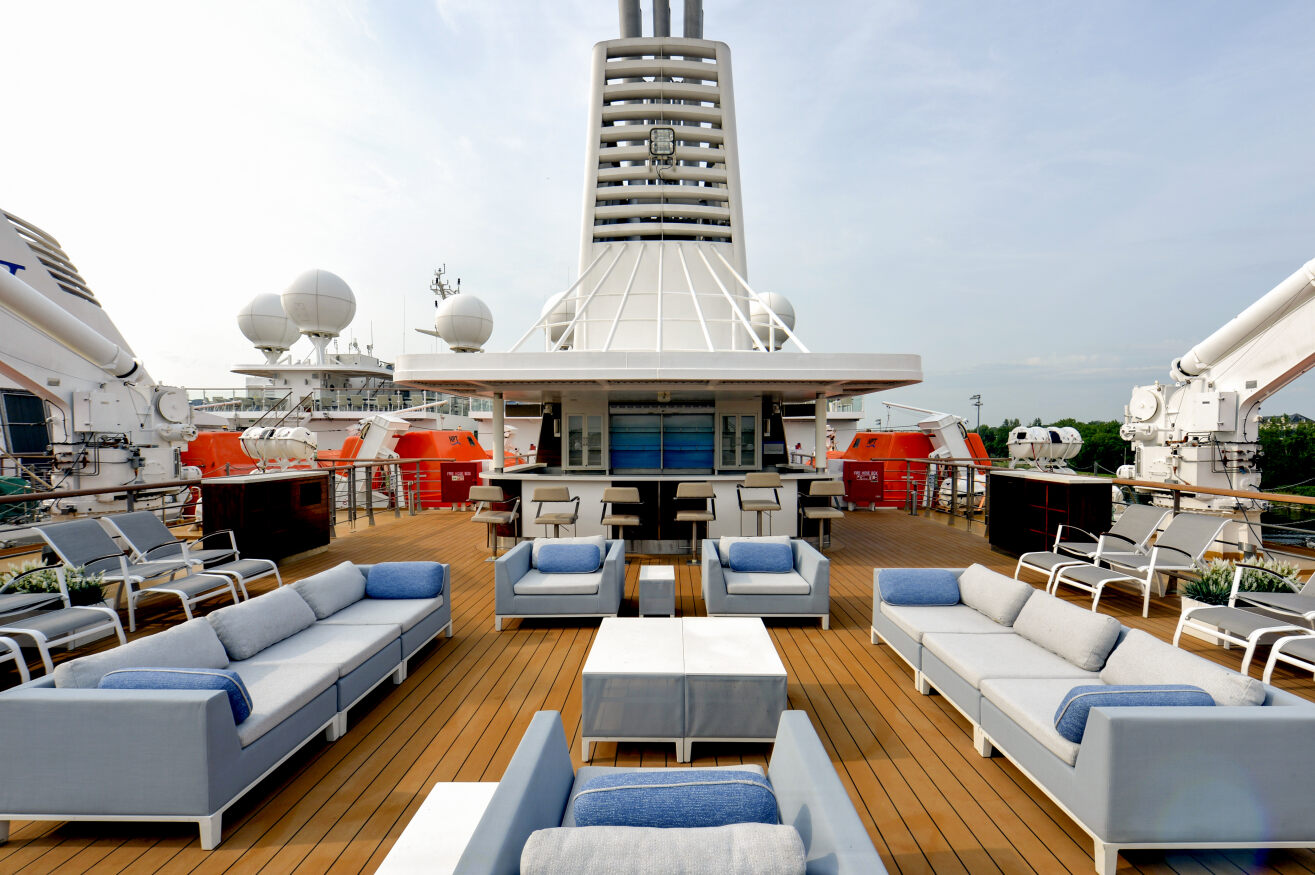
Sun Deck and Bar
More information coming soon.
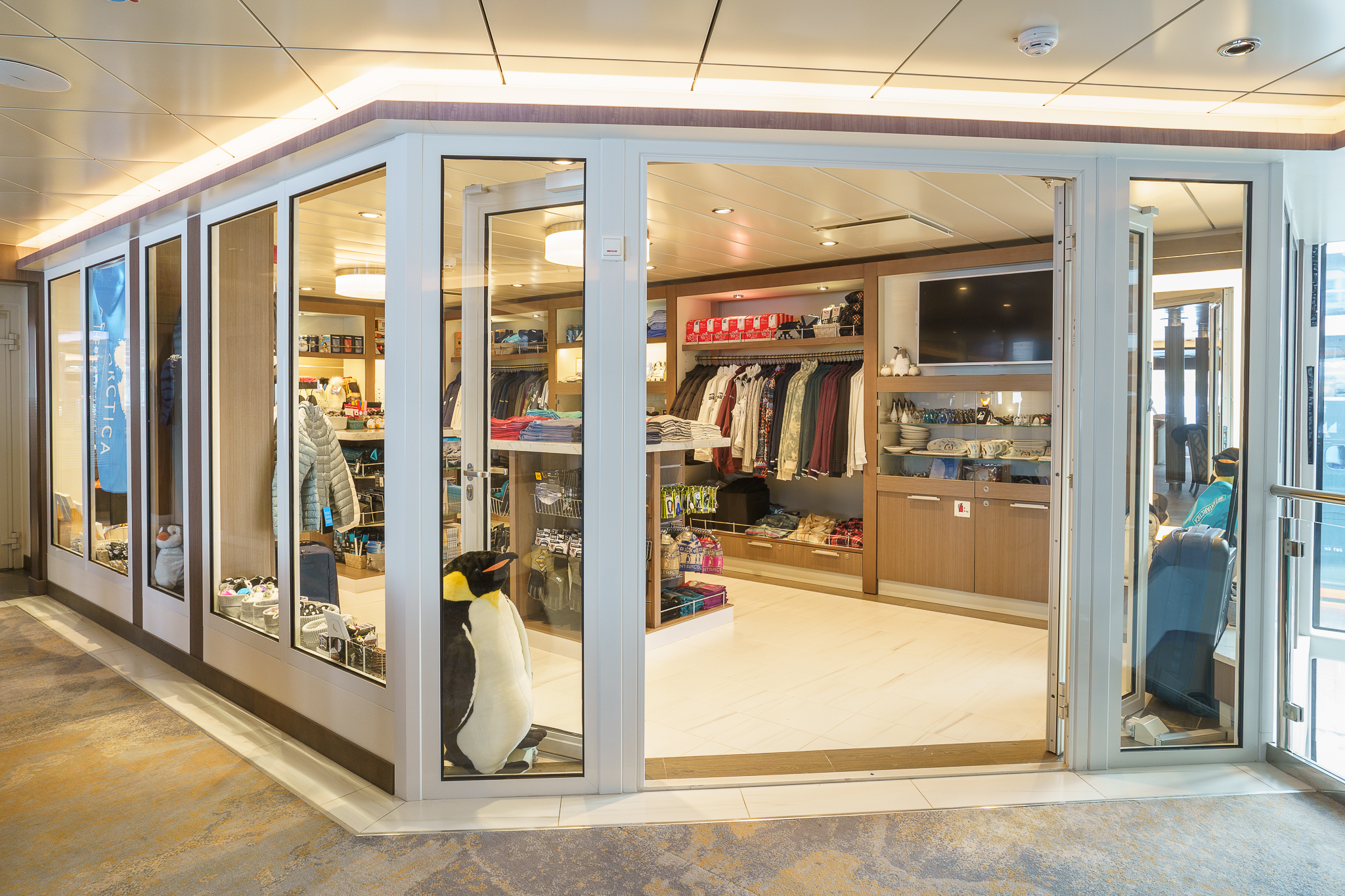
Polar Boutique
The Polar Boutique can be located on Deck 5.
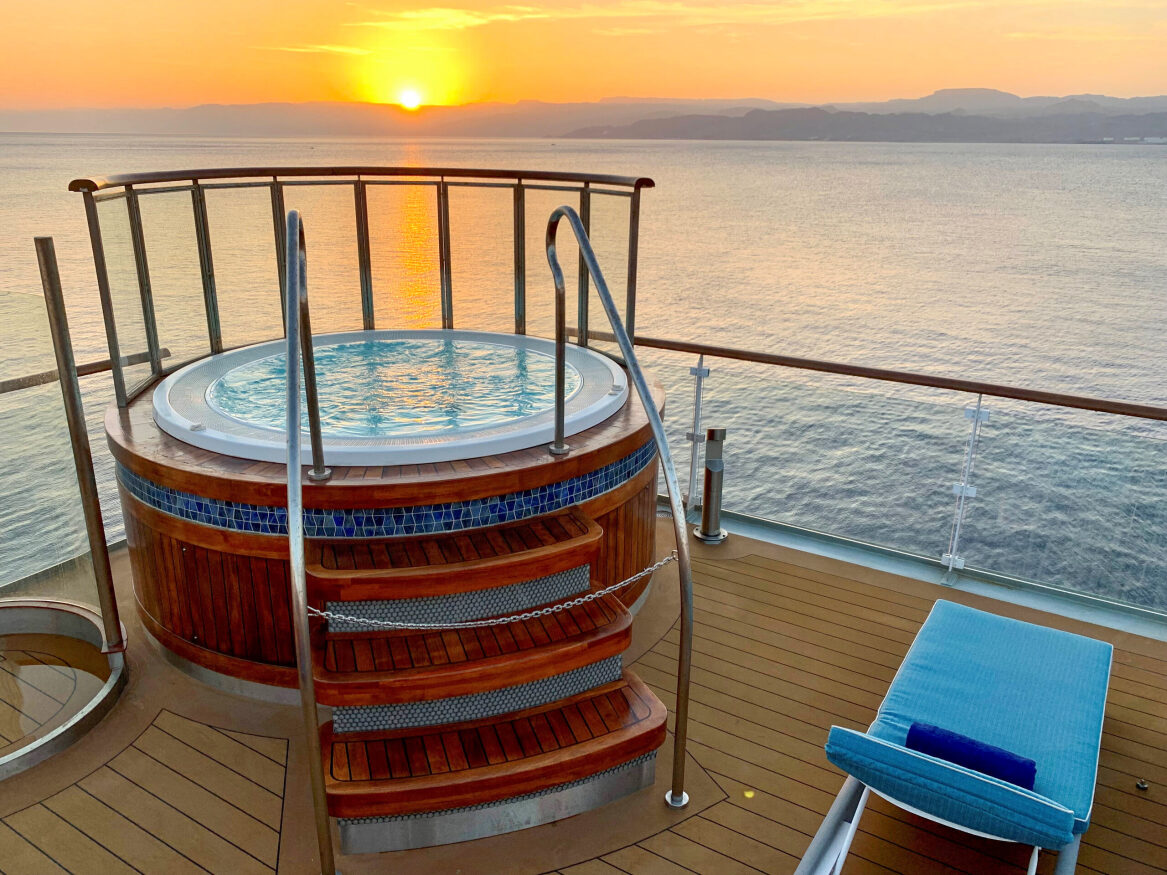
Jacuzzis
Two outdoor Jacuzzis on deck 7, at the ship’s stern, mean you can relax alfresco while soaking up the breath-taking polar views.
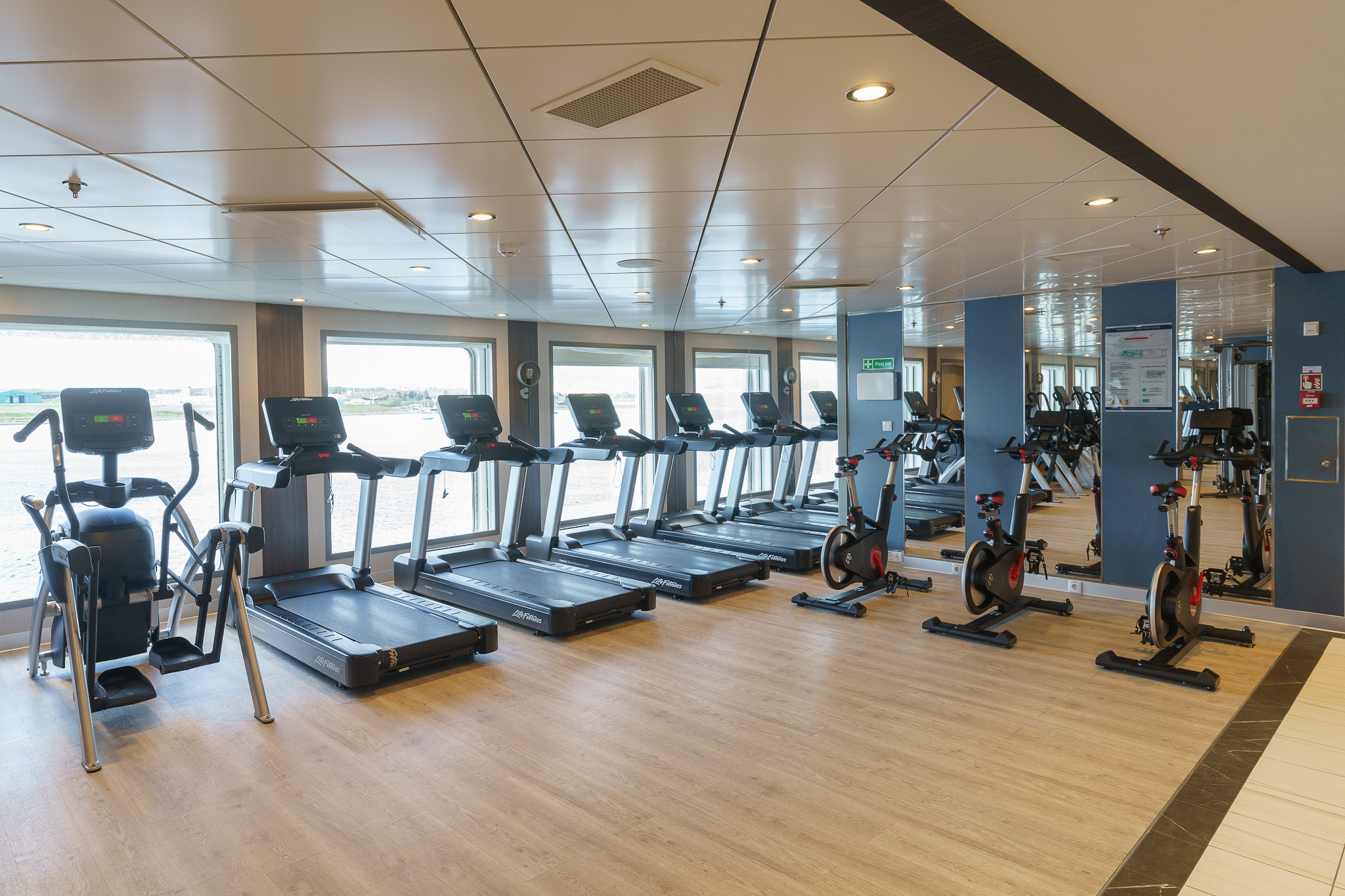
Fitness Centre
Stay fit with the latest work-out equipment in the Fitness Center on Deck 7.
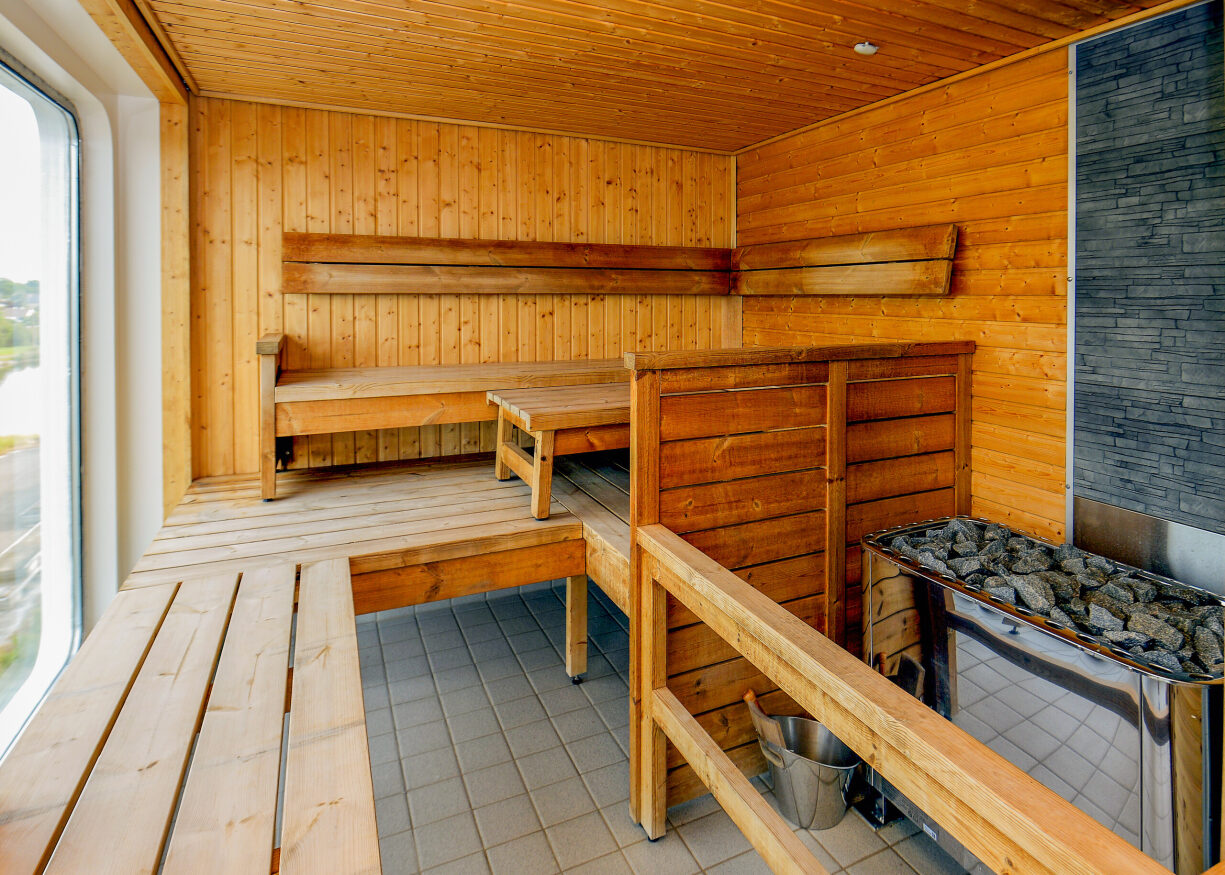
Dry Sauna
After a day of exciting off-ship adventure, guests can relax on the sauna’s traditional wood benches while gazing at the polar wilderness just outside the large sauna windows. Accommodates 15 people on Deck 7.
Leading Edge Sustainability
With the latest sustainability technology in polar expedition, the ship features fuel-efficient Rolls-Royce engines and the ground-breaking MAGS gasification system that converts waste into energy, eliminating the environmental impact of waste transportation.
Medical Facilities
Quark Expeditions provides an English-speaking doctor on board who manages a medical clinic stocked with a supply of common prescription medicines and basic first aid equipment.
If you are under regular treatment for any ailment, you must bring a sufficient supply of medicine. We recommend that you pack an extra two weeks’ supply of medication in case of emergency. We cannot accept responsibility for not having a specific brand or type of drug on board. Should you fall ill, the doctor will refer to the medical forms that you completed and returned to us; therefore it is vital that the information you provide is complete and accurate
Dress Code
To Wear on Board
- Comfortable casual clothing like lighter shirts, pants or jeans, etc. (in case the ship gets warm)
- Comfortable non-slip closed-toed, heelless shoes (flip flops, sandals or slip-on shoes should not be worn on board due to safety concerns)
- Workout attire (for the fitness center and other indoor activities)
- Swimsuit (for the Polar Plunge! Some vessels may also have a pool, hot tub, sauna and/or steam room. See your ship book for details.)
Just a reminder: no formal evening wear required on our voyages! (but if you want to you can bring a little something more dressy for the Captain’s Welcome and Farewell cocktail parties)
Additional Items
- Passport, visas, immunization records, travel documents, etc. as required
- Camera gear complete with charger, storage medium, transport & cleaning kit (lens cloth etc.) and extra batteries
- Waterproof cell phone case or rain sleeve for camera
- Earplugs and eye masks for sleeping
- Voltage converters and plug adapters (see ship book for details)
- Moisturizer for face and hands (skin dryness due to wind and temperature changes)
- Seasickness, indigestion, headache, or other medications
- Small amount of local currency (see pre-departure book for more details)
- Insect repellant
- Mosquito netting
For Shore Excursions & Hiking
In addition to the mandatory gear requirements (as above) for the transit from ship to shore, it is recommended to bring:
- Worn-in Hiking footwear: While Muck-boots are provided and encouraged for most shore excursions, additional hiking footwear (Goretex-lined boots or similar water-proof hiking boots) can add to your hiking comfort, especially if you are a keen hiker
- (Smart) Wool or synthetic hiking socks for above footwear (bring an extra pair)
- Lightweight and quick-dry, trekking pants that may or may not convert to zip-off shorts* (*depending on your thermo-regulation)
- Breathable waterproof pants* and rain jacket** for outdoor activities in inclement weather (*can be the same pair you use for Zodiac operations / ** can be outer shell of complimentary Quark 3in1 Parka)
- Comfortable long or short-sleeve shirt for hiking either synthetic/quick-dry or merino (smart) wool
- (Hiking) gloves (medium thickness, waterproof preferred)
- Hat, buff or scarf (for wind and weather protection)
- UV protection (hat, polarized sun glasses, sun block, lip balm)
- Collapsible Walking stick for hikes (if required). Quantities are available on every vessel to borrow.
- Additional reusable thermos or water bottle (in addition to the reusable collapsible water bottle provided)
By Sea & Air
All transfers ship to shore, helicopter flights & Zodiac/ship cruising
- Waterproof Pants (Mandatory for every Zodiac and helicopter ride. For Ultramarine guests who are participating in Helicopter flights, we recommend packing loose fitting rain pant style waterproof pants, rather than fitted ski pants. You will also be required to wear a drysuit, which our team will help you prepare for on the ship.)
- Base-layer wool or synthetic top*
- Base-layer wool or synthetic bottom*
- Mid-layer warm or fleece top*
- Mid-layer warm or fleece bottom*
- Warm hat that covers ears (bring an extra)
- Scarf, buff, or other face protection
- Warm wool or synthetic socks (keep a dry pair in your bag, and bring extras for layering)
- Waterproof gloves or mitts (bring an extra, lighter pair for hiking)
- Glove liners*
- Hand and feet warmers*
- Binoculars
- Polarized sunglasses with UV protection (bring an extra pair)
- Sunscreen
- Ski goggles (for Zodiac cruising on snowy or windy days)
- Waterproof, lightweight backpack or dry sack &/or rain sleeve for camera or a waterproof phone case (to keep camera & gear dry)
Smoking Policy
To protect the health and safety of its guests, Quark Expeditions® maintains a no smoking policy in the interior of the ship including cabins, near Zodiacs and on landings. Smoking on the ship is permitted in the designated smoking area only, which your Expedition∘ Team members will be happy to point out for you. Always make sure to extinguish cigarettes properly and dispose of them in the proper receptacle. Please, never throw cigarettes overboard.
Dietary Requirements and Allergies
All guests—including vegetarians, meat-eaters, as well as those who follow a gluten-free diet—will be equally impressed with the dining options on our ships. Quark Expeditions® is able to cater to most special dietary requests, as long as you clearly indicate your needs on the required expedition forms when you book your voyage. Menus will be clearly labeled for vegetarian and gluten free options, but please do notify your server of the dietary restrictions you indicated on your form. We regret that kosher food cannot be prepared.
Laundry
A complete list of laundry fees will be provided on board. Laundry is collected each morning; please allow 48 hours for your laundry to be returned. Ironing services are also available at a minimal charge. We encourage you to take advantage of the laundry services, as it will mean you can pack fewer articles of clothing. If you prefer to hand wash small items in your cabin, please remember to bring environmentally friendly detergent.
Wi-Fi & Communications
When you are not busy exploring the natural beauty of the Polar Regions, you may wish to connect with family and friends back home to share some of your voyage highlights. Guests on Quark Expeditions can now enjoy free Wi-Fi as part of our “Raise a Glass and Stay Connected Free” program. This complementary Wi-Fi service permits basic Internet browsing and voice applications.
Please note that we travel to some of the most remote parts of the world. As we utilize satellite equipment for our connection, Wi-Fi signal may be intermittent.
To access email or internet on your personal computer, tablet or smart phone, connect to the network on your device, where you can access our complimentary plan, or purchase Priority Wi-Fi.
Complimentary Wi-Fi
- Lower speeds
- Suitable for basic internet browsing, texting and voice calling using text and voice apps
- Some site filtering
- No charge
- One device logged in at a time
Priority Wi-Fi
- Higher speeds
- Suitable for larger data volume apps, video calling, video streaming (in lower resolutions) etc.
- See rates by logging in
- One device logged in at a time
Expedition Brochures
Find Ocean Explorers itineraries here.

Deck 9
- Top Deck

Deck 8
- Observation Deck
- Observation Bistro
- Observation Lounge & Bar
- Elevator

Deck 7
- Penthouse Suite
- Owners Suite
- Veranda Stateroom
- Studio Veranda Single
- Polar Deck and Bar
- Jacuzzis
- Gym
- Tundra Spa & Sauna
- Bridge
- Bridge Deck
- Elevator

Deck 6
- The Discovery Library
- Junior Suite
- Veranda Suite
- Veranda Stateroom
- Elevator

Deck 5
- Main Dining Room
- Private Dining Room
- Reception
- Polar Boutique
- Latitude Bar & Lounge
- Explorer Lecture Lounge
- Elevator

Deck 4
- Deluxe Veranda Forward
- Veranda Suite
- Veranda Stateroom
- Expedition Desk
- Elevator

Deck 3
- Ready Room
- Medical Facilities
- Zodiac Embarkation Points
- Studio Single
- Elevator
Itinerary
Sprawling Reykjavík, the nation’s nerve center and government seat, is home to half the island’s population. On a bay overlooked by proud Mt. Esja (pronounced eh-shyuh), with its ever-changing hues, Reykjavík presents a colorful sight, its concrete houses painted in light colors and topped by vibrant red, blue, and green roofs. In contrast to the almost treeless countryside, Reykjavík has many tall, native birches, rowans, and willows, as well as imported aspen, pines, and spruces.Reykjavík’s name comes from the Icelandic words for smoke, reykur, and bay, vík. In AD 874, Norseman Ingólfur Arnarson saw Iceland rising out of the misty sea and came ashore at a bay eerily shrouded with plumes of steam from nearby hot springs. Today most of the houses in Reykjavík are heated by near-boiling water from the hot springs. Natural heating avoids air pollution; there’s no smoke around. You may notice, however, that the hot water brings a slight sulfur smell to the bathroom.Prices are easily on a par with other major European cities. A practical option is to purchase a Reykjavík City Card at the Tourist Information Center or at the Reykjavík Youth Hostel. This card permits unlimited bus usage and admission to any of the city’s seven pools, the Family Park and Zoo, and city museums. The cards are valid for one (ISK 3,300), two (ISK 4,400), or three days (ISK 4,900), and they pay for themselves after three or four uses a day. Even lacking the City Card, paying admission (ISK 500, or ISK 250 for seniors and people with disabilities) to one of the city art museums (Hafnarhús, Kjarvalsstaðir, or Ásmundarsafn) gets you free same-day admission to the other two.
Day programme:
Arrive in the Icelandic capital and make your way to the group hotel near Keflavik airport, included in your Charter Flight & Hotel Package. You will have the rest of the day to explore this fascinating city, known for its Norse history and stunning architecture. If you do plan to visit Reykjavik, allow for a one-hour transfer to and from the airport area.
Nuuk, meaning “the cape”, was Greenland’s first town (1728). Started as a fort and later mission and trading post some 240 kilometers south of the Arctic Circle, it is the current capital. Almost 30% of Greenland’s population lives in the town. Not only does Nuuk have great natural beauty in its vicinity, but there are Inuit ruins, Hans Egede’s home, the parliament, and the Church of our Saviour as well. The Greenlandic National Museum has an outstanding collection of Greenlandic traditional dresses, as well as the famous Qilakitsoq mummies. The Katuaq Cultural Center’s building was inspired by the undulating Northern Lights and can house 10% of Nuuk’s inhabitants.
Day programme:
After breakfast, guests and their luggage will be transferred to the airport for the charter flight to Nuuk, the capital of Greenland. Upon arrival, guests will be transferred to their ship, Ocean Explorer.
Located just north of the Arctic Circle, Sisimiut is the northernmost town in Greenland where the port remains free of ice in the winter. Yet it is also the southernmost town where there is enough snow and ice to drive a dogsled in winter and spring. In Sisimiut, travelling by sled has been the primary means of winter transportation for centuries. In fact, the area has been inhabited for approximately 4,500 years. Modern Sisimiut is the largest business center in the north of Greenland, and is one of the fastest growing Greenlandic cities. Commercial fishing is the lead economy in the town‘s thriving industrial base.
Day programme:
Congratulations, you’ve crossed 66°33’ north latitude. On our first-off ship excursion in the Arctic, we’ll visit Sisimiut, a community rich with Greenlandic history and culture. As we approach via the inner harbor, you’ll spot locals coming and going from the marina, bringing halibut, shrimp and other seafood freshly harvested from Baffin Bay. Upon reaching shore, we’ll walk winding roads through this vibrant town dotted with colorful homes and Arctic cotton grass blooming under the summer sun. While the waterfront may be lively with boat traffic, life uphill moves at a relaxed, peaceful pace. You may hear children laughing, sled dogs barking, and locals exchanging greetings. Greenlandic dogs, often seen in kennels throughout town, reflect the deep bond between owners and their canine teams. As in any Arctic community, always ask before petting or approaching these working dogs. Today’s activities feature a locally guided town walk that includes admission to the museum, and a taste of local Greenlandic food. You will also be able to converse with locals who will be eager to learn about your part of the world. One scenic walk leads to the Taseralik Cultural House, beside Nalunnguarfiup Tasia, a small tranquil lake at the base of the 780-meter (2,550 feet) Nasaasaaq Mountain. You’ll walk the same paths locals use every day, experiencing not just the look of Sisimiut, but its rhythm, sounds and genuine sense of place. Guests can also book our Mountain Bike Adventure Option (see page 12). Led by local partners, this biking tour includes the town harbor area as well as the tundra surrounding Sisimiut.
Day programme:
In September, Disko Bay is bathed in an ethereal autumn light—a phenomenon specific to the high latitudes. Giant icebergs drift with the currents, many of which can be seen in nearby Illulisat Icefjord, which was designated a UNESCO World Heritage Site in 2004 because of its outstanding natural beauty and its significance in understanding ice-cap glaciology. You’ll quickly realize that icebergs come in all shapes and sizes— some of them larger than Ocean Explorer. Disko Island shelters the expansive bay, where we hope to make landfall at or near the small community of Qeqertarsuaq. Colorfully painted homes dot the gentle rocky slopes of this quiet community, which moves at a pace set by the changing seasons, the tides, and the steady rhythm of small skiffs heading out from the harbor into the vast surrounding landscape. The sea horizon here feels endless. Icebergs drift past—some bound for Baffin Island, Labrador, or even Newfoundland—reminding us of our vast, interconnected world. From this point, we begin to leave behind the more populated regions of West Greenland and push farther northwards. Shortly after lunch, we set a course northward toward Ultima Thule—the extreme far north.
Day programme:
There’s a good chance you will wake up surrounded by icebergs and mountainous landscapes to the east. We continue our push north, arriving at the beautiful community of Upernavik around midday. Although much farther north than most Greenland communities, Upernavik is relatively large, with a population topping 1,000, most of whom live in brightly painted homes that climb the hillside from the sea. The signature quiet of the town amplifies the lap of waves on rock, barking sled dogs, children’s laughter, and the hum of ATVs. Down in the small harbor, you may see fishermen and hunters heading out or just returning from sea. Although Upernavik is an active harbor town, the pace is noticeably slower than in Sisimiut. There’s a deep connection to the sea and sea ice. Here, we’ll meet friendly, welcoming locals—proud of their home and local culture. We may visit the grave of Navarana, the wife of famous Arctic explorer Peter Freuchen, who was buried here in the 1920s. Navarana, a seasoned Arctic traveler, joined her husband and Knud Rasmussen on numerous expeditions, using her vast knowledge to guide them through the coastlines, ice, and cultures of northern Baffin Bay. We aim to leave Upernavik after dinner to continue our epic journey to the high north.
In AD 850, the Vikings established their parliament in Tórshavn, a name which translates as “Thor’s harbor.” It was named after Thor, the god of thunder and lightning in Norse mythology. The town became a center of trade for the island, and in fact was designated as the only legal place for the islanders to sell and buy products. This trade monopoly was abolished in 1856. Today it is the capital and largest city of the Faroe Islands, with fish-processing plants, a shipyard, and woolen products making up. It is considered to be one of the oldest capitals in Northern Europe.
Day programme:
Approaching Qaanaaq (home to fewer than 700 people) along Inglefield Fjord, near the entrance to Smith Sound, we’ll likely encounter large icebergs drifting or resting in the waters around town. The ship will navigate through this maze of ice to reach Greenland’s northernmost community—and the second northernmost town in the world (after Longyearbyen, Svalbard). But unlike Longyearbyen, which welcomes tens of thousands of visitors annually, Qaanaaq is far more remote and receives only a small fraction of that number. We’ll reach this community by Zodiac, arriving at the end of the pier where we’ll likely be greeted by smiling children— just as curious about us as we are about their High Arctic way of life. In town, you’re welcome to wander among the colorful homes, where you’ll meet friendly locals and see many working sled dogs. As mentioned above, always ask before petting these dogs, who spend much of their life out on the sea ice. In town, we urge you to visit Qaanaaq Katersugaasivia (Qaanaaq Museum), which showcases the ingenious tools of Inuit hunters—including collapsible barbed hooks crafted from ivory, bone and animal hide. Historic photographs offer a glimpse into life at these northern extremes, and the friendly museum staff are happy to answer questions. Locals may also share stories of life on the sea ice, where hunting and fishing remain vital to survival. The legacies of explorers like Knud Rasmussen, Robert Peary, and Peter Freuchen and his Greenlandic Inuit wife, Arctic guide Navarana, are also celebrated in this museum. For those keen to explore outdoors, short hikes above town may be possible, weather permitting, of course. Keep your camera ready to capture the sweeping views of endless landscapes and seascapes. While this itinerary includes several community visits, Qaanaaq often leaves the strongest impression in terms of its deep, ongoing relationship with the surrounding wilderness. Located hundreds of miles farther north than most settlements, Qaanaaq is difficult to reach by boat, helicopter or plane. As a result, the community continues to rely on traditional skills refined over centuries of adaptation to this high Arctic environment. Expect to see a mix of modern conveniences—as well as tried-and-true practices of past generations. For example, while skiffs with outboard motors are anchored off shore, you will also see traditional kayaks, propelled by hand-carved paddles, gliding through the water. As we sail south, many travelers leave with a deep appreciation for this remarkable, remote community— wishing they could stay just a little longer.
In the iceberg-laden waters surrounding the remote community of Uummannaq it is common to see whales. This area of Greenland is also known for its huge basalt mountains, and the small hunting and fishing village of Uummannaq rests at the foot of the heart-shaped Uummannaq Mountain, a name that translates to mean “in the shape of a seal’s heart”. The town of over 1200 people has a granite church and the country’s most northerly ferry terminal. The economy of Uummannaq revolves largely around the halibut/fish-processing factory.
Day programme:
We arrive in Uummannaq Fjord in the morning and cruise toward the community of Uummannaq, which, in Greenlandic, translates to “heartshaped,” inspired by the dramatic mountain that rises above the town. Visiting this remote community is a rare privilege. We reach town by Zodiac and may be greeted by locals—and the eversmiling chief of police. It’s been said that smiles in Uummannaq are as common as drifting icebergs. Winding roads take you past colorful homes before reaching a meadow of turf houses and a stone church. You can visit the local museum and artisan market for a glimpse of life in northern Greenland. Another nearby museum honors artist Rockwell Kent, who was inspired by the landscapes of Uummannaq Fjord and Disko Bay. You may choose to join a guided walk or explore on your own. Several homes may open for kaffemik—a social gathering with warm drinks, light snacks, and a chance for locals and visitors to connect. Rest assured, the people of Uummannaq will be curious about your part of the world. Shy smiles and translated conversations are natural parts of these authentic cultural exchanges—and often become some of the most memorable moments of your time in this remote Greenlandic community. A parting gift from one local fisherman: “Keep life simple—simple is beautiful.”
Day programme:
Today we’ll explore the northern regions of Disko Bay, possibly including the Eqi Glacier—known locally as Eqip Sermia. This tidewater glacier is a highlight for many reasons. Its wide glacial face makes it one of Greenland’s most active glaciers, regularly calving ice into the sea. You’ll likely see icebergs drifting in the bay, along with smaller pieces called brash ice. On quiet days, you can hear the ice popping and crackling—and if you’re lucky, the thunderous rumble of the calving glacier. Though the glacier is the main attraction, the surrounding landscapes make for interesting shore excursions. Whether you prefer a slow walk among the tundra, taking in autumn vegetation and sweeping views, or a more vigorous hike for elevated glacial vistas, the terrain suits all levels. Underfoot, expect a mix of rock and vegetation, and we’ll tread carefully to protect the fragile plant life that thrives during the brief Arctic summer.
Known as the birthplace of icebergs, the Ilulissat Icefjord produces nearly 20 million tons of ice each day. In fact, the word Ilulissat means “icebergs” in the Kalaallisut language. The town of Ilulissat is known for its long periods of calm and settled weather, but the climate tends to be cold due to its proximity to the fjord. Approximately 4,500 people live in Ilulissat, the third-largest town in Greenland after Nuuk and Sisimiut. Some people here estimate that there are nearly as many sled dogs as human beings living in the town that also boasts a local history museum located in the former home of Greenlandic folk hero and famed polar explorer Knud Rasmussen.
Day programme:
Ilulissat, located in Disko Bay, is home to the UNESCO World Heritage Site of Ilulissat Icefjord, which serves as the thoroughfare for countless icebergs calved from the world’s fastest-moving glacier, Sermeq Kujalleq. A small boardwalk leads to an elevated overlook, where you can view bergs of all sizes spread out before you. The overlook, a rocky outcropping, gives the feeling of standing at the edge of town and the beginning of a vast wilderness. Looking out over the ice evokes a humbling sense of scale. As you explore, notice the Arctic cotton grass and summer wildflowers thriving in theslong daylight hours. The inner harbor often holds evidence of the icefjord’s reach, with drifting icebergs mingling among fishing boats and skiffs. The town itself is well worth exploring, and has become one of Greenland’s top destinations. Recent years have brought growth— colorful homes now sit beside new restaurants, boutique hotels and small businesses. History buffs will be excited to know Ilulissat is the birthplace of Arctic explorer Knud Rasmussen, who traveled by dog sled from Greenland to Alaska (and briefly Siberia) during the Fifth Thule Expedition (1921–1924). Fluent in Kalaallisut, he moved slowly, learning from and documenting the Circumpolar Inuit he met—considered one of the Arctic’s greatest expeditions. The dramatic landscapes around Ilulissat inspired Rasmussen’s life of exploration. And as we approach town, watch out for whales, which occasionally frequent the iceberg-laden waters.
Itilleq is an idyllic little village located on a small island about ahalf a mile off the west coast of Greenland, and only about a mile north of theArctic Circle. It is one of the most picturesque villages in Greenland with itsquaint colorful houses surrounded by stunning rugged mountains and glaciers.Originally, the village of Itilleq was founded on another island in 1847, butwas later moved to its present location. The 100 people living here todaysurvive mainly on hunting and fishing, with a fish factory being the mainemployer.
Day programme:
The small settlement of Itilleq is a favorite among guests and Expedition Team members, thanks to the warm welcome we’ve received over the years. When it comes to community charm, Itilleq stands out. Approximately 100 residents live among brightly painted homes—greens, pinks, purples, baby blues, mustard yellows, and chocolate browns. Many people earn their living at sea, as evidenced by the small seafood processing building near the pier. Despite its size, the village is full of life, from respected elders to playful children. You may be invited to a kaffemik (where people socialize over coffee and cake), or follow a short dirt road to a viewpoint near the cemetery. The view into the f jord and surrounding mountains is worth the walk. Watch your step— lichens, succulents, and mushrooms thrive underfoot. A longstanding tradition is a friendly football (soccer) match with locals, including guests, staff, crew, and residents. It’s a fun, memorable experience—whether you’re on the f ield or cheering from the sidelines.
The name Kangerlussuaq means “Big Fjord” in the local Kalaallisut language. The settlement of about 500 people is located in western Greenland on flat land at the head of a fjord with the same name. Kangerlussuaq is the site of Greenland’s largest commercial airport and most of the economy here is dependent on the air transportation hub and tourism. The rugged lands around the settlement support terrestrial Arctic fauna including muskoxen, caribou, and Gyrfalcons.
Day programme:
Today, we disembark in Kangerlussuaq, formerly known as Søndre Strømfjord, and transfer you to your charter flight to Reykjavik, where you’ll spend the night in your included hotel, both of which are included in your Charter Flight & Hotel Package.
Sprawling Reykjavík, the nation’s nerve center and government seat, is home to half the island’s population. On a bay overlooked by proud Mt. Esja (pronounced eh-shyuh), with its ever-changing hues, Reykjavík presents a colorful sight, its concrete houses painted in light colors and topped by vibrant red, blue, and green roofs. In contrast to the almost treeless countryside, Reykjavík has many tall, native birches, rowans, and willows, as well as imported aspen, pines, and spruces.Reykjavík’s name comes from the Icelandic words for smoke, reykur, and bay, vík. In AD 874, Norseman Ingólfur Arnarson saw Iceland rising out of the misty sea and came ashore at a bay eerily shrouded with plumes of steam from nearby hot springs. Today most of the houses in Reykjavík are heated by near-boiling water from the hot springs. Natural heating avoids air pollution; there’s no smoke around. You may notice, however, that the hot water brings a slight sulfur smell to the bathroom.Prices are easily on a par with other major European cities. A practical option is to purchase a Reykjavík City Card at the Tourist Information Center or at the Reykjavík Youth Hostel. This card permits unlimited bus usage and admission to any of the city’s seven pools, the Family Park and Zoo, and city museums. The cards are valid for one (ISK 3,300), two (ISK 4,400), or three days (ISK 4,900), and they pay for themselves after three or four uses a day. Even lacking the City Card, paying admission (ISK 500, or ISK 250 for seniors and people with disabilities) to one of the city art museums (Hafnarhús, Kjarvalsstaðir, or Ásmundarsafn) gets you free same-day admission to the other two.
Day programme:
Today, after breakfast, make your way independently to the airport for your f light home, or continue your personal travel plans as prearranged.
Ship features
Owners Suite
This palatial, airy apartment offers stunning views from its large private veranda on the highest cabin level. The luxurious suite features a large master bedroom, living room and dining area and two large master bathrooms, among other amenities.
Bed Config.
Two rooms. One double bed made up of two twin berths fold out sofa bed
Junior Suite
Located on Deck 6 and approximately 298 sq. f. (27.7 sq. m,) in size. These 2-room suites have one double bed that can be configured into two singles in the inner bedroom and an outer sitting room furnished with a sofa-bed, and activity table for two. From the bedroom there a floor to ceiling glass view that opens to a double sized walkout balcony. There are also 2 TV’s, state of the art ‘infotainment’ system and private bathroom with bathtub, vanity and heated floor.
Bed Config.
Two rooms. One double bed made up of two twin berths fold out sofa bed
Penthouse Suite
This unique 2-room suite is located on Deck 7 and is approximately 269 sq. f (25.0 sq. m.) in size. It has one double bed that can be configured into two singles in the inner bedroom.and the outer sitting area is furnished with a sofa-bed. Walk-out from either room to a double sized balcony . There are also 2 TV’s, state of the art ‘infotainment’ system and private bathroom with shower, vanity and heated floor. And an additional powder room in the outside sitting area.
Bed Config.
Two rooms. One double bed made up of two twin berths fold out sofa bed
Veranda Suite
Located throughout the ship and approximately 205 sq. ft. (19.2 sq. m,) in size, these cabins have one double bed that can be configured into two singles, and seperate sitting area furnished with a sofa-bed. There is a floor to ceiling glass view that opens to a walkout balcony. There is also a desk and chair, TV, state of the art ‘infotainment’ system and private bathroom with shower, vanity and heated floor.
Bed Config.
One double bed made up of two twin berths and fold out sofa bed
Veranda Stateroom
Located throughout the ship and approximately 208 sq. f. (19.3 sq. m,) in size, these cabins have one double bed that can be configured into two singles, and seperate sitting area furnished with two club chairs and a reading table. There is a floor to ceiling glass view that opens to a walkout balcony. There is also a desk and chair, TV, state of the art ‘infotainment’ system and private bathroom with shower, vanity and heated floor. Note: 611 and 612 do not have the club chairs and a reading table.
Bed Config.
One double bed made up of two twin berths
Deluxe Veranda Forward
Located on Deck 4 and approximately 182 sq. f. (16.9 sq. m,) in size, these cabins have one double bed that can be configured into two singles. There is a floor to ceiling glass view that opens to a walkout balcony. There is also a desk and chair, TV, state of the art ‘infotainment’ system and private bathroom with shower, vanity and heated floor.
Bed Config.
One double bed made up of two twin berths
Studio Veranda Single
Designed for one. This unique cabin is located on Deck 7 and approximately 162 sq. f. (15.1 sq. m.). It has one twin bed with a floor to ceiling glass view that opens to a generous walkout balcony. There is also TV, state of the art ‘infotainment’ system and private bathroom with shower, vanity and heated floor.
Bed Config.
One twin single
Studio Single
Designed for one. These cabins are located on Deck 3 and approximately 166 sq. ft. (15,4 sq. m,) in size, with one double bed and a porthole view. There is also a desk and chair, TV, state of the art ‘infotainment’ system and private bathroom with shower, vanity and heated floor.
Bed Config.
One double bed made up of two twin berths
Main Dining Room
Contemporary meets cozy in this modern dining room with its stylish lighting and contemporary art. Located on Deck 5, the Main Dining Room seats 144 guests, and features expansive floor-to-ceiling windows that open onto the spectacular polar wilderness.
Private Dining Room
Tasteful and intimate. This stylish, private dining room on deck 5 provides a relaxed dining experience—with views of the polar landscape—for up to 36 guests.
Observation Bistro
With its marine blue and off-white colors—is your go-to spot for lighter fare and graband-go snacks. This relaxed eatery seats up to 44 guests, who can take in full views of their polar surroundings and wildlife while enjoying a light bite.
Off-Ship Adventures
With four separate sea-level embarkation points and a fleet of 15 Zodiacs, Ocean Explorer offers a comprehensive breadth of off-ship activities including Zodiac cruising and paddling, allowing you to intimately connect with the polar wilderness.
Expedition Team
The perfect polar expedition doesn’t just happen. It takes a team of talented, knowledgeable and experienced professionals to bring it all together. Our Expedition Team is comprised of seasoned veterans with rich backgrounds in marine biology, history, glaciology, geology and more. With the highest staff-to-guest ratio in the industry, our Expedition Teams safely deliver your trip-of-a-lifetime to maximize your polar adventure every step of the way.
Zodiac Cruising
Zodiacs are used for transferring you ashore, transporting your luggage when necessary and for taking you ocean-level cruising among icebergs, whales and seabirds. During the expedition, you will visit remote and isolated sites that are accessible only by Zodiac.
These large, heavy-duty inflatable vessels are extremely safe and were specially designed for expedition work. Zodiacs are the workhorses of Polar expeditions. Separate air compartments retain a large reserve of buoyancy even if these sturdy boats are damaged. Their flat bottom design permits the craft to land directly onto the cobble and ice-strewn beaches that you will encounter on your Polar expedition.
Sea Kayaking
The kayak adventure option is open to all levels of experience. However, it is highly recommended that you have some sea kayaking related experience prior to kayaking in the polar regions with Quark Expeditions. Our sea kayaks are the ideal means by which to slow down and connect with the pristine natural environments and surroundings.
Positioning yourself in the seat of a kayak is one of the most intimate ways travelers can connect with the polar regions—at water level, up close, where you can touch and feel every polar sensation imaginable. The Sea Kayak Program enables a small group of like-minded individuals to forge bonds as they explore fjords, glacial faces or mazes of sea ice.
Conditions and logistics permitting, your kayak guide(s) will endeavor to have you paddling as often as possible throughout the voyage. Typically, sea kayakers are shuttled by Zodiac from the ship to an ideal starting point, where the kayak excursion begins. Guests return to the ship by Zodiac at the end of their paddling experience. Some kayak excursions are designed so guests can go ashore and explore.
Stand-up Paddleboarding
Stand-up Paddleboarding, popularly known as SUPing, originated in Hawaii. Quark Expeditions is the first company to bring this watersport all the way to Antarctica.
SUPing combines the immersive experience of kayaking but in a standing position. Participants, if they prefer, can kneel, sit or even lie down and stare up at the azure Antarctic sky. Because of their wide base and tail fins, SUP boards are quite stable, enabling participants – after a bit of practice – to stop staring at their feet and admire the surrounding scenery. Imagine seeing Gentoo penguins gliding below you, or making eye contact with a Weddell seal lying on a piece of ice as you paddle by.
Guests receive on-ship and on-water instruction from a qualified SUP guide. In addition, a safety driver (in a Zodiac) stays within range to offer assistance.
Polar Plunge
The Polar Plunge is scheduled once during each voyage. Throughout the journey, the Expedition Leader and Captain constantly monitor conditions in order to choose the optimal time and location. The Polar Plunge sometimes takes place onshore or, in many cases, from the gangway or Zodiac. All participants wear a tethered harness and plunge into the polar waters from the side of Zodiac or safety of the gangplank cheered on, of course, by fellow passengers and Expedition Team.
Safety is paramount—the onboard physician always attends the Polar Plunge. Guides in survival gear circle the area in Zodiacs as guests take their turn jumping or cannon-balling into the polar waters.
Hiking
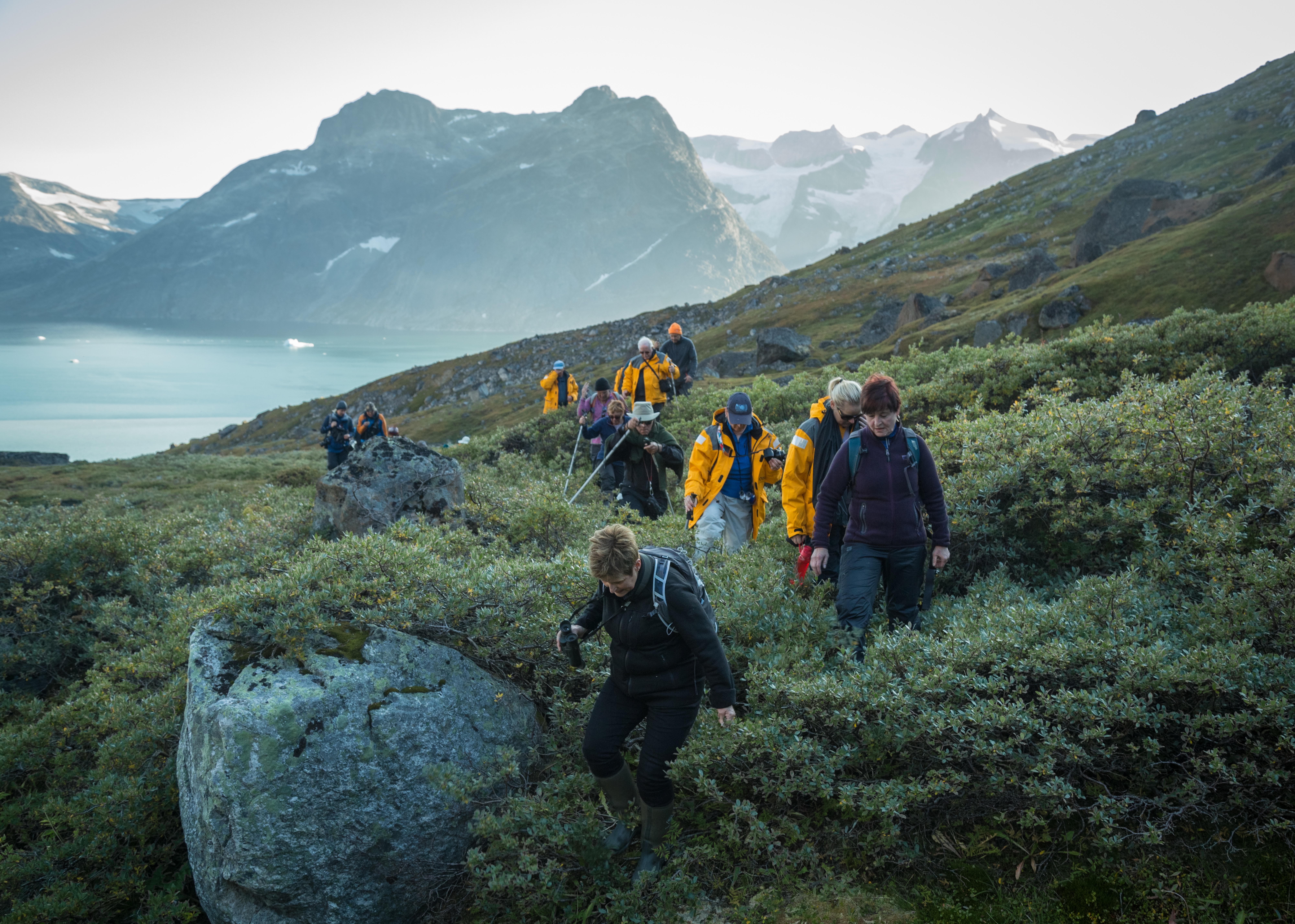
Hiking in the polar regions differs from your typical trail experience. Here, in a tree-less terrain, you are the tallest figure on the landscape as you walk over spongy tundra, crusty snow or sandy beaches in remotes parts of the Arctic and Antarctica. Stepping ashore anywhere in the polar regions means you’re not a distant observer.
Our organized hikes range from short jaunts to the top of lookouts or visits to see wildlife or longer walks of several kilometers over ice and rock and snow. Hiking excursions may last from two to three hours with plenty of time for photographs of wildlife, learning moments from your experienced guides, or just time to stand back and admire the incredible polar surroundings.
No experience is necessary but participants should be able to get in and out of a Zodiac and walk on uneven terrain. Hiking options are tailored to all interests and abilities, from those who want to contemplate the landscape in silence to photographers who want that perfect image to energetic travelers who want to summit a peak in the hopes of seeing wildlife in their natural habitat.
Paddling Excursion
Explore the ocean from a more intimate vantage point on a sit-on-top kayak. No experience is required to manoeuvre these very stable kayaks, allowing you to enjoy an unforgettable experience on the water, taking in breathtaking landscapes and wildlife. Whether it’s your first time in a kayak or you want greater flexibility to try other Adventure options, this shorter excursion is for you.
Paddling in the Polar Regions is highly weather-dependent and a one-time experience. Your kayak guides will attempt to take you out on the water for 1-1.5 hours of paddling. Offered on most voyages, spaces are limited. All equipment, guides and instructions are provided by Quark.
Pricing subject to change based on season. Please proceed to checkout or contact a Polar Travel Adviser for more details.
Camping
Imagine for a moment, staring at the stars in the indigo glow of an Antarctic night as you bed down for the night outside in the elements. The buzz of your daily life becomes a distant memory as you listen to the bray of penguin, the ethereal calls of the Weddell sea – even the exhalation of a humpback whale. And then you fall asleep.
Antarctic Camping with Quark Expeditions is an unforgettable experience. After dinner onboard, you’ll be escorted ashore by Zodiac to camp out on the snow for the night in your ready-to-roll bivy sack (tents can be used upon request). Once you decide on your spot, you set up camp and enjoy the peace as the Antarctic night unfolds.
Camping in Antarctica is limited to 50 participants, all of whom will be briefed beforehand on the principals of basic camping. Prior to you settling down for the night, Quark Expeditions staff will prepare the site, including setting up a perimeter in safe, flat to gently-sloping and beautiful site. You’re free to choose where (within the perimeters) you want to settle down for the night.
You’ll be equipped with the following:
- Mummy-style sleeping bag
- Bivy sack
- Insulated sleeping pad
- Sleeping bag liner
- 3 or 4 season tent provided upon request (pending availability)
- Quark Expeditions Parka
- Waterbottle (Small collapsible reusable water bottles provided onboard upon embarkation)
- Muck Boots (insulated waterproof boots provided onboard upon embarkation)
Other recommended gear:
- Base and mid-layer clothing
- Warm hat
- Warm gloves
- Hand-warmers
- Camera and accessories
- Backpack
- Eye mask if you wish complete darkness
- Need a pillow? Roll up your parka!
- Essential medication and or supplements
Explorer Lecture Lounge
Enjoy daily chats with and presentations by our world-class onboard polar experts—expedition guides, specialists, photography guides and other special guests who will introduce you to the fascinating history, biology, ornithology, glaciology and geology of the region, and much, much more.
Photography
Documenting your voyage so you can take the memories home is a rewarding experience. Our photography guides will help you hone your skills to capture the beauty of the polar regions.
The Latitude Bar
A popular social hub on Deck 5, the beautifully-lit Latitude Bar—with its lush sofas and faux marble-topped end tables—is large enough to seat 46 and is ideal for enjoying a quiet drink on your own or hanging out with friends.
Observation Lounge
This stylish lounge at the top of the ship guarantees incredible views. Guests also frequent this spacious lookout on Deck 8 to enjoy cocktails and conversation with fellow travelers. Seats 63.
Discovery Library
Located on Deck 6 at the top of the gorgeous atrium staircase, this beautiful Library with floor-to-ceiling glass, accommodates up to 47 people
Sun Deck and Bar
More information coming soon.
Polar Boutique
The Polar Boutique can be located on Deck 5.
Jacuzzis
Two outdoor Jacuzzis on deck 7, at the ship’s stern, mean you can relax alfresco while soaking up the breath-taking polar views.
Fitness Centre
Stay fit with the latest work-out equipment in the Fitness Center on Deck 7.
Dry Sauna
After a day of exciting off-ship adventure, guests can relax on the sauna’s traditional wood benches while gazing at the polar wilderness just outside the large sauna windows. Accommodates 15 people on Deck 7.
Leading Edge Sustainability
With the latest sustainability technology in polar expedition, the ship features fuel-efficient Rolls-Royce engines and the ground-breaking MAGS gasification system that converts waste into energy, eliminating the environmental impact of waste transportation.
Medical Facilities
Quark Expeditions provides an English-speaking doctor on board who manages a medical clinic stocked with a supply of common prescription medicines and basic first aid equipment.
If you are under regular treatment for any ailment, you must bring a sufficient supply of medicine. We recommend that you pack an extra two weeks’ supply of medication in case of emergency. We cannot accept responsibility for not having a specific brand or type of drug on board. Should you fall ill, the doctor will refer to the medical forms that you completed and returned to us; therefore it is vital that the information you provide is complete and accurate
Dress Code
To Wear on Board
- Comfortable casual clothing like lighter shirts, pants or jeans, etc. (in case the ship gets warm)
- Comfortable non-slip closed-toed, heelless shoes (flip flops, sandals or slip-on shoes should not be worn on board due to safety concerns)
- Workout attire (for the fitness center and other indoor activities)
- Swimsuit (for the Polar Plunge! Some vessels may also have a pool, hot tub, sauna and/or steam room. See your ship book for details.)
Just a reminder: no formal evening wear required on our voyages! (but if you want to you can bring a little something more dressy for the Captain’s Welcome and Farewell cocktail parties)
Additional Items
- Passport, visas, immunization records, travel documents, etc. as required
- Camera gear complete with charger, storage medium, transport & cleaning kit (lens cloth etc.) and extra batteries
- Waterproof cell phone case or rain sleeve for camera
- Earplugs and eye masks for sleeping
- Voltage converters and plug adapters (see ship book for details)
- Moisturizer for face and hands (skin dryness due to wind and temperature changes)
- Seasickness, indigestion, headache, or other medications
- Small amount of local currency (see pre-departure book for more details)
- Insect repellant
- Mosquito netting
For Shore Excursions & Hiking
In addition to the mandatory gear requirements (as above) for the transit from ship to shore, it is recommended to bring:
- Worn-in Hiking footwear: While Muck-boots are provided and encouraged for most shore excursions, additional hiking footwear (Goretex-lined boots or similar water-proof hiking boots) can add to your hiking comfort, especially if you are a keen hiker
- (Smart) Wool or synthetic hiking socks for above footwear (bring an extra pair)
- Lightweight and quick-dry, trekking pants that may or may not convert to zip-off shorts* (*depending on your thermo-regulation)
- Breathable waterproof pants* and rain jacket** for outdoor activities in inclement weather (*can be the same pair you use for Zodiac operations / ** can be outer shell of complimentary Quark 3in1 Parka)
- Comfortable long or short-sleeve shirt for hiking either synthetic/quick-dry or merino (smart) wool
- (Hiking) gloves (medium thickness, waterproof preferred)
- Hat, buff or scarf (for wind and weather protection)
- UV protection (hat, polarized sun glasses, sun block, lip balm)
- Collapsible Walking stick for hikes (if required). Quantities are available on every vessel to borrow.
- Additional reusable thermos or water bottle (in addition to the reusable collapsible water bottle provided)
By Sea & Air
All transfers ship to shore, helicopter flights & Zodiac/ship cruising
- Waterproof Pants (Mandatory for every Zodiac and helicopter ride. For Ultramarine guests who are participating in Helicopter flights, we recommend packing loose fitting rain pant style waterproof pants, rather than fitted ski pants. You will also be required to wear a drysuit, which our team will help you prepare for on the ship.)
- Base-layer wool or synthetic top*
- Base-layer wool or synthetic bottom*
- Mid-layer warm or fleece top*
- Mid-layer warm or fleece bottom*
- Warm hat that covers ears (bring an extra)
- Scarf, buff, or other face protection
- Warm wool or synthetic socks (keep a dry pair in your bag, and bring extras for layering)
- Waterproof gloves or mitts (bring an extra, lighter pair for hiking)
- Glove liners*
- Hand and feet warmers*
- Binoculars
- Polarized sunglasses with UV protection (bring an extra pair)
- Sunscreen
- Ski goggles (for Zodiac cruising on snowy or windy days)
- Waterproof, lightweight backpack or dry sack &/or rain sleeve for camera or a waterproof phone case (to keep camera & gear dry)
Smoking Policy
To protect the health and safety of its guests, Quark Expeditions® maintains a no smoking policy in the interior of the ship including cabins, near Zodiacs and on landings. Smoking on the ship is permitted in the designated smoking area only, which your Expedition∘ Team members will be happy to point out for you. Always make sure to extinguish cigarettes properly and dispose of them in the proper receptacle. Please, never throw cigarettes overboard.
Dietary Requirements and Allergies
All guests—including vegetarians, meat-eaters, as well as those who follow a gluten-free diet—will be equally impressed with the dining options on our ships. Quark Expeditions® is able to cater to most special dietary requests, as long as you clearly indicate your needs on the required expedition forms when you book your voyage. Menus will be clearly labeled for vegetarian and gluten free options, but please do notify your server of the dietary restrictions you indicated on your form. We regret that kosher food cannot be prepared.
Laundry
A complete list of laundry fees will be provided on board. Laundry is collected each morning; please allow 48 hours for your laundry to be returned. Ironing services are also available at a minimal charge. We encourage you to take advantage of the laundry services, as it will mean you can pack fewer articles of clothing. If you prefer to hand wash small items in your cabin, please remember to bring environmentally friendly detergent.
Wi-Fi & Communications
When you are not busy exploring the natural beauty of the Polar Regions, you may wish to connect with family and friends back home to share some of your voyage highlights. Guests on Quark Expeditions can now enjoy free Wi-Fi as part of our “Raise a Glass and Stay Connected Free” program. This complementary Wi-Fi service permits basic Internet browsing and voice applications.
Please note that we travel to some of the most remote parts of the world. As we utilize satellite equipment for our connection, Wi-Fi signal may be intermittent.
To access email or internet on your personal computer, tablet or smart phone, connect to the network on your device, where you can access our complimentary plan, or purchase Priority Wi-Fi.
Complimentary Wi-Fi
- Lower speeds
- Suitable for basic internet browsing, texting and voice calling using text and voice apps
- Some site filtering
- No charge
- One device logged in at a time
Priority Wi-Fi
- Higher speeds
- Suitable for larger data volume apps, video calling, video streaming (in lower resolutions) etc.
- See rates by logging in
- One device logged in at a time
Expedition Brochures
Find Ocean Explorers itineraries here.
Deck 9
- Top Deck
Deck 8
- Observation Deck
- Observation Bistro
- Observation Lounge & Bar
- Elevator
Deck 7
- Penthouse Suite
- Owners Suite
- Veranda Stateroom
- Studio Veranda Single
- Polar Deck and Bar
- Jacuzzis
- Gym
- Tundra Spa & Sauna
- Bridge
- Bridge Deck
- Elevator
Deck 6
- The Discovery Library
- Junior Suite
- Veranda Suite
- Veranda Stateroom
- Elevator
Deck 5
- Main Dining Room
- Private Dining Room
- Reception
- Polar Boutique
- Latitude Bar & Lounge
- Explorer Lecture Lounge
- Elevator
Deck 4
- Deluxe Veranda Forward
- Veranda Suite
- Veranda Stateroom
- Expedition Desk
- Elevator
Deck 3
- Ready Room
- Medical Facilities
- Zodiac Embarkation Points
- Studio Single
- Elevator